


Why do most office filing systems fail just as the archive boxes reach capacity? You've likely dealt with the frustration of spines splitting under heavy loads or inconsistent sizing that makes a mockery of your shelf alignment. It's a common headache for procurement officers and administrators trying to maintain order while managing tight budget cycles. Selecting the right lever arch files is a mechanical challenge, not just a storage one; getting it wrong leads to wasted man-hours and compromised records.
We'll show you how to select the most durable and cost-effective filing solutions for your specific business, school, or government environment. You'll learn to match material durability to access frequency while ensuring compliance with Australian archiving standards like AS ISO 15489. We'll cover technical specifications for professional-grade hardware, bulk pricing strategies, and the practical steps to build a standardised system that remains intact for years.
Key Takeaways
- Discover how to match file materials like polypropylene or paperboard to your specific Australian climate to ensure long-term structural integrity.
- Master technical features such as the Rado locking system to prevent misalignment and keep your files standing straight under heavy loads.
- Simplify large-scale procurement for schools and government departments by utilising official purchase orders for bulk lever arch files.
- Optimise your archiving workflow with colour-coded systems and standardised labelling to reduce retrieval times and improve office efficiency.
Selecting the right lever arch file materials and specifications
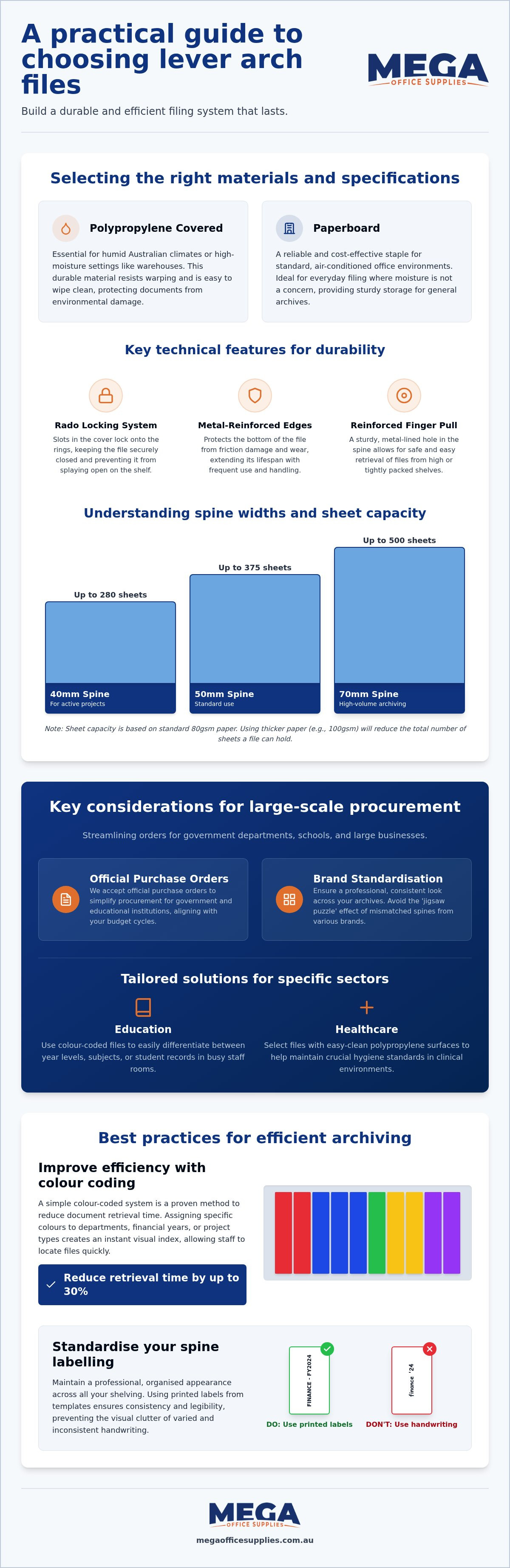
Choosing the correct lever arch files depends on your specific environment and document volume. While traditional paperboard is a cost-effective staple for air-conditioned offices, polypropylene-covered files are essential for humid Australian climates or high-moisture warehouse settings where paperboard might warp. Grounded in the history of the lever arch file, modern designs have evolved to handle the rigours of high-volume workplaces.
To better understand this concept, watch this helpful video:
The Rado locking system is a critical technical feature that separates professional hardware from budget alternatives. This system uses precise slots in the front cover that the rings lock into when closed. It provides structural stability, preventing the file from splaying open or sagging when stored upright on a shelf. For files accessed daily, metal-reinforced bottom edges are non-negotiable to prevent friction damage, while a reinforced finger pull hole ensures safe retrieval from height.
Understanding spine widths and sheet capacity
Capacity is determined by spine width and the thickness of your media. A standard 70mm spine typically accommodates 375 to 500 sheets. However, if you're using premium 100gsm A4 copy paper, your total sheet count will decrease. Overloading leads to mechanism misalignment and eventual failure. For smaller active projects or student resources, 40mm or 50mm slimline alternatives offer a more space-efficient footprint.
Pro-tip: Listen for a crisp, satisfying click when closing your Rexel or Marbig mechanism. This sound indicates perfect ring alignment, which is the hallmark of a professional-grade file built for longevity.
Key considerations for bulk procurement and government orders
Large-scale organisations require a structured institutional procurement process to manage high-volume stationery needs without friction. We facilitate this by accepting official purchase orders from Australian government departments and schools. Standardising on reliable brands like Rexel or Avery ensures aesthetic consistency across large-scale fit-outs. It prevents the visual clutter of mismatched spines; nobody wants their archive room looking like a jigsaw puzzle gone wrong.
Managing budget cycles is more efficient when you utilise business application forms to access volume-based pricing. This is particularly useful during the end of financial year (EOFY) period. Procurement officers can secure lever arch files in bulk, ensuring a consistent supply for the next twelve months while staying within strict fiscal limits. Our team handles these high-capacity orders with logistical precision, focusing on speed of fulfilment across Australia.
Tailoring orders for educational and healthcare environments
Schools often require specific educational supplies, such as colour-coded files to differentiate between year levels or student records. This visual organisation reduces retrieval time for bulk lever arch files in busy staff rooms. In healthcare, the focus shifts to hygiene. Selecting files with easy-clean polypropylene surfaces helps maintain sanitisation standards in clinical areas where paperboard would be unsuitable. If you're managing a large facility, consider browsing our full range of filing and storage solutions to find the right fit for your sector.
Best practices for efficient document archiving and storage
Efficient document management relies on a logical workflow. Implementing a colour-coded system is a proven method to reduce retrieval time by 30%. We recommend assigning specific colours to departments or financial years to create an instant visual index. This allows staff to identify the correct section of the archive from a distance. To maintain a professional appearance across your filing cabinets, always use Avery templates for spine labelling. Printed labels prevent the clutter of inconsistent handwriting; your archives shouldn't look like a collection of primary school scrapbooks.
Effective storage also requires synergy with your office furniture supplies. Standard commercial shelving is typically 450mm deep. This depth is specifically designed to accommodate the footprint of lever arch files without unsightly overhang or wasted space. Aligning your hardware with your furniture prevents physical obstructions in high-traffic walkways and maximises the utility of every square metre in your facility.
Transitioning from active files to long-term archive boxes
Active files should only remain on primary shelving while they are frequently accessed. Once a project concludes or a financial year ends, decant the contents into specialised archive boxes. You'll know it's time to move them when the lever arch files are full and the documents are only required for compliance purposes. Adhering to government document archiving guidelines ensures you meet statutory retention periods without cluttering your active office space. For deeper insights into managing high-volume records, read The Comprehensive Guide to Lever Arch Files for Australian Offices.
Standardising your workplace organisation for long term efficiency
Establishing a robust organisational system requires more than just purchasing stationery; it involves matching hardware specifications to your specific operational environment. We've examined how technical features like the Rado locking system and polypropylene materials ensure your lever arch files withstand the rigours of high-volume Australian workplaces. By standardising your procurement and following established archiving guidelines, you can minimise retrieval times and maintain a professional aesthetic across your facility.
As an award-winning Australian family business with over 150 years of combined industry expertise, we understand the logistical requirements of schools and government departments. We simplify the acquisition process by accepting official Australian Government purchase orders and offering competitive bulk pricing. Our team is available weekdays to provide direct, local support for your next fit-out.
Browse our full range of professional lever arch files and filing solutions
We look forward to helping you build a more efficient workplace ready for 2026.
Frequently Asked Questions
What is the difference between a lever arch file and a ring binder?
Lever arch files feature a heavy duty arched mechanism operated by a metal lever, providing significantly more capacity than a standard ring binder. While ring binders use rings opened manually, the lever system offers greater compression and stability for large document volumes. This makes them the preferred choice for long term archiving and high capacity storage in professional environments.
How many sheets of 80gsm A4 paper can a standard 70mm lever arch file hold?
A standard 70mm lever arch file typically accommodates between 375 and 500 sheets of 80gsm A4 paper. Using sheet protectors or thick dividers will reduce this total capacity. We recommend staying within these limits to ensure the Rado locking system functions correctly and to prevent the mechanism from bending or failing during daily use.
Are lever arch files recyclable in Australia after the metal mechanism is removed?
Traditional paperboard files are generally recyclable in Australia once the metal lever mechanism is removed and disposed of separately. Polypropylene covered versions are more durable but require different processing; the internal board is recyclable, but the plastic coating may not be accepted in all kerbside bins. Always verify with your local waste authority to ensure compliance with regional recycling standards.
Does Mega Office Supplies accept government purchase orders for bulk stationery?
We accept official Australian Government purchase orders from all departments, local councils, and schools. Our team understands the lever arch files procurement process for the public sector and provides bulk pricing to suit specific budget cycles. As an Australian family owned business with over 150 years of combined expertise, we ensure reliable national delivery and local support.
Article by
Mega Office Supplies Team
The Mega Office Supplies Team provides practical buying guides and workplace advice for Australian businesses, schools, government organisations, healthcare providers, hospitality venues, warehouses and home offices. Family-owned and operated since 2009 and based in Tweed Heads South on the Gold Coast–Tweed border, Mega Office Supplies brings more than 150 years of combined team experience to helping Australian workplaces choose the right office supplies, furniture, technology, cleaning, safety and education products — backed by genuine local service from real people.
General Information
This article is provided as general information only to help customers compare and choose office, workplace, school, cleaning, technology, furniture, safety and business supplies. Product details, specifications, compatibility, availability, pricing and suitability may vary. Always check the individual product page, manufacturer information, workplace requirements and relevant safety guidance before purchasing or using a product.


