

Most desktop stapler jams aren't caused by a faulty mechanism; they happen because someone loaded the wrong staples into the tray. We've all experienced the quiet frustration of watching a fastener buckle on the final page of a multi-page report, or squinting at cryptic packaging codes like 26/6, 24/6, and 23/8 when replenishing the stationery cupboard.
Reliable binding depends on matching wire gauge and leg length to actual paper volume. In this guide, we'll decode staple sizing numbers on packaging and equipment, explain how wire strength affects sheet capacity, and show you how to select the right supplies for uninterrupted workplace administration. We also compare everyday desktop options against heavy-duty alternatives and rust-resistant materials so you can order across departmental budgets with total confidence.
Key Takeaways
- Learn how to read two-number sizing codes so you immediately recognise the wire gauge and leg length stamped on packaging.
- Match leg length and chisel point tips accurately against 80gsm paper counts to stop everyday staples from buckling under pressure.
- Identify when to choose standard galvanised wire for indoor paperwork versus stainless steel for humid storage or long-term archiving.
- Align bulk stationery orders with your sector's operational budget cycle to minimise administrative downtime across busy departments.
Decoding staple sizing: match gauge and leg length
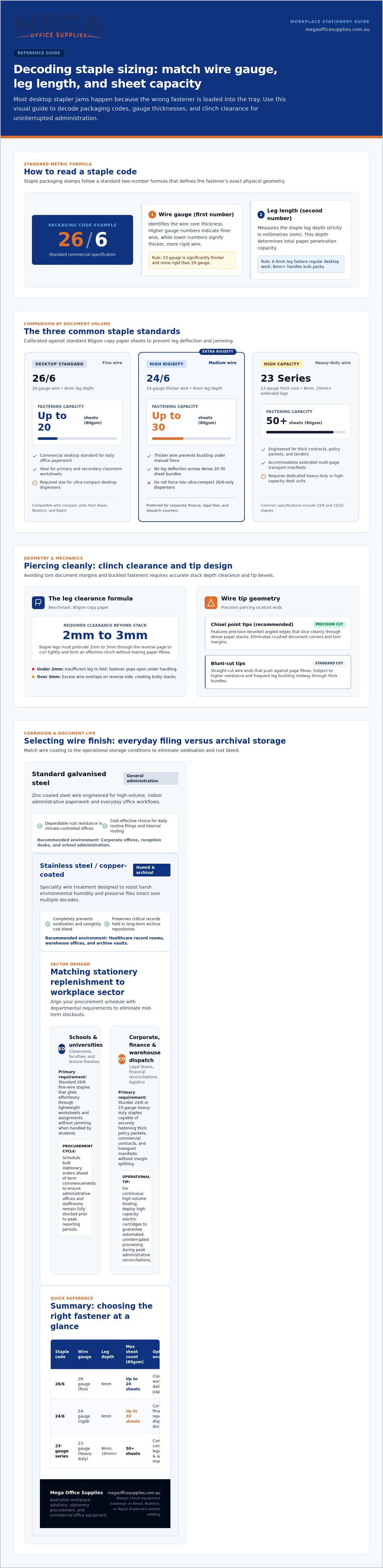
Refilling a desktop unit shouldn't feel like a guessing game. The standard metric label stamped on packaging uses a straightforward two-number formula: wire gauge followed by leg length in millimetres. As detailed in the historical taxonomy of the Staple (fastener), gauge functions counterintuitively; a higher number signifies a finer wire, while a lower number indicates a thicker, more rigid core.
To see how wire gauges compare across practical workplace applications, watch this visual breakdown:
Understanding staple codes: what 26/6, 24/6, and heavy-duty numbers mean
Australian workplaces typically rely on three distinct fastening specifications for daily documentation:
- 26/6 staples: The commercial desktop standard. Built with 26-gauge fine wire and a 6mm leg, this size fastens routine paperwork up to 20 sheets of standard 80gsm paper.
- 24/6 staples: Formed from a slightly thicker wire with the same 6mm depth, providing extra rigidity for up to 30 sheets without leg deflection.
- 23-gauge series (such as 23/8, 23/10): Heavy-duty staples featuring thick wire and extended legs, engineered for high-capacity desk units tackling thick policy packets, commercial contracts, and warehouse manifests.
Forcing 24/6 wire into an ultra-compact dispenser calibrated strictly for 26/6 cartridges causes immediate magazine jams. Check the stamped guide on your Rexel, Bostitch, or Rapid equipment before replenishing everyday office supplies to prevent administrative delays.
Product features to compare: sheet capacity, wire strength, and finish
Piercing cleanly through paper requires matching fastener geometry directly to sheet density. Using standard 80gsm copy paper as your benchmark, fasteners require roughly 2mm to 3mm of leg clearance beyond stack thickness to curl tightly and form an effective clinch. Beyond depth, pay attention to the wire tips. Chisel point tips feature precision-bevelled edges that slice through dense paper stacks cleanly, avoiding the torn margins and crushed corners common with blunt-cut alternatives.
Wire finish determines how your files hold up over time. Standard galvanised steel provides dependable rust resistance for regular, climate-controlled office filings. In humid warehouse offices or healthcare records rooms where documents remain bound for decades, stainless steel or copper-coated staples prevent oxidisation and unsightly rust bleed.
What to consider before buying for high-volume document handling
Standard 6mm fasteners tackle up to 20 or 30 sheets with ease, but larger tasks quickly overwhelm desktop units. Multi-page financial reconciliations or tenders exceeding 50 sheets call for dedicated heavy-duty staples from established brands like Rexel, engineered to pierce thick bundles without buckling midway. If your department manages continuous processing, opt for high-capacity electric cartridges that ensure smooth, automated binding during peak administration cycles. Before finalising your purchase order, check our wide selection of office supplies to verify cartridge compatibility.
Tips for choosing the right option across commercial and education sectors
Fastener requirements change depending on your operational environment. Busy primary and secondary classrooms demand standard 26/6 staples that glide smoothly through lightweight worksheets without jamming when handled by students. Corporate finance teams, legal departments, and busy warehouse dispatch counters need sturdier 24/6 or 23-gauge wires capable of binding thick multi-page manifests, transport dockets, and contractual documentation without splitting paper margins.
Consolidating your desk essentials alongside core office supplies simplifies supplier management. For public sector entities, streamlining procurement through Australian Government official purchase orders ensures full compliance with institutional governance frameworks while eliminating unnecessary checkout friction.
Aligning procurement with workplace demand and institutional budget cycles
Timing your orders around administrative cycles avoids mid-term stockouts and last-minute scrambles:
- Schools and universities: Schedule bulk orders ahead of term commencements to ensure classrooms and administrative offices remain fully stocked before peak reporting weeks.
- Corporate workplaces: Review routine stationery consumption ahead of end-of-financial-year allocations to secure volume pricing on essential operating consumables.
- Healthcare and public administration: Align replenishment with quarterly allocation milestones to prevent supply shortages across client-facing facilities.
We've been family owned and operated since 2008, and our specialists help public departments, corporate teams, and schools accurately forecast their fastening demands. Contact our team weekdays between 8am and 6pm AEST for fast product quotes and tailored guidance.
Equip your workplace with the right fastening supplies
Selecting the correct fasteners protects your paperwork and extends the working life of your desktop hardware. Decoding metric codes like 26/6 and 24/6, matching leg length directly to 80gsm sheet density, and selecting rust-resistant finishes prevents frustrating jams across administrative departments. As a family owned and operated business since 2008, we supply Australian businesses, schools, and government departments with durable staples from trusted brands like Rexel, Bostitch, Rapid, and Marbig.
Official Australian Government purchase orders are processed directly online to support straightforward public sector procurement. If you require tailored advice or custom bulk quotes for upcoming budget cycles, our local support team is ready to assist weekdays between 8am and 6pm AEST.
Explore our full range of workplace staples and fastening supplies
Keep your office moving without unnecessary paper jams or administrative delays.
Frequently asked questions
What do staple numbers like 26/6 and 24/6 actually mean?
The first number indicates the wire gauge, while the second number measures the leg length in millimetres. For instance, 26/6 denotes a finer 26-gauge wire with a 6mm leg depth. Conversely, 24/6 uses a thicker 24-gauge wire across the same 6mm length, providing greater lateral strength to penetrate denser paper stacks without buckling.
Can you use 26/6 staples in a 24/6 desktop stapler?
Many standard commercial desktop staplers accept both 26/6 and 24/6 refills, but you must check the chassis stamp first. Loading finer 26/6 wire into an anvil channel machined strictly for heavier gauges can cause loose clinching or misfeeds. If your stapler specifies 24/6 exclusively, stick to that heavier gauge to prevent jamming the magazine track.
How many sheets of standard copy paper can a 6mm staple hold?
A standard 6mm fastener reliably secures between 20 and 30 sheets of standard 80gsm copy paper. A 26/6 staple cleanly fastens up to 20 pages, whereas a sturdier 24/6 variant handles up to 30 sheets. Pushing a 6mm leg through larger stacks leaves insufficient wire beneath the document to fold flat against the rear page.
What type of staples do I need for heavy-duty staplers?
Heavy-duty desktop units require dedicated thick-wire series, most commonly the 23-gauge range such as 23/8, 23/10, or 23/13. These heavy-gauge staples feature extended leg lengths designed specifically to pierce between 50 and 100 or more sheets. Always match the exact cartridge or strip code printed on your heavy-duty machine to ensure reliable feeding under high spring tension.
Article by
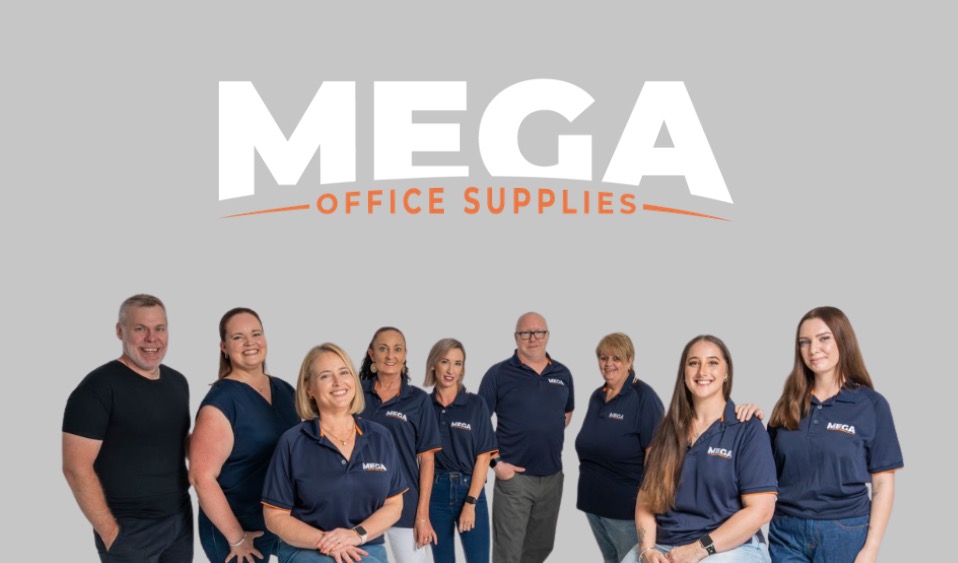
Mega Office Supplies Team
The Mega Office Supplies Team provides practical buying guides and workplace advice for Australian businesses, schools, government organisations, healthcare providers, hospitality venues, warehouses and home offices. Family owned and operated since 2008 and based in Tweed Heads South on the Gold Coast–Tweed border, Mega Office Supplies helps Australian workplaces choose the right office supplies, furniture, technology, cleaning, safety and education products — backed by genuine local service from real people.
General Information
This article is provided as general information only to help customers compare and choose office, workplace, school, cleaning, technology, furniture, safety and business supplies. Product details, specifications, compatibility, availability, pricing and suitability may vary. Always check the individual product page, manufacturer information, workplace requirements and relevant safety guidance before purchasing or using a product.


