


Did you know that just 0.5 grams of genuine blu tack is laboratory-rated to support a 105-gram vertical load, yet most workplace displays fail due to incorrect application? We've all dealt with the frustration of arriving at the office to find a critical wall planner slumped on the carpet or, even worse, discovering a permanent oily shadow on the paintwork after a notice is removed. We know that procurement officers and facility managers need reliable mounting solutions that don't result in costly repair bills at the end of a lease. In this guide, we'll share the professional techniques for applying, removing, and repurposing this Australian-made staple to ensure your displays remain secure without damaging your surfaces. You'll learn how to master load-bearing limits, handle high-humidity environments, and rejuvenate old putty to keep your organisation running efficiently.
Key Takeaways
- Learn how to properly activate the adhesive by warming and stretching the material to ensure your displays remain secure on various office surfaces.
- Master the specific rolling technique required to lift old remnants cleanly without tearing paint or leaving oily shadows on your walls.
- Discover how to utilise blu tack for strategic workplace organisation, from cable management to stabilising desk accessories in high-traffic staff centres.
- Understand surface compatibility rules to prevent damage to porous materials and ensure your office or classroom remains in professional condition.
Mastering the mechanics of effective Blu Tack application
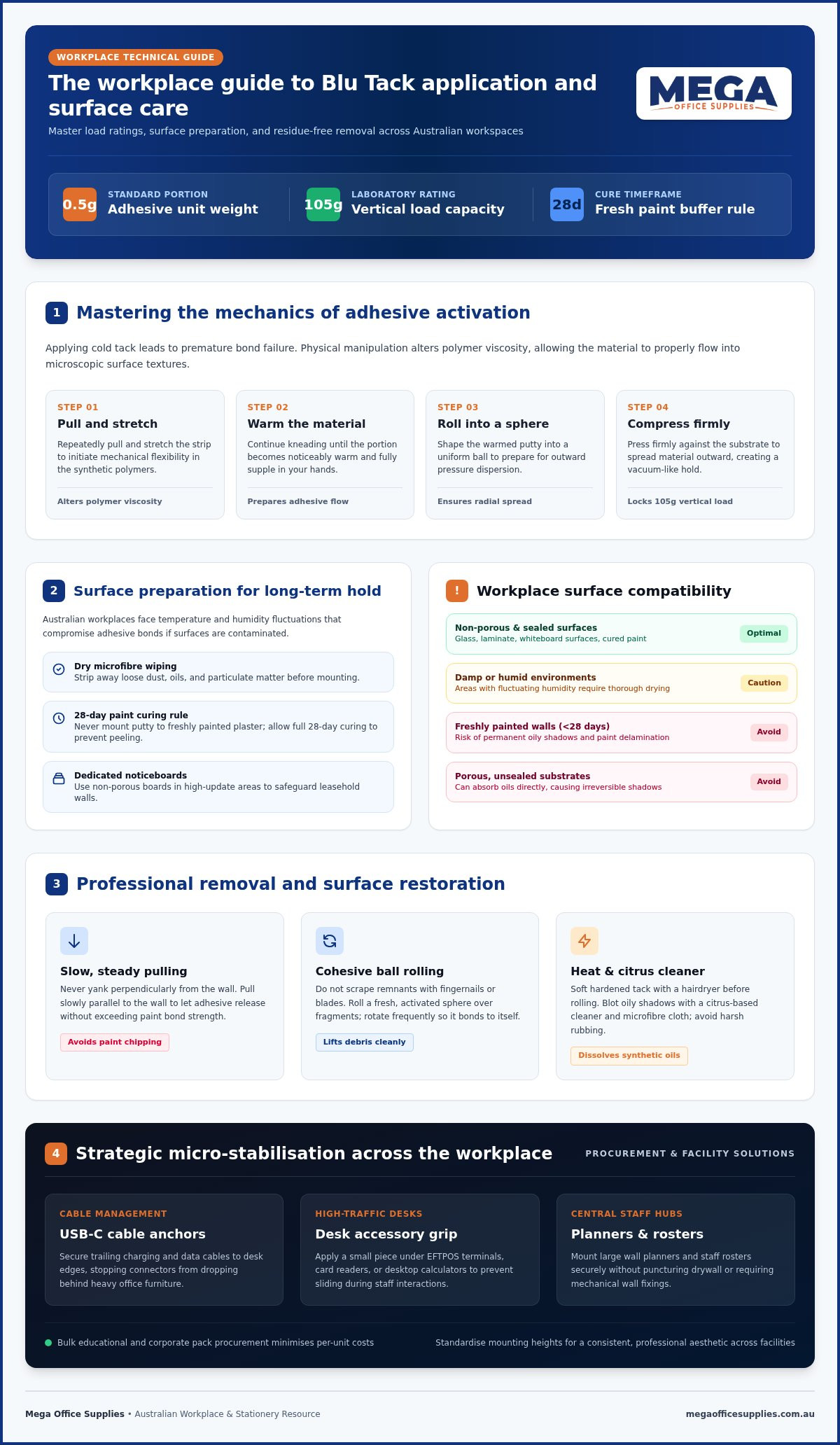
Achieving a reliable bond requires more than just pressing a cold strip of adhesive against a wall. Applying cold tack is an exercise in optimism that usually ends with your signage on the floor. The effectiveness of blu tack depends on a process called activation. We recommend pulling and stretching the material repeatedly until it becomes supple and noticeably warm. This physical manipulation changes the polymer's viscosity, allowing it to flow into the microscopic textures of the surface. Once the material is malleable, roll it into a uniform sphere. This shape is critical because it ensures the adhesive spreads outwards from the centre when compressed, creating a vacuum-like seal that can support the official laboratory rating of 105 grams per 0.5-gram portion.
Surface preparation for long-term adhesion
Proper surface preparation is the best defence against gravity in high-humidity Australian environments. Before application, ensure the mounting area is completely free of surface contaminants. Use a dry microfibre cloth to strip away dust and residual oils that might cause the bond to fail over time. We've seen many instances where applying putty to damp or freshly painted walls leads to permanent staining or paint damage. It's best to wait at least 28 days for new paint to cure fully before mounting any signage. For professional environments requiring frequent display updates, consider exploring our office supplies category for dedicated noticeboards and planning systems. These provide a stable, non-porous substrate that minimises the risk of surface damage while maintaining a clean, organised workspace.
Professional removal techniques to protect workplace surfaces
Removing blu tack requires a methodical approach to ensure the underlying substrate remains intact. Avoid the temptation to yank the material perpendicularly from the wall. This high-velocity action often exceeds the paint's bond strength, leading to unsightly chips or peeling. Instead, use a slow, steady pulling motion that allows the adhesive to release its grip gradually. If small shreds remain on the surface, don't attempt to scrape them off with your fingernails or a sharp tool. Roll a fresh, activated sphere of tack over the remnants. The cohesive properties of the material mean it will naturally bond to itself, lifting the debris away cleanly. Rotate the ball frequently as you dab to ensure a fresh, sticky surface is always making contact with the wall.
Eliminating oily residue and hardened remnants
In older office fit-outs, you might encounter tack that has hardened after years of exposure to the air. Attempting to remove this while cold will likely damage the plasterboard. We suggest applying a small amount of heat from a hairdryer to soften the polymers before rolling them away. If an oily shadow persists on the paintwork, a specialised solution is required. Applying a citrus-based cleaner from our cleaning and hygiene range will effectively break down the synthetic oils without stripping the wall colour. Use a gentle blotting motion with a clean microfibre cloth to lift the shadow rather than rubbing it deeper into the surface. Maintaining a pristine professional environment is easy when you have the right supplies on hand. You can restock your office supplies through our online portal for fast national delivery across Australia.
Strategic workplace applications and procurement considerations
Beyond simple mounting, blu tack acts as a functional tool for micro-stabilisation in high-traffic workspaces. We use it to secure trailing USB-C cables to desk edges, preventing them from slipping behind heavy furniture. It's equally effective for steadying wobbly desk accessories; a small portion under a card reader or calculator provides enough friction to stop it from sliding during use. When mounting wall planners or staff rosters in central hubs, this adhesive provides a secure hold without the permanence of nails or screws. For large-scale environments, procuring bulk packs through our educational supplies category is the most efficient way to minimise per-unit costs and ensure staff always have access to necessary tools.
Organising educational and corporate environments
Maintaining a professional aesthetic requires consistency across all displays. We recommend implementing a standardised mounting height for noticeboards and classroom posters to create a sense of order. This approach is particularly important in government and healthcare settings where visual clarity is paramount. For a deeper dive into inventory management, refer to our stationery supplies Australia pillar guide. We understand the complexities of institutional budgets, so we offer a quote-on-request service for large-scale orders. This ensures schools and government departments can secure high-volume supplies while remaining fully compliant with their specific procurement cycles. Our team has decades of experience assisting with these requirements, providing the reliability you expect from a seasoned industry partner.
Securing your workplace assets with professional mounting
Mastering the application and removal of blu tack ensures your office or classroom remains in pristine condition while maintaining a high standard of organisation. We've established that proper activation through kneading and a slow removal process are the keys to avoiding permanent wall damage. For schools and government departments, consolidating these supplies through official procurement cycles ensures budget compliance and operational continuity. Our team has over 150 years of combined experience assisting Australian organisations with high-volume requirements. We accept official Australian Government purchase orders and offer free delivery on orders over $149. If you need help with a bulk quote, our local Australian support team is available weekdays from 8:00 AM to 6:00 PM AEST.
Browse our full range of adhesives and office supplies
We look forward to helping you equip your workspace with reliable, professional-grade solutions that stand the test of time.
Frequently asked questions
How do I remove Blu Tack stains from a painted wall?
You can remove oily shadows by dabbing the area with a citrus-based solvent or eucalyptus oil. These substances break down the synthetic oils that have leached into the paintwork from old blu tack remnants. Apply the cleaner to a clean cloth and blot the spot gently. For stubborn marks, sugar soap is often effective. Avoid aggressive scrubbing, as this can strip the paint.
Can Blu Tack be reused once it has dried out?
Genuine blu tack is a permanently plastic synthetic polymer that doesn't dry out or shrink under normal conditions. If the material feels hard, it's usually due to cold temperatures or a buildup of dust. You can rejuvenate the tack by pulling and stretching it until the warmth from your hands restores its original suppleness. This process reactivates the adhesive for long-term reuse.
Is Blu Tack safe for use in food preparation areas or hospitals?
This adhesive is safe for sensitive environments because it's non-toxic, solvent-free, and compliant with Australian Toy Safety Standard AS/NZS ISO 8124:2012. It's free from common food allergens like wheat and gluten, making it suitable for hospital wards and school canteens. Its non-carcinogenic formula ensures it meets the strict safety guidelines required by healthcare organisations and government departments across Australia.
How much weight can a standard strip of Blu Tack actually hold?
A 0.5-gram portion of the material is laboratory-rated to support a vertical shear load of up to 105 grams on clean, non-porous surfaces. This capacity depends on proper activation through kneading and the texture of the substrate. For heavier items, we recommend applying multiple spheres across the top edge and corners to distribute the weight evenly and prevent the display from falling. For valuable prints or substantial decorative pieces where temporary tack isn't suitable, professional framing provides a much safer long-term solution; discover First4Frames Gallery to explore quality picture framing and art print options.
Article by
Mega Office Supplies Team
The Mega Office Supplies Team provides practical buying guides and workplace advice for Australian businesses, schools, government organisations, healthcare providers, hospitality venues, warehouses and home offices. Family-owned and operated since 2009 and based in Tweed Heads South on the Gold Coast–Tweed border, Mega Office Supplies brings more than 150 years of combined team experience to helping Australian workplaces choose the right office supplies, furniture, technology, cleaning, safety and education products — backed by genuine local service from real people.
General Information
This article is provided as general information only to help customers compare and choose office, workplace, school, cleaning, technology, furniture, safety and business supplies. Product details, specifications, compatibility, availability, pricing and suitability may vary. Always check the individual product page, manufacturer information, workplace requirements and relevant safety guidance before purchasing or using a product.


