


Last Friday, did someone in your office discover a "science project" growing in the back of the communal fridge? It's a common Australian workplace grievance where the tea room slowly descends into chaos because nobody knows whose turn it is to wipe the bench. We understand that maintaining a shared space is less about the scrubbing and more about clear expectations. That's why we've developed a comprehensive office kitchen cleaning schedule template to help you restore order and improve workplace culture.
By implementing a structured framework, you can eliminate the "not my job" mentality and ensure your facility meets essential hygiene standards. We'll show you how to assign accountability fairly, manage fridge rotations, and stock the right professional-grade cleaning chemicals without overcomplicating your procurement process. With over 17 years of experience supporting Australian businesses, we've seen how a simple, printable plan can transform a messy sink into a functional hub for your team.
Key Takeaways
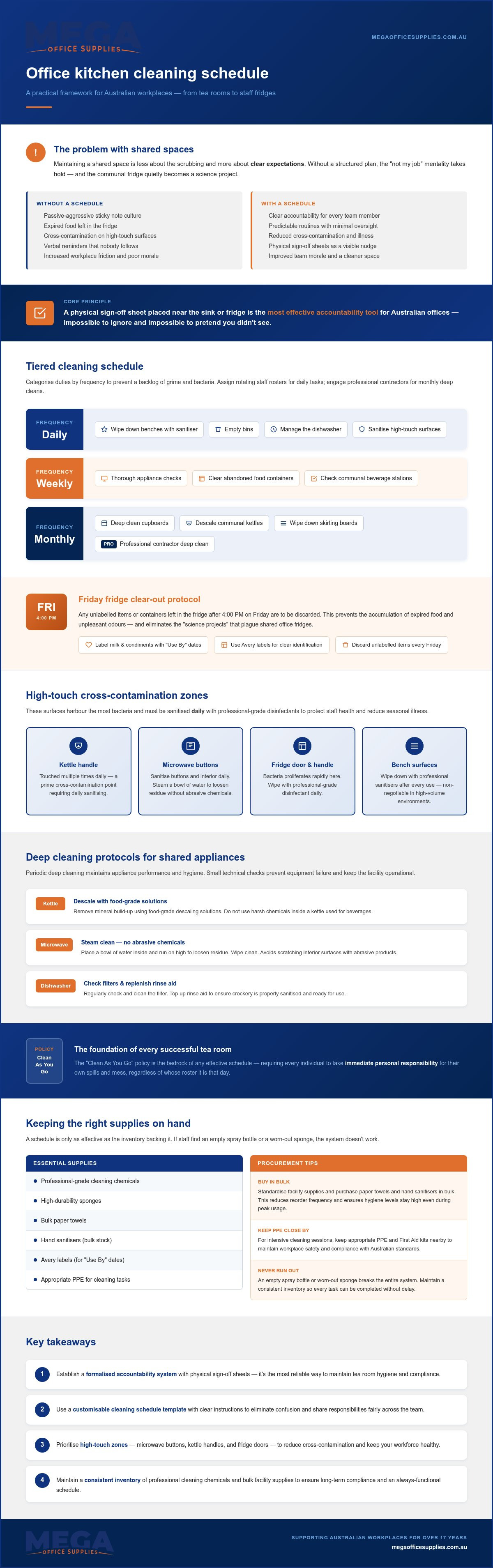
- Establishing a formalised accountability system with physical sign-off sheets is the most reliable way to maintain tea room hygiene and compliance.
- Use our customisable office kitchen cleaning schedule template to provide clear instructions and eliminate confusion regarding shared staff responsibilities.
- Focus on high-touch zones like microwave buttons and kettle handles to reduce cross-contamination and keep your workforce healthy.
- Ensure long-term compliance by maintaining a consistent inventory of professional cleaning chemicals and bulk facility supplies.
Designing a functional office kitchen cleaning schedule
Deciding how to distribute tea room duties fairly often causes more tension than the actual mess itself. You need a system that ensures shared spaces remain hygienic and compliant with Australian workplace health standards without relying on constant verbal reminders. While digital apps have their place, a physical sign-off sheet placed near the sink or fridge remains the most effective accountability tool for Australian offices. It provides a constant visual nudge that's impossible to ignore, ensuring tasks are actually completed rather than just discussed in a staff meeting.
Establishing this structure offers significant psychological benefits. When everyone knows the rules, the dreaded "passive-aggressive sticky note" culture disappears, which significantly reduces workplace friction and improves overall morale. Using a clear office kitchen cleaning schedule template turns a point of contention into a predictable routine that staff can follow with minimal oversight.
Determining task frequency and accountability
Successful workplace maintenance relies on categorising duties by their required frequency to prevent a backlog of grime and bacteria. We recommend a tiered approach:
- Daily: Wiping down benches with professional sanitisers, emptying bins, and managing the dishwasher.
- Weekly: Conducting thorough appliance checks and clearing out abandoned food containers before they become a biological hazard.
- Monthly: Deep cleaning cupboards, wiping down skirting boards, and descaling communal kettles.
Assigning these tasks requires a balance between staff participation and professional support. While rotating rosters ensure fairness for light daily duties, we recommend engaging professional cleaning contractors for heavy-duty monthly maintenance. The "Clean as You Go" policy acts as the foundation of any successful office kitchen cleaning schedule template, requiring every individual to take immediate responsibility for their own spills and mess.
Essential cleaning tasks for a hygienic tea room
Maintaining a hygienic tea room requires a focus on high-touch surfaces where bacteria easily proliferate. An effective office kitchen cleaning schedule template must prioritise kettle handles, fridge doors, and microwave buttons. These areas are frequent cross-contamination points. Sanitise them daily with professional-grade disinfectants to protect staff health. High-volume environments demand this level of manual precision to prevent the spread of seasonal illnesses and maintain a productive workforce.
Shared appliances require periodic deep cleaning to maintain performance and hygiene. Descale kettles using food-grade solutions to remove mineral buildup. Sanitise microwave interiors by steaming a bowl of water to loosen residue without using abrasive chemicals. Don't overlook the dishwasher. Checking filters and replenishing rinse aid ensures crockery is properly sanitised and ready for use. These small technical checks prevent equipment failure and ensure the facility remains operational.
We recommend using Avery labels to clearly mark "Use By" dates on communal milk and condiments. This simple step prevents confusion and reduces food waste across the team. For consistent results, browse our range of commercial cleaning supplies to stock your facility cupboards with professional-grade solutions that meet Australian workplace standards.
Procuring professional cleaning and facility supplies
An office kitchen cleaning schedule template is only as effective as the inventory backing it. If staff find an empty spray bottle or a worn-out sponge, the system doesn't work. Maintaining a consistent stock of cleaning chemicals and high-durability sponges ensures every task on the roster can be completed without delay. We recommend standardising your facility supplies by purchasing bulk paper towels and hand sanitisers. This industrial-scale approach reduces the frequency of reordering. It ensures hygiene levels remain high even during peak tea room usage. For more intensive cleaning sessions, keeping the right PPE and First Aid kits nearby is essential for maintaining workplace safety and compliance.
Streamlining procurement for large-scale organisations
Managing supplies across multiple departments requires a logistical partner who understands the specific workflows of professional buyers. Schools and government departments can utilise official purchase orders to simplify their replenishment cycles, ensuring a frictionless transaction process. For businesses, opening a business account provides access to volume pricing on high-turnover consumables like bin liners and dishwashing liquid. This financial transparency helps administrators track costs while securing competitive rates. Our team provides custom quotes for complex facility management needs to ensure you receive the most efficient solution for your specific workplace environment.
Maintain a compliant and productive workplace
Establishing a clear office kitchen cleaning schedule template is the first step toward a healthier office culture. By formalising accountability through physical sign-off sheets and prioritising high-touch surfaces, you reduce friction and ensure compliance with Australian hygiene standards. A successful tea room relies on more than just a rota; it requires a consistent inventory of professional-grade supplies to ensure staff can perform their duties effectively.
As a family owned and operated business since 2008, we provide the bulk pricing and local expert support needed to keep your facility stocked. Our local team understands the specific requirements of schools, government departments, and businesses across the country. We're here to help you streamline your procurement and maintain a safe environment.
Browse our range of professional cleaning and hygiene supplies
Taking control of your shared spaces today ensures a cleaner and more organised environment for your team tomorrow.
Frequently asked questions
Who is responsible for cleaning the office kitchen in Australia?
Under Australian workplace standards, the employer is responsible for providing a safe and hygienic environment. In practice, this is often a shared responsibility between staff for daily tasks, like wiping benches, and professional cleaning contractors for heavier duties. A clear office kitchen cleaning schedule template helps define these boundaries to ensure nothing is missed during the working week.
How often should an office fridge be deep cleaned?
An office fridge should undergo a basic clear-out weekly, typically on a Friday afternoon, while a thorough deep clean is recommended monthly. The monthly process involves removing all shelves and drawers to sanitise them with food-safe chemicals. Regular maintenance prevents the growth of mould and the accumulation of expired food that can lead to unpleasant odours in shared spaces.
What are the essential items for an office kitchen cleaning kit?
A comprehensive cleaning kit should include professional-grade disinfectants, dishwashing liquid, and bulk paper towels. You also need sponges, microfibre cloths, and multi-purpose surface sprays. For safety, ensure the kit contains PPE such as gloves and is stored near a first aid kit. Stocking these supplies consistently ensures your office kitchen cleaning schedule template can be followed without interruption.
Does a cleaning schedule help with OH&S compliance?
Yes, a documented cleaning schedule is a vital part of meeting Occupational Health and Safety (OH&S) requirements in Australia. It provides proof that the organisation is taking active steps to minimise health risks such as food poisoning or cross-contamination. Maintaining a clean tea room also helps prevent slips and falls, ensuring a safer environment for all employees.
Article by
Mega Office Supplies Team
The Mega Office Supplies Team provides practical buying guides and workplace advice for Australian businesses, schools, government organisations, healthcare providers, hospitality venues, warehouses and home offices. Family owned and operated since 2008 and based in Tweed Heads South on the Gold Coast–Tweed border, Mega Office Supplies helps Australian workplaces choose the right office supplies, furniture, technology, cleaning, safety and education products — backed by genuine local service from real people.
General Information
This article is provided as general information only to help customers compare and choose office, workplace, school, cleaning, technology, furniture, safety and business supplies. Product details, specifications, compatibility, availability, pricing and suitability may vary. Always check the individual product page, manufacturer information, workplace requirements and relevant safety guidance before purchasing or using a product.


