


Imagine arriving at a high-stakes interview only to find your best work has bonded permanently to a cheap plastic sleeve. It's a professional nightmare that often occurs when the wrong materials are used for long-term storage. We understand that a flimsy cover or a pocket that tears under pressure can undermine years of hard-earned experience in seconds. If your current presentation looks more like a primary school project than a corporate asset, it's time for an upgrade. This 2026 guide explains how to select the ideal display books for portfolios by focusing on micron thickness, archival safety, and material durability. We will examine why polypropylene beats PVC every time and how to choose a spine that stays intact through years of heavy handling. You will learn to identify museum-grade standards that protect your documents from yellowing while ensuring your first impression is as sharp as your professional expertise.
Key Takeaways
- Evaluate how the tactile quality and durability of polypropylene covers influence professional first impressions during tenders and interviews.
- Identify the correct micron ratings and archival standards required to prevent document degradation and ink lifting over long periods.
- Select the most effective display books for portfolios based on industry-specific requirements, from corporate filing systems to high-volume school reports.
- Streamline your organisation by utilising spine labels and trusted brands like Rexel or Marbig to ensure consistent presentation and ease of retrieval.
Choosing the right display book for your professional portfolio
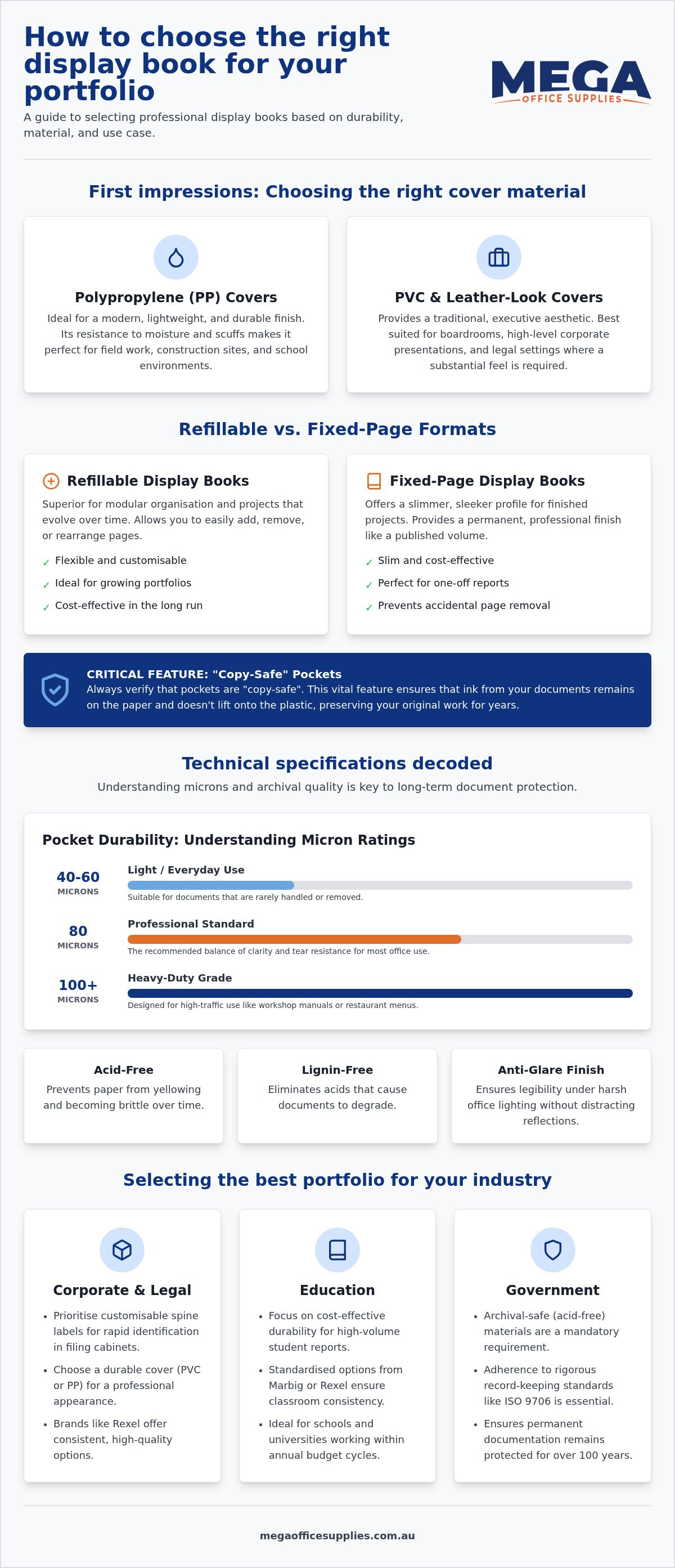
First impressions are often formed before you speak; the tactile quality of your cover is a critical consideration for high-stakes interviews and tenders. A physical artist's portfolio or business proposal needs to feel substantial to the touch. We recommend polypropylene (PP) covers for professionals who require a modern, lightweight, and durable finish. These covers resist moisture and scuffing, making them ideal for field work, construction sites, or school environments. Conversely, PVC and leather-look covers provide a traditional, executive aesthetic better suited for boardrooms and high-level corporate presentations. While it's tempting to focus solely on the contents, a cheap-looking cover can ruin a professional first impression before the meeting even begins. After all, nobody wants their career highlights housed in a folder that looks like it was borrowed from a primary schooler.
Refillable vs. fixed-page formats
Your choice depends on how frequently your work evolves. Fixed-page display books offer a slimmer profile and are generally more cost-effective for one-off reports or student assignments. However, if you need modular organisation, refillable display books for portfolios are superior. These systems, often using a multi-ring or snap-in mechanism, allow you to add or rearrange sheet protectors as your project grows. Regardless of the format, always verify that the pockets have "copy-safe" properties. This technical specification ensures that ink remains on the paper rather than lifting off onto the plastic, preserving your original documents for years. For finished projects where the sequence is final, a fixed-page book provides a sleek, permanent finish that feels like a published volume. This prevents pages from being accidentally removed or misplaced during a presentation.
Technical specifications: microns, materials, and archival quality
The durability of display books for portfolios is largely determined by the micron rating of the internal pockets. This technical specification dictates how well the book handles frequent page-turning and heavy handling during critical presentations. For effective showcasing your portfolio, you must also consider the visual finish. Anti-glare finishes are essential for documents viewed under harsh office lighting. They ensure your work remains legible from all angles without distracting reflections. Archival quality is equally non-negotiable for long-term storage. When sourcing display books for portfolios, we recommend looking for acid-free and lignin-free materials to prevent the yellowing or degradation of original documents. These materials follow international standards like ISO 9706, ensuring a lifespan of over 100 years for sensitive paper assets. A micron is a unit of measurement, representing one-thousandth of a millimetre, used to indicate the thickness and strength of plastic pockets.
Understanding micron ratings for pocket durability
Selecting the right thickness prevents pockets from tearing after minimal use. We stock various grades to suit different professional requirements:
- 40 to 60 microns: Suitable for light, everyday use where documents are rarely removed or handled.
- 80 microns: The professional standard for office supplies, offering a balance of clarity and tear resistance.
- 100+ microns: Heavy-duty grade designed for high-traffic environments, such as workshop manuals or restaurant menus.
Investing in higher micron counts ensures your presentation remains intact during repetitive page-turning. You can browse our full range of premium filing and storage solutions to find the right technical fit for your budget.
Selecting the best portfolio for your industry and use case
Corporate and legal requirements often focus on retrieval efficiency and long-term organisation. We recommend prioritising A4 display books for portfolios that feature customisable spine labels. This allows for rapid identification when documents are archived in filing cabinets. For educational institutions, consistency across classrooms is the main priority. We suggest standardised Marbig or Rexel options in bulk quantities. These brands provide the durability needed for student reports while remaining cost-effective for schools and universities working within strict annual budget cycles.
Government departments must adhere to rigorous record-keeping standards. In these sectors, acid-free and archival-safe display books are a mandatory requirement for permanent documentation. This ensures sensitive paper remains pristine without chemical degradation over decades. For those in the creative arts, A3 display books provide the necessary scale for visual impact. Large-format work requires reinforced covers to prevent the book from bowing or warping when stored upright. Without this structural support, your portfolio can end up looking more like a Pringle than a professional presentation after just a few months on a shelf.
Portfolios for high-stakes presentations
Customisation is essential when presenting tenders or business proposals. Choose a display book with a clear front pocket to allow for custom-branded title pages. This creates a tailored look that generic folders simply cannot match. The binding mechanism is another functional detail to consider. Whether you select a comb, wire, or heat-sealed system, ensure the book can lay flat on a boardroom table. This allows stakeholders to view your work naturally without the pages flipping shut. If you are managing a national rollout for a government body, remember that we accept official Australian Government purchase orders to streamline your procurement. Our team has over 150 years of combined experience to help you find the right high-volume solution.
Securing your professional legacy with the right storage
Selecting the right presentation tools ensures your work remains protected and professional for years. By prioritising high micron ratings and archival-safe materials, you avoid common pitfalls like ink lifting or document yellowing. Whether you're managing a government procurement rollout or updating a personal creative archive, the right display books for portfolios act as a silent partner in your professional success.
We bring over 17 years of Australian industry expertise to every order. Our NSW-based team provides genuine local support. We help you navigate technical specifications and bulk pricing for business or school accounts. We're here to ensure you get the right high-capacity solution without the friction of global competitors.
Browse our full range of professional display books and portfolios
Equipping your workplace with durable, museum-grade storage is an investment in your reputation that pays dividends every time you open the cover.
Frequently Asked Questions
What is the best display book for an interview portfolio?
The best choice for an interview portfolio combines a professional appearance with high-grade protection. We recommend a leather-look or premium polypropylene cover from trusted brands like Rexel or Marbig. Ensure the internal pockets have at least an 80-micron rating to withstand frequent handling. A clear front pocket is also helpful for custom branding, allowing you to present a tailored, executive image.
Are all display book pockets archival-safe and acid-free?
No, not all pockets are archival-safe; many cheaper alternatives use PVC, which can off-gas and damage your documents over time. You should specifically look for polypropylene pockets labelled as acid-free and copy-safe. This prevents ink from lifting off the paper and sticking to the plastic. We stock archival-safe display books for portfolios to ensure your permanent records meet rigorous government and legal standards.
What is the difference between A3 and A4 display books for portfolios?
The difference lies in the visual scale and the specific requirements of your industry. A4 display books are the standard for corporate reports, legal documentation, and professional CVs. Conversely, A3 display books for portfolios offer the necessary space for creative arts, architectural plans, or photography. While A3 provides more impact, these larger formats often require reinforced covers to remain stable during vertical storage.
Can I add more pages to a standard display book?
Your ability to add pages depends on whether the book has a fixed or refillable binding mechanism. Fixed-page books have a permanent pocket count and cannot be expanded. If you need a modular system, choose refillable portfolios with a multi-ring or snap-in spine. These allow you to insert additional sheet protectors as your work grows, providing the flexibility required for an evolving professional collection.
Article by
Mega Office Supplies Team
The Mega Office Supplies Team provides practical buying guides and workplace advice for Australian businesses, schools, government organisations, healthcare providers, hospitality venues, warehouses and home offices. Family-owned and operated since 2009 and based in Tweed Heads South on the Gold Coast–Tweed border, Mega Office Supplies brings more than 150 years of combined team experience to helping Australian workplaces choose the right office supplies, furniture, technology, cleaning, safety and education products — backed by genuine local service from real people.
General Information
This article is provided as general information only to help customers compare and choose office, workplace, school, cleaning, technology, furniture, safety and business supplies. Product details, specifications, compatibility, availability, pricing and suitability may vary. Always check the individual product page, manufacturer information, workplace requirements and relevant safety guidance before purchasing or using a product.


