


Most Australian procurement officers treat a4 paper as a simple commodity, yet choosing the wrong technical specification can quietly degrade your high-speed copiers and inflate your annual maintenance budget. It's a common frustration when a critical board report is ruined by ink bleed-through or when a "bargain" pallet of reams leads to a week of constant paper jams and expensive technician call-outs. We understand that managing bulk orders for multiple departments requires a precise balance of technical performance and fiscal responsibility.
By mastering the technical nuances of a4 paper, you'll ensure crisp, professional-looking documents while protecting your office machinery and streamlining your procurement costs. This guide provides the industry-grade insight needed to navigate the 2026 landscape, including the impact of new national packaging regulations and the specific gsm requirements for high-volume workflows. We'll examine how to evaluate whiteness levels, opacity, and weight to ensure your workplace remains efficient, organised, and fully equipped for the year ahead. Whether you are stocking a school staffroom or a government department, selecting the right reams is a critical step in maintaining a professional and functional office environment.
Key Takeaways
- Understand the technical relationship between GSM, CIE Whiteness, and ISO Brightness to select the correct grade for every workplace document.
- Learn how to match specific paper types to laser and inkjet machinery to minimise equipment wear and prevent frequent paper jams.
- Identify the most cost-effective procurement strategies for a4 paper, including the hidden logistical benefits of carton and pallet-level ordering.
- Explore specialised requirements for legal and medical archiving, focusing on acid-free materials that ensure document longevity.
- Master 2026 sustainability standards by differentiating between FSC, PEFC, and varying levels of recycled fibre content.
Understanding A4 Paper Specifications: GSM, Whiteness, and Brightness
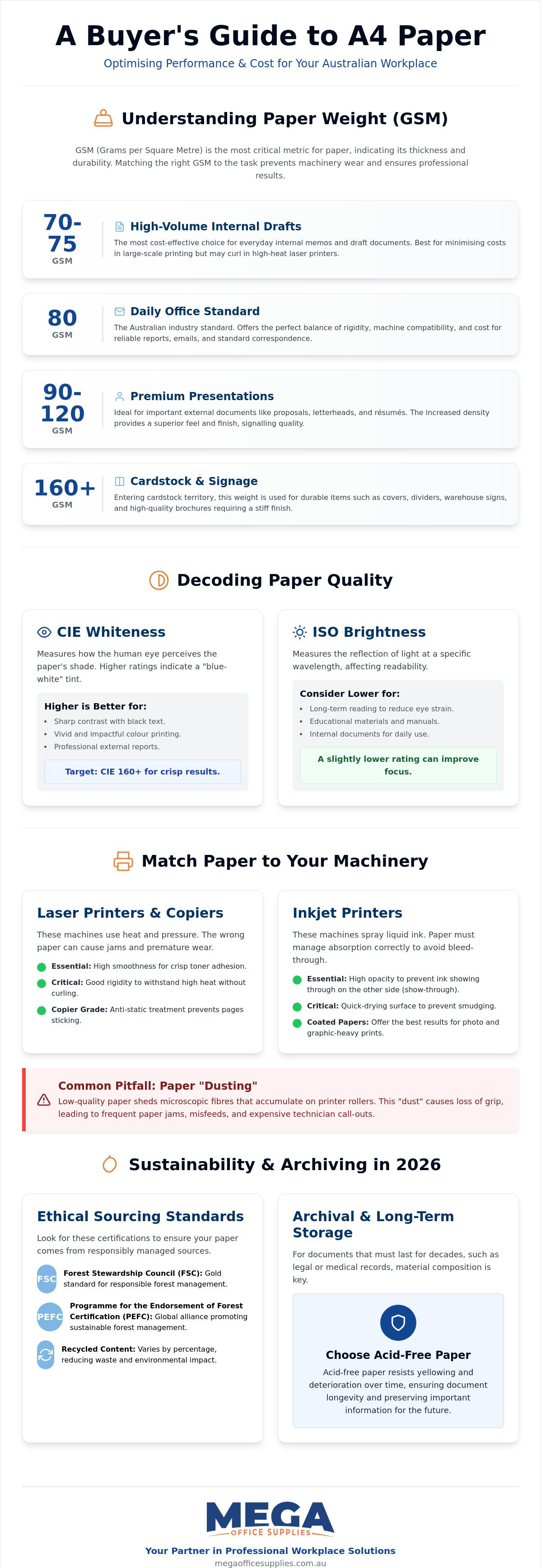
Selecting the correct grade of a4 paper involves understanding its physical architecture rather than just its dimensions. While the standard dimensions for office sheets are governed by international paper sizes, the internal density and surface finish dictate how a document performs in a high-volume environment. The most critical metric for any procurement officer is GSM, or Grams per Square Metre. This represents the weight of a single square metre of the paper, providing a direct indication of its thickness and durability.
To better understand how a4 paper is graded by weight, watch this helpful video:
The GSM Spectrum: From 70gsm to 250gsm
Choosing the correct weight is essential for balancing cost with professional standards. Most Australian workplaces utilise a tiered approach to their paper inventory based on the following ranges:
- 70-75gsm: These lightweight sheets are best suited for high-volume internal drafts. They offer cost savings for large organisations but can be prone to curling in high-heat laser printers.
- 80gsm: This is the Australian industry standard for daily office correspondence. It provides the ideal balance of rigidity and machine compatibility for standard reports and filing.
- 90-120gsm: These premium weights are used for external presentations, letterheads, and CVs. The increased density offers a superior tactile feel that signals quality to the recipient.
- 160-250gsm: This range enters cardstock territory. It's used for durable signage in warehouses or professional brochures that require a stiff, high-grade finish.
Whiteness vs. Brightness: Which Metric Matters?
While often used interchangeably, these metrics measure different properties. CIE Whiteness refers to how the human eye perceives the paper under a full spectrum of light. A higher CIE rating, typically 160 or above, indicates a "Blue-White" tint. This creates a sharper contrast with black text and makes colours appear more vivid. In contrast, ISO Brightness measures the amount of light reflected at a specific wavelength. For documents requiring long-term readability, such as educational resources or staff manuals, a slightly lower whiteness can reduce eye strain and improve focus.
Beyond these metrics, opacity and smoothness play vital roles in document quality. High opacity is non-negotiable for duplex printing to prevent "show-through" from the reverse side. Smoothness affects how toner particles adhere to the surface. A rougher sheet can lead to patchy print results, while a precision-engineered smooth surface ensures crisp, professional-grade output every time. These technical nuances ensure your office machinery remains protected from excessive dust and mechanical strain.
Matching Paper Types to Your Office Equipment
Many procurement managers assume all a4 paper is cross-compatible. The mechanical reality of your hardware suggests otherwise. Laser and inkjet machines use fundamentally different methods to bond an image to the page. Laser printers rely on heat and pressure to fuse dry toner, while inkjets project liquid droplets that must be absorbed quickly. Choosing a sheet of a4 paper that isn't engineered for your specific machine type can lead to poor image quality or mechanical failure.
Low-quality reams often suffer from "dusting". This happens when microscopic paper fibres shed during the feed cycle. These particles accumulate on delicate rubber rollers, causing them to lose grip and lead to frequent misfeeds. This debris acts like fine sandpaper, prematurely wearing down the fuser and transfer belt components. High-speed photocopiers present a different challenge. They generate significant friction during rapid throughput. Using specific "Copier" grade paper is essential here. These sheets are treated to prevent static buildup, ensuring pages don't stick together as they exit the fuser.
Laser Printer Optimisation
The fuser unit in a laser printer can reach temperatures exceeding 200 degrees Celsius. To handle this, laser-compatible paper is designed with high heat resistance to prevent curling or "cockling" as it passes through the rollers. A smooth surface is equally vital. It allows for precise toner adhesion, resulting in sharp text and professional-grade graphics. For businesses running high-volume fleets, pairing your paper with the right office technology supplies ensures consistent uptime and reduces the need for technician call-outs.
Inkjet Performance and Drying Times
Inkjet technology requires a surface that can manage moisture without allowing the ink to spread, a phenomenon known as "wicking". High-quality inkjet paper often features a treated surface that keeps the ink near the top layer. This results in more vibrant colour reproduction and faster drying times. If your staff are printing marketing materials or photo-heavy reports, using a dedicated inkjet-coated sheet prevents the smudging often seen on generic multipurpose paper.
For general office tasks, "Multipurpose" paper offers a functional middle ground. It's engineered with enough surface sizing to handle light inkjet use while remaining stable under laser heat. Selecting the right grade for your specific equipment is a simple way to optimise your workplace stationery budget while maintaining professional standards.
Evaluating Paper Quality for Different Professional Environments
The operational requirements for a4 paper vary significantly depending on the specific sector. A one-size-fits-all approach to procurement often leads to wasted resources or, conversely, documents that fail to meet professional standards. In warehouse environments, for instance, a4 paper serves as the backbone of logistics. Picking slips and dispatch notes are handled frequently in dusty, high-activity areas. These documents require a durable finish that resists tearing and remains legible even after significant manual handling. For industrial settings, a standard 80gsm sheet with high internal bond strength is usually sufficient to prevent the paper from becoming flimsy under stress.
Healthcare and legal sectors face entirely different challenges. Here, the focus shifts from short-term durability to long-term permanence. When documents are destined for archival storage, the chemical composition of the sheet is critical. Acid-free paper is a necessity to prevent yellowing and degradation over decades. By matching the technical specifications of your reams to the specific demands of your workplace, you ensure that every document, from a temporary warehouse manifest to a permanent medical record, performs its intended function without compromise.
Corporate and Legal Documentation
Legal firms and corporate offices require a sense of prestige and reliability. For client-facing contracts and formal correspondence, we recommend selecting weights of 90gsm or higher. This increased density provides a superior tactile experience that reinforces the importance of the document. Beyond the feel, ensure your paper meets ISO 9706 standards for permanence. This international benchmark guarantees the paper will last for centuries under proper storage conditions. To maintain an organised archive, many firms pair these high-grade sheets with durable office supplies designed for high-capacity filing.
High-Volume Education and Government Use
Schools and government departments operate under strict budgetary constraints while managing massive print volumes. The goal here is to balance cost-per-ream with machine reliability. Communal printers in staffrooms or open-plan departments are prone to downtime if fed with low-grade, dusty paper. Utilising standardised educational supplies helps streamline the procurement process and ensures consistency across multiple classrooms or branches. For administrative ease, we accept official purchase orders from government departments, providing a frictionless way to maintain stock levels. Staying informed through industry news and updates can also help procurement officers anticipate price fluctuations and manage annual budgets more effectively.
Procurement Strategies: Bulk Buying and Storage Best Practices
Effective management of your a4 paper inventory requires more than simply finding the lowest unit price. Procurement officers must navigate a hierarchy of volume: a single ream contains 500 sheets, a standard carton holds five reams, and a full pallet typically consists of 40 to 48 cartons. Transitioning from carton-based ordering to pallet deliveries represents a significant shift in logistical efficiency. For high-volume environments like government departments or large schools, pallet orders maximise return on investment by reducing the frequency of deliveries and lowering the per-unit cost of the raw material.
However, the hidden costs of "cheap" unbranded paper often outweigh the initial savings. Low-grade sheets frequently lead to increased equipment downtime. A single paper jam in a high-speed copier doesn't just waste a sheet; it disrupts workflow and may require a technician call-out if delicate internal sensors are damaged. To streamline your procurement process and access tailored pricing for high-volume needs, completing a business application allows for more efficient account management and rapid quoting for bulk requirements.
The Logistics of Bulk Ordering
Before moving to pallet-level procurement, consider your facility's physical constraints. A standard pallet of a4 paper requires approximately 1.2 square metres of floor space and can weigh over 600 kilograms. Ensure your delivery point has a suitable loading dock or that you've requested a tailgate delivery if a forklift isn't available. For national organisations, coordinating these deliveries across multiple sites requires a centralised inventory system to track usage rates and prevent overstocking in smaller branches.
Protecting Your Investment: Storage and Acclimatisation
Implement the "First In, First Out" (FIFO) principle to ensure older stock is used before newer arrivals. This prevents reams from sitting in storage for extended periods, where they might be exposed to fluctuations that lead to yellowing. Crucially, observe the "24-hour rule" for acclimatisation. Move the required reams into the printer room at least a full day before use. This allows the paper to reach the same temperature and humidity as the office environment, ensuring stable performance through the fuser. To secure your supply chain and maintain optimal stock levels, browse our full range of bulk stationery to simplify your monthly replenishment.
Navigating Sustainability and Ethical Sourcing in 2026
Sustainability is no longer a voluntary addition to your procurement strategy. New mandatory national packaging regulations in 2026 require businesses with an annual turnover exceeding $5 million to meet strict targets regarding recyclability and material sourcing. For procurement managers, this means a4 paper is now a primary focus for corporate ESG (Environmental, Social, and Governance) reporting. Choosing certified reams ensures your organisation remains compliant while supporting the circular economy. In 2025, recycled fibre already constituted 64% of the Australian paper packaging market, and this volume continues to grow as infrastructure expands.
FSC and PEFC: What These Logos Mean
Procurement officers should prioritise two primary certifications: FSC (Forest Stewardship Council) and PEFC (Programme for the Endorsement of Forest Certification). FSC certification ensures that the timber used in your paper is harvested from forests managed to protect biodiversity and the rights of indigenous communities. PEFC acts as an umbrella for national forest certification systems, providing a similar level of assurance regarding sustainable management. Integrating ethical procurement into your broader facility supplies strategy ensures that every department contributes to the organisation’s social responsibility goals. These logos act as a trust signal for stakeholders who demand transparency in the supply chain.
Carbon Neutral certification is another critical factor. Many Australian manufacturers now offer reams that offset the entire production and transport cycle. Sourcing Australian-made paper further reduces your "paper miles," as the domestic price of paper remains competitive due to a 2026 increase in local wood harvest volumes. This local sourcing strategy significantly lowers the carbon footprint associated with international shipping and logistics.
The Performance of Modern Recycled Paper
The myth that recycled a4 paper is "grey" or "dusty" has been thoroughly debunked by 2026 manufacturing standards. Modern de-inking and bleaching processes allow 100% recycled reams to achieve CIE whiteness ratings that rival virgin fibre. When reviewing recycled options, it's vital to distinguish between Post-Consumer Waste (PCW) and Pre-Consumer Waste. PCW is sourced from household and office recycling bins, offering the highest environmental benefit. Pre-consumer waste consists of factory offcuts that were never used by a consumer.
Transitioning your office to a sustainable paper model doesn't require a sacrifice in print quality. High-grade recycled sheets are now engineered with the same smoothness and opacity specifications discussed in our section on laser printer optimisation. This ensures that your commitment to the environment doesn't result in increased equipment downtime or poor document presentation. By selecting certified, high-performance recycled stock, you protect your office machinery while meeting the highest ethical standards of the modern Australian workplace.
Future-Proofing Your Workplace Stationery Strategy
Selecting the correct a4 paper is a technical decision that directly impacts equipment longevity and corporate sustainability targets. By matching GSM ratings to your specific hardware and implementing proper storage techniques, you can eliminate the operational friction caused by paper jams and moisture-related curling. As the 2026 mandatory packaging regulations take effect, choosing certified sustainable reams is no longer optional for professional ESG reporting. It's a critical component of a modern, efficient procurement system.
Mega Office Supplies has served as a reliable partner for Australian workplaces since 2005. As a family-owned business, we provide decades of combined industry expertise to ensure your procurement process is seamless and cost-effective. We offer consistent national delivery for corporate and government orders, providing the scale needed for high-volume demands without losing our local service focus. Browse our full range of A4 Copy Paper and Bulk Cartons today to secure high-performance stock for your facility. Equip your organisation with the precision-engineered supplies required for a productive and professional year ahead.
Frequently Asked Questions
What is the standard weight for A4 copy paper in Australia?
The standard weight for a4 paper in Australian workplaces is 80gsm. This specification provides the necessary rigidity for high-speed printing while remaining cost-effective for bulk procurement. While 70gsm and 75gsm options exist for high-volume drafts, 80gsm remains the benchmark for reports, correspondence, and communal printing. It offers reliable performance across both laser and inkjet fleets without the curling issues often associated with lighter, economy-grade sheets.
Can I use inkjet paper in a laser printer?
You should generally avoid using dedicated inkjet paper in a laser printer. Laser machines utilise high heat to fuse dry toner to the page, which can melt the specialised coatings found on inkjet-specific sheets. This melting can damage the fuser unit or cause the sheet to stick to the rollers. For mixed-fleet environments, it's safer to use multipurpose paper designed to handle both heat and liquid absorption.
How many sheets are in a standard ream of A4 paper?
A standard ream of a4 paper contains 500 individual sheets. For procurement planning, most Australian offices order by the carton, which typically holds five reams, or 2,500 sheets total. Large-scale operations such as schools or government departments often purchase by the pallet. A full pallet generally contains 40 to 48 cartons, providing a significant volume of 200 to 240 reams for high-throughput environments.
What does "GSM" stand for in paper specifications?
GSM stands for Grams per Square Metre, which is the international metric used to measure the weight and density of paper. It's calculated by weighing a single square metre of the material. A higher GSM indicates a thicker, heavier, and more opaque sheet. While 80gsm is the standard for office documents, weights like 100gsm or 120gsm are preferred for professional letterheads and external client presentations.
Why does my A4 paper keep jamming in the photocopier?
Frequent jams are often caused by poor storage or using low-quality paper with high dust content. If paper is stored in humid conditions or on concrete floors, it absorbs moisture and loses its structural integrity, leading to misfeeds. Additionally, microscopic paper fibres can build up on the printer's intake rollers. Regularly cleaning your equipment and ensuring your paper is properly acclimatised to office conditions will significantly reduce mechanical downtime.
Is recycled A4 paper bad for my printer?
Modern recycled paper is perfectly safe for your office equipment and doesn't cause additional wear. Manufacturing standards in 2026 ensure that recycled reams meet the same smoothness and dust-free specifications as virgin fibre paper. Using high-quality recycled stock allows your organisation to meet sustainability targets without sacrificing print clarity or risking damage to delicate internal components. It's an efficient way to support the circular economy.
How should I store bulk A4 paper to keep it fresh?
To keep bulk paper fresh, store cartons in a cool, dry area away from direct sunlight and off the floor. Using a pallet or racking prevents ground moisture from wicking into the bottom reams. You should also keep the paper in its original moisture-proof wrapper until it's ready for use. Observe the 24-hour rule by moving stock into the printer room a day before printing to allow it to reach ambient humidity.
What is the difference between A4 and Letter size paper?
A4 and Letter size are not interchangeable. A4 is the international standard used in Australia, measuring 210mm by 297mm. Letter size is the American standard, which is shorter and wider at 215.9mm by 279.4mm. Using Letter size settings for Australian documents will result in cut-off text or incorrect margins. Always ensure your software and printer tray settings are set to A4 to maintain professional standards.
Article by
Mega Office Supplies Team
The Mega Office Supplies Team provides practical guidance for Australian businesses, schools, government organisations, healthcare providers, hospitality venues, warehouses and home offices. Based in Tweed Heads South, Mega Office Supplies is a family-owned and operated Australian business offering office stationery, workplace furniture, technology products, labels, printers, cleaning and janitorial supplies, safety products, art materials, education resources and everyday business essentials from trusted brands.
General Information
This article is provided as general information only to help customers compare and choose office, workplace, school, cleaning, technology, furniture, safety and business supplies. Product details, specifications, compatibility, availability, pricing and suitability may vary. Always check the individual product page, manufacturer information, workplace requirements and relevant safety guidance before purchasing or using a product.


