

Have you ever spent hours perfecting a high-stakes presentation, only to find the wire binding combs you ordered are completely incompatible with your machine's punch pattern? It's a frustrating setback that often leads to crushed spines, snagged pages, or documents that simply won't turn. We understand that in a busy Australian office, you need supplies that work the first time without the technical guesswork.
Choosing the right spine involves more than just picking a colour; it requires a precise match between the pitch of your machine and the diameter of the wire. This guide will help you master these technical specifications so you can choose the perfect spines for your professional reports and manuals. We'll show you exactly how to match sheet counts to wire sizes and identify the correct pitch for your equipment, giving you the confidence to produce polished, 360-degree opening documents every time.
Key Takeaways
- Identify whether your machine requires a 3:1 or 2:1 pitch to ensure your spines align perfectly with the punched holes.
- Learn to match the millimetre diameter of wire binding combs to your document thickness to ensure pages turn freely without snagging.
- Discover the benefits of using premium twin-loop wires for professional reports that need to lay flat or fold back completely.
- Compare professional-grade brands like Gold Sovereign and Fellowes to secure the most durable binding solution for high-volume Australian workplaces.
Deciphering wire binding specifications: Pitch, loops, and compatibility
Wire binding, frequently referred to as twin-loop or double-loop binding, remains the gold standard for Australian professionals who require documents to lay flat or fold back a full 360 degrees. This method provides a level of durability and security that plastic alternatives cannot match. However, the most common mistake we see is a misunderstanding of pitch. Pitch refers to the specific number of holes per inch along the binding edge. It dictates which wire binding combs will physically fit into the holes your machine punches.
To better understand how these components interact, watch this helpful overview:
Assuming all wire systems are universal is a costly error. Trying to force a 2:1 pitch wire into a 3:1 punched document is like trying to fit a square peg in a round hole; it won't work and usually results in wasted supplies. We stock a comprehensive range of binding machines designed to handle these precise specifications with ease.
The 3:1 pitch vs. 2:1 pitch distinction
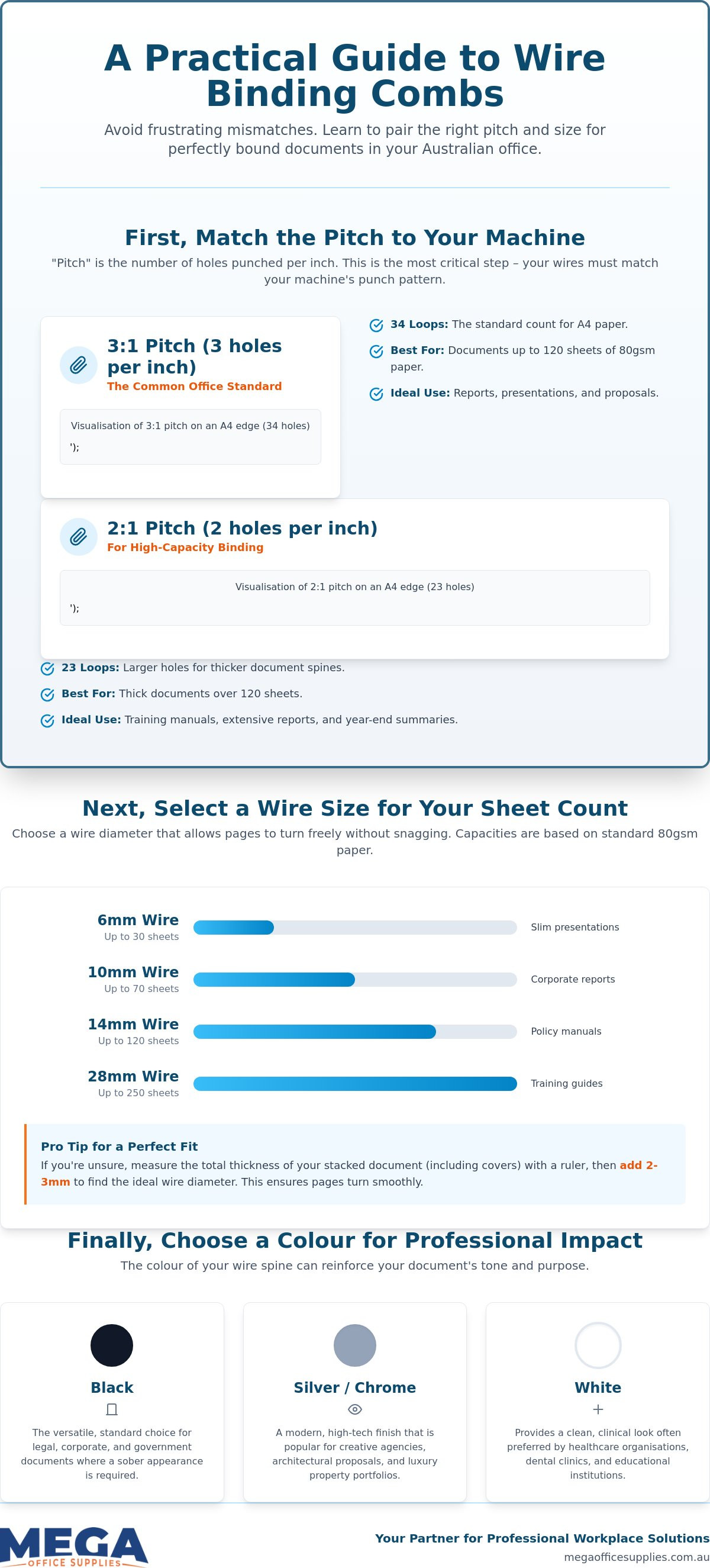
Pitch is the measurement of holes per inch on a binding edge. For A4 documents, the 3:1 pitch is the most common office standard. It creates 34 small, square holes and is ideal for reports up to 120 sheets. Conversely, the 2:1 pitch is reserved for substantial manuals and large reports. It uses 23 loops for an A4 edge, providing the extra strength needed for heavier sheet counts.
Loop counts and A4 standardisation
In the Australian market, 34-loop wires are the recognised standard for A4 3:1 binding. High-quality wire binding combs, such as the PHE Gold Sovereign 3:1 Pitch 34 Loop series, are a staple in government and corporate sectors due to their precision. While 34 loops is the norm, you might encounter 21-loop variations in specific GBC systems or documents designed for US-letter sizes. Always count the loops on your current stock before reordering to ensure a perfect match for your equipment.
Selecting the correct wire size and capacity for your project
Selecting the right diameter for your wire binding combs is a matter of practical physics. If the spine is too small, the document will struggle to open, and the pages will eventually snag or tear at the punch holes. To ensure a professional finish, always allow for a 'buffer zone' where the sheets can move freely around the loops. This is particularly vital for manuals and coursework that require frequent handling. A document that lays perfectly flat is far more functional for the end user and prevents the wire from deforming over time.
Calculating capacity involves more than just a simple sheet count. You must account for the specific gsm of your A4 copy paper and the microns of your binding covers. For instance, a standard 200-micron PVC cover adds significant bulk compared to a single sheet of paper. If you're unsure about the total thickness, we recommend measuring the stack with a ruler and adding 2mm to the total to find the ideal wire diameter. Professional environments often keep a variety of sizes on hand to avoid the 'crushing' effect that occurs when a spine is overloaded.
You can explore our full range of professional wire binding combs to find the exact size and colour for your next project.
The sheet capacity guide
- 6mm Wires: Best for slim presentations and marketing handouts (up to 30 sheets of 80gsm paper).
- 10mm to 12mm Wires: The 'sweet spot' for most corporate reports and internal documents (50 to 100 sheets).
- 14mm to 28mm Wires: High-capacity options designed for extensive policy manuals, training guides, and year-end financial summaries.
Choosing colours for professional impact
- Black wires: The versatile, standard choice for legal, corporate, and government documentation where a sober appearance is required.
- Silver/Chrome wires: A modern, high-tech finish that is popular for creative agencies, architectural proposals, and luxury property portfolios.
- White wires: Provides a clean, clinical look often preferred by healthcare organisations, dental clinics, and educational institutions for student workbooks.
Professional wire binding combs: Our top recommendations
For high-volume environments like print rooms and government departments, the choice of wire binding combs often comes down to brand reliability and logistical efficiency. We've seen that the Gold Sovereign (PHE) range remains the industry benchmark for precision. These wires maintain their shape during the crimping process better than generic alternatives, which prevents the frustration of lopsided spines. For those who prioritise ease of use and consistent loop formation, the Fellowes range offers a reliable alternative that minimises waste and ensures a clean finish every time.
Procurement officers in schools and large businesses find that buying in 'Box of 100' or 'Box of 50' quantities is the most cost-effective strategy. It reduces the per-unit cost and ensures you aren't caught short during peak periods like the end of the financial year or the start of the school term. Our team can help you navigate these high-volume requirements and find the exact specifications for your machinery.
High-capacity solutions for substantial manuals
When dealing with extreme volumes, the PHE 28mm White Wire in a 2:1 pitch is a standout choice. Its 23-loop A4 format provides the structural integrity needed for the heaviest manuals. For frequently used training guides that require maximum strength, the PHE 25mm Black Wire (2:1 pitch) is a durable workhorse. We also stock specialised options like the GBC 14mm Black 21 Loop wires, which are designed for specific professional binding systems often found in commercial print environments.
Everyday essentials for reports and presentations
Most standard office documentation relies on the 3:1 pitch. The PHE 8mm and 12mm Black Wires are our most requested go-to options for these reports. If you want a particularly polished finish, the Fellowes 11mm Black 34 Loop wires provide a premium look that holds its form under pressure. For client-facing proposals where aesthetics matter, the PHE 6mm Silver Wire offers a contemporary, slimline appearance that distinguishes your work from the standard black spine.
Maximise the impact of your professional documentation
Producing professional-grade documents requires a precise understanding of technical hardware and consumable compatibility. By mastering the distinction between 3:1 and 2:1 pitch and selecting the appropriate millimetre diameter for your specific sheet count, you ensure every report remains functional and durable. Our commitment to the Australian market is backed by over 17 years of industry experience, providing a reliable supply chain for schools, government departments, and corporate offices nationwide.
We understand the logistical needs of busy procurement officers. This is why we offer free delivery on orders over $149 Australia-wide and accept official Government purchase orders. These services ensure your team can access high-quality wire binding combs without friction or unnecessary delays. Our extensive catalogue is designed to meet the demands of high-volume environments where precision is non-negotiable.
With these technical specifications mastered, you can now procure your binding supplies with absolute confidence and achieve a polished finish every time.
Frequently Asked Questions
What is the difference between 3:1 and 2:1 pitch wire binding?
The primary difference is the hole spacing, where 3:1 pitch features three holes per inch and 2:1 pitch features two. This measurement determines the total loop count for an A4 document; a 3:1 pitch requires 34 loops, while a 2:1 pitch uses 23 loops. You must match your wire binding combs to the specific punch pattern of your machine to avoid hardware damage or ruined reports.
Can I use wire binding combs with a plastic comb binding machine?
No, you cannot use wire spines with a standard plastic comb binding machine. Plastic comb systems punch 21 rectangular holes along an A4 edge, which does not align with the 34 or 23 loops found on wire binding combs. Because the hole shapes and spacing are completely different, the two systems are not interchangeable. Attempting to force a wire into a plastic comb punch pattern will result in misaligned pages and a document that won't open.
How do I calculate the sheet capacity if I am using thick covers?
You should calculate capacity by measuring the total thickness of your document stack in millimetres rather than relying on sheet count alone. Thick covers, such as 200-micron PVC or heavy 350gsm cardstock, significantly increase the document's spine width. We recommend adding a 2mm buffer to your total stack height. This extra space ensures the pages have enough room to rotate freely without resistance or snagging.
What happens if I use a wire that is too small for my document?
Using a wire that is too small prevents the document from opening 360 degrees and causes the pages to snag or tear at the punch holes. The wire loops will often appear "crushed" or strained because there isn't enough diameter to accommodate the paper's arc. It's always better to select a slightly larger diameter to maintain the professional aesthetic of your report and ensure it can withstand frequent handling in a busy office environment.
Article by
Mega Office Supplies Team
The Mega Office Supplies Team provides practical buying guides and workplace advice for Australian businesses, schools, government organisations, healthcare providers, hospitality venues, warehouses and home offices. Family owned and operated since 2008 and based in Tweed Heads South on the Gold Coast–Tweed border, Mega Office Supplies helps Australian workplaces choose the right office supplies, furniture, technology, cleaning, safety and education products — backed by genuine local service from real people.
General Information
This article is provided as general information only to help customers compare and choose office, workplace, school, cleaning, technology, furniture, safety and business supplies. Product details, specifications, compatibility, availability, pricing and suitability may vary. Always check the individual product page, manufacturer information, workplace requirements and relevant safety guidance before purchasing or using a product.


