


What if your choice of laminating machines had more to do with thermal capacity and micron compatibility than simple paper size? Professional finishing is a precise calculation of heat and pressure, yet many Australian workplaces still rely on hardware that causes frequent jams or inconsistent bubbling. Whether you're managing a busy school art room or a high-volume warehouse, a reliable machine is the difference between a crisp, protected document and a frustrated afternoon of troubleshooting.
At Mega Office Supplies, we understand that procurement officers and business owners value stability and functional clarity. You need hardware that minimises downtime and handles bulk demands without friction. This guide provides the technical insight needed to select heavy-duty solutions, from the automated GBC Foton 30 priced at $1,424.50 to high-capacity roll laminators. We'll explore how to evaluate warm-up times and roller counts to ensure your organisation achieves a bubble-free finish every time. You will learn how to navigate technical specifications and safety standards like AS/NZS 4024:2019 to find the perfect fit for your specific office volume and finishing requirements.
Key Takeaways
- Understand how thermal and cold pressure sealing provides a waterproof, tamper-proof barrier for essential workplace documents.
- Compare technical specifications for laminating machines, focusing on micron ratings from 80 to 250 and modern warm-up technologies.
- Identify industry-specific applications, such as creating wipe-clean menus for hospitality or durable classroom resources for the education sector.
- Master preventative maintenance techniques, including the use of carrier sheets, to avoid document jams and ensure hardware longevity.
- Learn why procurement teams prioritise reliable Australian partners with extensive industry experience to manage bulk hardware and consumable requirements.
Understanding Laminating Machines: A Professional Overview
A professional laminating machine functions as a protective sealer, using either thermal adhesive or cold pressure to encase documents between layers of durable plastic film. Understanding what lamination is helps procurement officers appreciate how the process enhances colour contrast while providing a waterproof, tamper-proof barrier for critical assets. For many Australian organisations, this hardware is indispensable for maintaining OH&S signage in rugged warehouse environments or preserving permanent records in healthcare settings. These machines are generally categorised into pouch, roll, and fully automated units, each tailored to specific workplace throughput and finish requirements.
Pouch vs. Roll Laminators: Which Suits Your Volume?
Pouch units are the standard choice for most office environments and educational supplies cupboards. They work best for individual items such as certificates, visitor passes, or small-batch instructional notices used in staff kitchens. Setup is fast and requires minimal training, though the per-unit cost of pouches is typically higher than bulk film. Roll laminators are the preferred heavy-duty solution for high-volume production. They facilitate continuous lamination and large-format finishing for posters or architectural plans. While roll systems require more manual control during the initial setup, their ability to handle massive batches with lower consumable costs makes them a staple in professional administrative hubs.
Hot vs. Cold Laminating Technology
Most professional laminating machines utilise hot technology, which uses heat-activated adhesives to create a permanent, high-clarity bond. This method is the industry standard for documents that need to withstand heavy handling. However, heat isn't appropriate for every medium. Cold lamination is a critical requirement for heat-sensitive materials such as thermal paper, certain glossy photographs, or older archival documents that might melt or discolour under high temperatures. Many modern units now offer dual-mode functionality. These versatile machines allow operators to toggle between heat settings, ensuring the safe handling of diverse workplace assets without the need for multiple pieces of hardware.
At Mega Office Supplies, we've observed how the right choice in hardware directly impacts daily productivity. Selecting from various laminating machines isn't just about the initial purchase price; it's about matching the machine's thermal capacity to your specific document types. A well-matched machine reduces the risk of expensive reprints and ensures that your organisation's safety notices and instructional materials remain legible and professional for years to come.
Evaluating Key Specifications for High-Performance Office Use
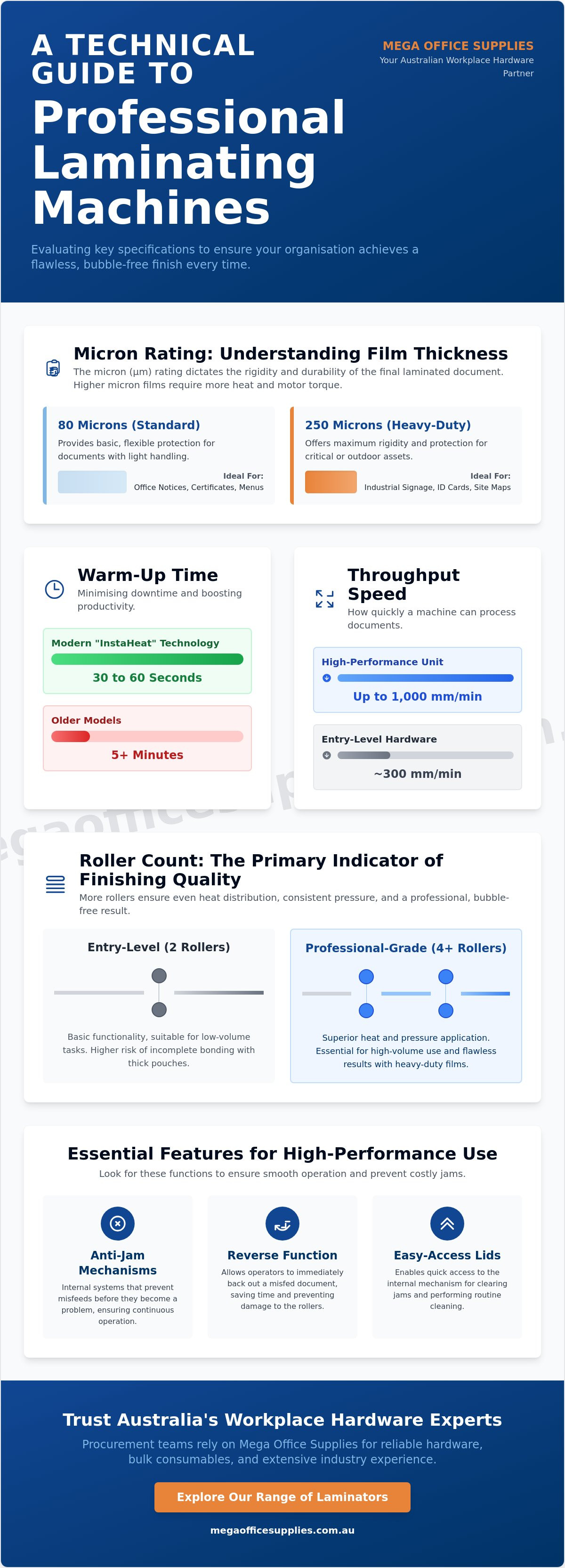
Choosing between different laminating machines requires a firm grasp of technical variables that dictate output quality and hardware longevity. The most critical metric for any procurement officer is the micron rating. Microns (µm) represent the thickness of the laminating film. A standard 80-micron pouch provides basic protection for office notices, whereas a heavy-duty 250-micron pouch offers the rigidity required for industrial site maps or outdoor signage. It's a common mistake to assume any machine can handle any pouch. High-micron films require significantly more heat and motor torque. Attempting to run 250-micron film through a basic unit often results in motor strain or incomplete adhesive bonding.
Productivity in a fast-paced Australian administrative centre depends on warm-up times and throughput speed. Modern "InstaHeat" technology allows machines to reach operating temperature in roughly 30 to 60 seconds, a vast improvement over older models that required a five-minute wait. Once ready, speed is measured in millimetres per minute (mm/min). A high-performance unit might process 1,000mm/min, effectively clearing a backlog of reports in a fraction of the time taken by entry-level hardware. Reliability is further enhanced by anti-jam mechanisms. Look for "Easy-Access" lids and "Reverse" functions that allow operators to correct misfeeds instantly before the film wraps around the internal rollers.
Thermal Capacity and Roller Count
The number of rollers inside a machine is the primary indicator of finishing quality. While entry-level models use two rollers, professional-grade laminating machines typically feature four or six. More rollers ensure even heat distribution and consistent pressure, which are essential for eliminating air bubbles and silvering. Precise temperature control is also vital when managing various film thicknesses. Maintaining these systems involves understanding the safe handling of laminating adhesives, particularly when heat-activated chemicals are involved. Professional units often include variable temperature settings, allowing users to adjust the heat to match the specific micron count of the pouch being used.
Format Versatility: Beyond Standard A4
Investing in an A3 machine provides greater flexibility even for organisations that primarily process A4 documents. An A3 entry allows you to feed A4 pouches in a landscape orientation, which significantly increases throughput speed. For specialised tasks, such as creating staff ID cards or business cards, small-format units provide dedicated precision. Conversely, large-format roll systems are necessary for architectural plans or educational charts that exceed standard office paper sizes. If you're looking to upgrade your department's capabilities, you can view our range of professional hardware to compare specific model capacities and find a solution that matches your workflow.
Selecting the Right Machine for Your Specific Industry Application
Every workplace environment presents unique challenges that dictate which laminating machines will provide the best return on investment. Hospitality venues, for instance, require hardware capable of producing wipe-clean menus and durable table talkers that withstand frequent sanitisation with cleaning chemicals. In corporate settings, the focus often shifts toward professionalising internal signage, instructional guides, and ID badges. For industrial sites and warehouses, the priority is heavy-duty protection for safety protocols and outdoor-ready site maps that must remain legible despite exposure to moisture and dust.
Australian schools face a distinct set of demands, particularly during peak back-to-school periods or before major events. These institutions require machines with high duty cycles that don't overheat after processing a single classroom set of resources. When browsing educational supplies, procurement officers should look for hardware that handles continuous operation. Protecting student awards and teaching aids for long-term use is a primary goal, ensuring that expensive colour printing isn't wasted due to premature wear or environmental damage.
High-Volume Signage and Educational Resources
For high-volume tasks, the choice of film finish is just as important as the machine itself. While gloss is the standard choice for vibrant colours, matte finishes are often superior for readability in classrooms or warehouses with bright fluorescent lighting. Using heavy-duty 250-micron pouches for reusable workplace templates, such as daily checklists or safety sign-in sheets, ensures the document remains rigid and professional. Choosing a machine with a robust motor is essential when consistently using these thicker pouches to prevent premature mechanical failure.
Professional Presentation and Certificates
Achieving a "lay-flat" finish is critical for high-end corporate documentation and official certificates. A common issue in professional finishing is "silvering," which appears as a faint haze or tiny bubbles on dark printed backgrounds. This usually occurs when the heat setting is too low or the roller pressure is inconsistent. Selecting a machine with precise temperature controls allows you to dial in the exact heat required for the paper stock. For documents displayed in reception areas or near windows, using pouches with UV protection is a practical step to prevent the sun from fading your organisation's important notices and credentials.
Maintenance and Troubleshooting: Ensuring Machine Longevity
Maintaining professional laminating machines requires a disciplined, no-nonsense approach to prevent mechanical failure. Most issues in high-volume environments, like school art rooms or busy reception areas, stem from neglected adhesive build-up on the internal rollers. When glue oozes from the edges of a pouch, it adheres to the rollers, eventually causing documents to wrap around the mechanism. Using a carrier sheet acts as a protective barrier, catching excess adhesive and significantly extending the service life of your hardware. If you notice a "tacky" sound during operation or visible residue on finished documents, it's time for immediate maintenance.
Jam Prevention and Error Correction
Preventing a document jam is simpler than clearing one. Follow these three critical steps for every session:
- Step 1: Always insert the sealed end of the pouch into the machine first. Feeding the open end causes air pockets and allows adhesive to leak directly onto the rollers.
- Step 2: Match the pouch thickness to the machine setting. As discussed in previous sections, running a 250-micron pouch on an 80-micron setting prevents the adhesive from melting correctly, leading to a physical blockage.
- Step 3: Use the "Reverse" function immediately if you see the document entering at an angle. Don't wait for it to disappear; stopping the feed early prevents a minor misalignment from becoming a major mechanical jam.
Cleaning and Roller Care
Routine cleaning protocols are essential for removing adhesive residue before it hardens. After every high-volume session, run a dedicated cleaning sheet through the machine while it's still hot. These sheets are designed to "wick away" excess glue from the rollers. You should never use sharp objects, such as scissors or knives, to scrape rollers. Even a tiny nick in the silicone surface will cause permanent "speckling" or bubbles on every future document. Similarly, avoid abrasive chemicals that can degrade the roller material over time.
Storage also plays a role in longevity. Keeping your unit in a dust-free environment or under a simple cover prevents particles from entering the mechanism. Dust on the rollers creates imperfections in the lamination, often mistaken for machine failure. If you observe consistent rippling or cold spots despite using the correct settings, the rollers may have reached the end of their duty cycle. To keep your workflow moving, you can view our selection of heavy-duty laminating machines to find a reliable replacement or upgrade for your office.
Why Procurement Teams Trust Mega Office Supplies for Workplace Hardware
Procurement officers and school administrators require more than just a product; they need a dependable supply chain that understands the rigours of the Australian commercial environment. Mega Office Supplies leverages over 150+ years of combined service experience to act as a reliable partner for businesses, government departments, and healthcare providers. Our "Mega" catalog serves as a comprehensive one-stop-shop, ensuring you can source heavy-duty laminating machines alongside essential bulk consumables without the administrative burden of managing multiple vendors. This logistical prowess is backed by a nationwide delivery network that reaches warehouses, reception areas, and staff kitchens across the country.
We provide expert local support through our dedicated 1300 783 961 phone number. This accessibility ensures that technical queries regarding roller counts or requests for bulk quotes are handled by professionals who understand the practicalities of workplace maintenance. You won't be dealing with a faceless global entity; instead, you gain access to a team that values longevity and functional clarity. Whether you're upgrading a single home office or coordinating a national rollout, our focus remains on providing hardware that reduces downtime through reliable, professional-grade performance.
Bulk Orders and Combined Service Value
Efficiency is the cornerstone of effective procurement. By combining orders for A4 copy paper, toner cartridges, and laminating film, organisations can significantly streamline their internal logistics and reduce freight touchpoints. Our platform provides transparent RRP pricing and competitive bulk discounts tailored for large-scale office fit-outs. To facilitate rapid budget approval, procurement teams frequently use our "View Quote" feature. This functional signature provides a clear, itemised breakdown of costs, allowing for transparent financial tracking and faster processing through internal accounts departments.
The Safe Pair of Hands for Australian Businesses
Our family-owned heritage translates into a higher level of customer accountability and a sense of local pride. We're a hardworking partner that prioritises the supply of equipment built for high-volume demands. We don't just sell hardware; we provide the peace of mind that comes from knowing your equipment is backed by a century and a half of collective industry knowledge. From art rooms in regional schools to busy hospitality venues, our clients rely on us to provide the stability and expertise needed to keep their operations running without friction. If you're ready to secure hardware that delivers crisp, bubble-free results, you can view our range of professional laminating machines and bulk pouches here.
Securing Your Workplace Documentation for the Long Term
Selecting the right hardware is a fundamental investment in your organisation's operational efficiency. By matching technical specifications like micron capacity and roller count to your specific industry volume, you ensure that every document is finished with professional clarity. Implementing a strict maintenance routine, including the use of carrier sheets and regular cleaning, will protect your equipment from the common pitfalls of adhesive build-up and mechanical jams. These practical steps ensure your laminating machines remain a reliable asset for years to come.
Mega Office Supplies provides the security and peace of mind needed for such essential procurement. With over 150+ years of combined service experience and reliable nationwide delivery, we're the safe pair of hands for Australian schools and businesses. Our local support team is available on 1300 783 961 to assist with bulk quotes or technical guidance. You can browse our heavy-duty laminating machines and bulk consumables at Mega Office Supplies to find a solution that meets your high-volume demands. We're confident this guide has equipped you to make an informed choice for a more protected workplace.
Frequently Asked Questions
What is the difference between a 2-roller and a 4-roller laminator?
A 4-roller machine utilises two rollers to melt the adhesive and two additional rollers to press and seal the document. This configuration ensures superior heat distribution and pressure compared to 2-roller models, which often result in rippling or uneven finishes. For high-volume office use, 4-roller systems are the standard for achieving a flat, professional seal without the risk of silvering or air pockets.
Can I laminate several small items in one large A4 pouch?
You can laminate multiple small items in a single A4 pouch provided you leave at least a 5mm gap between each object. It's critical not to cut the pouch before feeding it through the machine, as this leads to adhesive leakage and roller damage. Once the lamination is complete and cooled, you can trim the individual items while maintaining a sealed edge around each one for a waterproof finish.
How do I choose the correct micron thickness for my document?
Selecting the correct micron thickness depends on the intended use and the mechanical capacity of your laminating machines. Standard 80-micron pouches are suitable for documents kept in files, while 125-micron pouches offer more rigidity for frequently handled notices. For industrial site maps or outdoor signage, 250-micron film provides the highest level of protection, provided your hardware is rated for that specific thickness and thermal demand.
Why is my laminating machine producing cloudy or bubbly results?
Cloudy results usually indicate the temperature is too low to fully melt the adhesive, while bubbles suggest the heat is too high. If your machine has variable temperature controls, adjust the setting to match the micron thickness of your pouch. Silvering or cloudiness can also occur if the machine hasn't reached its full operating temperature, so always wait for the "ready" signal before inserting your document.
Do I need a carrier sheet for every laminating task?
You only need a carrier sheet if your specific machine instructions require one or if you're laminating small items that don't fill the pouch. Modern "carrier-free" machines are designed to operate without them, but using one provides an extra layer of protection against adhesive seepage. Always check your hardware's manual to ensure you aren't voiding the warranty or causing a jam by omitting or using a carrier sheet incorrectly.
What should I do if a pouch gets jammed inside the machine?
If a jam occurs, use the "Reverse" function or the manual release lever immediately to stop the document from wrapping further around the rollers. Never attempt to pull the pouch out by force while the rollers are moving, as this can tear the silicone surface. If the jam is severe, turn off the power and wait for the unit to cool before seeking assistance from your organisation's maintenance officer to avoid further damage.
Can I use a hot laminator for photos and thermal paper?
Hot lamination is safe for most modern photographs, but it will ruin thermal paper by turning the entire page black. For heat-sensitive materials like receipts or archival faxes, you must use a machine with a "Cold" setting and specialised pressure-sensitive pouches. This dual-mode functionality is essential for workplaces that handle a variety of document types, including delicate art projects and historical records that cannot withstand high temperatures.
Are there laminating machines that don't require a warm-up period?
Machines featuring "InstaHeat" technology can warm up in as little as 30 to 60 seconds, representing a 90% reduction in wait time compared to older models. Cold laminators require no warm-up time at all since they rely entirely on pressure rather than heat to seal the film. For busy administrative environments, selecting a high-speed thermal unit with a rapid start-up prevents significant delays during urgent tasks and improves overall workplace productivity.
Article by
Mega Office Supplies Team
The Mega Office Supplies Team provides practical guidance for Australian businesses, schools, government organisations, healthcare providers, hospitality venues, warehouses and home offices. Based in Tweed Heads South, Mega Office Supplies is a family-owned and operated Australian business offering office stationery, workplace furniture, technology products, labels, printers, cleaning and janitorial supplies, safety products, art materials, education resources and everyday business essentials from trusted brands.
General Information
This article is provided as general information only to help customers compare and choose office, workplace, school, cleaning, technology, furniture, safety and business supplies. Product details, specifications, compatibility, availability, pricing and suitability may vary. Always check the individual product page, manufacturer information, workplace requirements and relevant safety guidance before purchasing or using a product.


