

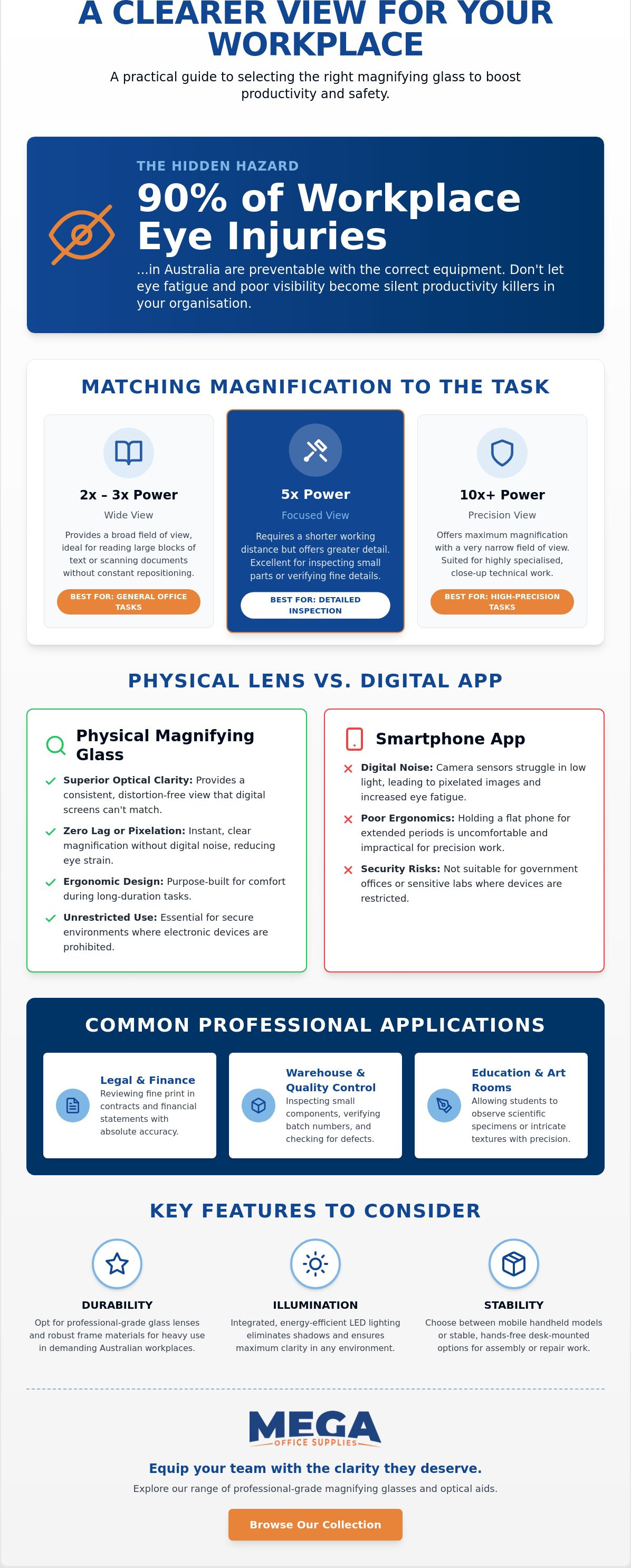
Did you know that an estimated 90% of the 30,000 workplace eye injuries reported in Australia each year are entirely preventable with the correct equipment? Most procurement officers and warehouse managers agree that eye fatigue and poor visibility are silent productivity killers that compromise staff safety and accuracy. Choosing a magnifying glass shouldn't be a matter of guesswork, yet the technical confusion between dioptre and magnification power often leads to unsuitable tools gathering dust in a stationery cupboard.
This guide will help you master the technical specifications and real-world use cases required to select the perfect optical aid for your office, classroom, or industrial site. We will explore the essential factors for identifying correct magnification levels, comparing durable materials for heavy use, and ensuring your team remains comfortable during high-precision tasks. By the end of this article, you'll have the practical knowledge to invest in hardware that withstands the rigours of the Australian workplace while providing the functional clarity your staff deserves. Whether you are outfitting a laboratory or a dispatch centre, our goal is to ensure your selection provides long-term value and reliability.
Key Takeaways
- Understand how the correct convex lens reduces eye fatigue during repetitive inspection tasks in professional environments.
- Learn the technical difference between magnification power and dioptre to ensure you match the tool's focal length to your specific workflow.
- Compare the mobility of a handheld magnifying glass against the stability of desk-mounted options for hands-free assembly or repair work.
- Identify industry-specific requirements to select tools that offer high-volume durability for Australian warehouses, schools, or healthcare centres.
- Discover essential maintenance and storage protocols to protect sensitive lens coatings and extend the operational life of your hardware.
Understanding the Role of Magnifying Glasses in the Modern Workplace
A magnifying glass is essentially a convex lens designed to produce an enlarged image of an object, providing a crucial visual aid for intricate tasks. While many view them as simple curiosities, in a professional context, they are precision instruments of productivity. High-quality office supplies must meet rigorous standards to support staff health. By enlarging text and fine details, these tools significantly reduce eye strain and fatigue during repetitive inspection or high-volume reading tasks.
The distinction between casual hobbyist tools and professional-grade equipment is stark. Workplace-ready models prioritise optical clarity and durability over low-cost plastic lenses found in general retail. The industry standard has shifted toward illuminated and ergonomic designs. Modern versions integrate energy-efficient LED lighting and balanced handles to minimise physical stress on the user, ensuring that safety and comfort remain at the forefront of procurement decisions.
To better understand this concept, watch this helpful video:
Why Physical Lenses Outperform Digital Apps
Physical lenses offer superior clarity and zero lag. Smartphone camera sensors often struggle with focal depth and digital noise in low-light environments, leading to pixelated images that increase eye strain. Dedicated tools provide a consistent, distortion-free view that apps cannot replicate. From an ergonomic perspective, holding a specifically weighted tool or using a mounted lens is far more comfortable for long-duration tasks than gripping a flat, backlit phone. Reliability is another key factor. In secure Australian government offices or sensitive laboratory environments where electronic devices are restricted, a physical magnifying glass remains the only practical solution for detailed work.
Common Professional Applications
The utility of these tools extends across diverse Australian sectors. In legal and finance departments, reviewing contracts and financial statements often involves navigating dense blocks of fine print where accuracy is non-negotiable. Quality control teams in Australian warehouses rely on magnification to inspect small components, verify batch numbers, and check for structural defects in hardware. Within the classroom, educational supplies must include robust magnifiers for science labs and art rooms, allowing students to observe specimens or intricate textures with precision. These applications prove that despite digital advancements, the requirement for high-quality optical hardware remains a constant in the professional landscape.
Key Specifications: Magnification Power and Lens Material
Selecting a magnifying glass requires a precise understanding of the trade-off between power and perspective. While a 10x lens sounds impressive, it significantly restricts your field of view. For standard document review or reading fine print on professional office stationery, a 2x to 3x magnification is usually sufficient. This range provides a wide enough viewing area to see several words or a whole paragraph at once without constant repositioning. It's the standard for general office tasks where speed and comfort are prioritised.
Focal length is another critical factor that impacts user experience. As magnification power increases, the lens must be held closer to the object. This physical constraint can lead to discomfort or unwanted shadows if the user isn't prepared. A 5x lens might require a working distance of only a few centimetres, whereas a 2x lens allows for a much more natural working posture. For high-precision inspection in a warehouse, a shorter focal length is acceptable, but for reading reports, a longer focal length is essential to maintain a healthy sitting position.
Glass vs. Acrylic Lenses
Professional lenses are typically manufactured from either optical glass or high-grade acrylic. Glass lenses offer exceptional scratch resistance and superior optical clarity, which is why they remain the preferred choice for static office environments and laboratory settings. However, they are notably heavier and more fragile. Acrylic lenses are lightweight and shatterproof, making them ideal for Australian classrooms or busy warehouse floors. If your staff are frequently on the move or working in high-traffic areas, the shatter-resistant nature of acrylic provides an added layer of safety and longevity.
Understanding Dioptre vs. Magnification
Dioptre is the refractive power of a lens measured in reciprocal metres. To convert this into a magnification level you recognise, use this simple formula: (Dioptre / 4) + 1. For example, a 3-dioptre lens provides 1.75x magnification. When selecting a magnifying glass for technical inspection, checking both specifications ensures the tool is fit for purpose. A lens with too high a dioptre for a simple reading task will only cause unnecessary eye strain and a restricted field of view, defeating the purpose of the aid.
Comparing Different Types: Handheld vs. Hands-Free Magnifiers
Selecting the appropriate configuration for your team depends entirely on the duration and nature of the task at hand. Handheld models remain the most versatile choice for mobile staff who require quick spot-checks. A traditional handheld magnifying glass is ideal for receptionists verifying identification documents, warehouse supervisors checking labels on high-shelf stock, or hospitality staff reviewing small print on invoices. These tools offer immediate utility without the need for a fixed setup, making them a staple of any well-equipped stationery cabinet.
Conversely, hands-free or desk-mounted models are essential for technical roles that require bilateral coordination. If an employee is performing intricate assembly, circuit board repair, or lengthy document proofing, a mounted lens provides the necessary stability. These units often feature adjustable swing arms, allowing the user to position the lens precisely while keeping both hands free for tools or keyboards. For staff moving across expansive facilities or retail centres, pocket and folding models provide a compact solution that fits easily into a high-vis vest or apron pocket.
The Benefits of Illuminated Lenses
Illuminated magnifiers have transitioned from a niche requirement to a standardised workplace necessity. Integrating LED lights ensures that low-light corners of a warehouse or shadowed desk areas don't compromise visual accuracy. Modern LED integration provides several operational advantages:
- Shadow Reduction: Built-in lighting eliminates shadows cast by the user's head or hands, providing a clear, high-contrast view of the subject matter.
- Energy Efficiency: LED bulbs consume significantly less power and have a longer lifespan than older incandescent options, reducing maintenance costs in large-scale facilities.
- Power Versatility: Procurement officers can choose between battery-operated models for field use or plug-in desktop versions for fixed workstations to ensure consistent performance.
Ergonomics and Handle Design
Poorly designed tools are a leading cause of repetitive strain in the workplace. Handles with rubberised grips are vital for minimising hand fatigue, particularly during high-frequency inspection tasks. A professional-grade magnifying glass should also feature balanced weight distribution; a large-diameter lens paired with a poorly weighted handle will quickly lead to wrist strain. Just as you would invest in ergonomic office chairs to support spinal health, selecting the right optical tool is a commitment to your staff's long-term physical comfort and operational efficiency.
Choosing the Right Magnifier for Your Specific Industry
National procurement strategies rely on consistency to maintain operational standards across multiple sites. Selecting a magnifying glass shouldn't be an isolated purchase; it requires a coordinated approach that considers the specific environmental hazards and task requirements of each department. For organisations operating across various Australian states, bulk procurement ensures that every staff member, from the laboratory technician to the dispatch clerk, has access to the same high-quality optical tools. This uniformity simplifies maintenance and training while reinforcing a commitment to workplace safety.
Education and Schools
Safety is the primary consideration when selecting tools for Australian classrooms. Shatterproof acrylic lenses are essential for student use in science labs and art rooms to prevent injuries from accidental drops. For group demonstrations, large-diameter lenses provide a wider viewing area, allowing multiple students to observe specimens or textures simultaneously. Ensuring your faculty has access to durable educational supplies helps foster a more engaging and safe learning environment for all year levels.
Warehousing and Logistics
In the warehousing sector, tools must withstand high-volume use and rugged conditions. High-magnification loupes are particularly effective for checking small serial numbers, verifying component labels, and inspecting structural integrity on the warehouse floor. Because many dispatch areas have inconsistent lighting, illuminated handheld models are the preferred choice for staff working in dimly lit racking aisles. Investing in professional-grade facility supplies reduces the risk of picking errors and improves overall inventory accuracy.
General Office and Administration
Clerical roles often involve lengthy periods of reviewing dense documentation. Desktop magnifiers are excellent for reading fine print on A4 copy paper, reducing the need for staff to lean forward and compromise their posture. For front-of-house areas such as reception desks or executive suites, choosing models with professional aesthetics ensures the tools blend seamlessly with existing office furniture. A well-chosen magnifying glass is a vital component of a comprehensive range of office supplies designed to support administrative precision.
To secure consistent, professional-grade equipment for your entire team, browse the full range of workplace solutions at Mega Office Supplies.
Final Considerations: Durability, Maintenance, and Value
A professional magnifying glass is an investment in visual accuracy that requires proper care to maintain its optical integrity. Choosing the cheapest available option often leads to higher long-term replacement costs; low-quality lenses are prone to chromatic aberration and physical degradation. Standardising equipment across multiple office locations simplifies the maintenance cycle. When every branch utilises the same hardware, procurement officers can manage replacement schedules and spare parts with much greater efficiency, ensuring a consistent standard of support for all staff members.
Cleaning protocols are vital for preserving sensitive lens coatings. Staff should always use microfibre cloths rather than paper towels or rough fabrics, as even minor abrasions can permanently distort the view. For storage, protective pouches or dedicated hard cases are non-negotiable. These solutions prevent dust accumulation and protect the lens from impact damage during transit or when stored in a desk drawer, effectively extending the operational life of the tool and protecting your capital expenditure.
Tips for Choosing the Right Option
Before committing to a large-scale order for your team, test the weight and balance of the specific model. A tool that feels unwieldy will likely be ignored by staff or cause unnecessary wrist fatigue. If you are selecting an illuminated model, ensure the light source is easily replaceable or features a reliable rechargeable system; discarding an entire unit due to a failed bulb is an avoidable waste of resources. Always verify the warranty and technical support offered by an established Australian retailer to ensure you have recourse should a defect arise in a commercial setting.
Procuring for National Operations
National operations benefit from centralising their supply chains to ensure quality and cost control. Bulk ordering through a business application allows for better volume management and improved financial transparency across different departments. By consolidating your requirements with a single provider for all stationery supplies Australia wide, you minimise logistical friction and ensure that every site receives the same professional-grade equipment. For expert guidance on high-volume requirements or to discuss specific technical needs for your facility, contact the team at Mega Office Supplies for direct assistance and reliable procurement solutions.
Optimising Your Workplace Vision and Efficiency
Selecting a professional magnifying glass is a strategic decision that directly impacts staff safety and operational precision. By aligning technical specifications like magnification power and dioptre with specific workflow needs, you ensure your team can perform intricate tasks without unnecessary eye strain. Prioritising durable materials, such as shatterproof acrylic for schools or illuminated lenses for warehouses, provides the longevity required in high-volume commercial environments. Consistent maintenance remains the final piece of the puzzle, protecting your equipment from avoidable wear and tear.
Mega Office Supplies is a trusted supplier to Australian government departments and schools, offering the regional expertise needed to manage complex national supply chains. Our team ensures fast national delivery on all office essentials, providing the peace of mind that comes with a reliable, well-oiled logistics operation. Equipping your team with the right optical tools today creates a more comfortable and productive workplace for the future.
Browse our full range of professional magnifying glasses and office supplies
Frequently Asked Questions
What is the best magnification for reading standard office documents?
A magnification level of 2x to 3x is the standard recommendation for reviewing reports, invoices, or legal contracts. This range provides a sufficiently wide field of view, allowing you to see several words or a whole sentence without constantly moving the lens. Higher powers often restrict the viewing area too much for comfortable, long-duration reading tasks on a standard desk.
How do I clean a magnifying glass lens without scratching it?
You should only use a clean microfibre cloth to wipe the lens surface to maintain optical clarity. Avoid using paper towels, tissues, or your shirt sleeve, as these materials often contain abrasive fibres that will permanently scratch the sensitive lens coating. For stubborn smudges, a small amount of dedicated lens cleaning solution is much safer than using harsh household chemicals.
Does a higher magnification always mean a better magnifying glass?
Higher magnification isn't inherently better; it's simply a different tool for a specific task. As the magnification power increases, your field of view shrinks and the focal length becomes much shorter, requiring you to hold the lens closer to the object. A high-power 10x lens is perfect for inspecting a tiny circuit board, but it's completely unsuitable for reading a standard A4 page.
What is the difference between a magnifying glass and a loupe?
A traditional magnifying glass usually features a larger lens with a handle for general-purpose use at a distance from the eye. A loupe is a smaller, high-magnification tool designed to be held very close to both the eye and the object. Loupes are typically utilised for intense inspection of jewellery, printing dots, or small electronic components in a laboratory or workshop.
Are LED-illuminated magnifying glasses worth the extra cost?
LED-illuminated models are generally worth the investment for any workplace with inconsistent lighting or shadowed workstations. They eliminate shadows cast by your own head or hands, which significantly reduces eye fatigue during detailed inspections. Modern LEDs are also highly energy-efficient, meaning battery-operated versions last much longer than older incandescent models, reducing your long-term maintenance requirements.
Can I use a magnifying glass if I already wear prescription spectacles?
You can certainly use a magnifying glass while wearing your prescription spectacles to further enhance your vision. The lens acts as a secondary aid to enlarge the image for your existing vision correction. Simply adjust the distance between the magnifier and the object until the image appears sharp and clear through your glasses, ensuring a comfortable working posture.
What lens material is best for a busy warehouse environment?
Shatterproof acrylic is the most reliable lens material for a busy warehouse or industrial site where equipment might be dropped. While glass offers slightly better scratch resistance, it's far too heavy and fragile for environments with concrete floors. Acrylic lenses are lightweight, durable, and provide more than enough clarity for checking serial numbers, labels, or small component defects.
How do I calculate the magnification power if only the dioptre is listed?
You can calculate the magnification power by dividing the dioptre by four and then adding one to the result. For instance, a 5-dioptre lens provides 2.25x magnification. Procurement officers should always perform this quick calculation to ensure the technical specifications of a desk lamp or loupe actually meet the specific task requirements of their staff.
Article by
Mega Office Supplies Team
The Mega Office Supplies Team provides practical guidance for Australian businesses, schools, government organisations, healthcare providers, hospitality venues, warehouses and home offices. Based in Tweed Heads South, Mega Office Supplies is an Australian business, family owned and operated since 2008, offering office stationery, workplace furniture, technology products, labels, printers, cleaning and janitorial supplies, safety products, art materials, education resources and everyday business essentials from trusted brands.
General Information
This article is provided as general information only to help customers compare and choose office, workplace, school, cleaning, technology, furniture, safety and business supplies. Product details, specifications, compatibility, availability, pricing and suitability may vary. Always check the individual product page, manufacturer information, workplace requirements and relevant safety guidance before purchasing or using a product.


