


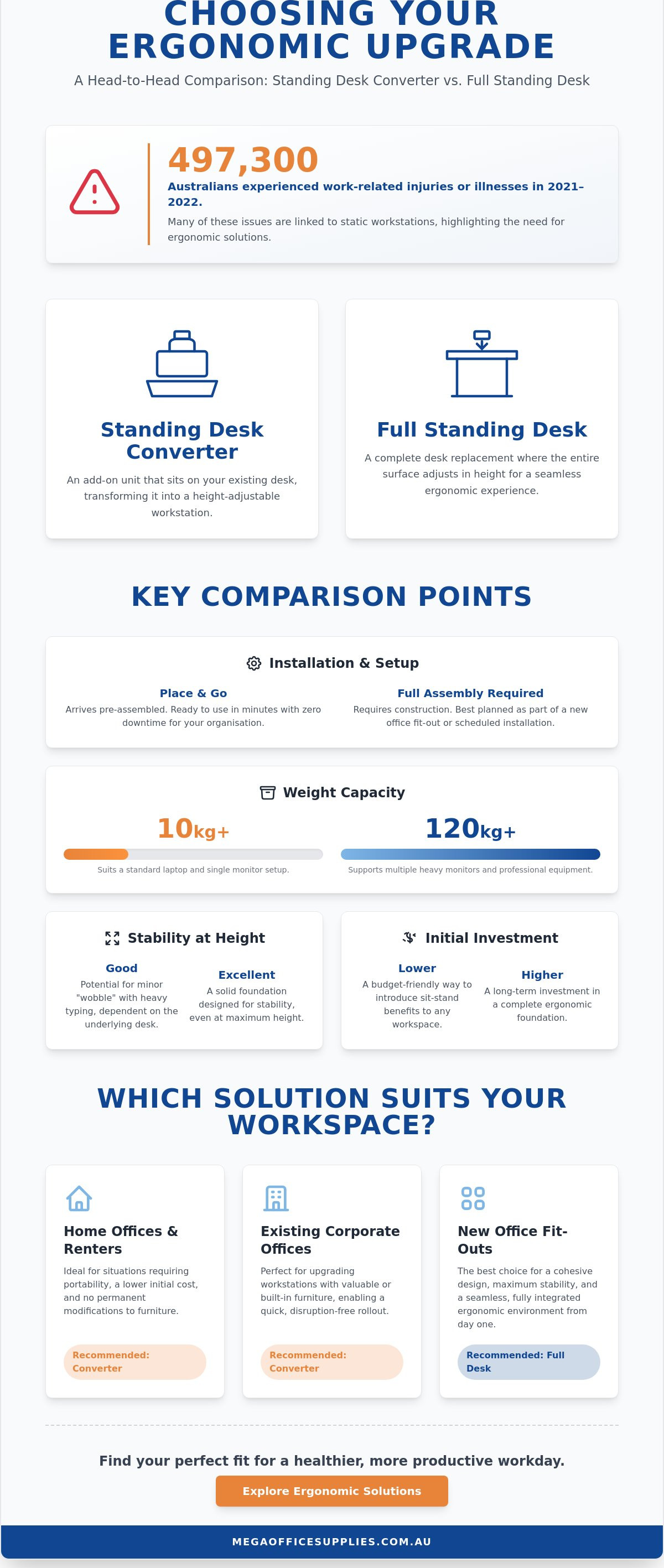
The Australian Bureau of Statistics reported that 497,300 people experienced work-related injuries or illnesses between 2021 and 2022. For many office-based professionals, these issues stem directly from static workstations that contribute to persistent back pain and afternoon fatigue. You've likely realised that a change is necessary to protect your health, yet the choice between a standing desk converter vs full standing desk remains a common point of confusion for procurement officers and home office users alike.
We understand the dilemma of wanting a professional ergonomic upgrade without necessarily discarding your existing furniture or overextending your budget. This 2026 guide compares the technical specifications, ergonomic benefits, and logistical requirements of desk converters and full standing desks to find your ideal workplace solution. We'll explore how each option handles equipment stability and space constraints, ensuring you have the practical information needed to improve your posture and daily energy levels.
Key Takeaways
- Identify the core functional differences between a standing desk converter vs full standing desk to determine which solution best integrates with your current office layout.
- Discover how to retain your investment in high-quality legacy furniture by selecting a desktop converter that requires minimal assembly and no furniture removal.
- Compare technical specifications including weight capacities, ranging from 10kg for compact units to over 120kg for heavy-duty electric standing desks.
- Evaluate stability and "wobble" factors at full height extension to maintain equipment security and professional performance during your workday.
- Apply our scenario-based framework to choose the right ergonomic upgrade for specific Australian environments like schools, healthcare facilities, or home offices.
Understanding the Sit-Stand Shift in Australian Workplaces
Australian workplaces are undergoing a significant transition in how they approach physical health and desk-based tasks. The fundamental choice for many organisations often comes down to a standing desk converter vs full standing desk. A Standing desk serves as a complete furniture replacement where the entire work surface moves vertically. In contrast, a converter is a compact unit placed on top of an existing fixed-height surface. Both options aim to reduce the sedentary risks associated with modern administrative and professional roles.
Regional businesses, from busy logistics warehouses to urban corporate centres, now prioritise movement as a core component of employee productivity. High-quality office furniture is no longer just about aesthetics; it is a tool for maintaining long-term wellness. Providing adjustable options allows staff to alternate their posture, which is essential for managing energy levels across an eight-hour shift. This shift ensures that the physical environment supports the demanding workflows of modern industry.
To understand the practical considerations of these units, watch this overview of common challenges:
The Health Imperative: Why Movement Matters
Prolonged sitting is linked to metabolic slowdown and chronic musculoskeletal discomfort, particularly in the lower back and neck. Active working is the intentional combination of sitting, standing, and moving throughout the day to stimulate circulation and maintain focus. By integrating height-adjustable solutions, organisations can help staff manage physical fatigue. This is especially relevant in medical clinics and school reception areas where staff frequently move between computer work and face-to-face interactions.
WHS Compliance and Ergonomic Standards
Australian organisations must adhere to strict Work Health and Safety (WHS) regulations to ensure a safe environment for all personnel. The AS/NZS 4442:1997 standard provides specific recommendations for desk height ranges to accommodate different body types. Providing a variety of adjustable setups helps employers meet their duty of care. Customisable workstations allow a diverse workforce to find their neutral ergonomic position, reducing the likelihood of strain-related absenteeism. When evaluating a standing desk converter vs full standing desk, procurement officers should consider how each model aligns with these national standards for stability and adjustment range.
Standing Desk Converters: The Efficient Retrofit for Existing Furniture
A standing desk converter is the primary solution for organisations that have already invested in high-quality office furniture. Unlike a complete desk replacement, a converter typically arrives almost entirely assembled. You simply place it on your current surface and begin working. This makes it an ideal choice for shared workspaces or temporary home office setups where portability is required. When weighing up the choice of a standing desk converter vs full standing desk, the converter offers a significantly lower entry cost while still providing the essential health benefits of a standing desk.
Preserving Your Current Desktop Assets
Many Australian government departments and corporate suites feature custom joinery or premium timber desks that are far too valuable to discard. These assets are often built into the room's architecture, making a full replacement impossible. A converter allows you to upgrade these workstations without the logistical headache of furniture disposal or professional installation. It represents a "zero-downtime" implementation for busy professional environments. You can set up the unit during a lunch break and return to your tasks without any interruption to your workflow.
Mechanical vs. Gas-Spring Lift Systems
You should evaluate the internal lifting mechanism carefully before making a purchase. Basic manual models require significant physical effort to adjust, which can be difficult if you have multiple monitors. Gas-spring mechanisms provide a smooth, stepless transition that requires minimal force from the user. These systems are designed for durability and frequent daily use. We recommend choosing a model with a dedicated keyboard tray to ensure your wrists remain in a neutral position regardless of the height setting. If you need help selecting a specific model, you can view our full range of workplace ergonomics to compare different lifting capacities.
Space Considerations for Compact Workstations
Space is a critical factor in compact home offices, clinics, or school staff rooms. You must measure the depth of your current desk before purchasing a converter to ensure the base fits securely. Most units require a minimum depth of 600mm to 800mm to remain stable. Vertical-lift models are particularly effective in tight quarters because they rise straight up rather than swinging out toward the user. This design minimises desk-space intrusion and keeps your walkway clear. You should also consider the weight load limits of your base desk, as adding a heavy converter and monitors can put stress on cheaper, non-commercial grade surfaces.
Full Standing Desks: Investing in a Complete Ergonomic Foundation
While a converter is a practical retrofit, the full standing desk is the gold standard for dedicated ergonomic workstations. These purpose-built units replace your existing furniture entirely, providing superior stability through heavy-duty steel frames. For professional buyers evaluating a standing desk converter vs full standing desk, the latter offers a significantly higher weight capacity. Most electric frames support between 80kg and 120kg, allowing for multiple monitors and heavy desktop hardware without compromising the motor's lifespan. You can read more in our professional guide to standing desks.
Aesthetically, these desks offer a clean, modern workspace. They eliminate the "bulk" associated with desktop converters, providing a unified surface that maintains a professional image in corporate reception areas or executive suites. The expanded height range is also a critical factor. Full desks often adjust lower and higher than converters, ensuring a perfect fit for both very tall and shorter users. This versatility is essential for inclusive workplace design.
Electric vs. Manual Height Adjustment
Modern electric desks feature programmable memory presets. This allows multiple users in hot-desking environments to save their preferred sitting and standing heights with a single touch. Dual-motor systems are standard for professional-grade setups, ensuring the desk rises evenly even with an unbalanced load. While manual crank desks are a cost-effective, permanent standing solution, they lack the speed and convenience required for frequent transitions. Evaluating the advantages and disadvantages of standing and sitting throughout the day ensures your chosen mechanism supports consistent movement.
Integrated Cable Management and Accessories
Full desks excel in hardware integration. Under-desk trays and grommets allow you to organise power leads and data cables, keeping the work surface clear of clutter. This foundation makes it much easier to mount monitor arms securely, as the entire desktop is a uniform thickness. Integrated power rails improve workplace safety by reducing trip hazards. These features ensure your workstation remains functional and compliant with modern safety expectations, providing a seamless experience for high-intensity computer work.
Head-to-Head Comparison: Weight Capacity, Stability, and Space
Technical payload capacity is often the deciding factor when comparing a standing desk converter vs full standing desk. Desktop converters are engineered for lighter loads, typically supporting between 10kg and 15kg. This is sufficient for a laptop and a single lightweight monitor but can struggle under the weight of professional-grade dual-monitor setups. In contrast, full standing desks are built with heavy-duty steel frames that provide a payload range of 80kg to 120kg or more. This allows you to house multiple monitors, CPUs, and heavy peripherals without straining the lifting mechanism.
Usable surface area also differs significantly between the two. Converters often feature a tiered design that prioritises the keyboard and mouse but leaves little room for documents or large-scale hardware. Full desks offer a completely flat, expansive surface that maximises your working area. You must also consider the "wobble factor" at maximum height extension. While all adjustable furniture has some movement, a floor-standing frame with a wider base generally offers superior vibration control compared to a unit sitting atop another desk.
Stability and Vibration Control
The centre of gravity for a desktop converter is much higher than that of a full desk, which can lead to screen bounce during fast typing. You should test stability by applying light pressure to the front edge at your preferred standing height. Stability varies based on your flooring; hard floors provide a solid foundation, while thick carpets may require a desk with adjustable levelling feet to remain steady. We recommend using anti-fatigue mats to complement either solution, as they reduce the strain on your joints during long standing sessions.
Monitor Arm and Peripheral Compatibility
Mounting heavy dual-monitor arms to a converter can be challenging because the clamping force is concentrated on a smaller, often thinner, surface. Full desks offer greater flexibility for customising hardware layouts and can easily accommodate various technology upgrades. You must verify the clamping surface thickness on both models to ensure your monitor arms can be fastened securely without damaging the desktop. Professional-grade desks usually feature reinforced edges designed specifically for these attachments.
Long-Term Durability and Maintenance
Moving parts in gas-spring converters eventually lose tension over several years of frequent use. Electric motors in full desks are designed for high-cycle durability, though they require access to a power point. Cleaning a flat desk surface is straightforward, whereas tiered converters have more crevices where dust and debris can accumulate. For national office deployments, we suggest prioritising products with professional-grade warranties to ensure long-term reliability. Ensure your hardware remains secure by browsing our range of heavy-duty standing solutions today.
Decision Matrix: Which Solution Suits Your Professional Environment?
Choosing between a standing desk converter vs full standing desk requires an objective assessment of your operational environment and long-term ergonomic goals. A converter is often the most sensible choice for retrofitting existing offices where high-quality legacy furniture must be preserved. It provides a budget-conscious upgrade path that minimises logistical disruption, making it ideal for organisations that need to implement ergonomic changes across dozens of workstations simultaneously. Because these units require minimal assembly, they represent an efficient solution for rapid workplace deployments.
A full standing desk is the preferred option for new office fit-outs or for professionals who utilise heavy equipment. If your setup includes multiple large monitors, mounted CPUs, and various peripherals, the superior weight capacity of an electric frame ensures long-term stability. From a procurement perspective, investing in full desks for government or corporate headquarters aligns with long-term "duty of care" strategies by providing the highest level of adjustment range and durability. Once the primary hardware is selected, you can complete the workstation with essential office supplies such as document holders and cable organisers to maintain a productive environment.
Scenario-Based Recommendations
For a home office located in a shared living space, a converter is frequently the better choice due to its smaller footprint and the ability to be moved if the room's function changes. Modern corporate environments that utilise "hot-desking" should prioritse full electric desks with memory presets. This allows different staff members to find their saved ergonomic height instantly. In medical consulting rooms or school reception areas, a compact converter allows staff to maintain eye contact with visitors while transitioning between seated and standing tasks without the need for a bulky furniture overhaul.
Final Checklist Before Purchase
Before finalising your order, ensure you have verified these three critical technical requirements:
- Check 1: If choosing a converter, does your current fixed-height desk support the combined weight of the unit plus all your hardware?
- Check 2: For electric standing desks, do you have sufficient power outlets and appropriate cable length to allow the desk to rise to its maximum height without tensioning leads?
- Check 3: Is the specific height range of the model sufficient to accommodate your tallest and shortest users according to Australian ergonomic standards?
Our team has decades of combined industry experience helping procurement officers and business owners select the right hardware for their specific sector. Whether you are managing a high-volume government fit-out or a single home office upgrade, selecting a durable, professional-grade solution ensures your workforce remains energised and injury-free.
Optimising Your Ergonomic Workstation
Deciding between a standing desk converter vs full standing desk depends on your existing infrastructure and hardware requirements. If you intend to preserve high-quality legacy furniture, a gas-lift converter offers a seamless retrofit with minimal assembly. For those starting with a clean slate or managing heavy dual-monitor setups, a full electric desk provides superior stability and a broader height range to suit all users. Balancing these technical specifications with your daily workflow ensures your office remains both functional and compliant with modern ergonomic standards.
Mega Office Supplies brings over 20 years of combined industry experience to Australian office solutions. We provide national delivery across Australia for all commercial and home office furniture. Our comprehensive range includes electric frames, manual desks, and gas-lift converters designed for durability in classrooms, clinics, and corporate centres. Browse our full range of ergonomic standing desks and converters to find the ideal foundation for your workplace. Investing in the right hardware today supports your long-term health and professional productivity.
Frequently Asked Questions
Is a standing desk converter as good as a full standing desk for posture?
Yes, a converter can provide excellent ergonomic support if it allows for independent adjustment of your monitor and keyboard tray. The goal is to keep your screen at eye level while your elbows remain at a 90-degree angle. While a full desk offers a broader adjustment range for very tall or short users, a high-quality converter effectively facilitates the necessary movement to reduce musculoskeletal strain during the workday.
Can any desk support a standing desk converter?
Most commercial-grade desks can support a converter, but you must verify the weight capacity of your existing furniture first. A standard unit can weigh up to 25kg before you add monitors and accessories. You also need sufficient desktop depth, typically between 600mm and 800mm, to ensure the base sits securely without overhanging the edge. This prevents the workstation from becoming front-heavy or unstable during height transitions.
Do standing desk converters wobble when you type?
Minor vibration is common at maximum height, but professional-grade models use heavy steel bases to minimise this effect. When evaluating a standing desk converter vs full standing desk, the full desk is generally more stable because its weight is distributed across a floor-standing frame. Choosing a converter with a vertical-lift or Z-shaped mechanism rather than a cheaper, lightweight alternative will significantly improve stability for high-intensity typing tasks.
How much weight can a full electric standing desk hold compared to a converter?
Full electric desks typically support between 80kg and 120kg, whereas most converters are limited to a payload of 10kg to 15kg. This substantial difference is due to the powerful dual-motor systems used in dedicated height-adjustable frames. If your setup includes multiple monitors, a heavy CPU, or large-format printer paper and stationery, a full desk is the more reliable choice for maintaining equipment security and motor longevity.
Are standing desk converters difficult to assemble?
No, most converters are designed for "out-of-the-box" utility and arrive almost entirely assembled. In most cases, the only requirement is to attach the keyboard tray using a few provided screws. This simplicity makes them an ideal choice for rapid office deployments or school staff rooms where you need to upgrade workstations quickly without the downtime associated with building complex furniture frames from scratch.
Is it worth buying an electric standing desk for a home office?
Investing in an electric desk is highly beneficial if you work from home for more than four hours daily. The convenience of programmable memory presets encourages more frequent position changes, which is essential for metabolic health. While the choice of a standing desk converter vs full standing desk often depends on space, the electric desk offers a more permanent, high-capacity foundation for a dedicated professional workspace.
What is the best way to transition to a standing desk without fatigue?
The most effective method is to start with 15 to 30 minutes of standing per hour and increase this duration gradually. You should always use an anti-fatigue mat to cushion your feet and reduce pressure on your lower back. Remember that the objective is "active working," which involves alternating between sitting, standing, and moving rather than remaining in a single standing position for several hours at a time.
Article by
Mega Office Supplies Team
The Mega Office Supplies Team provides practical guidance for Australian businesses, schools, government organisations, healthcare providers, hospitality venues, warehouses and home offices. Based in Tweed Heads South, Mega Office Supplies is a family-owned and operated Australian business offering office stationery, workplace furniture, technology products, labels, printers, cleaning and janitorial supplies, safety products, art materials, education resources and everyday business essentials from trusted brands.
General Information
This article is provided as general information only to help customers compare and choose office, workplace, school, cleaning, technology, furniture, safety and business supplies. Product details, specifications, compatibility, availability, pricing and suitability may vary. Always check the individual product page, manufacturer information, workplace requirements and relevant safety guidance before purchasing or using a product.


