

Selecting the wrong blade for a high-volume task is the fastest way to end up with jagged edges and a very frustrated procurement officer. We understand that deciding on scissors vs cutters for craft projects often feels like a simple choice, but the reality is that your selection directly impacts workplace safety and the professional finish of your materials. If you've ever tried to trim heavy cardstock with standard desk scissors, you'll know that enthusiasm is no substitute for proper mechanical leverage.
At Mega Office Supplies, our team helps you kit out your workspace efficiently. We'll show you how to balance manual precision with the speed of a dedicated trimmer. This guide identifies the most cost-effective tools for your volume requirements while ensuring your school or office remains compliant with modern safety standards.
Key Takeaways
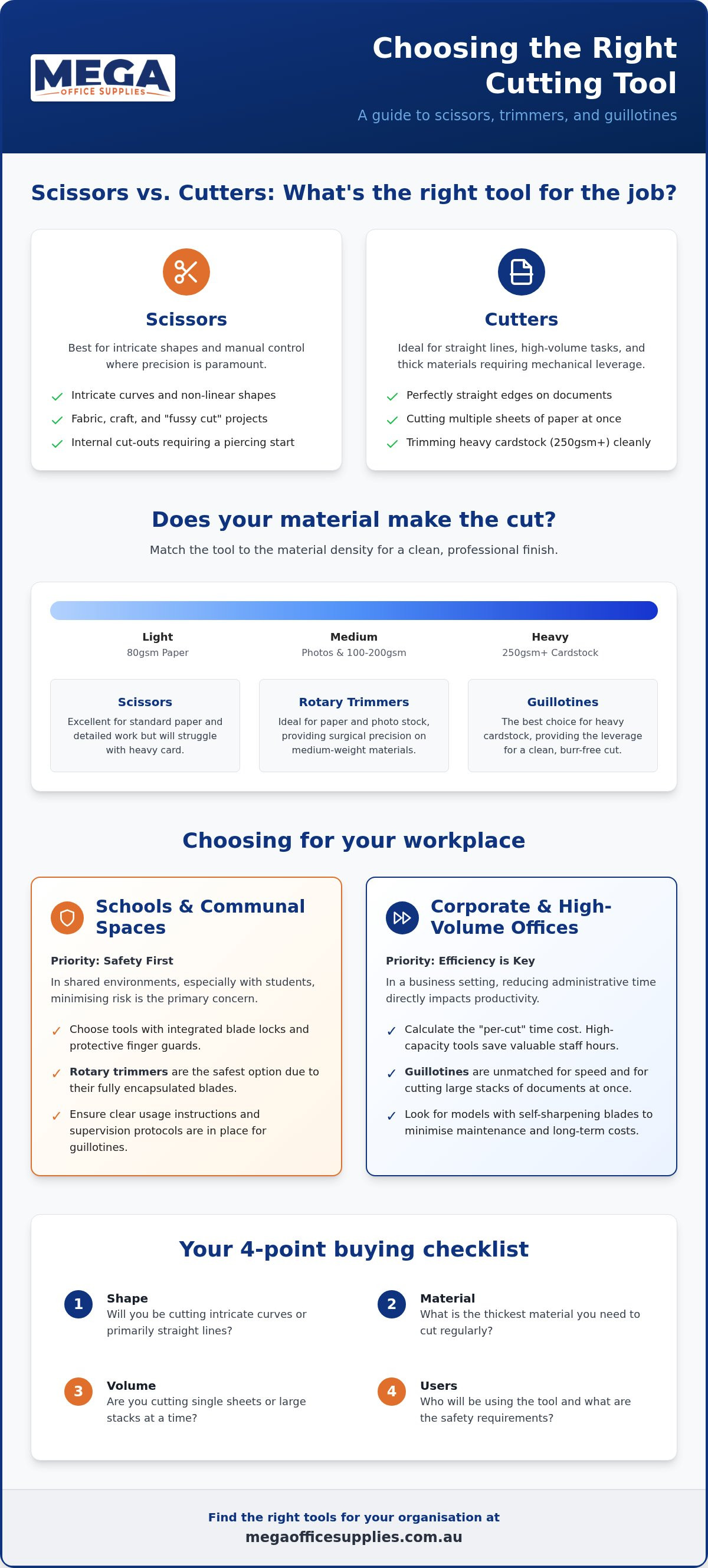
- Learn when to prioritise the manual freedom of scissors for intricate curves over the mechanical speed and leverage of a dedicated trimmer.
- Navigate the choice of scissors vs cutters for craft projects by evaluating your specific material thickness and total output requirements.
- Ensure workplace safety compliance in school and office settings by selecting cutters featuring integrated blade locks and protective guards.
- Identify how high-capacity guillotines and rotary trimmers can minimise administrative time while achieving burr-free finishes on professional documents.
Choosing between scissors and cutters for your craft projects
Selecting the incorrect blade for a high-volume task is a quick way to compromise both the project's finish and your team's efficiency. We've found that the decision regarding scissors vs cutters for craft projects ultimately rests on the complexity of your cutting lines and the physical volume of the material. If you're processing 50 sheets of 80gsm paper for a school handout, a mechanical cutter is a necessity rather than a luxury.
When to opt for the versatility of scissors
Scissors remain the standard for non-linear shapes, fabric crafts, and projects requiring a "fussy cut" finish on delicate materials. To understand the tool's mechanics, one can examine the history and types of scissors, which explains the shearing action where two blades bypass each other to create a clean break. Unlike the slicing action of a single blade, the shearing process uses two sharp edges to cut through a material simultaneously. For long crafting sessions in schools or government departments, we suggest prioritising ergonomic handles from professional brands like Rexel or Carl to minimise hand fatigue and maintain precision.
While running with scissors is ill-advised, choosing the wrong ones for a 300-page project is a different kind of marathon that often leads to inconsistent results. We recommend browsing our curated art and craft supplies to find scissors with stainless steel blades that resist adhesive build-up from tapes and stickers. Identifying the right balance of scissors vs cutters for craft projects ensures that your blade tension stays true, providing a clean edge across varied paper weights and textiles.
Evaluating cutters for high-volume and straight-edge precision
Material density determines the effectiveness of your cutting tool. Standard 80gsm copy paper slices easily, but 250gsm craft board requires significant mechanical leverage. If you're using scissors for heavy cardstock, you'll eventually ruin the tension of the blades and produce a jagged edge. Guillotines provide the highest leverage for thick materials and multiple sheets, ensuring a clean, burr-free finish. This is where the choice of scissors vs cutters for craft projects becomes a matter of physics. While guillotines offer unmatched speed, they require strict safety protocols, such as blade locks and finger guards, to protect users in busy environments.
Rotary trimmers vs guillotines for professional finishes
Rotary trimmers are the gold standard for scrapbooking and photo trimming where a perfectly square edge is non-negotiable. These tools use a circular blade housed in a protective carriage, making them significantly safer for communal educational supplies areas. For high-volume office supplies procurement, guillotines from brands like Rexel or GBC are often preferred for their sheer speed and ability to cut through stacks of paper at once. It's a trade-off between the surgical precision of a rotary blade and the raw capacity of a lever-action arm.
When evaluating long-term costs, look for models with self-sharpening blades to keep maintenance low. Following procurement best practices ensures your organisation balances initial outlay with durability. We've found that choosing the right trimmer reduces the "per-cut" time cost for administrative staff. If you're kitting out a new workspace, you can browse our full range of craft cutters to find a model that matches your daily sheet capacity.
Procurement considerations for schools and corporate offices
Procurement for large-scale Australian organisations often aligns with specific budget cycles rather than individual project needs. When kitting out schools or government departments, we focus on identifying tools with integrated safety guards and blade locks to meet national workplace health and safety standards. Selecting between scissors vs cutters for craft projects at this scale requires a calculation of "per-cut" time costs. High-capacity guillotines allow administrative staff to process bulk document sets far more quickly than manual scissors, freeing up time for core educational or operational tasks. For organisations planning large-scale fit-outs, our business application form provides a pathway to volume pricing and dedicated account support.
Safety features and blade longevity for heavy-use environments
In primary school classrooms, safety is the primary driver for tool selection. Encapsulated blades in rotary trimmers are a preferred choice as they prevent accidental contact with the sharp edge, ensuring a secure environment for students. While standard blades are sufficient for basic paper, we recommend stainless steel blades for complex projects involving adhesives. These blades offer high resistance to the sticky residue from tapes, maintaining cutting performance over longer periods without the need for frequent replacement. For further advice on managing bulk procurement, our stationery supplies Australia guide offers a detailed look at kitting out professional spaces. By matching tool capacity to your organisation's specific output, you can ensure your selection of scissors vs cutters for craft projects remains a sound long-term investment.
Optimising your workplace cutting workflow
Choosing between scissors vs cutters for craft projects involves balancing manual dexterity with the mechanical efficiency required for high-volume output. We've established that while scissors offer unmatched control for intricate shapes, a dedicated guillotine or rotary trimmer is essential for maintaining professional standards and workplace safety. By selecting tools with integrated guards and self-sharpening blades, you'll reduce maintenance costs and improve administrative speed.
As a family owned and operated business since 2008, we support your procurement. We accept official Australian Government purchase orders and provide direct, local support to ensure you select durable hardware for your specific budget cycle. Our team is available weekdays from 8 am to 6 pm AEST to assist with your selection.
Browse our full range of professional scissors and cutters
We're here to help you achieve a professional, burr-free finish on every document in your workspace.
Frequently asked questions
Which is better for paper, scissors or a cutter?
What is the safest cutting tool for primary schools?
Rotary trimmers with encapsulated blades are a secure option for educational environments. Unlike open-blade guillotines, these units house the sharp edge within a protective carriage, significantly reducing the risk of accidental contact. We recommend kitting out classrooms with models that feature non-slip bases and finger guards to meet Australian workplace health and safety standards while fostering student independence.
How do I choose a guillotine for a high-volume office?
Prioritise sheet capacity and blade material when selecting hardware for heavy-use administrative areas. A professional-grade guillotine from brands like Rexel or GBC should offer a minimum capacity of 20 to 40 sheets of 80gsm paper per cut. Look for features such as automatic paper clamps and self-sharpening blades to ensure the organisation maintains a clean, burr-free finish over thousands of cycles.
Can I use craft scissors to cut through 300gsm cardstock?
While heavy-duty scissors may cut 300gsm cardstock, repetitive use on dense materials will quickly dull the blades and loosen the pivot tension. This leads to crushed edges rather than clean shears. For cardstock of this weight, we suggest using a dedicated trimmer or guillotine. This approach protects your precision scissors for lighter tasks while ensuring your heavier projects have a crisp, professional edge.
Article by
Mega Office Supplies Team
The Mega Office Supplies Team provides practical buying guides and workplace advice for Australian businesses, schools, government organisations, healthcare providers, hospitality venues, warehouses and home offices. Family owned and operated since 2008 and based in Tweed Heads South on the Gold Coast–Tweed border, Mega Office Supplies helps Australian workplaces choose the right office supplies, furniture, technology, cleaning, safety and education products — backed by genuine local service from real people.
General Information
This article is provided as general information only to help customers compare and choose office, workplace, school, cleaning, technology, furniture, safety and business supplies. Product details, specifications, compatibility, availability, pricing and suitability may vary. Always check the individual product page, manufacturer information, workplace requirements and relevant safety guidance before purchasing or using a product.


