


What if the secret to a high-performance executive office isn't a dedicated room, but the strategic use of a single metre of vertical wall space? Most Australians working from home understand the frustration of trying to balance professional demands with a floor plan that simply wasn't designed for it. You've likely felt the physical strain of an unsuitable chair or the mental fatigue that comes from seeing work stationery and files cluttering your dining table. Finding effective home office setup ideas for small spaces requires moving beyond mere miniaturisation and focusing on industrial-grade efficiency and layout precision.
We'll show you how to transform even the most compact corner into a high-performance workspace that supports your health and your daily output. Drawing on decades of collective industry experience, this guide provides practical strategies for selecting ergonomic office chairs with auto-adaptive support and integrating compact standing desks into multi-purpose rooms. You'll learn how to utilise vertical storage to clear visual clutter, ensuring your professional life remains organised while your home remains a place of rest. We will examine the essential hardware and layout configurations that define a modern, small-scale professional environment in 2026.
Key Takeaways
- Perform a professional spatial audit of your Australian home to identify underutilised micro-zones like alcoves or hallways that are suitable for a high-performance workspace.
- Reclaim floor space and improve room visibility by integrating wall-mounted "floating" desks and corner configurations into multi-purpose living areas.
- Explore professional home office setup ideas for small spaces that prioritise vertical organisation and modular shelving to keep essential documents and stationery within reach.
- Maintain workplace ergonomics in compact areas by selecting professional-grade seating that provides full pelvic support without the footprint of a traditional executive chair.
- Minimise your hardware footprint by choosing multi-function devices and compact paper shredders to ensure secure document management in a home environment.
Assessing Your Environment: Defining the Small Office Challenge
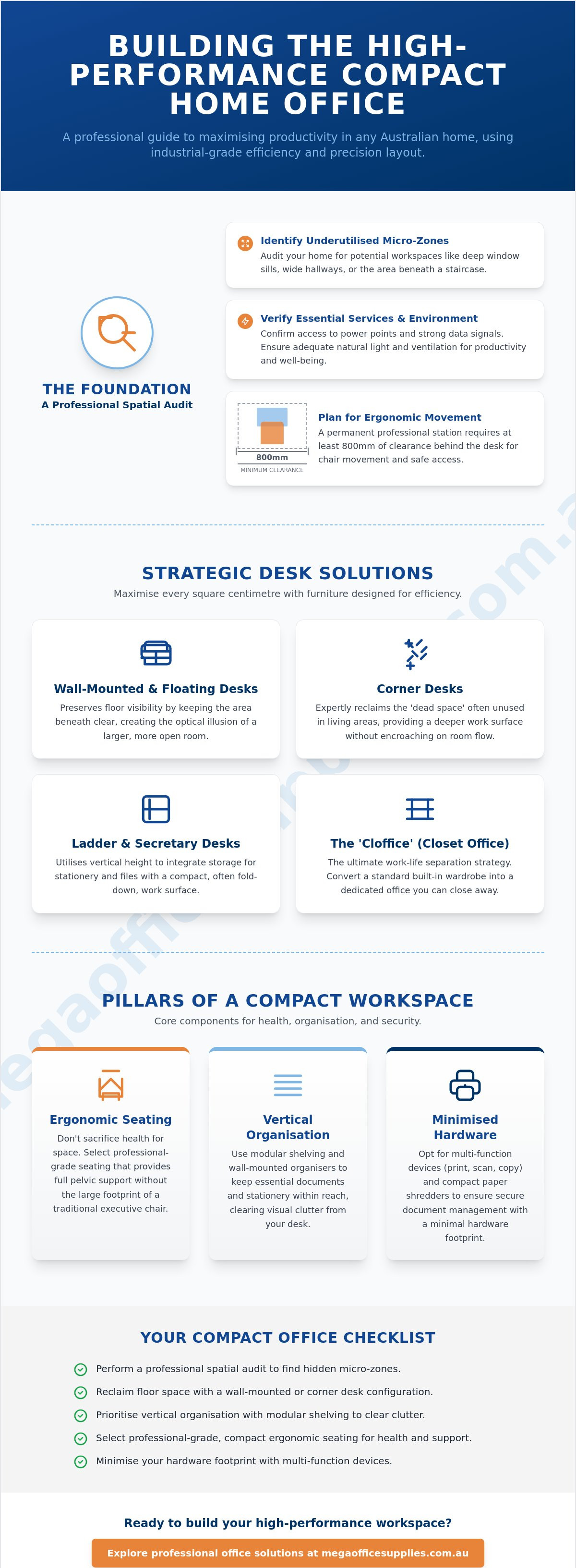
Establishing a professional workspace within an Australian apartment or a compact suburban home requires a shift from aesthetic decoration to logistical planning. You must begin with a rigorous spatial audit. This involves more than just identifying an empty corner; it requires measuring every millimetre of potential floor and wall space. The Small office/home office (SOHO) model has evolved, and in 2026, the focus is on high-density efficiency. Look for underutilised micro-zones such as deep window sills, wide hallways, or the space beneath a staircase. These areas often provide enough footprint for a high-performance station without disrupting the flow of your living area.
To better understand this concept, watch this helpful video:
Connectivity and environmental factors are just as critical as the furniture itself. Before committing to any home office setup ideas for small spaces, you must verify power point access and data signal strength in your chosen zone. A lack of natural light or poor ventilation will quickly degrade your productivity and well-being. If you're tucked into an alcove, ensure there's enough clearance for airflow and that you've accounted for the heat generated by monitors and hardware. Practicality must lead every decision.
The Anatomy of a Compact Workspace
Differentiate between a "touchdown" spot for quick emails and a permanent professional station. A permanent station requires a minimum clearance of at least 800mm behind the desk to allow for ergonomic chair movement and safe walkway access. Setting realistic goals for square metre usage is vital. Don't try to fit a full-sized boardroom desk into a studio apartment. Focus on multi-functional integration where your furniture serves a dual purpose without sacrificing its primary industrial utility.
Defining Your Workflow Requirements
Your specific daily tasks dictate your hardware needs. If your work is primarily digital, you might only need depth for dual monitors. However, if you handle physical documentation, surface area for lever arch files becomes non-negotiable. Audit your essential kit early. Whether it's a reliable supply of pens or high-speed scanners, every item must have a designated home. Consider your need for privacy. A hallway setup offers great space efficiency but may require noise-cancelling equipment if the household is active during business hours.
Strategic Desk Solutions: Maximising Every Square Centimetre
The selection of a desk is the most consequential decision in any small-scale workspace. In a compact environment, every millimetre must be justified by its utility. Wall-mounted or floating desks are particularly effective because they preserve floor-space visibility. By keeping the area beneath the work surface clear, you create the optical illusion of a larger room while maintaining a stable professional platform. Corner desks are another robust option, specifically designed to reclaim the "dead space" that often goes unused in Australian living areas. These configurations provide a deeper work surface than standard rectangular desks without encroaching into the centre of the room.
Innovative home office setup ideas for small spaces also include the use of ladder desks and secretary bureaux. These pieces of furniture utilise vertical height to provide storage for stationery and files while offering a fold-down or integrated work surface. For those who require a total separation between their professional and domestic lives, a "cloffice" (closet office) conversion is a superior strategy. This involves removing the doors or shelving from a standard built-in wardrobe to install a desk and lighting. It allows you to physically close the door on your work at the end of the day, which is essential for mental health in a shared living environment. To keep the area feeling open, select materials that minimise visual weight, such as glass tops or light-coloured timber finishes.
The Evolution of the Compact Standing Desk
Traditional fixed desks are often bulky and difficult to reposition. A standing desk provides a more versatile alternative for limited footprints. Manual crank models offer reliability without requiring proximity to power points, while electric height-adjustable models allow for seamless transitions during the day. If you don't have room for a full standing unit, desktop converters can turn any small table into an ergonomic home office setup. These devices sit on top of your existing surface and provide the necessary elevation for your monitor and keyboard.
Alcove and Nook Transformations
Custom-fit shelving can replace a traditional desk in narrow recesses. This approach maximises every centimetre of width and allows you to install multiple tiers of storage above the primary work zone. Lighting is a common failure point in these dark corners. Use slimline task lamps or adhesive LED strips to maintain visibility without cluttering the surface. To manage acoustics in open-plan areas, consider adding felt or cork panels to the alcove walls to dampen sound during video calls. You can explore a range of high-capacity office furniture designed for Australian professional standards.
Ergonomic Seating: Why Small Spaces Still Need Professional Support
Using a dining chair for eight hours of professional output is a logistical error that leads to chronic physical fatigue. While domestic furniture might blend into your home's decor, it lacks the mechanical support required for long-term spinal health. High-performance home office setup ideas for small spaces must prioritise pelvic and lumbar stability over visual trends. A professional-grade chair is non-negotiable for preventing strain and maintaining focus during intensive work blocks. In the Australian climate, breathable mesh finishes are often superior to heavy upholstery because they facilitate better airflow and heat dissipation during summer months.
When floor space is limited, you must select hardware that offers a high degree of adjustability within a compact footprint. One of the most effective ways to maximize your space is to choose a chair with flip-up armrests or a dedicated armless design. These configurations allow the chair to be tucked completely under the desk surface when the workday ends, clearing walkways and reducing visual clutter in shared living areas. Always verify the weight ratings and commercial-grade durability of your seating to ensure it meets Australian safety standards for daily professional use.
Selecting the Right Ergonomic Office Chair
The core of a healthy workstation is a high-quality ergonomic office chair that features an adjustable seat pan. Proper seat pan depth is essential for maintaining circulation in the lower limbs; there should be a small gap between the edge of the seat and the back of your knees. Additionally, consider the type of castors required for your environment. Soft-tread wheels are necessary for protecting hard timber or laminate floors, while standard hard castors provide the necessary grip for carpeted areas. You can find a range of suitable models in our office furniture collection.
Active Seating and Ergonomic Accessories
In extremely tight spots where a full-sized chair isn't feasible, active seating solutions like stools or perch chairs offer a viable alternative. These are particularly effective for sit-stand transitions, as they encourage core engagement and take up significantly less room than traditional seating. If your desk height is fixed and your feet don't sit flat on the floor, integrate a footrest to align your posture. For those utilising standing desk solutions in small corners, anti-fatigue mats provide the necessary cushioning to reduce pressure on your joints and lower back during extended periods of standing.
Vertical Organisation and Professional Storage Ideas
When floor space is a finite resource, the vertical plane becomes your most valuable logistical asset. Effective home office setup ideas for small spaces must move beyond the desk surface to utilise the entire volume of the room. Modular shelving systems are a superior choice for growing businesses. They allow for incremental expansion as your document volume increases. Installing shelves above your monitor line keeps essential tools within reach while clearing the primary work surface for deep-focus tasks. Cable management is equally critical. Integrating under-desk trays or cord channels eliminates "cord spaghetti" on the floor; this reduces trip hazards and simplifies cleaning in tight quarters.
Maintaining a professional standard in a multi-purpose room requires a strict clean desk policy. At the end of each shift, daily stationery and mail should be processed and stored. This practice is essential for mental separation when your office is also your living room. Visual clutter acts as a constant reminder of unfinished tasks. By clearing the surface, you reset the environment for domestic use. This transition is a key component of successful home office setup ideas for small spaces in shared dwellings.
Mobile Storage and Pedestal Solutions
Fixed cabinetry is often too restrictive for small Australian apartments. Slimline mobile pedestals are a more flexible alternative. These units are specifically designed to slide directly under your desk when not in use. If you handle sensitive business or medical records, select models with integrated locking mechanisms for secure storage. For shared hardware like printers or bulk A4 copy paper, utilising mobile carts or trolleys is a smart logistical move. These can be wheeled into a cupboard or a different room when the equipment isn't required, preserving the flow of your living space.
Document Management in Miniature
Efficient retrieval is the hallmark of a professional operation. Use colour-coded lever arch files to categorise projects and financial records. This allows for rapid identification without needing to browse through every spine. Desktop file sorters are useful for managing current, high-priority projects that require immediate access. For long-term records that must be retained but aren't used daily, archive boxes are the industry standard. These can be stacked in a garage or atop high cupboards to keep your immediate work zone clear of historical clutter. You can browse our full range of office organisation products to streamline your workspace today.
Integrating Technology and Essential Office Machinery
A professional operation requires more than a basic laptop. High-performance home office setup ideas for small spaces must account for the physical footprint of essential hardware. Multi-function devices (MFDs) are the industry standard for compact environments because they consolidate printing, scanning, and copying into a single unit. This consolidation is vital for maintaining a clear work surface and reducing the need for multiple power outlets. Monitor arms are another critical tool for reclaiming desk real estate. By lifting the screen off the desk, you create usable space underneath for stationery or external drives. This setup also allows for precise ergonomic adjustments, which are essential for long-term health.
Security and document maintenance are often overlooked in home environments. A compact paper shredder is a necessary investment for any professional handling sensitive client data or financial records. These units fit easily under a desk or in a cupboard, ensuring you comply with privacy standards without sacrificing room. Similarly, slimline laminating machines provide a durable finish for reference guides or price lists, preventing wear in high-use areas. Protect all your technology with high-quality, surge-protected power boards to prevent hardware failure from irregular voltage spikes, which can be common in residential areas.
The Compact Tech Stack
Wireless peripherals are essential for reducing visual noise and improving the logistical flow of your station. In 2026, the reliability of these devices has increased significantly, making them a dependable choice for high-volume work. Using a wireless keyboard and mouse allows you to reposition your tools instantly, which is particularly useful on narrow desks. Docking stations offer a streamlined, one-cable connection for laptop-centric workers, facilitating a fast transition from mobile to desktop modes. Effective cable routing using clips or under-desk trays ensures a professional, distraction-free aesthetic that prevents your workspace from feeling overwhelmed by hardware.
Professional Presentation and Safety
Even in a small-scale office, the quality of your output must remain high. Small-scale binding machines allow you to produce professional client proposals and reports without relying on external services. This level of self-sufficiency is a hallmark of a well-run operation. Safety remains a priority in every Australian workplace. Ensure your small office complies with basic first aid requirements by keeping a stocked kit within reach. This commitment to professional standards ensures your home office functions with the same reliability as a corporate headquarters.
Explore our full range of office furniture designed for Australian professionals.
Future-Proofing Your Compact Professional Workspace
Transforming a limited floor plan into a high-performance workspace is a matter of logistical precision rather than compromise. By conducting a rigorous spatial audit and prioritising vertical organisation, you can maintain a professional standard without encroaching on your domestic living area. The integration of commercial-grade ergonomic seating and multi-function technology is essential for long-term productivity and physical well-being. These home office setup ideas for small spaces provide a clear blueprint for an environment that is both efficient and sustainable.
As a family-owned Australian business with decades of combined industry experience, we provide the hardware necessary to maintain a professional edge. We offer national delivery on all commercial-grade office essentials to ensure your station is equipped for the demands of 2026. You can view our range of professional furniture and office supplies at Mega Office Supplies to start your transformation. With the right layout and industrial-quality tools, your compact office will support your professional goals with absolute reliability.
Frequently Asked Questions
How do I fit a desk into a small bedroom without it feeling cluttered?
You can fit a desk into a small bedroom by selecting a wall-mounted or floating design that preserves floor visibility. This approach prevents the room from feeling cramped while providing a stable work surface. Utilising vertical wall space for shelving helps keep the primary desk area clear of stationery and documents. It's also effective to choose furniture with a slimline profile to maintain a professional aesthetic without overwhelming the domestic environment.
What is the minimum desk size required for a professional home office setup?
A professional workspace generally requires a minimum desk width of 1000mm to 1200mm to accommodate a monitor and laptop comfortably. While smaller "touchdown" spots exist, this size ensures you have adequate room for peripherals and document handling. When considering home office setup ideas for small spaces, depth is also critical. A depth of at least 600mm is recommended to maintain the correct focal length between your eyes and the screen.
Can I use a standing desk in a small apartment or unit?
You can certainly use a standing desk in a small apartment by choosing a compact electric model or a desktop converter. Many modern sit-stand workstations are designed with a footprint as small as 900mm in width. These units allow you to maintain ergonomic health without requiring a dedicated room. If floor space is extremely limited, a desktop converter sits on any existing table, turning a dining area into a professional station instantly.
How do I hide my computer cables in a small home office?
You can hide computer cables by installing an under-desk cable management tray or using adhesive cord channels. These tools keep "cord spaghetti" off the floor and away from your feet, which is vital in tight quarters. In a small home office, routing cables along the back of desk legs or using braided cable sleeves creates a clean, distraction-free appearance. This logistical step also makes cleaning the area much easier and reduces trip hazards.
What ergonomic chair is best for small spaces and tight corners?
An armless ergonomic chair or a model with flip-up arms is the most effective choice for tight corners. These designs allow the chair to be pushed completely under the desk when the workday ends, clearing walkways in shared living areas. Look for chairs that offer high-density foam and adjustable lumbar support. This ensures you don't sacrifice pelvic stability or comfort even when working within a very small footprint.
How can I organise my office supplies if I don’t have room for a large cabinet?
You can organise your office supplies by using slimline mobile pedestals or vertical wall-mounted organisers. Mobile pedestals are designed to slide directly under your desk, providing secure storage for stationery and files without consuming extra floor space. If you don't have room for any floor-based storage, consider using pegboards or modular shelving above your monitor. This keeps your essential tools within reach while maintaining a clear and professional work surface.
Is a corner desk or a straight desk better for a small room?
A corner desk is often better for a small room because it reclaims "dead space" that is otherwise underutilised. These desks provide a larger work surface relative to the floor space they occupy compared to straight desks. However, a straight desk might be preferable if you need to move the station frequently. If you choose a corner model, ensure it has enough depth to support your equipment without forcing you into a cramped posture.
Do I need a separate room to have a productive home office in Australia?
You don't need a separate room to maintain a productive home office in Australia if you manage your micro-zone correctly. Many professionals successfully operate from alcoves, hallways, or converted closets. The key is to establish clear boundaries through the use of dedicated furniture and professional organisation. By utilising high-quality home office setup ideas for small spaces, you can create a high-performance environment that rivals a traditional corporate headquarters in terms of output.
Article by
Mega Office Supplies Team
The Mega Office Supplies Team provides practical guidance for Australian businesses, schools, government organisations, healthcare providers, hospitality venues, warehouses and home offices. Based in Tweed Heads South, Mega Office Supplies is a family-owned and operated Australian business offering office stationery, workplace furniture, technology products, labels, printers, cleaning and janitorial supplies, safety products, art materials, education resources and everyday business essentials from trusted brands.
General Information
This article is provided as general information only to help customers compare and choose office, workplace, school, cleaning, technology, furniture, safety and business supplies. Product details, specifications, compatibility, availability, pricing and suitability may vary. Always check the individual product page, manufacturer information, workplace requirements and relevant safety guidance before purchasing or using a product.


