

How many minutes do you lose each day rummaging through a chaotic drawer for a highlighter or a specific cable while a client waits on the line? Most professionals accept this daily friction as a standard part of office life, but we view it as a logistical failure that drains productivity. Organising desk drawers for maximum efficiency is more than a simple tidying exercise; it is a strategic engineering of your immediate workspace. We know that a cluttered drawer leads to tangled cords and the unnecessary expense of buying duplicate stationery. This guide provides a systematic approach to auditing your supplies, categorising tools, and implementing a layout that ensures high-priority items are always within reach. You will learn how to establish a standardised system that brings the "clean desk" feeling to every drawer in your office.
Key Takeaways
- Conduct a thorough audit using the "empty and clean" rule to identify hidden stock and reclaim available storage volume.
- Master the art of organising desk drawers for maximum efficiency by applying the 80/20 rule to prioritise your most-used office tools.
- Optimise your ergonomic workflow by placing high-frequency items within the "prime real estate" section of your top drawer.
- Ensure long-term order across your team by implementing professional labelling and a strict "one in, one out" maintenance policy.
Audit and categorisation: the foundation of drawer efficiency
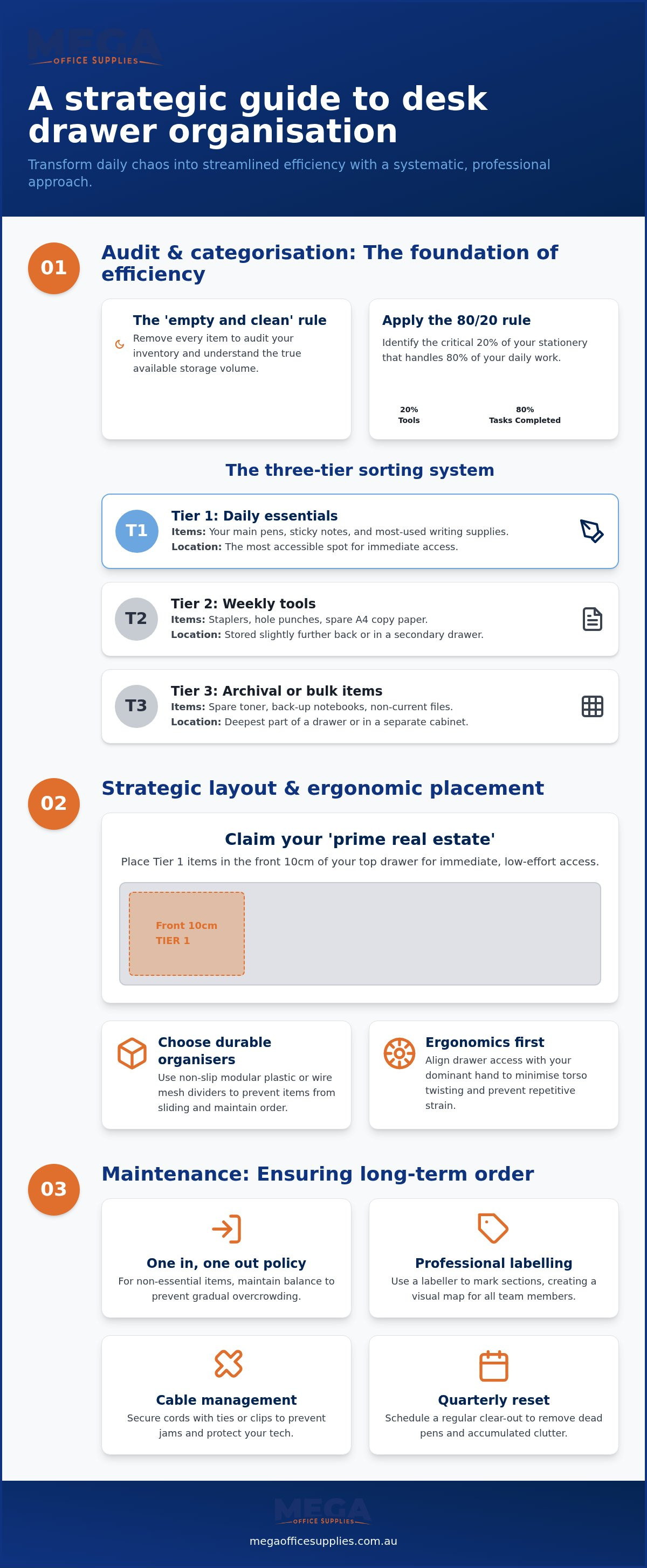
Before you can achieve a streamlined workspace, you must strip the environment back to its basics. We advocate for the "empty and clean" rule. Remove every item until you can see the bare base of the unit. This process allows you to understand the true available volume and identify any mechanical issues with the runners or caught cables. Organising desk drawers for maximum efficiency requires a cold, hard audit of what you actually use. If you haven't used that promotional stress ball since the 2018 Christmas party, it's probably time to let it go.
Apply the 80/20 rule to your current inventory. In most Australian professional environments, 20% of your stationery handles 80% of your daily tasks. Group your items by function, separating writing instruments from technology accessories and filing supplies. This prevents the "junk drawer" phenomenon where disparate items become entangled. Whether you're in a school, a government department, or a warehouse office, this functional grouping ensures that similar tools are always co-located for rapid retrieval. Organising desk drawers for maximum efficiency is impossible without this initial logical separation.
The three-tier sorting system for professional environments
To maintain long-term order, we recommend categorising tools into three distinct tiers based on retrieval frequency:
- Tier 1: Daily essentials. Keep your pens, sticky notes, and most-used writing supplies in the most accessible spot for immediate access.
- Tier 2: Weekly tools. Items like staplers, hole punches, and spare A4 copy paper should be stored slightly further back or in a secondary drawer.
- Tier 3: Archival or bulk items. Store spare toner, back-up notebooks, and non-current files in the deepest part of the drawer or a separate cabinet to minimise daily clutter.
Strategic layout and the role of drawer organisers
While DIY cardboard solutions might suffice for a home craft room, professional environments require the durability of modular plastic or wire mesh dividers. These materials withstand the rigours of high-volume use in schools, warehouses, and government offices without degrading or harbouring dust. Organising desk drawers for maximum efficiency involves selecting non-slip organisers that eliminate the "shunting" effect. Without these, every movement of the drawer causes items to slide, undoing your categorisation efforts and potentially damaging sensitive technology accessories.
Adhere to the "prime real estate" principle by placing Tier 1 items within the front 10cm of your top drawer. This area requires the least amount of physical reach and is visible the moment the drawer is cracked open. For those managing deep filing units, avoid the common trap of the "junk pit". Utilise stacked trays to maximise vertical space. This tiered approach allows you to store bulkier Tier 2 items beneath your daily essentials, ensuring every cubic centimetre of the drawer serves a functional purpose.
This functional approach can also extend to how you store personal care items.
Ergonomic placement and repetitive strain prevention
Strategic layout is a critical component of workplace health. Align your drawer access with your dominant hand to minimise repetitive torso twisting. This methodical organisation complements the support provided by a professional ergonomic office chair, ensuring your body remains in a neutral position. By reducing the reach distance for heavy tools like staplers or hole punches, you actively mitigate the risk of wrist strain. We recommend browsing our range of office furniture supplies to find dividers that fit your specific desk dimensions and workflow requirements.
Maintenance and professional labelling systems
A successful organisational system requires consistent upkeep to prevent the slow creep of stationery clutter. We suggest a strict "one in, one out" policy for all non-essential items. This discipline ensures that your drawers don't become overcrowded as the financial year progresses. Organising desk drawers for maximum efficiency is only half the battle; the other half is preservation. Use high-quality labelling machines to clearly mark divider sections. This is particularly effective for team-shared desks, as it provides a visual map that dictates exactly where each tool belongs, removing any ambiguity for staff members.
Inventory control for schools and government offices
In high-volume environments like schools or government departments, labels serve a dual purpose. By identifying "re-order points" on your stationery dividers, you can see at a glance when stock is low, preventing sudden shortages. A standardised drawer layout also simplifies the onboarding process for new staff. They can find what they need immediately without asking colleagues for assistance. This level of organisation integrates perfectly with a modern workspace, whether you're using a standard desk or a height-adjustable standing desk. Consistent systems create a reliable foundation for daily productivity.
Optimise your workflow with a structured storage system
Organising desk drawers for maximum efficiency is a low-cost investment that pays dividends in daily productivity and ergonomic health. By auditing your current inventory and implementing a modular layout, you eliminate the daily friction of rummaging for tools. Maintaining this order with professional labelling ensures your system remains intact throughout the busiest financial periods. Our team supports Australian businesses, schools, and government departments. We accept official government purchase orders and provide local support on weekdays from 8 am to 6 pm AEST to help you select the right hardware for your fit-out.
Browse our range of professional drawer organisers and office supplies
Transforming a chaotic drawer into a high-frequency retrieval system is the first step toward a more focused and professional workday.
Frequently Asked Questions
What are the best types of organisers for shallow desk drawers?
Low-profile modular trays or slim metal mesh dividers are the most effective options for shallow drawers. These professional-grade units typically range from 30mm to 50mm in height, ensuring they don't catch on the desk frame. Choosing stackable components allows you to customise the configuration for specific tools like pens and paperclips while maintaining the necessary vertical clearance for smooth operation.
How do I stop my drawer dividers from sliding around?
You can stop dividers from sliding by using organisers with integrated rubber feet or by applying a non-slip drawer liner to the base. For a more permanent solution in high-volume environments like warehouses or schools, a small amount of adhesive putty secured to the tray corners provides stability. This prevents the shunting effect that occurs during rapid, repetitive drawer movements.
Should I keep my most-used files in a desk drawer or a filing cabinet?
Keep your active, Tier 1 files in your desk drawer for immediate access, while storing Tier 2 and 3 records in a central filing cabinet. Organising desk drawers for maximum efficiency relies on keeping only the most critical documents within reach. This ergonomic approach reduces the time spent leaving your workstation to retrieve high-frequency paperwork required for your current projects.
How can I organise a desk drawer without any built-in dividers?
Use after-market modular inserts or adjustable spring-loaded dividers to create structure in a drawer without built-in sections. These professional tools allow you to engineer a custom layout that fits your specific inventory of stationery and tech accessories. It's a scalable method for organising desk drawers for maximum efficiency, providing a standardised system that works across various desk types and office environments.
Article by
Mega Office Supplies Team
The Mega Office Supplies Team provides practical buying guides and workplace advice for Australian businesses, schools, government organisations, healthcare providers, hospitality venues, warehouses and home offices. Family owned and operated since 2008 and based in Tweed Heads South on the Gold Coast–Tweed border, Mega Office Supplies helps Australian workplaces choose the right office supplies, furniture, technology, cleaning, safety and education products — backed by genuine local service from real people.
General Information
This article is provided as general information only to help customers compare and choose office, workplace, school, cleaning, technology, furniture, safety and business supplies. Product details, specifications, compatibility, availability, pricing and suitability may vary. Always check the individual product page, manufacturer information, workplace requirements and relevant safety guidance before purchasing or using a product.


