

Would you trust your most critical business records to a storage stack that looks more like a game of Jenga than a professional filing system? It is a frustrating reality for many administrators when a bottom box buckles under pressure, or a specific document remains lost in a sea of nameless cardboard. We understand that effective storage is about more than just clearing desk space; it is about protecting the integrity of your information for the long haul. Learning how to properly pack an archive box is a fundamental skill that prevents structural failure and ensures your team can retrieve files without a search party.
This guide provides technical specifications for weight distribution, professional labelling, and space-saving strategies. You will learn to create a stable, organised archive that remains protected and accessible for years to come.
Key Takeaways
- Select the appropriate board grade and GSM based on your document volume to ensure your storage stacks remain structurally sound over time.
- Master how to properly pack an archive box by placing heavier files at the base and using manilla folders to prevent contents from shifting.
- Utilise professional labelling machines to create a standardised system that includes department codes and clear destruction dates for easy retrieval.
- Learn the correct stacking protocols to maximise your storage space while maintaining direct access to frequently required records.
Choosing the correct archive box for your workplace requirements
Selecting the right container is the first step in learning how to properly pack an archive box. Check the board grade. If you choose a box with insufficient strength, the structural integrity will fail long before your retention period ends. We recommend assessing the total weight of your documents; high-volume paper records require a higher GSM (Grams per Square Metre) to prevent the bottom from bowing. For standard office use, a heavy-duty cardboard box from a trusted brand like Rexel provides the necessary durability for vertical stacking.
You also need to decide between a one-piece assembly or a box with a separate lid. One-piece boxes are excellent for long-term, deep storage where access is rare, as they often provide better dust protection. Separate lids are more practical for records that require occasional retrieval throughout the year. Buying a flimsy box for heavy files is like buying a budget parachute; it works perfectly until it really doesn't.
Understanding material durability and acid-free options
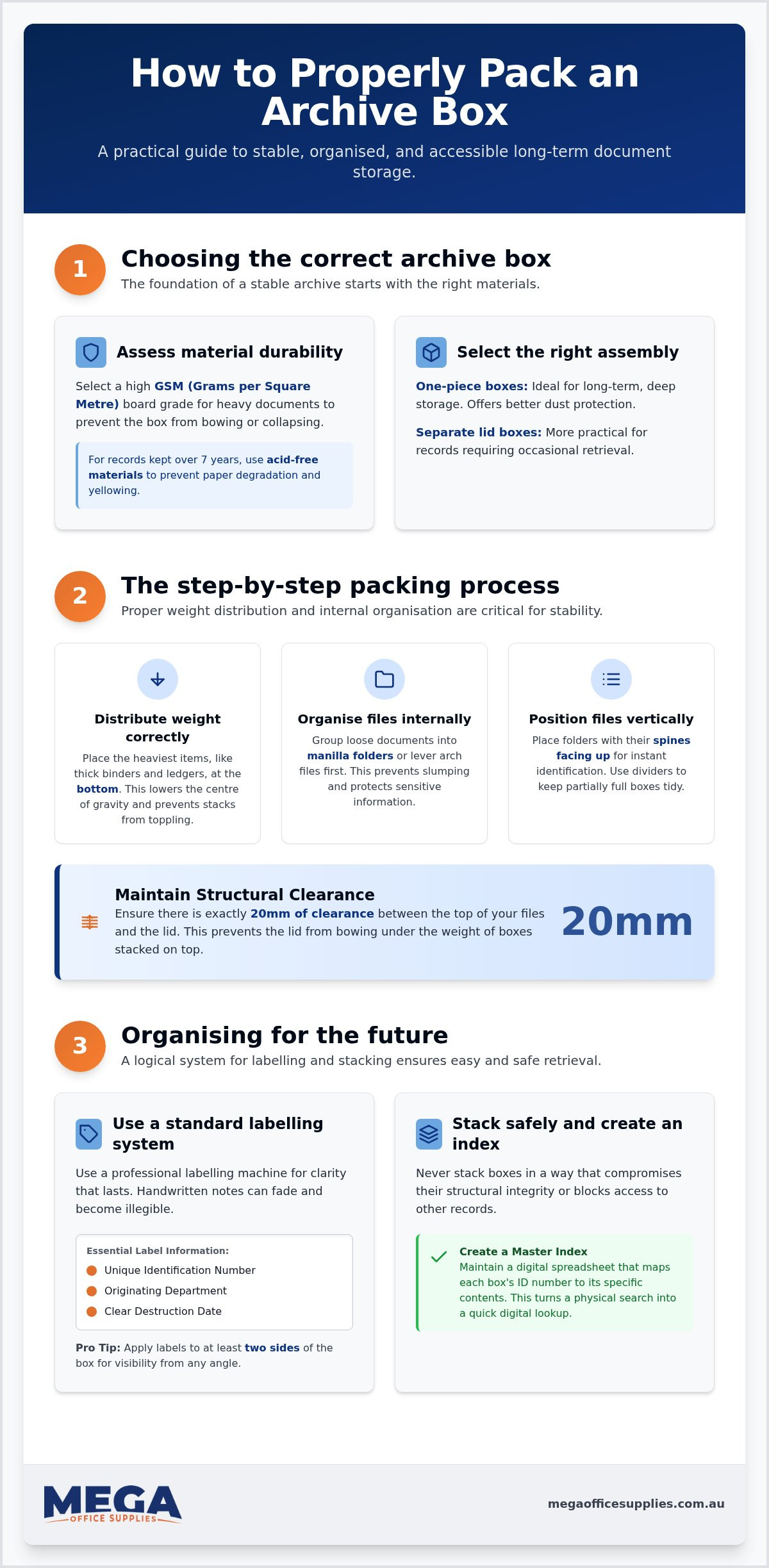
If your records must be kept for more than seven years, prioritise acid-free materials. Standard cardboard can emit gases that cause paper to yellow and degrade over decades. For high-density environments, look for reinforced handles and double-thickness bases. These features are essential if you plan to stack boxes more than three high in a warehouse or archive room. You can browse our full range of filing and storage solutions to find the specific board grade required for your retention schedule. Understanding these technical specifications ensures you know how to properly pack an archive box that won't collapse under its own weight.
The step-by-step process for packing and weight distribution
Once you've selected a high-GSM box, the focus shifts to internal organisation. The secret to how to properly pack an archive box lies in structural balance. Start by categorising your loose documents into logical groups based on department or date. We recommend placing these into lever arch files or manilla folders rather than tossing them in loose. This simple step ensures that sensitive documents don't slump or fold under their own weight over several years of storage.
Weight distribution is the most critical factor for long-term stability. Always place the heaviest items, such as thick binders or bound ledgers, at the bottom of the container. This lowers the centre of gravity and prevents the box from becoming top-heavy, which is the primary cause of toppling stacks in warehouse environments. Fill any significant voids with backing boards to prevent the contents from shifting during transport or handling. Gravity is a harsh mistress for a box packed with lead-heavy files on top and empty space at the bottom.
Maximising space with vertical filing and divider cards
Position your files vertically with the spines facing upwards. This method allows you to read labels instantly without removing every folder in the box, which is essential for efficient document retrieval. If the box isn't completely full, use internal dividers to keep the files upright; this prevents them from curling into a messy heap. Technical precision matters here. Ensure there's exactly 20mm of clearance between the top of your files and the lid. This specific gap prevents the lid from bowing when you stack another box on top, maintaining the structural integrity of your entire archive. Understanding how to properly pack an archive box helps you avoid these common structural pitfalls. If you're managing a high-volume project, ordering your storage supplies in bulk ensures you have a consistent system across all departments.
Organising for the future with labelling and stacking protocols
A professional storage system is only as effective as its retrieval protocol. Once you've mastered how to properly pack an archive box with the correct weight distribution, you must ensure the contents remain identifiable over decades. Handwritten notes often fade or become illegible over time. We recommend implementing a standardised system using professional labelling machines to maintain clarity. Every box requires a unique identification number, the originating department, and a clear destruction date. Apply these labels to at least two sides of the box so they remain visible regardless of how the unit is oriented on a shelf. A box labelled 'Misc' is essentially a black hole for workplace productivity; be specific with your descriptions to save hours of searching later.
Creating a master archive index and stacking safely
Digital records are your best ally in physical storage. Maintain a master index, such as a secure spreadsheet, that maps every box number to its specific file range. This allows your team to verify a box's contents before stepping into the warehouse. When it's time to store, safety is paramount. Stack your boxes in a 'brick-work' pattern, overlapping the joins to distribute weight evenly. This prevents the towers from leaning or toppling under pressure. Always keep your archives off the floor using pallets or heavy-duty shelving. This protects the base of the stack from moisture, dust, and cleaning chemicals. Following these protocols is just as vital as knowing how to properly pack an archive box in the first place.
Securing your workplace records for the long haul
Establishing a resilient filing system requires a combination of high-grade materials and disciplined organisation. By prioritising the correct GSM for your boxes and implementing a vertical filing system with standardised labels, you ensure your records remain both structurally sound and easily retrievable. Our team can help you select the right products for any retention schedule. Understanding how to properly pack an archive box is the best way to prevent collapsed stacks and wasted productivity. It's a simple process that yields long-term security.
Browse our full range of professional archive and storage boxes
We offer free delivery on orders over $149 Australia-wide with genuine local support from our Gold Coast and Tweed offices. If you need assistance with a high-volume project or specific product specifications, our team is available weekdays 8–6 AEST to provide direct assistance. Get organised today and enjoy the peace of mind that comes with a professional archive system.
Frequently asked questions
How many lever arch files can I fit into a standard archive box?
A standard Australian archive box typically accommodates five to six full lever arch files. For thinner document wallets or manilla folders, you can often fit up to twelve. It's vital not to force the files in, as this can distort the box shape and make retrieval difficult. Ensuring a snug but relaxed fit is key to how to properly pack an archive box without damaging the container.
Do archive boxes need packing tape to stay together?
Most professional archive boxes from brands like Marbig or Rexel feature an auto-fold or lock-bottom design that requires no tape. This allows for flat-packed storage and easy assembly without additional adhesives. However, if you're using a basic shipping carton for archiving, high-quality packing tape is essential for structural integrity. Tape can also help seal lids in high-dust warehouse environments if required.
How high can I safely stack archive boxes in a warehouse?
You should generally not stack archive boxes more than four high unless you're using a specialised racking system. Even with high-GSM cardboard, the bottom box bears the cumulative weight of everything above it. Stacking too high risks crushing the lower boxes and creating a safety hazard for staff. Proper stacking is a critical part of knowing how to properly pack an archive box for long-term storage.
What is the best way to label an archive box for long-term retrieval?
Use a professional label maker with UV-resistant tape to prevent text from fading over several years. Every box should clearly state the department, a unique ID number, the date range, and a 'Destroy After' date. Avoid using felt-tip markers directly on the cardboard; these can bleed and become illegible. Clear, printed labels ensure your records remain accessible and organised in any storage facility or home office.
Article by
Mega Office Supplies Team
The Mega Office Supplies Team provides practical buying guides and workplace advice for Australian businesses, schools, government organisations, healthcare providers, hospitality venues, warehouses and home offices. Family owned and operated since 2008 and based in Tweed Heads South on the Gold Coast–Tweed border, Mega Office Supplies helps Australian workplaces choose the right office supplies, furniture, technology, cleaning, safety and education products — backed by genuine local service from real people.
General Information
This article is provided as general information only to help customers compare and choose office, workplace, school, cleaning, technology, furniture, safety and business supplies. Product details, specifications, compatibility, availability, pricing and suitability may vary. Always check the individual product page, manufacturer information, workplace requirements and relevant safety guidance before purchasing or using a product.


