

Choosing a chair based solely on the height of the headrest is like buying a vehicle based only on the size of the spoiler. It looks impressive in the showroom, but it doesn't necessarily tell you how the equipment will handle a demanding eight-hour shift. We know that staring at a furniture catalogue often feels like trying to decode a foreign language while your lower back is already pulsing with a dull ache. The high back vs mid back office chair debate is one of the most common hurdles for procurement officers and home office workers alike.
We’ll help you identify the critical ergonomic differences that prevent neck strain and physical fatigue. You will discover how to choose a seat that fits your specific desk tasks and satisfies the rigorous AS/NZS 4438:1997 Australian standards. This guide compares the functional support of both styles, examines space requirements for smaller floor plans, and explains which certification levels actually matter for your workplace longevity. By the end, you'll be able to select a durable investment that supports your body and your budget.
Key Takeaways
- Identify the specific spinal regions each design supports, from the lumbar focus of mid back models to the full cervical support provided by high back chairs.
- Apply the 4-hour and 8-hour rules to determine the best high back vs mid back office chair for your specific daily workflow and desk time.
- Select materials like breathable mesh or heavy-duty fabrics that balance professional aesthetics with the practical demands of the Australian climate.
- Verify that your chosen seating meets the AS/NZS 4438:1997 standard to ensure long-term durability and safety in high-use environments.
- Coordinate your purchase with workplace budget cycles or EOFY requirements to maximise the value of your ergonomic investment.
Understanding the Functional Differences in Spinal Support
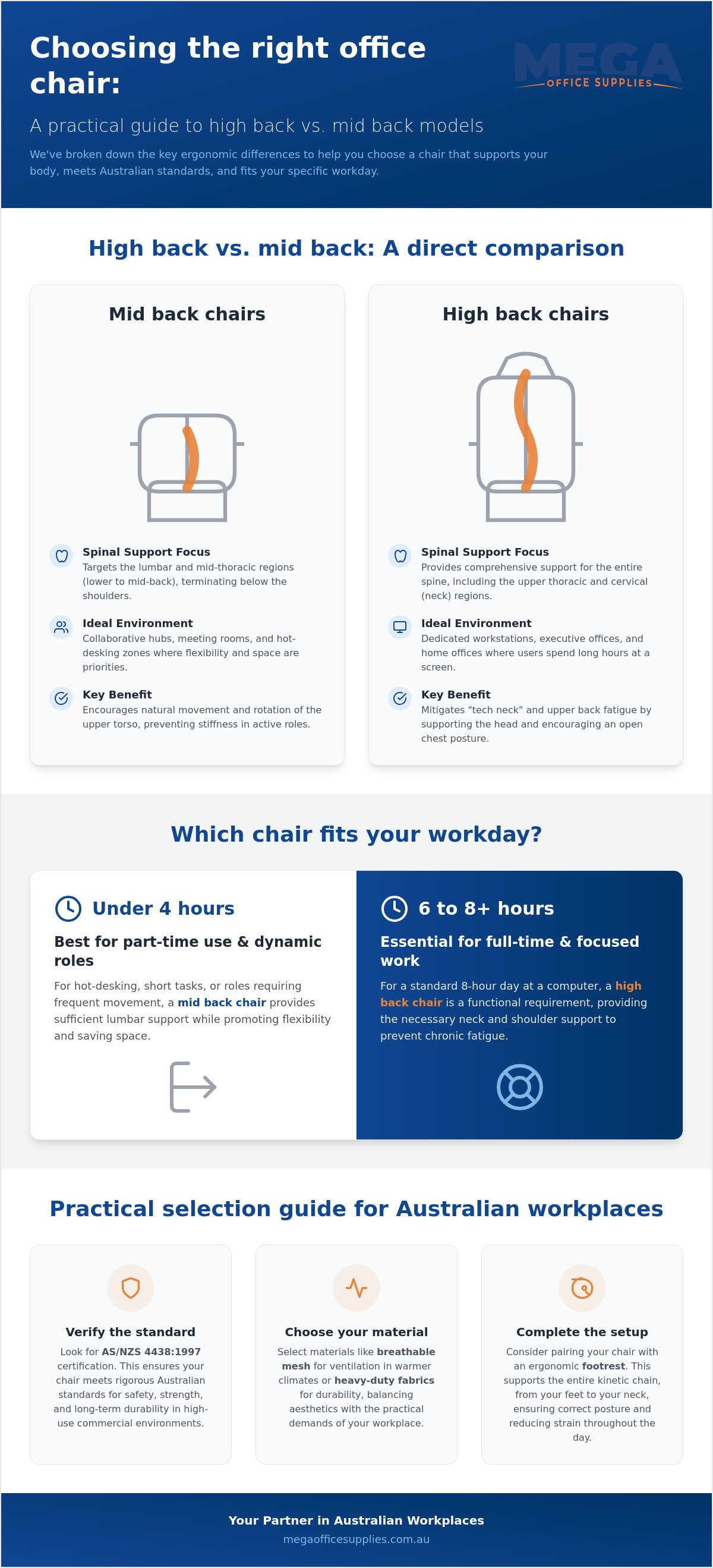
The core distinction between a high back vs mid back office chair involves which vertebrae receive direct contact and mechanical support. While both styles are engineered to promote healthy posture, they serve different physiological needs. A mid back chair typically terminates at the shoulder blades, focusing its structural tension on the lumbar and middle thoracic regions. In contrast, a high back model extends to the base of the skull, providing a consistent surface for the upper thoracic and cervical (neck) areas. This extra height is vital for maintaining the ergonomic design of office chairs, as it helps prevent the "hunched" shoulder position often seen during intensive typing tasks.
To better understand these ergonomic principles in action, watch this helpful video:
Mid Back Chairs: Flexibility and Lumbar Focus
These models are the workhorses of dynamic Australian workplaces. They provide a compact footprint that suits hot-desking zones and collaborative hubs without crowding the floor plan. We often recommend these for active professionals who need to pivot frequently to access filing cabinets or printers. By stabilising the lower back while leaving the upper torso free, mid back chairs encourage natural rotational movement. This prevents the stiffness associated with static sitting while ensuring the lumbar spine remains properly aligned during shorter task durations.
High Back Chairs: Total Spinal Alignment
For dedicated workstation use, a high back chair offers comprehensive support that helps mitigate "tech neck" and upper back fatigue. These chairs often feature an integrated headrest, allowing users to recline and shift their weight safely during long research sessions. When browsing our range of office chairs, look for professional-grade models from brands like Rapidline that include multi-point adjustability. Ensuring your seat meets the AS/NZS 4438:1997 standard is essential for long-term safety. This full-length support keeps the chest open and the shoulders back, which is critical for anyone spending more than six hours a day behind a screen.
The Decision Matrix: Task Duration and Work Habits
Determining the right fit for your team often comes down to the stopwatch rather than the job title. When evaluating a high back vs mid back office chair, we use a simple time-based matrix to guide procurement. The 4-hour rule suggests that mid back chairs are often superior for part-time use, hot-desking, or roles requiring frequent movement. For staff who spend the full 8-hour standard at a computer, a high back chair provides the necessary support to prevent chronic fatigue. It’s a bit like choosing between a pair of sturdy work boots and lightweight trainers; both have their place, but you wouldn't want to swap them at the wrong time.
We need to dispel the myth that high back seating is reserved for executive offices. It's a functional requirement for anyone prone to upper back strain, not a status symbol. To further enhance comfort, we recommend pairing either style with Kensington footrests to maintain correct leg alignment throughout the day. This combination ensures that the entire kinetic chain, from the floor to the neck, is properly supported.
Seating for Collaborative Environments
Mid back chairs are the preferred choice for meeting rooms and training centres. Their lower profile keeps lines of sight open and maintains a uniform aesthetic across open-plan offices. They provide sufficient support for the lumbar region during a 90-minute workshop without the bulk of a full-height backrest. This makes them ideal for environments where the chair needs to be tucked neatly under the desk when not in use, maximising available floor space.
Seating for Concentrated Work
For deep work sessions, high back support minimises physical distractions caused by discomfort. High-performance models often include synchro-tilt or tilt-tension mechanisms. These features allow the chair to move with the user, maintaining contact with the spine as they lean forward to type or recline to read. If you’re outfitting a dedicated workspace, you can browse our full range of ergonomic seating to find a model that suits your specific workflow.
Practical Selection Guide for Australian Workplaces
When comparing a high back vs mid back office chair for the Australian climate, material choice is just as critical as spinal support. Breathable mesh is often the preferred selection for warmer regions; it facilitates consistent airflow and prevents heat build-up during long summer shifts. Professional fabrics offer superior durability for high-traffic environments like schools or healthcare facilities where longevity is the primary concern. For government and education departments, we ensure our range includes models that meet the AFRDI Blue Tick Level 6 certification, which guarantees the chair can withstand severe commercial use.
Procurement timing also plays a significant role in your decision. Businesses often time their seating upgrades with EOFY to maximise tax-deductibility; conversely, public sectors operate within strict annual budget cycles. To simplify this process, we accept Australian Government purchase orders, providing a frictionless experience for departmental administrators. This ensures that your organisation receives professional-grade equipment without the administrative hurdles often found with global retailers.
Space Planning and Aesthetics
Back height significantly influences the visual weight of a room. A high back chair provides excellent support but can easily overwhelm a compact home office or a small study nook. In these instances, a mid back chair offers a sleeker profile that maintains an open, airy feel. We recommend matching your chair’s colour and material to your existing office furniture to create a cohesive professional environment that reflects your brand's stability.
The Mega Office Supplies Advantage
We help you navigate the technical nuances of workplace ergonomics. Choosing the right high back vs mid back office chair shouldn't be a guessing game based on a single photo. Our "real person" support team is available weekdays from 8 am to 6 pm AEST to assist with bulk quotes or specific fit-out requirements. This direct assistance ensures that your investment meets both your ergonomic needs and your operational budget.
Selecting the Right Support for Your Next Shift
Choosing between a high back vs mid back office chair is a decision that directly impacts your daily productivity and long-term physical health. We've established that the 4-hour and 8-hour rules provide a practical framework for deciding between the agility of a mid back model and the full-spine alignment of a high back chair. Your choice should ultimately reflect your specific task duration and the functional demands of your workspace.
As a family owned and operated business since 2008, we take pride in helping national organisations and individuals find professional-grade equipment that meets rigorous safety standards. Reliable support shouldn't be a luxury; it's a fundamental requirement for a well-organised office. With national delivery available, we make it simple to secure durable seating that protects your team and your investment.
Browse our full range of ergonomic office chairs
We look forward to helping you equip your office with a seating solution that stands the test of time and keeps you comfortable throughout the working week.
Frequently Asked Questions
Which chair is better for lower back pain?
Both styles can address lower back pain effectively provided they feature dedicated, adjustable lumbar support. Mid back chairs focus specifically on stabilising the lumbar and middle thoracic regions; making them a primary choice for targeted lower back relief during active tasks. If your discomfort extends to the upper back or neck; a high back chair provides the full-length spinal alignment necessary to reduce overall musculoskeletal strain.
Do mid back chairs have a weight limit compared to high back chairs?
Back height does not determine the weight capacity of an office chair. Weight limits are dictated by the structural integrity of the base; the gas lift cylinder; and the seat plate construction. When comparing a high back vs mid back office chair; you'll find that both categories offer standard commercial ratings as well as heavy-duty variants. We recommend checking for AFRDI Level 6 certification if you require a chair rated for severe commercial use or higher weight loads.
Are high back chairs more expensive to maintain?
High back chairs are not more expensive to maintain than mid back models. Ongoing maintenance costs typically involve the replacement of standard components such as castors; gas lift struts; or arm pads. These parts are generally universal across professional-grade seating ranges. While the initial purchase price of a high back model may be higher due to the additional materials; the long-term upkeep requirements for both styles are identical in a typical Australian workplace.
Can I add a headrest to a mid back chair later?
Most mid back chairs are not engineered to accommodate an aftermarket headrest. The internal frame of a mid back model usually lacks the specific mounting points and structural reinforcement required to support the leverage of a headrest safely. If you suspect you'll need cervical support for long hours of computer work; it's more practical to choose a high back vs mid back office chair from the start. Attempting to modify a chair often voids the manufacturer's warranty and can compromise the ergonomic integrity of the seat.
Article by
Mega Office Supplies Team
The Mega Office Supplies Team provides practical buying guides and workplace advice for Australian businesses, schools, government organisations, healthcare providers, hospitality venues, warehouses and home offices. Family owned and operated since 2008 and based in Tweed Heads South on the Gold Coast–Tweed border, Mega Office Supplies helps Australian workplaces choose the right office supplies, furniture, technology, cleaning, safety and education products — backed by genuine local service from real people.
General Information
This article is provided as general information only to help customers compare and choose office, workplace, school, cleaning, technology, furniture, safety and business supplies. Product details, specifications, compatibility, availability, pricing and suitability may vary. Always check the individual product page, manufacturer information, workplace requirements and relevant safety guidance before purchasing or using a product.


