


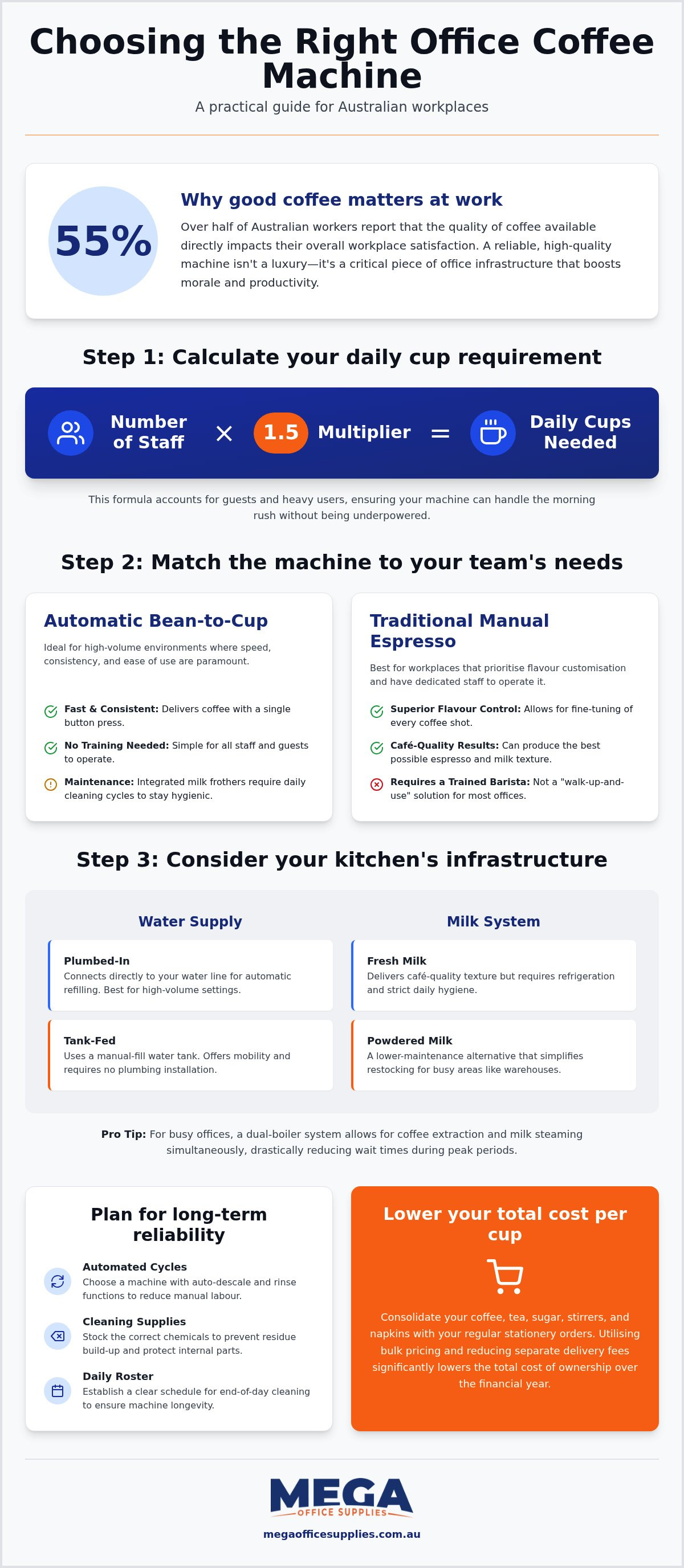
55% of Australian workers report that the quality of coffee available to them directly impacts their overall workplace satisfaction. It's a clear signal that the humble kitchenette setup has evolved into a critical piece of office infrastructure. Most office managers agree that a temperamental machine leads to staff frustration and an afternoon exodus to the local café. This 2026 buying guide provides a practical framework to help you select the right commercial coffee machine for office environments based on daily cup volume and maintenance requirements. We've drawn on our 17 years of industry experience to ensure you find a professional-grade solution that fits your budget and your benchtop. You'll learn how to calculate the total cost of ownership and choose a reliable system that even the most tech-averse staff can operate without a manual. Let's find a solution that works as hard as your team does.
Key Takeaways
- Determine your required capacity by multiplying your staff headcount by 1.5 to account for guests and those who view caffeine as a primary food group.
- Compare plumbed-in versus tank-fed water supplies to balance the convenience of automatic refills against the practical layout of your office kitchenette.
- Choose a commercial coffee machine for office use that matches your daily volume to ensure the hardware survives the morning rush without constant maintenance.
- Lower your total cost per cup by consolidating tea room consumables with your regular stationery orders to reduce delivery overheads and administrative friction.
Assessing your workplace requirements and coffee machine types
Choosing a commercial coffee machine for office use often comes down to a simple calculation of volume versus counter space. We recommend determining your daily cup requirements by multiplying your total staff count by 1.5. This formula accounts for guests and heavy users, ensuring your hardware isn't underpowered during the 9:00 am rush. Unlike domestic appliances, professional-grade systems are built for high-frequency use. They feature robust internal components designed to withstand hundreds of cycles daily without the mechanical failure common in home units.
To better understand how high-end commercial hardware operates in a professional setting, watch this detailed review:
Space is a significant constraint in most Australian kitchenettes and tea rooms. Evaluate the physical footprint of the unit, including clearance for overhead cupboards and access to water lines. It's helpful to research the broad types of coffeemakers available to see how specific boiler sizes and hopper dimensions align with your existing cabinetry. A machine that is too large for its designated benchtop will lead to cleaning difficulties and restricted workflow.
Automatic bean-to-cup vs traditional manual espresso
Automatic machines prioritise speed and consistency, allowing staff to prepare drinks with a single button press. These are ideal for high-volume environments where efficiency is paramount. Conversely, traditional manual machines offer superior flavour control but require a trained barista, which usually limits them to hospitality-focused offices. You must also consider the hassle factor of daily maintenance. While automatic models are convenient, they often include integrated milk frothers that need specific cleaning cycles to remain hygienic and functional.
Key technical specifications and maintenance considerations
Infrastructure decisions dictate the long-term reliability of your commercial coffee machine for office. Plumbed-in models eliminate the need for manual refills but require a fixed water connection. For smaller teams, tank-fed machines offer mobility without the need for professional plumbing. Technical specifications tested and reviewed by Popular Science highlight that boiler capacity is the most critical factor for managing the morning rush. A dual-boiler system ensures that coffee extraction and milk steaming occur simultaneously, which reduces wait times during peak periods.
Milk selection also influences your maintenance schedule. Choosing the right milk system for your commercial coffee machine for office helps balance flavour quality with cleaning effort. Fresh milk carafes deliver café-quality texture but require refrigeration and strict hygiene protocols. In high-traffic zones like warehouses or large schools, powdered milk systems provide a lower-maintenance alternative that simplifies the restocking process.
Daily and weekly cleaning requirements
Automated descale and rinse cycles are essential features that reduce the manual labour required from your staff. Without these, calcium build-up and milk proteins will quickly degrade internal components. Ensure your procurement includes the correct cleaning chemicals to prevent residue accumulation. Establishing a clear roster for end-of-day maintenance ensures the machine remains operational for years. We suggest stocking up on cleaning and hygiene supplies to maintain your equipment's performance and longevity.
Integrating coffee solutions into your office procurement strategy
Managing a commercial coffee machine for office use shouldn't be a siloed task. Consolidating your coffee and tea supplies with your general stationery orders reduces delivery overheads and administrative friction. We've seen that high-intent buyers often overlook the logistical cost of multiple small orders from various vendors. Utilising bulk pricing models for consumables like sugar, stirrers, and napkins significantly lowers the total cost per cup over a financial year. It's also efficient to coordinate machine maintenance with your wider facility supplies schedule to ensure no downtime during peak operational periods.
Recent data from the National Coffee Association's 2024 office coffee trends suggests that employees now expect high-quality beverage options as a standard workplace benefit. This shift means procurement officers must view the coffee station as a retention tool rather than a luxury. Reliability is the cornerstone of this strategy.
Budgeting for consumables and tax considerations
Accurate forecasting requires tracking the monthly consumption of beans and milk. This data allows you to predict annual breakroom expenditure with precision rather than relying on guesswork. For private businesses, a commercial coffee machine for office is typically treated as a depreciating asset. We recommend consulting your accountant regarding EOFY claims and current asset write-off thresholds. Government and educational buyers often operate on different budget cycles and requirements. For these sectors, we provide a streamlined process through official purchase orders to facilitate kitchenette upgrades without the complexity of traditional retail transactions.
Securing your office coffee infrastructure
Selecting a commercial coffee machine for office use is a decision that impacts daily productivity and long-term facility costs. By calculating your volume requirements accurately and choosing between manual or automated milk systems, you ensure your kitchenette remains a functional hub rather than a source of frustration. Consolidating your equipment and consumables into a single procurement stream further reduces administrative overheads and logistical friction.
As a 100% Australian-owned family business with 17 years of operation, we provide the regional expertise and local support needed to keep your tea room running smoothly. Our team's combined experience exceeds 150 years, giving you the security of professional-grade hardware backed by local knowledge and dependable national delivery.
Browse our range of breakroom and kitchen supplies
We're here to help you build a more efficient workplace, one cup at a time.
Frequently asked questions
How many staff members warrant a commercial-grade coffee machine?
Any workplace with more than 10 staff members usually requires a commercial-grade unit. Domestic machines lack the thermal stability and pump durability needed for back-to-back brewing. If your team drinks 15 or more coffees daily, a commercial coffee machine for office use is essential. It prevents the frequent breakdowns and long wait times associated with underpowered home appliances in a professional setting.
Do we need a plumbed water connection for an office coffee machine?
No, a plumbed connection isn't mandatory, as many professional models feature internal water tanks. These tank-fed units are ideal for flexible office layouts or rented spaces where plumbing modifications aren't possible. However, plumbed-in machines are better for large teams because they eliminate manual refilling. They also allow for high-capacity inline filtration systems that improve coffee taste and protect the machine's internal boilers.
What is the average lifespan of a commercial coffee machine in an office environment?
A commercial machine generally lasts between 5 and 10 years depending on usage and maintenance. Heavy scale build-up from unfiltered water is the most common cause of early failure. To maximise longevity, you should follow the manufacturer's cleaning protocols and use professional-grade chemicals. Regular preventative maintenance and annual electrical safety testing ensure the unit remains a reliable fixture in your office kitchenette.
Is it better to buy a coffee machine outright or use a rental contract?
Buying outright is typically the better financial choice for Australian businesses and government departments. Rental contracts often include inflated consumable prices and long-term interest that exceed the machine's retail value. By purchasing your commercial coffee machine for office, you retain full control over your supply chain. You can then source beans and cleaning supplies in bulk to significantly reduce your ongoing cost per cup.
Article by
Mega Office Supplies Team
The Mega Office Supplies Team provides practical buying guides and workplace advice for Australian businesses, schools, government organisations, healthcare providers, hospitality venues, warehouses and home offices. Family-owned and operated since 2009 and based in Tweed Heads South on the Gold Coast–Tweed border, Mega Office Supplies brings more than 150 years of combined team experience to helping Australian workplaces choose the right office supplies, furniture, technology, cleaning, safety and education products — backed by genuine local service from real people.
General Information
This article is provided as general information only to help customers compare and choose office, workplace, school, cleaning, technology, furniture, safety and business supplies. Product details, specifications, compatibility, availability, pricing and suitability may vary. Always check the individual product page, manufacturer information, workplace requirements and relevant safety guidance before purchasing or using a product.


