

Can a simple bookshelf really be the difference between a focused lesson and a chaotic afternoon? Most Australian educators understand the daily struggle of navigating a classroom overflowing with craft supplies and student resources, particularly when working within the limited footprint of an older school building. It's difficult to inspire students when you're constantly dodging a stray tub of glue sticks or a precarious stack of exercise books.
We've spent decades helping schools implement practical classroom storage furniture ideas that withstand the rigours of the school year. In this guide, we'll show you how to transform a cluttered room into a series of functional zones that encourage student independence and meet mandatory Australian safety standards. You'll discover durable furniture solutions and layout strategies designed to minimise distractions, improve student focus, and perhaps even save your sanity during a messy art session.
Key Takeaways
- Transition from static layouts to flexible zones using mobile shelving and modular units that allow for quick room reconfigurations.
- Select the right storage categories for your age group, comparing the benefits of individual tote tray systems versus open pigeonhole units.
- Prioritise safety and longevity by choosing commercial-grade furniture with rounded corners and mandatory anti-tip features for Australian environments.
- Implement classroom storage furniture ideas that encourage student autonomy, helping to minimise daily clutter while keeping essential learning resources accessible.
Effective classroom storage furniture ideas for modern learning environments
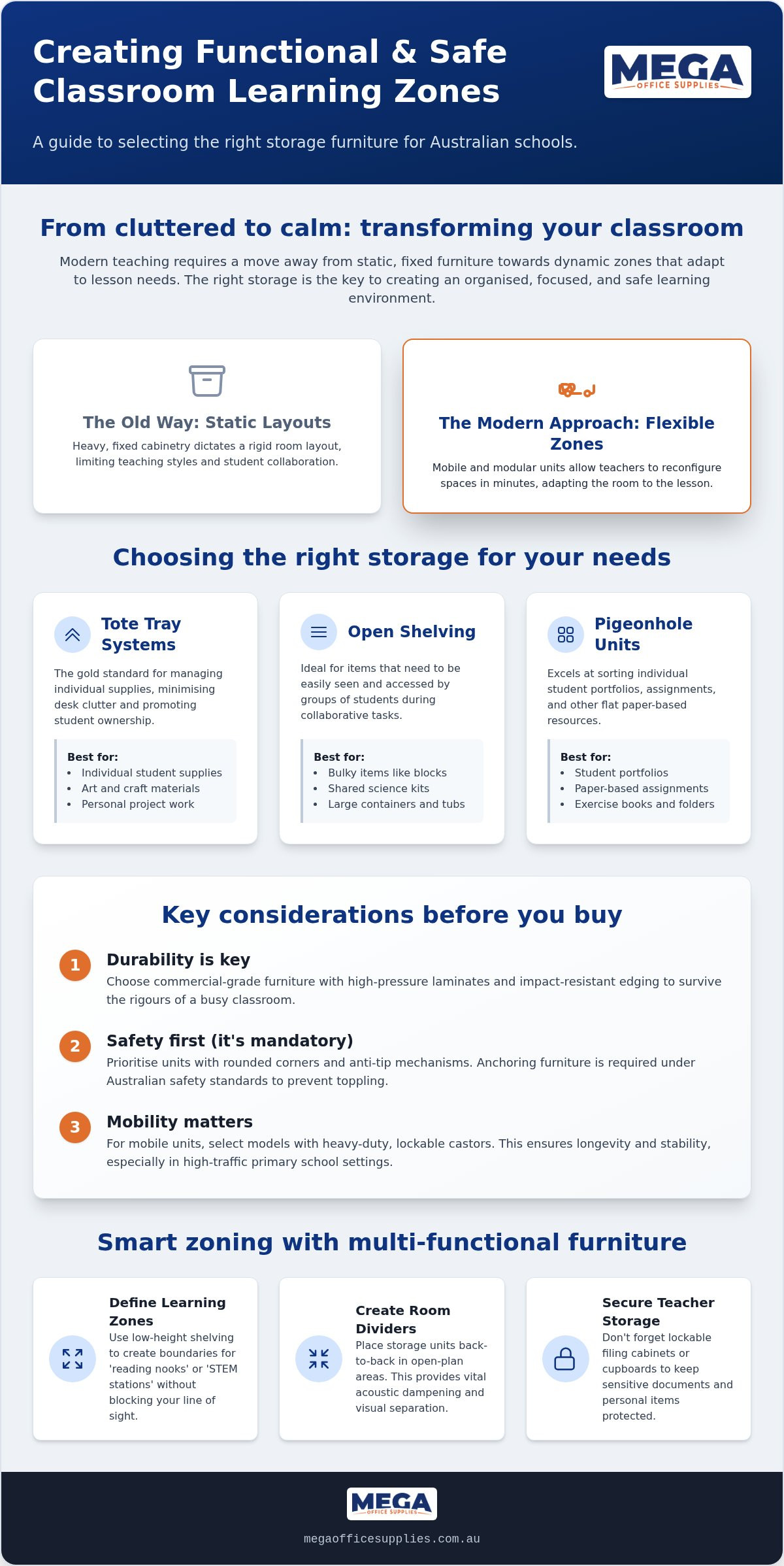
Modern pedagogy has moved away from static rows of desks toward dynamic, zoned areas. This shift within the classroom environment requires classroom storage furniture ideas that prioritise agility over permanence. We define flexible storage as modular furniture that serves at least two functional purposes in a classroom, such as a shelving unit that also acts as a room divider or a whiteboard surface. Using mobile shelving units allows teachers to reconfigure their space for group projects or quiet study in minutes. It ensures the room adapts to the lesson rather than the other way around.
Maximising vertical space is another critical strategy, especially in older Australian school buildings where floor space is at a premium. By utilising wall-mounted shelving or tall, narrow cabinets, you can reclaim 'dead space' on walls. This keeps the floor area clear for student movement and collaborative floor work. Implementing these classroom storage furniture ideas effectively reduces the feeling of overcrowding without needing a larger room.
Transitioning from traditional cupboards to mobile storage units
Heavy, fixed cabinetry is increasingly being phased out in favour of lockable, wheeled units. These mobile solutions offer far better floor plan versatility than traditional cupboards, which often dictate a rigid room layout. Tote tray trolleys are particularly effective for modern teaching. They promote student independence by allowing learners to manage their own educational supplies and craft materials without constant teacher intervention. When selecting these units, we recommend choosing models with heavy-duty castors. This ensures longevity in high-traffic primary school settings where furniture is moved daily. Reliability is key when your storage doubles as a moving part of your curriculum delivery, unless you enjoy the sound of squeaky wheels during a silent reading block.
Essential storage categories to organise your teaching space
Selecting the correct classroom storage furniture ideas requires a clear understanding of your specific curriculum needs and student age group. Tote tray systems remain the gold standard for managing individual student supplies and art materials because they promote a sense of ownership while minimising desk clutter. It's certainly more efficient than watching a student hunt for a single glue stick at the bottom of a communal bucket. When comparing open shelving to pigeonhole units, consider the volume of loose resources versus paper-based work:
- Open shelving: Best for bulkier items like building blocks, science kits, or shared containers.
- Pigeonhole units: Excel at sorting individual student portfolios and paper-based assignments.
For a truly collaborative environment, consider units with integrated whiteboards on the reverse. This creates double-sided, multi-functional stations that serve as both storage and brainstorming hubs. Teachers can find a comprehensive range of educational supplies through our online store to stock these new units.
Zoning your classroom with multi-functional furniture
Creating distinct learning zones involves using low-height shelving to define boundaries for 'reading nooks' or 'STEM stations'. These units establish clear areas without blocking your line of sight, which is essential for maintaining supervision in busy primary environments. In open-plan schools, placing storage units back-to-back creates natural room dividers that provide vital acoustic dampening between different learning groups. While student-facing storage is the priority, don't overlook secure teacher-only areas. Incorporating office furniture supplies like lockable filing cabinets ensures that sensitive documentation and personal items remain protected. Implementing these professional classroom storage furniture ideas ensures your space remains organised and adaptable. You can browse our classroom supplies to find durable options that meet Australian safety standards.
What to consider before buying classroom storage furniture
Before finalising any classroom storage furniture ideas, you must evaluate the structural durability of the materials. Professional educational furniture should feature high-pressure laminates and impact-resistant edging to survive the constant friction of heavy school bags and moving chairs. We recommend prioritising units with rounded corners and anti-tip mechanisms. This is particularly important under the Consumer Goods (Toppling Furniture) Information Standard 2024, which requires anchoring and warning labels for any storage units over 686 mm high. Safety isn't just a preference; it's a mandatory compliance requirement for modern learning spaces.
Aligning your procurement with Australian school budget cycles ensures you maximise available funding. While private institutions often focus on EOFY considerations for their operating supplies, government schools require a more formal administrative workflow. To simplify this process, we accept Australian Government purchase orders. This allows administrators to secure high-quality furniture without the delays often associated with standard retail payment methods.
Maximising durability and safety in high-traffic school areas
Selecting furniture that meets Australian standards for stability and weight-bearing capacity is vital. While domestic 'flat-pack' options might seem cost-effective, they frequently lack the reinforced joints necessary for a high-traffic school environment. Fully assembled or commercial-grade units offer the structural longevity required for decades of use. Before placing a bulk order, measure your space with precision. You must account for door swings and fire exit clearances. It is better to lose a few centimetres of shelf depth than to inadvertently block a critical evacuation path during an emergency drill.
Creating a functional and organised learning space
Implementing effective classroom storage furniture ideas is about more than just hiding supplies; it's about building a foundation for student independence. By prioritising mobile, multi-functional units and ensuring all furniture meets mandatory Australian anti-tip standards, you create a dynamic environment that adapts to any lesson. We understand that school procurement requires a reliable partner who understands local budget cycles and administrative needs.
With over 17 years of expertise and a combined team knowledge exceeding 150 years, we provide the regional support and industrial-grade quality your school demands. We accept official Australian Government purchase orders to make your ordering process as straightforward as possible.
Browse our full range of classroom storage and educational furniture
We look forward to helping you build an organised classroom where both teachers and students can thrive.
Frequently asked questions
What is the best way to store student water bottles in the classroom?
Dedicated bottle crates or pigeonhole units are the most efficient classroom storage furniture ideas for managing hydration in a busy room. They prevent spills on student work and keep bottles away from electronic devices. We recommend placing these units near the door or a sink to minimise unnecessary movement. Using a tiered rack saves bench space while keeping every bottle visible and easily accessible.
How do I choose between open shelving and cupboards with doors for a primary school?
Choosing between these options depends on the frequency of use and the desired visual environment. Open shelving is ideal for high-rotation resources like reading books because it allows for rapid access. Conversely, cupboards with doors are better for art supplies or seasonal materials. Closing the doors helps minimise visual distractions, which often helps students stay focused during quiet study periods.
Are there specific safety standards for Australian classroom furniture?
Several Australian Standards apply to educational furniture to ensure student safety and product longevity. The Consumer Goods (Toppling Furniture) Information Standard 2024 is a mandatory regulation for storage units over 686 mm high. Other benchmarks include standards for stability and weight-bearing capacity. We ensure our classroom storage furniture ideas align with these rigorous national safety requirements to provide peace of mind.
Can I use office filing cabinets for classroom storage?
Professional office filing cabinets are highly effective for secure, teacher-only storage within a classroom. They provide a lockable, fire-resistant space for sensitive student records, assessment data, and confidential documentation. While they aren't recommended for student-facing areas because of their weight and sharp edges, they are essential for maintaining administrative organisation. It's a practical way to keep your professional resources separate from classroom clutter.
Article by
Mega Office Supplies Team
The Mega Office Supplies Team provides practical buying guides and workplace advice for Australian businesses, schools, government organisations, healthcare providers, hospitality venues, warehouses and home offices. Family owned and operated since 2008 and based in Tweed Heads South on the Gold Coast–Tweed border, Mega Office Supplies helps Australian workplaces choose the right office supplies, furniture, technology, cleaning, safety and education products — backed by genuine local service from real people.
General Information
This article is provided as general information only to help customers compare and choose office, workplace, school, cleaning, technology, furniture, safety and business supplies. Product details, specifications, compatibility, availability, pricing and suitability may vary. Always check the individual product page, manufacturer information, workplace requirements and relevant safety guidance before purchasing or using a product.


