

You've spent hours perfecting a critical report, only to find the plastic has lifted the ink and toner when you try to remove the page. It's a common frustration in Australian offices, often paired with flimsy pockets that tear or glare that makes reading feel like a squinting exercise under overhead lights. We understand that choosing the right sheet protectors for documents is a technical decision that impacts both professional presentation and archival safety.
We draw on our team's extensive industry knowledge to help you select the ideal solution for your filing system. You'll learn how to identify the correct micron count for specific tasks, distinguish between clear and non-glare finishes, and ensure compatibility with standard Australian lever arch files. We outline the technical specifications you need to keep your records secure and legible for years to come.
Key Takeaways
- When choosing the right sheet protectors for documents, always verify they are acid-free and copy-safe to prevent ink from lifting and damaging your records.
- Match the micron thickness to the frequency of use, selecting 80 microns for standard archiving and 125 microns or more for heavy-duty workplace signage.
- Look for an 11-hole universal punch pattern to ensure your protectors fit all standard Australian 2, 3, and 4-ring lever arch files and binders.
- Evaluate your environment to decide between high-clarity clear finishes for presentations or non-glare surfaces to minimise reflections under harsh office lighting.
Understanding sheet protector specifications and materials
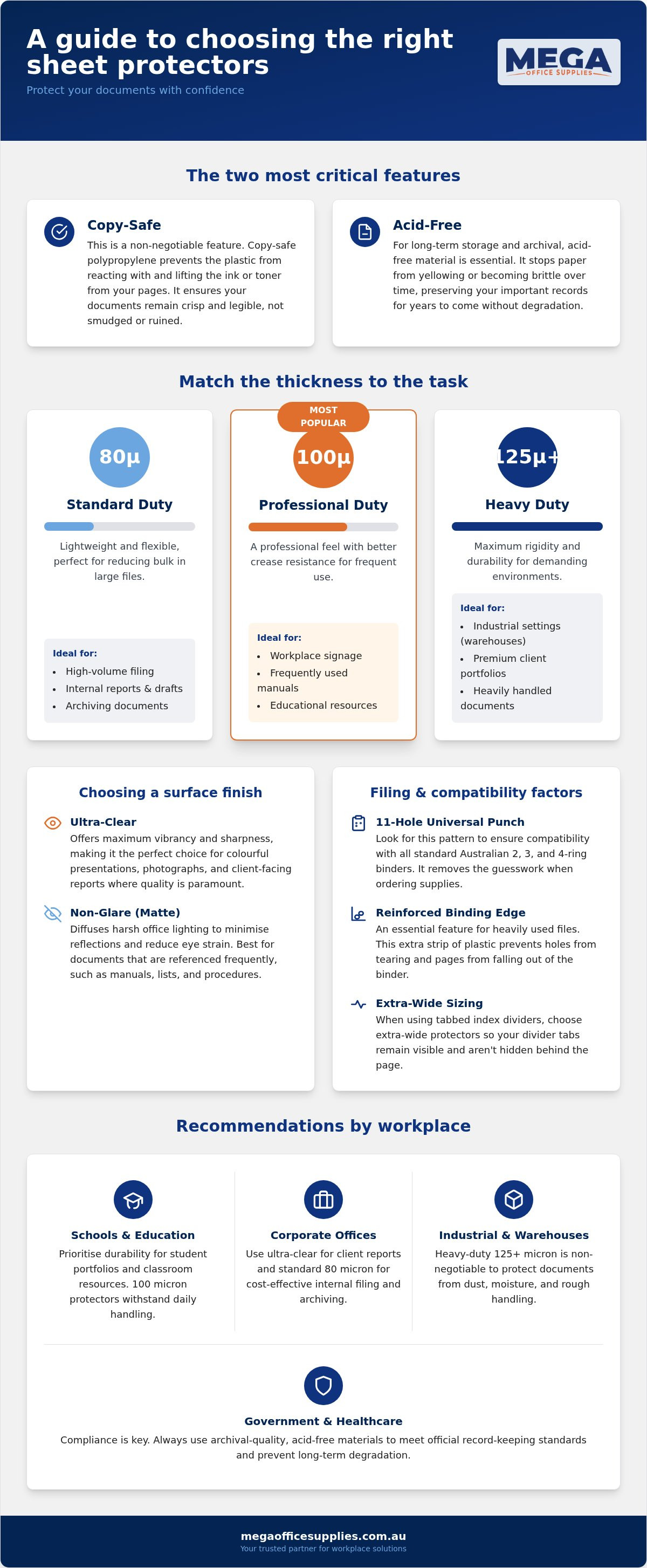
A sheet protector, often called a Punched pocket (sheet protector), is typically manufactured from polypropylene. This material is chosen for its chemical stability and durability. When choosing the right sheet protectors for documents, you must verify they are copy-safe and acid-free. These specifications prevent the plastic from reacting with toner or ink. Without these properties, your documents can bond to the sleeve. This causes ink to lift when you try to remove the page, which is about as helpful as a stapler with no staples.
Surface finish affects both aesthetics and legibility. Ultra-clear finishes offer maximum vibrancy, making them ideal for colourful presentations. However, non-glare or matte finishes are often better for high-readability under harsh office lights. These diffuse reflections, reducing eye strain for staff who reference documents frequently.
We measure the durability of these sleeves in microns. This unit defines the thickness and rigidity of the plastic. Selecting the correct thickness is a primary factor in choosing the right sheet protectors for documents that will last in high-traffic environments.
Choosing the right micron count for your needs
Matching thickness to your specific application ensures your stationery stands up to its intended use:
- Standard 80 micron: These are ideal for high-volume filing and everyday reports. They provide reliable protection without adding excessive bulk to your binders.
- Professional 100 micron: Best for workplace signage, frequently used manuals, and educational resources. They offer a more professional feel and better crease resistance.
- Heavy-duty 125+ micron: Designed for industrial environments and premium portfolios. These provide maximum rigidity and can withstand heavy handling in demanding conditions.
Practical considerations for filing and document access
Choosing the right sheet protectors for documents requires more than just picking a thickness. In Australia, our binder systems vary, making the 11-hole universal punch pattern a critical specification. This configuration ensures compatibility across standard 2, 3, and 4-ring binders, removing the guesswork from procurement. For high-capacity folders, we recommend protectors with a reinforced binding edge. This extra strip of plastic prevents the document from tearing away from the rings, a frequent point of failure in files that see heavy daily use.
Opening styles also dictate workflow efficiency. Top-loading pockets offer maximum security, ensuring pages don't slide out during transit. Conversely, side-loading options allow for rapid document swaps without opening the binder rings. For thicker brochures or multi-page reports, expandable sheet protectors are the correct choice. These feature gusseted sides that accommodate bulk without warping the plastic. Following archival storage guidelines by using chemically stable polypropylene ensures these documents remain protected without the risk of ink transfer over time.
Matching protectors to Australian binder systems
When organising bulk records in filing and storage systems, consider how the sleeves interact with your binders. Standard sheet protectors are slightly wider than A4 paper. If you use index dividers, ensure you select "extra-wide" versions so the tabs extend past the protector edge and remain visible. Always check that the protector width does not overhang the binder cover, as this leads to damaged edges when files are shelved. To ensure a perfect fit for your project, you can browse our range of binders and folders designed for professional use.
Selecting the right option for your workplace environment
Different workplaces demand different specifications. When choosing the right sheet protectors for documents in schools, durability for student portfolios is paramount. We recommend bulk procurement of student stationery to ensure classroom consistency. In government and healthcare sectors, compliance is the priority. You must use archival-quality, acid-free materials to meet official record-keeping standards without the risk of long-term degradation.
Corporate environments often balance professional aesthetics with budget. Clear finishes provide a sharp look for client-facing reports, while standard 80 micron sleeves are suitable for internal filing. For industrial and warehouse settings, heavy-duty protection is non-negotiable. Selecting 125+ micron protectors ensures documents withstand dust, moisture, and the rough handling typical of a busy distribution centre. Mismatched sleeves can make a professional filing system look like a bit of a lucky dip, which is rarely the desired aesthetic for an audit.
Tips for high-volume procurement and organisation
Managing large-scale projects is easier when you standardise your supplies. Utilising business accounts allows procurement officers to access bulk pricing, which helps minimise operational costs. To streamline the process for departments, we accept official Australian Government purchase orders. Standardising on a single trusted brand, such as Rexel or Marbig, ensures every sleeve has a consistent width and hole configuration. This simplifies the process of choosing the right sheet protectors for documents across multiple sites and maintains a uniform appearance across your entire filing system.
Optimise your professional filing system
Selecting the appropriate protection for your records involves balancing micron thickness with your specific workplace environment. Prioritising acid-free and copy-safe polypropylene is essential to prevent ink transfer, while ensuring compatibility with Australian 11-hole punch systems keeps your binders organised. Choosing the right sheet protectors for documents ensures your critical information remains legible and professional for years to come.
We've been family owned and operated since 2008. Our Gold Coast and Tweed Coast team provides real local support to help you find the exact specifications for your organisation's needs.
Browse our full range of professional sheet protectors and filing supplies
We look forward to helping you organise your workplace with the precision and reliability your team deserves.
Frequently asked questions
What is the difference between microns and mils in sheet protectors?
Microns are the metric unit used in Australia, while mils are imperial. One mil equals approximately 25.4 microns. In the Australian market, you'll almost exclusively see micron ratings. For instance, a standard 80 micron protector is roughly 3 mils. Choosing the right sheet protectors for documents involves understanding these metric measurements to ensure you get the correct thickness for your specific filing task.
Will my documents stick to the plastic over time?
Documents will only stick if you use low-quality PVC sleeves that contain migrating plasticisers. To prevent ink and toner from lifting, always choose polypropylene protectors labelled as copy-safe and acid-free. These materials are chemically stable and won't bond with your printed pages. This is a critical factor when choosing the right sheet protectors for documents intended for long-term archival storage.
Can I use sheet protectors in a 3-ring or 4-ring binder?
Yes, provided you select protectors with a universal 11-hole punch pattern. This configuration is specifically designed to fit Australian 2, 3, and 4-ring binders, as well as standard lever arch files. This versatility eliminates the need to buy different sleeves for various folder types. it makes it much easier to maintain a consistent and organised filing system across your entire office.
What is the best sheet protector finish for a presentation?
An ultra-clear, high-gloss finish is usually the best choice for presentations because it enhances the colour and contrast of your documents. It makes charts and images appear more vibrant. If you are presenting in a room with harsh overhead fluorescent lighting, consider a non-glare matte finish. This reduces reflections and ensures your audience can read the text clearly without distraction.
Article by
Mega Office Supplies Team
The Mega Office Supplies Team provides practical buying guides and workplace advice for Australian businesses, schools, government organisations, healthcare providers, hospitality venues, warehouses and home offices. Family owned and operated since 2008 and based in Tweed Heads South on the Gold Coast–Tweed border, Mega Office Supplies helps Australian workplaces choose the right office supplies, furniture, technology, cleaning, safety and education products — backed by genuine local service from real people.
General Information
This article is provided as general information only to help customers compare and choose office, workplace, school, cleaning, technology, furniture, safety and business supplies. Product details, specifications, compatibility, availability, pricing and suitability may vary. Always check the individual product page, manufacturer information, workplace requirements and relevant safety guidance before purchasing or using a product.


