

Have you ever pulled a duplicate from a file only to find the ink has smudged into an illegible grey blur? It's a common frustration in Australian workplaces, where the wrong choice of carbon paper often leads to messy hands and unusable documents. You likely agree that while digital backups are standard, a physical, tamper-proof copy provides a level of security that software cannot always replicate.
We'll show you how to select the right stationery for archival security and artistic precision. This guide explores the technical differences between handwriting and typewriter grades, the functional logic behind blue versus black ink, and how to maintain records that satisfy Australian regulatory standards. Choosing the correct sheets ensures your duplicates remain crisp for the seven-year retention period, preventing the "blue finger" look that plagues the unprepared.
Key Takeaways
- Distinguish between high-pressure pencil carbon for stylus use and thinner typewriter sheets to ensure clear, precise transfers every time.
- Select black carbon paper for formal legal or medical records to maintain professional standards, or use blue ink for standard handwritten receipts.
- Prioritise polymer-based coatings and appropriate gsm weights to minimise messy smudging and prevent the carrier paper from tearing during heavy use.
- Ensure the matte side faces down on a hard, flat surface to create legible duplicates that comply with Australian seven-year archival storage regulations.
Choosing the correct carbon paper for your specific needs
Selecting the wrong grade of these sheets often results in illegible records or unnecessary equipment wear. Most procurement officers don't realise that the transfer medium must match the pressure of the application tool. While it hasn't quite reached the celebrity status of the ballpoint pen, carbon paper remains the unsung hero of the duplicate receipt. We recommend identifying whether your organisation requires sheets for manual styluses or mechanical impact keys before placing a bulk order.
Understanding the history of carbon paper reveals how manufacturing evolved to support different workplace technologies. For modern office supplies, we distinguish between one-time use sheets and reusable variants. Reusable sheets are coated with a thicker ink layer, allowing for multiple transfers from the same surface, which offers superior value for high-volume administration.
Distinguishing between hand-writing and impact-printing paper
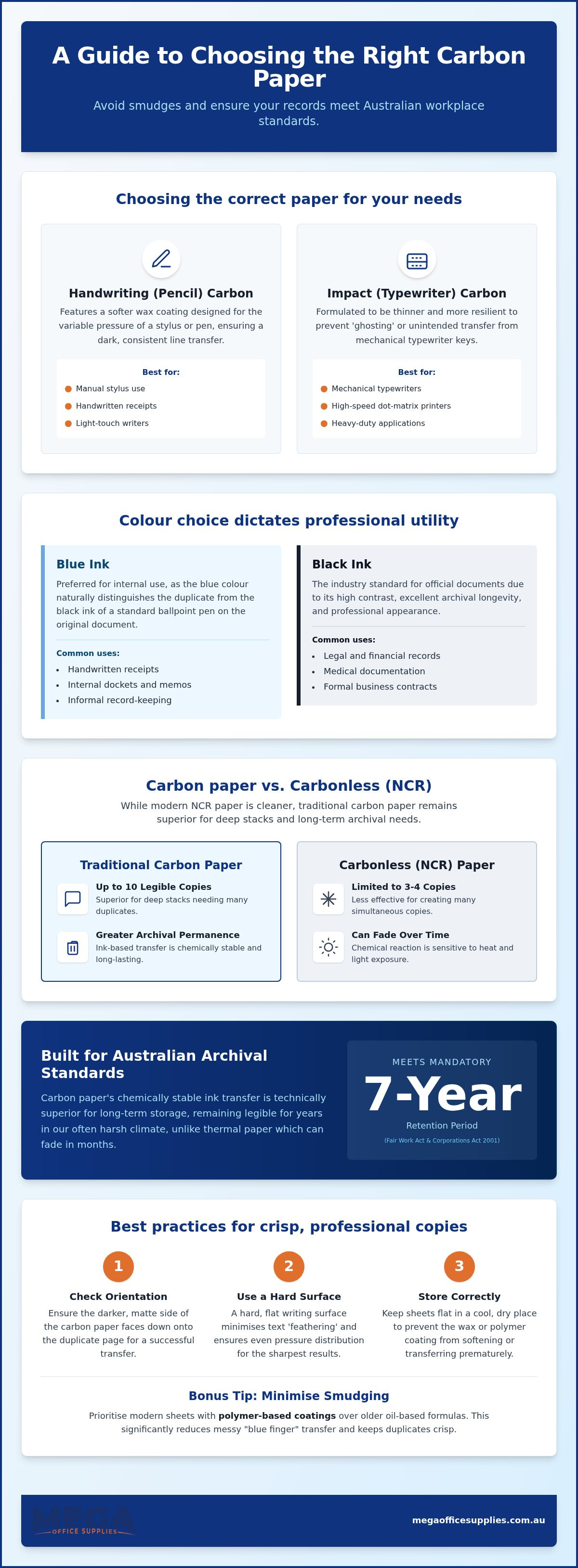
Pencil carbon features a softer wax coating specifically designed to react to the variable pressure of a stylus or pen. It ensures a dark, consistent line even if the writer has a light touch. Conversely, impact carbon is formulated to be thinner and much more resilient. This prevents 'ghosting' or unintended ink transfer when used with mechanical typewriters or high-speed dot-matrix printers.
Colour choice also dictates professional utility. Black ink is the industry standard for legal, medical, and formal business documents due to its high contrast and archival longevity. Blue ink is frequently preferred for handwritten receipts or internal dockets, as the colour naturally distinguishes the duplicate from the black ink of a standard ballpoint pen.
Technical specifications and paper quality considerations
The weight of the carrier paper, measured in grams per square metre (gsm), determines the sheet's resilience under pressure. We find that a higher gsm prevents the sheet from tearing when a user applies the heavy pressure required for multi-page duplication. Modern professional-grade sheets have transitioned away from messy oil-based formulas. Instead, they utilise a polymer-based ink that significantly reduces smudging and "blue finger" transfer. Understanding the carbon paper composition is vital for procurement, as these polymer coatings ensure that the duplicate remains crisp and legible for years. Choosing the wrong colour can lead to more confusion than a meeting that could have been an email.
Standard A4 sheets remain the most common format for Australian administrative tasks. However, specialised rolls are available for bespoke drafting or design work where continuous duplication is necessary. These rolls allow for custom sizing in architectural or engineering environments. For those managing high-volume document workflows, you can browse our full range of writing supplies to find compatible pens and styluses.
Carbon paper vs carbonless NCR alternatives
Many modern offices use No Carbon Required (NCR) paper for convenience. While NCR is cleaner, it relies on a chemical reaction that typically limits clear duplication to three or four sheets. Traditional carbon paper remains superior for deep stacks, allowing for up to 10 legible copies in a single pass. Crucially, carbon-ink transfers offer greater archival permanence, as NCR images can fade when exposed to light or heat.
Best practices for professional use and archival storage
Preventing an embarrassing blank copy starts with identifying the active side of the sheet before you begin writing. The darker, matte side of the carbon paper must face down onto the duplicate page to ensure successful ink transfer. For the sharpest results, we recommend using a hard, flat writing surface rather than a padded notebook or a soft desk mat. This simple step minimises "feathering" of the text and ensures that the pressure from your pen or stylus is distributed evenly through the stack. Stored correctly, your carbon paper will likely outlast your favourite office stapler.
In Australian business environments, long-term record retention is a legal necessity rather than a suggestion. Carbon paper copies are technically superior to thermal receipts for archival storage in our often harsh climate. Thermal paper reacts poorly to heat and light, frequently fading to white within months. By contrast, carbon-ink transfers are chemically stable. They remain legible for the mandatory seven-year retention period required for employment and financial records under the Fair Work Act and Corporations Act 2001.
Maximising the lifespan of your reusable carbon sheets
Proper storage is essential to maintain the integrity of the wax coating on multi-use sheets. We suggest keeping sheets flat in a cool, dry place to prevent the polymer or wax from softening or transferring prematurely. To extend the life of each page, rotate the sheet 180 degrees after heavy use. This technique allows you to access fresh ink areas that haven't been depleted by previous stylus strikes, ensuring your filing and storage systems remain clear and professional.
Securing your professional records with the right supplies
Selecting high quality carbon paper ensures your organisation maintains legible, tamper-proof records that satisfy Australian archival standards. By matching the sheet's gsm and ink coating to your specific writing tools, you eliminate messy smudges and preserve document integrity for the required seven-year retention period. Clarity matters. Getting your duplicates right the first time is certainly more productive than playing "guess the signature" on a faded receipt. Our team provides local support. We also accept official Australian Government purchase orders to simplify procurement for schools and departments.
Browse our full range of carbon paper and writing supplies
You're now equipped to choose the most durable solutions for your office. We're here to help you maintain a reliable and organised workflow.
Frequently asked questions
How many times can a single sheet of carbon paper be reused?
A single sheet of professional-grade carbon paper can typically be reused five to ten times depending on the pressure applied and the density of your writing. To maximise this utility, we suggest rotating the page 180 degrees after heavy use to access fresh ink reservoirs. Higher gsm carrier papers generally offer better durability for multiple transfers in busy administrative environments.
What is the difference between blue and black carbon paper for business?
Black ink is the primary choice for legal, medical, and financial records because it provides the highest contrast for archival scanning and long-term legibility. Blue ink is frequently used for handwritten receipts or dockets. This colour helps staff quickly distinguish the duplicate copy from the original document, which is usually written with a standard black ballpoint pen.
Can carbon paper be used on all types of stationery and copy paper?
You can use these sheets with most standard office stationery, including 80gsm copy paper and lightweight exercise books. Results may vary if you attempt to use heavy cardstock or highly textured paper, as these surfaces require significantly more pressure to achieve a clear transfer. We recommend testing a single sheet first to ensure the ink bonds correctly to your specific paper type.
Is carbon paper messy to use in a modern office environment?
Modern sheets are significantly cleaner than traditional versions because they utilise polymer-based inks rather than old-fashioned oil-based coatings. This technology reduces smudging and prevents ink from transferring to your hands or other documents during filing. If you handle the sheets by the edges, you won't end the day looking like you've been fingerprinting a very cooperative smurf.
Article by
Mega Office Supplies Team
The Mega Office Supplies Team provides practical buying guides and workplace advice for Australian businesses, schools, government organisations, healthcare providers, hospitality venues, warehouses and home offices. Family owned and operated since 2008 and based in Tweed Heads South on the Gold Coast–Tweed border, Mega Office Supplies helps Australian workplaces choose the right office supplies, furniture, technology, cleaning, safety and education products — backed by genuine local service from real people.
General Information
This article is provided as general information only to help customers compare and choose office, workplace, school, cleaning, technology, furniture, safety and business supplies. Product details, specifications, compatibility, availability, pricing and suitability may vary. Always check the individual product page, manufacturer information, workplace requirements and relevant safety guidance before purchasing or using a product.


