


Most "extra-large" office chairs are actually just wider versions of standard models, failing to address the fundamental geometric needs of a tall frame. If you're over 185cm, you've likely spent years dealing with seat pans that end mid-thigh and lumbar supports that press into your mid-back instead of your lower curve. It's a common frustration for tall professionals across Australia who find that typical commercial furniture simply doesn't rise high enough to keep their hips and knees at the correct ergonomic angles.
Finding the best office chair for tall person Australia requires looking beyond marketing labels and focusing on verifiable standards like AS/NZS 4438:1997 and AFRDI Level 6 Blue Tick certification. At Mega Office Supplies, our team draws on decades of combined industry experience to help you navigate these technical requirements. This guide will show you exactly how to match seat pan depth to your femur length and why the right gas lift range is non-negotiable for long-term spinal health. You'll learn which high-performance models currently lead the 2026 market and how to configure a workstation that provides genuine, professional-grade support.
Key Takeaways
- Understand why standard chairs cause the "perching" effect and how to identify models designed specifically for users over 185cm.
- Identify the critical technical specifications required for long femurs, including the benchmark 500mm seat pan depth and extra-high backrest designations.
- Learn the two-step measurement process to calculate your personal popliteal height and buttock-popliteal length for a precise ergonomic fit.
- Evaluate the 2026 market leading models to find the best office chair for tall person Australia based on AFRDI Level 6 Blue Tick certification.
- Discover how to coordinate high-volume procurement and professional office fit-outs through an established Australian-owned supplier.
The Unique Ergonomic Challenges for Tall Professionals in Australia
Within the Australian corporate landscape, a "tall user" is generally defined as any professional standing 185cm or taller. Most standard office furniture is manufactured to accommodate the 5th to 95th percentile of the general population, which often leaves those at the upper end of the height spectrum with equipment that is fundamentally unfit for purpose. This mismatch isn't merely a matter of personal preference; it represents a failure to apply the core principles of ergonomics, which require that the workplace be adapted to the specific physiological needs of the individual.
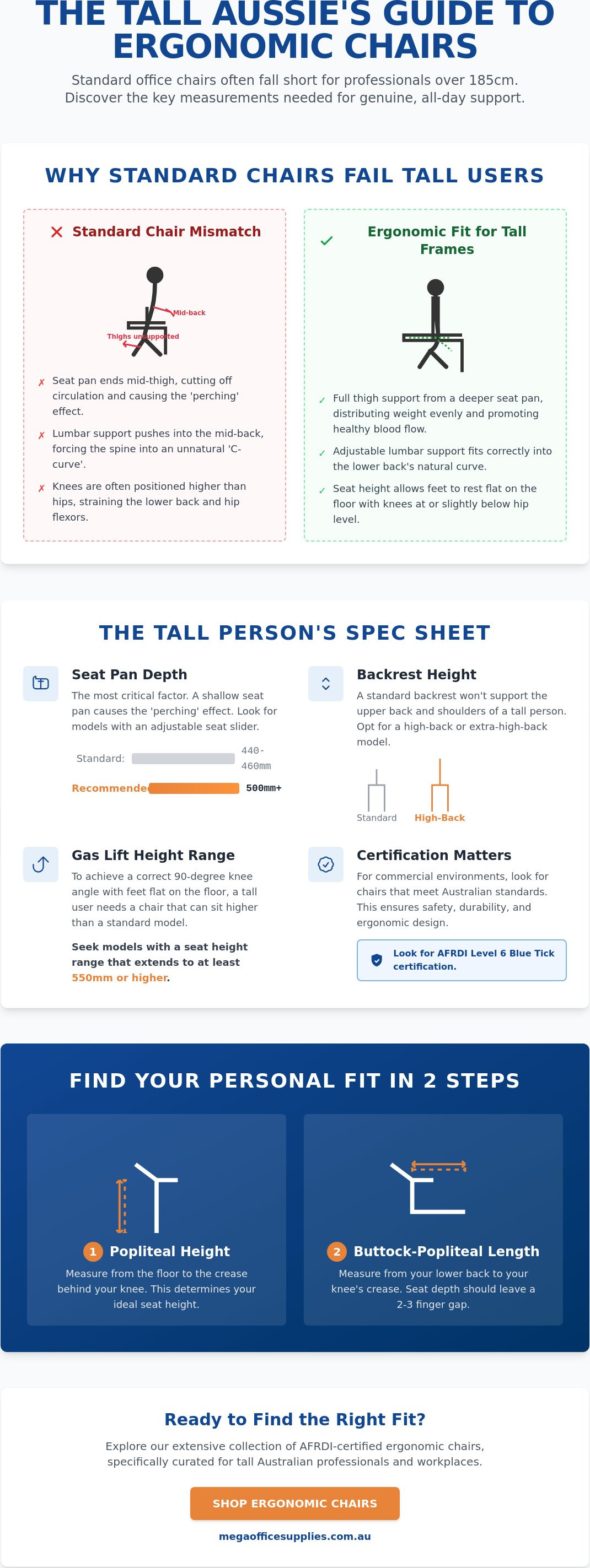
The most common issue tall professionals face is the "perching" effect. This occurs when the seat pan depth is too shallow for the user's femur length. Instead of the seat providing full support from the hips to just behind the knees, the chair ends mid-thigh. This concentrates the user's entire body weight onto a small surface area, leading to restricted blood flow and significant leg fatigue. Finding the best office chair for tall person Australia involves sourcing a model with an adjustable seat slider that can extend to provide a stable, supportive base for longer limbs.
To understand how specific chair dimensions impact user posture, watch this detailed review of high-capacity seating:
Physiological Impact of Poor Chair Fit
When a chair is too small, the body naturally compensates in ways that lead to chronic pain. A standard backrest often features lumbar support that hits a tall user in the mid-back rather than the lower spinal curve. This misalignment forces the spine into an unnatural "C-curve" slouch, putting excessive pressure on the intervertebral discs. Neck strain is also common; many integrated headrests on standard chairs hit the shoulder blades of a tall person instead of the occipital bone, effectively pushing the head and neck forward into a strained position.
The Productivity Case for Proper Sizing
For procurement officers and business owners, providing anthropometrically correct furniture is a vital risk management strategy. Using the best office chair for tall person Australia helps reduce the frequency of workplace injury claims related to musculoskeletal disorders. There's also a direct correlation between physical comfort and cognitive endurance. A professional who isn't constantly shifting their weight to alleviate hip or back pain can maintain focus for longer durations. Investing in high-back ergonomic solutions is a calculated decision that prioritises long-term staff health and operational efficiency over the false economy of "one-size-fits-all" seating.
The Tall Person Spec Sheet: Critical Features to Compare
Selecting the best office chair for tall person Australia requires a shift in focus from aesthetic appeal to technical specifications. While most manufacturers label their products as ergonomic, tall users need to look for specific measurements that accommodate longer skeletal frames. Standard commercial chairs often feature a seat depth of 440mm to 460mm, which is insufficient for anyone over 185cm. To maintain musculoskeletal health, you must prioritise hardware that meets or exceeds the benchmarks for deep-seated support and extended vertical range.
Following a structured ergonomic office setup guide ensures that individual components, such as seat height and backrest tension, work together to support your posture. For tall professionals, the objective is to achieve a neutral spine position while ensuring the legs are properly supported and the feet remain flat on the floor. If you're outfitting a corporate space, our range of ergonomic office furniture includes models specifically engineered with these extended dimensions.
Understanding Seat Pan Depth and Sliders
Seat Pan Depth is defined as the horizontal distance from the backrest to the front edge of the cushion. For those with long femurs, a minimum depth of 500mm is the industry benchmark. You should use the "Two-Finger Rule" to check your fit: there should be a gap approximately the width of two fingers between the edge of the seat and the back of your knees. While fixed deep pans are available, an adjustable seat slider is often the superior choice. It allows for manual precision, letting you extend the seat forward to provide maximum thigh support without putting pressure on the popliteal fossa (the back of the knee).
Gas Lift Classes and Height Extensions
The vertical range of your chair is determined by the gas lift. For Australian commercial environments, always look for a Class 4 gas lift. These are built with thicker steel walls and higher-grade internal components compared to Class 3, providing better durability and a smoother height adjustment range. If a standard desk height feels too low even at the chair's maximum extension, you might require a "High-Drafter" gas lift. This ensures your hips remain slightly higher than your knees, creating a 90 to 100-degree angle that prevents lower back strain. Verify that any lift used carries an AFRDI rating to ensure it meets safety and weight capacity standards for long-term workplace use.
Backrest height is equally critical. You should seek the "Extra High Back" designation, which typically indicates a backrest height of 600mm or more. This ensures the lumbar support reaches the lower curve of your spine while the upper portion supports your shoulder blades. Similarly, armrests must be both height and width adjustable. Narrow armrests on a broad frame force the shoulders to "shrug" or rotate inwards, leading to tension headaches and upper back pain. Choosing a chair with 4D armrests allows you to position the support exactly where your elbows naturally rest.
Evaluating the Top Contenders: Heavy-Duty vs. High-Back vs. Deep-Seat
Identifying the right hardware depends on whether you require increased weight capacity, a specific professional aesthetic, or maximum adjustability for long-duration tasking. The market for the best office chair for tall person Australia is generally divided into three specific types: heavy-duty "Big and Tall" models, high-back executive chairs, and deep-seat ergonomic task chairs. While some overlap exists, understanding these categories prevents the common mistake of purchasing a chair that looks large but lacks the reinforced internal components necessary for a taller frame.
The "Big and Tall" category is engineered for users who require both extra height and a higher weight rating, typically between 150kg and 200kg. These chairs feature wider wheelbases and reinforced seat plates to handle the increased leverage that longer limbs apply to the chair's pivot points. Conversely, high-back executive chairs prioritise full-length spinal support and often use premium materials. While they offer excellent shoulder support, you should ensure the model you select includes an independent seat-slide function, as many executive styles have fixed seat pans that may still be too short for those over 185cm.
AFRDI Standards and Workplace Safety
In the Australian procurement sector, the AFRDI Blue Tick certification is the definitive benchmark for quality. When you're evaluating the best office chair for tall person Australia, you should specifically look for Level 6 (Severe Commercial Use) accreditation. This rating confirms the chair has undergone rigorous independent testing for strength, durability, and stability in demanding environments. While an "Orange Tick" refers specifically to the gas lift component, the Blue Tick covers the entire chair assembly. Verifying these claims against the Australasian Furnishing Research and Development Institute database ensures you aren't relying on unverified manufacturer marketing.
Material Selection for Durability
The Australian climate makes thermal regulation a primary consideration for larger surface area seating. Mesh backrests provide superior airflow, which helps minimise heat build-up during long shifts in non-ducted environments. However, for the seat pan itself, high-density moulded foam often provides better long-term integrity than mesh, which can lose tension under high-leverage use. When browsing our commercial furniture range, consider the following material specifications:
- Reinforced Bases: Opt for polished aluminium or heavy-duty reinforced nylon bases rather than standard plastic to prevent cracks under stress.
- Castor Selection: Ensure the chair is fitted with large-diameter castors (60mm+) that match your flooring. Hard floor castors prevent sliding on timber, while carpet castors provide the necessary grip for standard office tiles.
- Upholstery Grade: Look for fabrics with a high Martindale rub count (50,000+) to ensure the seat edges don't fray from the increased movement typical of taller users.
Physical comfort in the workplace is a result of matching these industrial-grade materials with the specific dimensions of your body. A chair might look substantial, but without Level 6 accreditation and high-density components, it won't provide the decade-long service life expected in professional Australian offices.
Measuring for Success: How to Find Your Personal Fit
Relying on the "sit and test" method is often impractical for remote procurement or high-volume office fit-outs. To secure the best office chair for tall person Australia, you should adopt a data-driven approach based on your specific body measurements. This ensures the hardware you acquire provides the necessary geometric support for your frame without the need for constant trial and error. By following a structured measurement process, you can cross-reference your physical requirements with the technical specifications found on the Mega Office Supplies furniture catalogue.
The following five steps will help you determine the exact dimensions your chair must provide:
- Step 1: Measure Popliteal Height. While wearing your standard work shoes, measure the distance from the floor to the crease at the back of your knee. This figure determines the vertical range your gas lift must achieve.
- Step 2: Calculate Buttock-Popliteal Length. Sit on a flat surface with your back straight. Measure the horizontal distance from the back of your buttocks to the back of your knee. This measurement dictates your required seat pan depth.
- Step 3: Determine Backrest Height. Measure from the seat surface to your mid-shoulder. Your chosen chair should have a backrest that reaches this height to provide adequate scapular support.
- Step 4: Verify Desk Clearance. Check the chair's maximum armrest height against the underside of your desk to ensure you can sit close enough to your workstation without obstruction.
- Step 5: Cross-Reference Technical Specs. Match these four figures against the product data sheets to ensure the chair's adjustment ranges accommodate your results.
The Professional Measurement Toolkit
You don't need specialised equipment for this process; a standard metal tape measure and a flat-backed chair are sufficient. When calculating your required height, it's vital to account for "seat sink." This is the 20mm to 30mm of compression that occurs when you sit on high-density foam. If your popliteal height is at the very top of a chair's range, the seat sink might leave you sitting too low. Your feet must remain flat on the floor to maintain spinal neutral. If you find yourself reaching for the floor, the gas lift is likely too high or the seat pan is too deep.
Common Measurement Pitfalls to Avoid
One of the most frequent oversights is forgetting to account for the thickness of a chair mat. A heavy-duty polycarbonate or glass mat can add significant height to your floor baseline, which affects how your legs interact with the desk. Additionally, be cautious of integrated headrests. Many models marketed for tall users feature headrests with limited vertical adjustment that may end up pressing into your shoulder blades rather than supporting your neck. Finally, always check the "width between arms." A tall frame often requires a broader seat width to allow for natural movement and to prevent the armrests from restricting your hips. Browse our selection of professional ergonomic seating to find a model that matches your specific measurements.
Procuring Your Ergonomic Solution with Mega Office Supplies
Mega Office Supplies serves as a dependable partner for organisations seeking high-performance workplace solutions that stand the test of time. Sourcing the best office chair for tall person Australia requires more than just a catalog; it demands the technical insight held by a team with over 20 years of combined industry experience. We understand the specific workflow of professional buyers in government, education, and healthcare sectors who require durable, AFRDI-rated hardware delivered with logistical precision. Our status as a reliable Australian-owned operator ensures you receive direct support and regional expertise with every order.
Our extensive inventory features a curated range of ergonomic office chairs designed to meet the rigorous demands of the modern Australian workplace. We prioritise functional clarity and financial transparency, providing detailed technical specifications that allow you to match chair dimensions to the measurement data gathered in the previous sections of this guide. This methodical approach ensures that procurement officers and home office users alike can make confident, data-driven purchasing decisions.
Bulk Orders and National Delivery
Managing the procurement of bulky furniture items across a national network requires a high-capacity provider with proven logistical prowess. We coordinate large-scale roll-outs for corporate departments and government facilities, ensuring that heavy-duty seating arrives on schedule and ready for assembly. Our logistics team is equipped to handle high-volume demands without friction, whether you're outfitting a single home office or a multi-storey commercial centre. If you have specific tall-user requirements that fall outside standard configurations, our specialists provide direct assistance to help you identify the most suitable "Extra High Back" or deep-seat models from our collection.
Complete Workplace Ergonomics
A supportive chair is only one component of a healthy workstation. For the taller professional, pairing the best office chair for tall person Australia with a standing desk provides the ultimate flexibility in height adjustment. This combination allows for frequent posture changes, which is vital for minimising spinal compression and maintaining cognitive endurance throughout the workday.
To complete your ergonomic fit-out, consider these essential accessories available in our catalog:
- Monitor Arms: These are critical for tall users to ensure screens are at eye level, preventing neck strain and the "C-curve" slouch.
- Chair Mats: Protect your flooring while ensuring the smooth, low-resistance movement of heavy-duty castors.
- Footrests: Useful in scenarios where a desk height is fixed and the chair must be raised to a level where the feet no longer reach the floor comfortably.
Contact Mega Office Supplies today for a comprehensive workplace assessment quote or to discuss your specific furniture requirements with our experienced team.
Securing Long-Term Ergonomic Stability
Achieving a healthy workplace configuration for tall professionals requires moving beyond generic sizing to embrace precise geometric measurements. By prioritising a seat pan depth of 500mm and verifying AFRDI Level 6 Blue Tick certification, you ensure your equipment meets the rigorous standards of the Australian commercial environment. These technical details are the fundamental difference between chronic back pain and sustained productivity in any high-use office setting.
Mega Office Supplies leverages over 20 years of combined industry experience to provide specialist guidance on high-capacity and extra-high-back seating. Our team manages the logistical complexities of national Australian delivery on all bulky furniture, ensuring your ergonomic assets arrive ready for professional use. We specialise in AFRDI-certified commercial seating that provides the stability and durability required for high-volume procurement across government, education, and corporate sectors.
Browse our full range of professional Ergonomic Office Chairs at Mega Office Supplies to identify the best office chair for tall person Australia for your specific frame. Establishing the correct ergonomic foundation today ensures years of physical comfort and cognitive endurance in the workplace.
Frequently Asked Questions
What is the best seat depth for a tall person?
For a tall user, the ideal seat depth is typically 500mm or greater. This ensures the femur is supported along its entire length, preventing uncomfortable pressure points on the thighs. When searching for the best office chair for tall person Australia, you should aim for a gap of approximately two fingers between the seat edge and the back of your knees. Chairs with an adjustable seat slider are the most effective way to achieve this precise fit.
Do tall people actually need a headrest on their office chair?
Headrests are not strictly necessary if the backrest provides adequate shoulder support, but they can assist during reclined tasks. If you choose a model with a headrest, it must be vertically adjustable to ensure it hits your neck's curve rather than your shoulder blades. Many tall professionals find that standard headrests sit too low, which can actually force the head into a strained forward position that causes chronic neck tension.
What does AFRDI Level 6 mean for office chairs?
AFRDI Level 6 is the highest independent certification for office chairs in Australia, indicating suitability for "severe commercial use." This means the chair has passed rigorous testing for strength, durability, and stability over long durations. For tall or heavier users, this certification provides peace of mind that the chair's components, including the frame and gas lift, can withstand the increased leverage and weight typical of a larger physical frame.
Can I add a taller gas lift to a standard office chair?
You can often replace a standard gas lift with a taller version, provided the base and seat plate diameters are compatible. However, adding a taller lift to a chair not designed for it can sometimes compromise stability or exceed the manufacturer's safety ratings. It's always safer to procure a chair that is factory-certified with a high-range lift to ensure the entire assembly remains balanced and structurally sound during daily use.
How high should my office chair be if I am over 190cm?
If you are over 190cm, your seat height should be adjusted so your hips are slightly higher than your knees. This creates an open hip angle of roughly 90 to 100 degrees, which reduces pressure on the lower back discs. Your feet must remain flat on the floor to maintain stability. Finding the best office chair for tall person Australia often requires a gas lift that extends to at least 550mm or higher to achieve this position.
Is mesh or fabric better for heavy-duty tall chairs?
Mesh is excellent for the backrest as it promotes airflow and regulates temperature, which is a significant benefit in the Australian climate. For the seat pan, high-density moulded foam with fabric upholstery is often superior for tall users. Foam provides more consistent support for the thighs and maintains its structural integrity longer than mesh, which can lose tension over time when subjected to the higher leverage and weight of longer limbs.
How do I know if a chair will be tall enough before I buy it online?
To verify a chair's suitability online, you must compare the manufacturer's technical specifications with your own popliteal height. Measure from the floor to the back of your knee while wearing work shoes. Ensure the chair's seat height range includes this figure plus an extra 20mm to account for seat sink. Always look for a listed seat depth of at least 500mm to ensure proper thigh support before you commit to a purchase.
Are gaming chairs good for tall people in a professional office?
While some gaming chairs offer high backrests and deep seats, they often lack the sophisticated lumbar adjustments required for long-term ergonomic health. Many gaming models use "bucket seat" designs that can restrict movement for broader tall frames. In a professional Australian office, an AFRDI-certified task chair is generally a better investment. These models provide the manual precision and durability needed for eight-hour workdays without the bulky, non-breathable aesthetic of gaming furniture.
Article by
Mega Office Supplies Team
The Mega Office Supplies Team provides practical guidance for Australian businesses, schools, government organisations, healthcare providers, hospitality venues, warehouses and home offices. Based in Tweed Heads South, Mega Office Supplies is a family-owned and operated Australian business offering office stationery, workplace furniture, technology products, labels, printers, cleaning and janitorial supplies, safety products, art materials, education resources and everyday business essentials from trusted brands.
General Information
This article is provided as general information only to help customers compare and choose office, workplace, school, cleaning, technology, furniture, safety and business supplies. Product details, specifications, compatibility, availability, pricing and suitability may vary. Always check the individual product page, manufacturer information, workplace requirements and relevant safety guidance before purchasing or using a product.


