


Did you know that musculoskeletal conditions accounted for 23% of Australia's non-fatal disease burden in 2024? If you've spent your afternoon shifting in your seat to manage a sharp ache in your pelvis or felt the restrictive tightness of locked hip flexors, you're part of a growing number of professionals facing these challenges. Finding the best ergonomic chair for hip pain isn't simply a matter of choosing the softest cushion. It requires a precise understanding of how seating mechanics affect your lower limbs and circulation.
We understand that procurement officers and business owners need reliable, durable solutions that go beyond basic comfort. This guide will help you identify the specific ergonomic features required to alleviate hip pressure and show you how to select the right hardware for your professional environment. We'll examine why AFRDI Level 6 certification is a non-negotiable standard for commercial durability, how adjustable seat depth transforms thigh support, and the criteria you should use for successful bulk office fit-outs that prioritise long-term productivity.
Key Takeaways
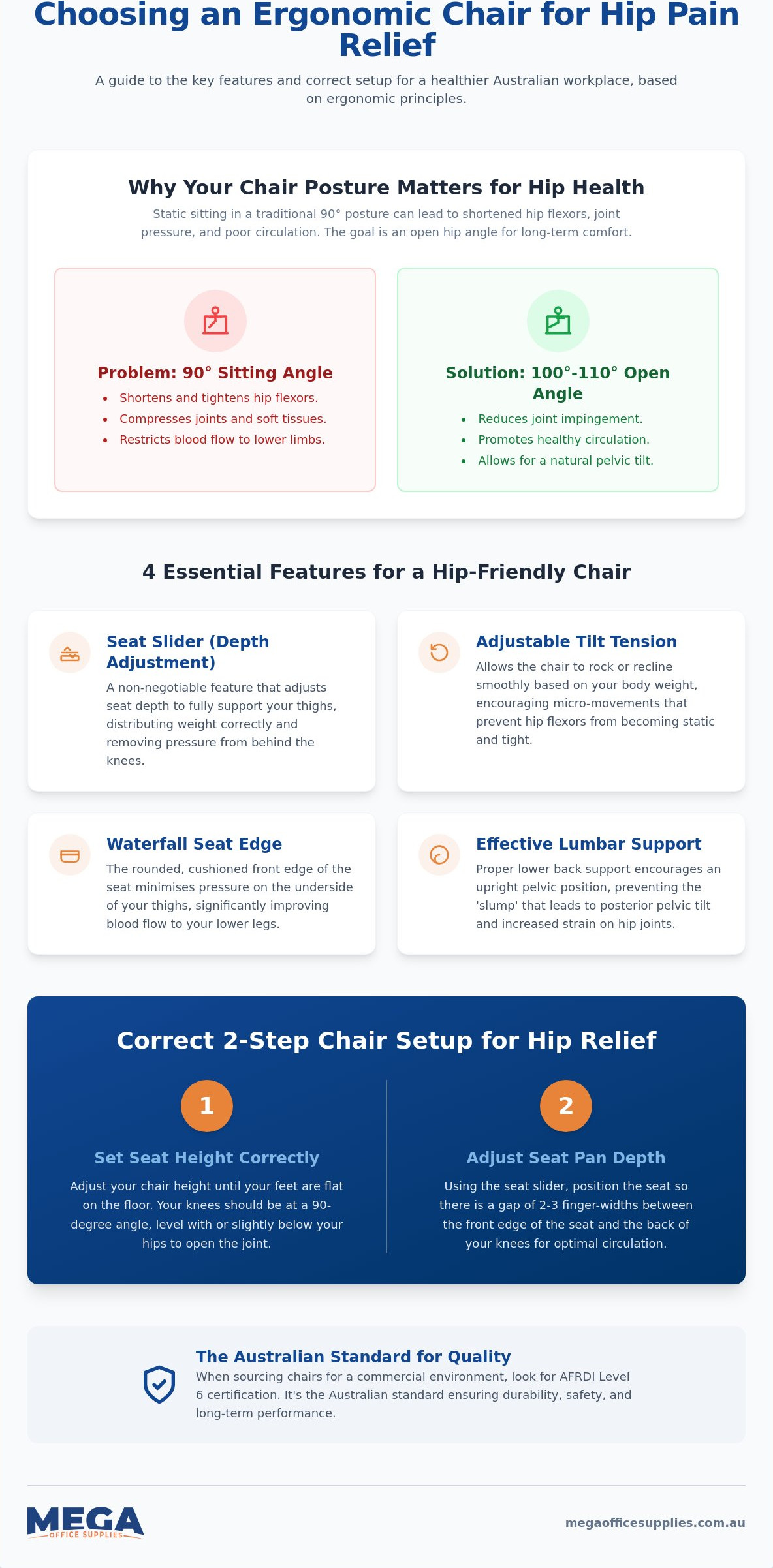
- Understand how traditional 90-degree sitting angles contribute to hip flexor tightness and why opening the hip-to-torso angle is essential for pressure relief.
- Identify why a seat slider is a non-negotiable feature when selecting the best ergonomic chair for hip pain to ensure your thighs are fully supported without restricting circulation.
- Compare the functional benefits of professional-grade task chairs and saddle chairs to determine which seating style best suits your specific workplace requirements.
- Learn the precise two-step adjustment process for setting seat height and depth to minimise pelvic pressure and maintain healthy blood flow during long shifts.
- Recognise the value of sourcing AFRDI-certified furniture from established Australian retailers to ensure long-term durability and accessible local warranty support.
Understanding Why Your Office Chair Causes Hip Pain
Static sitting is a primary driver of chronic hip discomfort in the modern Australian workplace. When you remain seated for eight hours, your hip flexors stay in a constantly shortened state, leading to adaptive tightness and reduced mobility. A deeper understanding of ergonomics reveals that the traditional 90-degree sitting posture actually places significant mechanical stress on the acetabulofemoral joint. It's vital to recognise that finding the best ergonomic chair for hip pain involves moving away from rigid designs that compress the soft tissues and nerves around the pelvis.
To better understand how seating impacts your joint health, watch this helpful video:
The Problem with Standard Office Seating
Standard chairs often rely on a "one size fits all" philosophy that ignores individual biomechanics and leg lengths. If a seat pan is too deep for your frame, it forces you to slump forward or creates a pressure point that restricts circulation behind the knees. Conversely, a shallow seat fails to support the thighs, which places the entire weight of the upper body directly onto the ischial tuberosities, commonly known as the sit bones. This concentrated pressure can exacerbate specific conditions like hip bursitis, where the fluid-filled sacs in the joint become inflamed. High-quality office chairs mitigate these risks by using high-density foam or mesh that distributes weight across a larger surface area.
The Role of Pelvic Tilt in Hip Relief
Your pelvic position dictates the alignment of your entire spine and the specific pressure felt in your hip sockets. A posterior tilt, where the pelvis tucks under, rounds the lower back and strains the hip joints. Professional-grade seating encourages a slight anterior tilt, helping to maintain the natural lumbar curve and reducing joint impingement. An open hip angle of 100 to 110 degrees reduces strain by allowing the pelvis to rotate forward naturally. This system of "hip-friendly" ergonomics prioritises movement over static bracing. Consider the following advantages of a dynamic seating system:
- Reduced Impingement: Open angles prevent the femoral head from pressing against the acetabulum.
- Improved Circulation: Removing pressure from the underside of the thighs helps maintain blood flow to the lower limbs.
- Active Engagement: Chairs with adjustable tilt tension allow for micro-movements that prevent the hip flexors from "locking" into a shortened position.
By selecting a chair that supports these mechanical requirements, you move beyond simple comfort toward a professional-grade solution that protects your long-term physical health and workplace productivity.
Essential Features: What to Consider Before Buying
Selecting the best ergonomic chair for hip pain requires a focus on specific hardware adjustments that allow for pelvic freedom. While many standard chairs offer basic height controls, a professional-grade solution must include a seat slider mechanism. This feature allows the user to adjust the depth of the seat pan independently of the backrest. It's the most critical component for managing hip pressure, as it ensures the weight of the torso is distributed across the full length of the thighs rather than being concentrated on the hip joints.
Beyond seat depth, several other technical specifications contribute to a hip-healthy workstation:
- Adjustable Tilt Tension: This allows the chair to respond to your body weight, supporting micro-movements that prevent the hip flexors from becoming static and tight.
- Waterfall Seat Edge: A rounded front edge on the seat cushion is designed to minimise pressure on the underside of the thighs, which improves circulation to the lower limbs.
- Lumbar Support: High-quality lumbar tracking encourages an upright pelvic position, preventing the "slump" that leads to posterior pelvic tilt and joint impingement.
Seat Pan Adjustment and Depth
Correct seat depth is achieved when there's a gap of approximately two to three fingers between the front edge of the seat and the back of your knees. If the seat is too deep, you'll likely slide forward to find relief, losing all back support and straining your hips. For shorter users in Australian offices, a seat pan that's too deep is a common cause of chronic discomfort. Conversely, multi-user workstations in government or healthcare settings require sliding mechanisms to accommodate staff of varying heights. You can browse our range of office chairs to find models equipped with these essential sliding features.
Contoured Cushioning vs. Mesh
The choice between high-density foam and mesh depends on your specific environment and the nature of your hip pain. Contoured foam provides superior pressure redistribution for those with sharp joint pain or bursitis, as it cradles the sit bones. However, in high-traffic Australian warehouses or staff rooms, breathable mesh is often preferred for temperature regulation and its ability to flex with the user's movements. Both materials offer professional-grade durability, but foam generally provides a more stable base for those needing strict pelvic alignment. If you're planning a full workspace upgrade, exploring our office furniture supplies can help you identify the best material for your specific operational needs.
Comparing Chair Styles for Hip Support
Finding the best ergonomic chair for hip pain requires matching the hardware to your specific workflow. While a standard task chair remains the industry benchmark, alternative designs provide targeted relief by altering the user's centre of gravity or widening the pelvic angle. The goal is to select a style that facilitates a neutral pelvis while accommodating the practical movements required by your profession.
Ergonomic Task Chairs for General Office Use
For administrative, government, and educational settings, standard task chairs offer the highest degree of adjustability. These models are designed to support a traditional seated position while allowing for the precise seat depth and tilt adjustments discussed previously. When procurement officers select Mega Office Supplies office chairs, they are often looking for AFRDI Level 6 certification. This Australian standard ensures the chair is suitable for heavy commercial use, supporting users up to 110kg for more than eight hours daily. This level of durability is essential for maintaining consistent pelvic alignment throughout a full shift, preventing the seat foam from degrading and creating uneven pressure points on the hips.
Alternative seating like saddle chairs and kneeling chairs takes a different approach to hip health. Saddle chairs promote an active sit by placing the legs in a wide, abducted position. This naturally opens the hip-to-torso angle beyond 120 degrees, which significantly reduces the load on the hip flexors. Kneeling chairs shift a portion of the body weight to the shins. This rotation of the pelvis forward helps maintain the natural lumbar curve, though these are typically recommended as secondary seating options rather than full-day solutions for those with existing joint inflammation.
Specialised Seating for Healthcare and Warehouses
Tips for Choosing and Setting Up Your Chair for Hip Relief
Acquiring the best ergonomic chair for hip pain is the first step toward a healthier workplace, but the hardware only functions correctly when calibrated to your specific measurements. Proper setup ensures that the weight of your torso is supported by the chair's mechanical structure rather than your soft tissues. Follow these four steps to optimise your workstation for immediate pelvic relief.
- Step 1: Adjust Chair Height. Set the seat height so your feet rest flat on the floor. Your hips should be positioned slightly higher than your knees. This creates an open angle that prevents the femoral head from impinging on the hip socket during long periods of focus.
- Step 2: Calibrate Seat Depth. Use the seat slider to support your thighs fully. Ensure there is a two-finger gap between the front of the seat and the back of your knees. This prevents the seat from pressing against the popliteal fossa and restricting blood flow.
- Step 3: Dial in Tilt Tension. Adjust the tension so the chair supports your weight while allowing you to recline with minimal effort. Effortless reclining encourages micro-movements that keep hip flexors from becoming static and tight.
- Step 4: Position Lumbar Support. Align the lumbar curve with the small of your back. This stabilises the pelvis and prevents the posterior tilt that leads to joint strain and lower back compensation.
The Importance of Frequent Movement
Even a professional-grade chair cannot completely offset the effects of total physical inactivity. Research into workplace health suggests taking movement breaks every 30 minutes to reset your posture and mobilise the hip joints. Integrating standing desks into your office layout allows you to alternate between sitting and standing, which is a highly effective strategy for managing chronic hip tightness. Simple seated stretches, such as the figure-four stretch, can also be performed throughout the day to release the glutes and piriformis muscles without leaving your workstation.
Trial and Error: The Procurement Process
For procurement officers managing large-scale fit-outs, testing chairs in the actual work environment is essential. Body types vary significantly across a workforce, and a chair that suits one employee may not provide adequate support for another. Organising a trial period for staff ensures that the selected models are compatible with diverse physical requirements before committing to a high-volume purchase. If you are managing a corporate or government fit-out, you can use the Mega Office Supplies business application to streamline your ordering process and access professional-grade furniture solutions with regional expertise.
Browse our range of AFRDI-certified ergonomic office chairs
Sourcing Professional Ergonomic Solutions in Australia
Procuring the best ergonomic chair for hip pain involves more than simply browsing a product catalogue. It requires a partnership with a reliable Australian retailer capable of managing national logistics and providing consistent support. Mega Office Supplies has been an established name in the industry since 2005, specialising in ergonomic workplace solutions and commercial furniture fit-outs. We understand that procurement officers and facility managers value stability and regional expertise over flashy marketing. By sourcing your furniture, stationery, and facility supplies from a single provider, you streamline your administrative workflow and ensure a uniform standard of quality across your entire organisation.
Our operation is built on decades of combined industry experience. This allows us to handle high-volume demands for businesses and government departments with manual precision. Supporting an Australian private company means you gain access to direct domestic support and a deep understanding of the practicalities of maintaining a local workplace. Whether you are equipping a primary school in Queensland or a warehouse in Victoria, our national delivery capability ensures your hardware arrives on schedule and ready for deployment.
Commercial Quality and Warranty
In the professional sector, durability is a financial necessity. Understanding AFRDI ratings is vital for any large-scale furniture investment. A Level 6 certification from the Australasian Furnishing Research and Development Institute signifies that a chair is suitable for heavy commercial use, typically defined as eight or more hours of daily use by individuals up to 110kg. Investing in these certified, commercial-grade solutions reduces long-term replacement costs and minimises the risk of workplace injury claims. Mega Office Supplies maintains a steadfast commitment to providing high-performance hardware that meets the strict safety and durability requirements of the government and educational sectors.
Complete Workplace Ergonomics
Total body alignment requires a holistic approach to the workstation. While the chair is the foundation, pairing it with accessories like footrests and monitor arms is essential for maintaining the open hip angle and neutral spine discussed in previous sections. These tools prevent the user from leaning forward or "perching" on the edge of the seat, which are common behaviours that lead to hip joint impingement. For a technical deep dive into seating mechanics, check out our ergonomic office chair pillar guide for more details.
A well-organised workspace is an investment in your team's long-term productivity and physical health. We invite you to explore our full range of ergonomic chairs and office furniture to find a durable, professional-grade solution tailored to your specific environment.
Optimising Your Workplace for Long-Term Pelvic Health
Selecting the best ergonomic chair for hip pain is a strategic investment in your organisation's productivity and employee wellbeing. Effective relief depends on a combination of an open pelvic angle, adjustable seat depth, and the consistent support of AFRDI-certified hardware. By prioritising these specific mechanical features, you move beyond temporary comfort to address the root causes of musculoskeletal strain. This proactive approach reduces the non-fatal disease burden within your professional environment.
Mega Office Supplies has supported Australian workplaces as a family-owned business since 2005. Our team brings decades of combined industry expertise to every consultation, ensuring your procurement process is efficient and accurate. With national delivery capabilities for corporate and government orders, we provide the logistical scale required for seamless office fit-outs across all regions.
Browse our Professional Range of Ergonomic Office Chairs
You now have the technical criteria needed to make an informed decision for your professional environment. Transitioning to a high-performance seating solution is a vital step toward a more active and pain-free workday.
Frequently Asked Questions
What is the best sitting position for hip pain?
The most effective sitting position involves maintaining an open hip-to-torso angle of approximately 100 to 110 degrees. You should ensure your feet are planted firmly on the floor or a footrest with your knees positioned slightly lower than your hips. This alignment prevents the femoral head from pressing into the hip socket, which is a fundamental setup for anyone using the best ergonomic chair for hip pain to manage daily discomfort.
How do I know if my seat pan is the correct depth?
You can verify your seat depth by sitting back fully against the lumbar support and checking the space behind your knees. There should be a clear gap approximately the width of two or three fingers between the front edge of the seat and your calves. If the seat pan is too deep and touches the back of your knees, it restricts circulation and forces the pelvis into a strained, forward position.
Can an ergonomic chair help with hip bursitis?
While an ergonomic chair is not a medical cure, it can significantly alleviate the aggravation of hip bursitis by redistributing body weight away from sensitive pressure points. High-density foam or specialised mesh seats help reduce direct pressure on the trochanteric bursa. Using a chair with a seat slider and adjustable tilt allows you to shift positions frequently, preventing the static loading that often makes bursitis symptoms worse during long shifts.
Is a mesh chair or a padded chair better for hip support?
Padded chairs with high-density foam are generally superior for specific hip pressure relief because they provide more substantial cradling for the sit bones. This is particularly helpful for users with sharp joint pain who need a stable base. However, high-quality mesh is an excellent alternative for those in warmer Australian climates who prefer more airflow and flexibility, provided the mesh has enough tension to prevent bottoming out.
Should I use a footrest with my ergonomic chair?
You should use a footrest if your desk height requires you to raise your chair to a point where your feet no longer rest flat on the ground. Dangling feet pull the pelvis forward and strain the hip flexors, leading to significant joint ache. A footrest ensures your lower limbs are supported at the correct angle, maintaining the slightly-above-knee hip position required for pelvic health.
How often should I replace my office chair to prevent hip issues?
Commercial-grade chairs with AFRDI Level 6 certification are designed for longevity, but you should generally consider a replacement every seven to ten years. If the seat foam has lost its resilience or the mechanical adjustments no longer hold their position, the chair can no longer support your pelvis correctly. Regularly inspecting the hardware ensures you don't wait until hip pain develops before upgrading your seating solution.
Do kneeling chairs actually work for hip pain?
Kneeling chairs are effective for opening the hip angle and encouraging a natural lumbar curve, but they are typically recommended as secondary seating options. They shift a portion of your body weight to the shins, which provides a welcome break from traditional sitting. However, they lack the comprehensive back support and seat depth adjustability required for full-day focus in a professional environment.
What features should I prioritise if I have a limited budget?
If you are working with a restricted budget, prioritise a manual seat slider and adjustable tilt tension above aesthetic upgrades. These features are the most critical components of the best ergonomic chair for hip pain because they allow for the precise physical customisation required to remove pressure from the joints. Investing in these functional basics ensures you receive the necessary support without the cost of high-end motorised components.
Article by
Mega Office Supplies Team
The Mega Office Supplies Team provides practical buying guides and workplace advice for Australian businesses, schools, government organisations, healthcare providers, hospitality venues, warehouses and home offices. Family-owned and operated since 2009 and based in Tweed Heads South on the Gold Coast–Tweed border, Mega Office Supplies brings more than 150 years of combined team experience to helping Australian workplaces choose the right office supplies, furniture, technology, cleaning, safety and education products — backed by genuine local service from real people.
General Information
This article is provided as general information only to help customers compare and choose office, workplace, school, cleaning, technology, furniture, safety and business supplies. Product details, specifications, compatibility, availability, pricing and suitability may vary. Always check the individual product page, manufacturer information, workplace requirements and relevant safety guidance before purchasing or using a product.


