

The most expensive heavy-duty plastic tub might actually be a worse choice for your essential records than a standard cardboard archive box. We understand the frustration of opening a container after several years only to find collapsed sides, silverfish damage, or documents that have turned yellow and brittle. You need a secure, stackable system that makes the most of your vertical space while keeping your organisation's history intact. This professional comparison clarifies the critical structural and functional differences between archive boxes vs storage boxes for long term storage to ensure your equipment and sensitive files remain protected for the long haul. We will examine load-bearing capacities, chemical stability for archival preservation, and the specific features that help Australian businesses and government departments meet their mandatory record retention periods. By the end, you will know exactly which container suits your specific workplace environment.
Key Takeaways
- Archive boxes feature reinforced bases and double-walled construction specifically designed for vertical stacking, whereas standard storage boxes are better suited for varied, non-uniform contents.
- Select your container materials based on the environment; use breathable cardboard for climate-controlled office archives and sealed polypropylene tubs for damp or uninsulated storage areas.
- Comparing archive boxes vs storage boxes for long term storage reveals that specific engineering choices, such as acid-free board, are essential for preventing document yellowing and structural failure over decades.
- Maximise organisational efficiency by establishing a central indexing register and clearly marking destruction dates to stay compliant with Australian record retention standards.
Defining the structural differences between archive and storage boxes
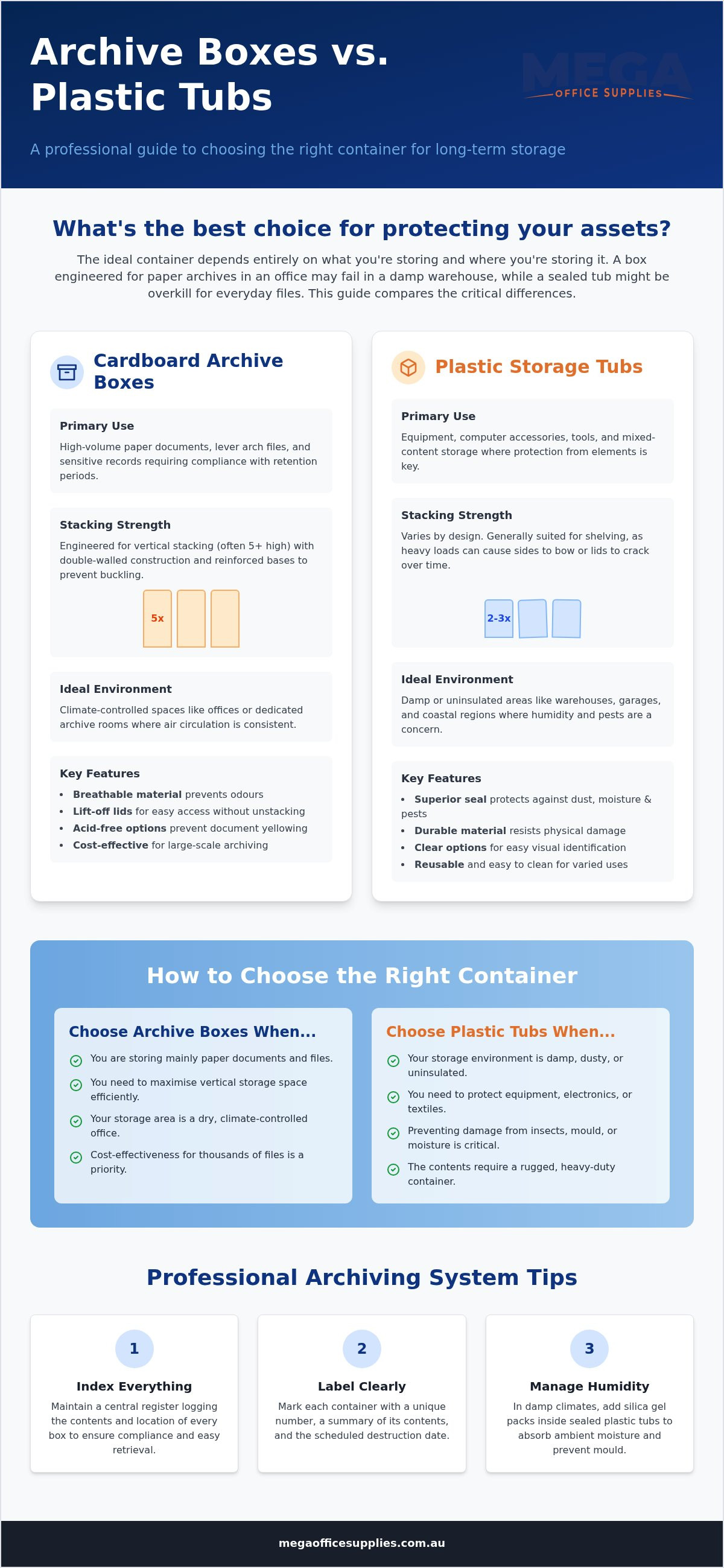
Structural integrity dictates the lifespan of any record-keeping system. While they might look similar on a shelf, the choice between archive boxes vs storage boxes for long term storage comes down to engineering. Archive boxes utilise double-walled cardboard and reinforced bases to support heavy paper weight without buckling under pressure. We prioritise the "burst strength" and gsm (grams per square metre) of the material, as these metrics determine how many years a box can remain at the bottom of a stack before the cardboard fibres fail.
To better understand this concept, watch this helpful video:
General storage boxes often prioritise internal volume over stackability, making them prone to leaning or collapsing. In contrast, professional archive boxes are standardised to fit perfectly on industrial shelving units or stack five-high in a warehouse environment. This vertical efficiency traces its roots back to the classic Hollinger box used by national institutions to preserve history. When comparing archive boxes vs storage boxes for long term storage, these standardised dimensions allow for a much higher density of records in a smaller footprint.
Cardboard archive boxes: built for vertical stacking and document access
Standard storage tubs often feature flap lids that can sag, but professional archive boxes use lift-off lids. This design allows for consistent air circulation and easier retrieval of lever arch files without unstacking the entire row. Trusted brands like Marbig and Fellowes incorporate "triple end" construction and reinforced hand-holes to prevent tearing when a staff member pulls a fully loaded box from a high shelf. These features ensure workplace safety and document security remain uncompromised throughout long retention periods.
Choosing the right container for your specific long term storage environment
Selecting between archive boxes vs storage boxes for long term storage depends heavily on your specific environment. Cardboard is naturally breathable, making it the preferred choice for climate-controlled office spaces where air circulation prevents the buildup of stale odours. However, in non-insulated Australian warehouses, cardboard can absorb ambient moisture or attract pests like silverfish. If you need to preserve family archives or sensitive corporate records in fluctuating conditions, environmental factors must dictate your material choice.
Polypropylene storage tubs offer a superior seal against dust, insects, and humidity. These containers are often better for protecting equipment, computer accessories, or for long-term garage storage where cardboard would soften. While plastic is durable, cardboard archive boxes remain the standard for massive volume archiving because they are more cost-effective and easier to label directly with a marker. If your project involves thousands of files, the logistical ease and stackability of cardboard often outweighs the ruggedness of plastic.
Plastic storage tubs vs cardboard: managing humidity and dust in Australian climates
In tropical regions or coastal warehouses, mould growth is a constant threat to paper integrity. We suggest using heavy-duty plastic for these high-humidity environments to prevent moisture ingress. Clear plastic facilitates rapid visual identification, while opaque cardboard provides privacy for sensitive records. For extra security, place silica gel packs inside plastic tubs to maintain a dry atmosphere. You can browse our range of filing and storage options to find the ideal match for your local climate.
Implementing a professional archiving system for your organisation
Implementing a professional archiving system requires more than just picking a container. It demands a rigorous indexing system where every box is numbered and logged in a central register before it enters long-term storage. For government and educational institutions, this is a compliance necessity rather than a suggestion. Boxes must be clearly labelled with destruction dates to align with mandatory document retention periods. By using standardised sizes across your entire organisation, you maximise the efficiency of your filing and storage footprint. It's much easier to stack a uniform wall of boxes than to play a high-stakes game of warehouse Tetris with mismatched tubs.
Labelling and indexing for rapid retrieval
To ensure legibility over a 15-year storage cycle, we recommend using professional labelling machines. Standard markers often fade or bleed into the cardboard, rendering the box anonymous just when you need to find a specific file. According to international standards for the storage of works on paper, identification is just as vital as physical protection. Arrange your archives in a "first-in, first-out" sequence so that the oldest records remain accessible for their scheduled destruction. Large-scale operations should consider our business application form to streamline bulk procurement of standardised solutions. This systematic approach ensures your decision between archive boxes vs storage boxes for long term storage results in a secure, manageable record-keeping asset.
Secure your organisation's future with the right storage strategy
Choosing between archive boxes vs storage boxes for long term storage depends on your specific environmental risks and the frequency of retrieval. Longevity is key. Standardising your containers ensures maximum warehouse efficiency and structural safety. Our team can help you select durable solutions for your records. We accept official Australian Government purchase orders and offer direct support from 8-6 AEST on weekdays to assist with bulk procurement. Implementing a rigorous indexing system today prevents the operational headache of lost records several years from now. You can trust our local knowledge to keep your organisation organised and compliant throughout every retention cycle.
Browse our full range of professional archive and storage boxes
We are here to ensure your important assets remain protected and accessible for the long haul.
Frequently Asked Questions
How many lever arch files can fit in a standard archive box?
A standard archive box typically accommodates five 70mm or 80mm lever arch files when placed upright. If you use slimline binders, you might fit up to seven. It's vital not to overstuff the box. Forcing extra files can compromise the reinforced base or cause the sides to bulge, which prevents secure stacking and risks damaging the documents inside.
Is it better to use plastic or cardboard for long-term document storage in a warehouse?
Cardboard is generally superior for high-volume paper records in climate-controlled warehouses because it allows the paper to breathe. However, when comparing archive boxes vs storage boxes for long term storage in non-insulated or damp environments, heavy-duty polypropylene tubs offer better protection. Plastic prevents moisture absorption and blocks pests, though it requires silica gel packs to manage internal condensation over several years.
How high can I safely stack cardboard archive boxes?
You can safely stack professional-grade archive boxes up to five units high on a level surface. This limit relies on using boxes with a high gsm and reinforced double-walled construction. Stacking beyond this height increases the load on the bottom box, potentially leading to structural failure. Always ensure the heaviest boxes stay at the base of the stack to maintain a stable centre of gravity.
Can I use regular packing tape on archive boxes, or do they need to be unsealed?
Most professional archive boxes feature lift-off lids designed to remain unsealed for easy access and air circulation. While you can use regular packing tape for added security during transport, it isn't recommended for long-term storage. Tape adhesive can degrade or leave a sticky residue that attracts dust. If security is a priority, consider using tamper-evident seals or security ties through the hand-holes instead.
Article by
Mega Office Supplies Team
The Mega Office Supplies Team provides practical buying guides and workplace advice for Australian businesses, schools, government organisations, healthcare providers, hospitality venues, warehouses and home offices. Family owned and operated since 2008 and based in Tweed Heads South on the Gold Coast–Tweed border, Mega Office Supplies helps Australian workplaces choose the right office supplies, furniture, technology, cleaning, safety and education products — backed by genuine local service from real people.
General Information
This article is provided as general information only to help customers compare and choose office, workplace, school, cleaning, technology, furniture, safety and business supplies. Product details, specifications, compatibility, availability, pricing and suitability may vary. Always check the individual product page, manufacturer information, workplace requirements and relevant safety guidance before purchasing or using a product.


