

Desk organisers for home-based businesses are ways to arrange tools, paperwork and work in progress so each task has a clear place. At home, the same surface often handles administration, calls and household activity, so the right setup starts with your work rather than a shopping list.
- Desk organisers for home-based businesses work best when each regular task has a defined place.
- Give incoming paper one defined home and review it on a set schedule so nothing stalls in a pile.
- Keep active work within reach, move reference material away and give incoming paper a clear route.
Why this matters
A desk can look tidy while hiding unfinished work in a drawer. For a home-based business, that means an invoice, customer note or order can disappear among household paperwork. Organise by what you do and what needs attention next, not by the shape of a container.
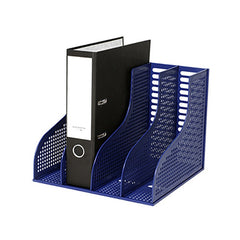
The aim is a clear working surface with a small number of dependable places for the things you use. Start with a stacking document tray or a compact desk organiser to give paperwork and daily tools a defined place. If you need ideas for different layouts, the guide to desk organisers for a tidy workspace covers the broader category; this guide focuses on the mixed tasks of running a business from home.
Why desk organisation matters for home-based businesses
A home office rarely has a separate reception desk, filing room and packing bench. The same workspace has to accommodate focused work, incoming documents and the tools used to finish a job. When those tasks share one unsorted pile, clearing space for the next task also risks moving something that still needs action.
Your first decision is therefore not which organiser to buy. It is which activities happen at the desk and which items must stay there. A business that mostly works on a screen needs a different arrangement from one that also handles printed forms or packs customer orders. Both need a reliable place for work that is waiting, work that is active and work that is finished. For a closer look at choosing durable options for daily use, see the professional guide to desk organisers.
Set up a desk around your actual work
Map your tasks
Run a desk audit before moving anything. Write down the tasks you regularly complete at the desk, then notice which objects each task needs. Include household items in the audit: they are easier to redirect when you have identified them than when they are mixed into a business pile.
Sort what you find by the action it requires. These groups are more useful than broad labels such as miscellaneous because they tell you what to do next. Put any sensitive business papers somewhere that other people using the room will not mistake for household paperwork.
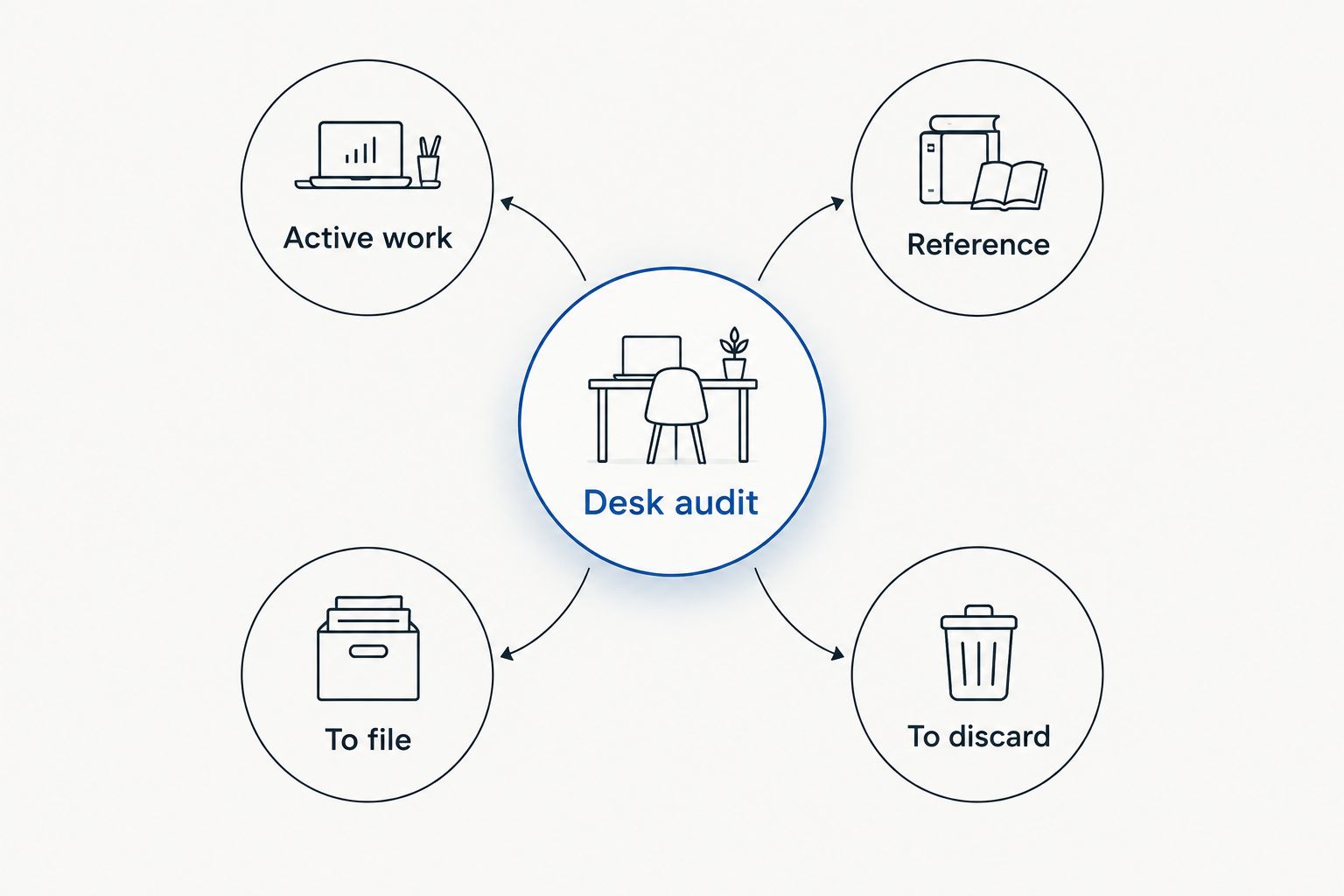
Use these groups for the first pass:
- Active work: Items you need to complete a current task.
- Reference: Information you consult but do not need to act on now.
- To file: Finished material you need to retain.
- To discard: Duplicates and material you no longer need, subject to your own record-keeping requirements.
A stacking document tray gives each of these groups a fixed slot on the desk, so sorted papers stay sorted. Browse desk organisers built for this kind of sorting.
Clear the work surface
Move everything off the part of the desk where you do your main task. Return only the equipment and tools that task requires. You do not need an empty-looking desk; you need enough clear space to work without shifting a stack each time you open a notebook or use a keyboard.
If the desk also serves as a household table, decide what a ready-to-work surface looks like. A repeatable setup matters more than a permanent one. Keep current business work together so it can be put away without mixing it with the household items that replace it.
Check the surface against these practical questions:
- Can you start your usual task without moving unrelated papers?
- Does each item left on the desk serve work you do there?
- Can you reach the tools you use without crossing your active work?
- Is there a clear spot for a document that arrives mid-task?
A desk organiser with defined compartments keeps the cleared surface from refilling with loose items. See the desk organisers range for options sized to a home desk.
Route incoming paper
Give every new paper item a next step as soon as it reaches the desk. An incoming area is useful only if you review it; otherwise it becomes another unsorted stack. Separate documents that need a response from documents you are keeping for reference.
A small business can receive supplier paperwork, customer correspondence and household post in the same room. Sort by purpose before filing. A labelled document tray works well to test the route before choosing anything else. Avoid putting an action item into long-term storage simply because the surface needs clearing.
Build a paper route you can maintain:
- Set aside one clearly identified place for new business papers.
- Mark the next action on papers that need a response.
- Move reference material out of the incoming area after review.
- File completed work separately from unfinished work.
Give everyday tools a home
Put frequently used stationery where the task happens and move occasional tools out of the immediate working area. A pen used for every call belongs within easy reach; spare stationery does not need the same position. A drawer tidy is a good starting point for learning what actually needs a dedicated place.
Group tools by use rather than forcing unlike items together. Writing tools, paper-handling tools and small electronic accessories tend to interrupt different tasks. If a container fills with things you rarely touch, the problem is the selection of items, not the absence of another container.
Set locations using these rules:
- Keep daily tools beside the task they support.
- Store spares separately from the tools currently in use.
- Give loose accessories a place where they will not cover paperwork.
- Remove items that belong to a different room.
A drawer tidy separates daily tools from spares without another container taking up desk space. See the drawer tidy collection.
Separate packing from administration
If your business packs orders at home, do not leave packing materials across the desk where you write, review documents or take calls. You can use the same surface for both jobs, but make them distinct sessions. Bring out what a packing session needs, finish the task and return the materials to their usual place.
Keep order information with the order while you work, then move completed paperwork into its filing route. This reduces the chance that a current order note gets buried under office stationery. If you do not pack orders, apply the same principle to another occasional task, such as assembling documents: temporary work still needs a clear start and finish.
Make the changeover simple:
- Identify the surface you need for administration.
- Keep packing or assembly materials together when not in use.
- Bring out only what the current job requires.
- Clear the temporary task before restarting desk work.
A desktop drawer unit gives packing or assembly materials a home you can close between sessions. Browse desktop drawer units.
Control the space around equipment
A screen, printer or other desk equipment can create awkward pockets where papers collect. Treat those pockets as part of the desk audit. Keep access to equipment clear, and place frequently handled documents where you can retrieve them without reaching around cables or lifting other work.
Do not choose storage from a photograph of someone else’s desk. Check your own available surface, drawer access and the space needed to use equipment. If the desk is shared, leave the next person a clear working area rather than a layout that only makes sense to you.
Check the physical layout:
- Keep the main working area free of loose cables and paper.
- Leave access to the equipment you use.
- Move rarely handled material away from the immediate desk.
- Test whether another user can find the active-work area.
A modular desk organisation set works well around fixed equipment, since pieces can be arranged to leave cable and drawer access clear. See the desk organisation collection.
Reset the desk on a schedule
A desk organisation system works only when completed work leaves the active area. Set a regular reset that fits your working pattern. Review the incoming area, return tools to their places and decide what each unfinished item needs next.
Keep this review separate from a full clear-out. The point is to restore a usable desk, not to redesign it each time. If the same item repeatedly lands in the wrong place, change its location or its label. If a container repeatedly overflows, decide whether its contents belong together before making it larger.
Use a short reset checklist:
- Review new papers and assign their next action.
- Move completed work out of the active area.
- Return everyday tools to their usual places.
- Clear the surface needed for your next task.
Compare organisation options
Choose a method for the work you handle, not a collection of matching containers. These options can work together. Start with the one that solves the interruption you encounter most often, then check whether the desk still needs anything else. Organising a cluttered desk for workplace efficiency walks through this same trade-off in more detail.
| Option | Best for | Key limitation |
|---|---|---|
| Reusing a drawer or container you own | Keeping everyday tools together while you test a layout | Contents become hard to find if unrelated tools share the space |
| A designated incoming-paper area | Businesses that regularly receive forms or correspondence | Needs a regular review or it becomes another pile |
| Separate active and reference filing | Work that combines current tasks with documents you retain | Filing too early can hide work that still needs action |
| A temporary packing or assembly area | Businesses that use the desk for occasional hands-on jobs | Materials must be cleared before the desk returns to administration |
| A digital task list alongside physical filing | Tracking actions linked to paper documents | The physical document still needs a known location |
These are workflow choices, not a ranking of things to buy. Try the arrangement with one or two pieces before committing to more. If papers remain hard to find, make their categories clearer. If the surface remains crowded, remove items that do not support the task you are doing there.
Common mistakes home-based businesses make
- Buying storage before sorting the work. A container can hide a mixed pile without making the next action clearer. Sort active, reference and completed material first.
- Treating incoming paper as filing. A document that needs a reply is not finished simply because it has been put away. Keep action items visible in a defined review area.
- Mixing household and business paperwork. A shared room does not require a shared pile. Give each type of paper its own route when it enters the space.
- Leaving occasional tasks set up permanently. Packing or assembling documents can take over the surface needed for daily work. Put temporary materials away when that session ends.
- Making the system harder than the work. Too many categories add decisions every time you put something down. Use names you recognise and revise them when they stop helping.
FAQ
What are desk organisers for home-based businesses?
Desk organisers for home-based businesses are arrangements for keeping work tools, papers and active tasks in defined places. Start by sorting your tasks, then use the storage you already have to test where each item belongs.
How do I organise a desk used for both business and household tasks?
Keep business and household paperwork in separate places, even when both use the same desk. Clear a defined working surface when you change tasks, and return current business work to its own location.
Should I buy an organiser before clearing my desk?
No; sort what is on the desk before choosing storage. An existing drawer or container will show whether the problem is missing space or unclear categories.
Where should incoming business paperwork go?
Incoming business paperwork needs one identified place and a regular review. Separate items requiring action from reference material and completed records after that review.
How do I keep order packing from taking over my desk?
Treat packing as a separate session and keep its materials together when the session ends. Clear the working surface before switching back to administration.
Is a digital task list enough to organise business paperwork?
A digital task list can track the next action, but it does not locate a physical document. Give the paper a defined place and make its task entry specific enough to find it.
How often should I reset my home-business desk?
Reset it on a schedule you will follow consistently. Review new papers, move completed work and clear the surface needed for the next task.
One last thing
The most useful space on a home-business desk is not another compartment: it is a clear place to do the next job. Before adding storage, check whether unfinished work has an owner, a next action and a known location. Once that's clear, Mega Office Supplies stocks the trays, tidies and drawer units to match the system you've chosen.


