

Filing cabinet gets searched close to 9,900 times a month across Australia, and most of those searches aren't about a brand — they're about drawer depth, lock security and how many folders actually fit. This guide groups the filing cabinet types that make sense for small business storage, with a clear pick for cramped offices, growing archives and confidential HR records. Mega Office Supplies stocks the folders and storage gear that go inside whichever cabinet you land on.
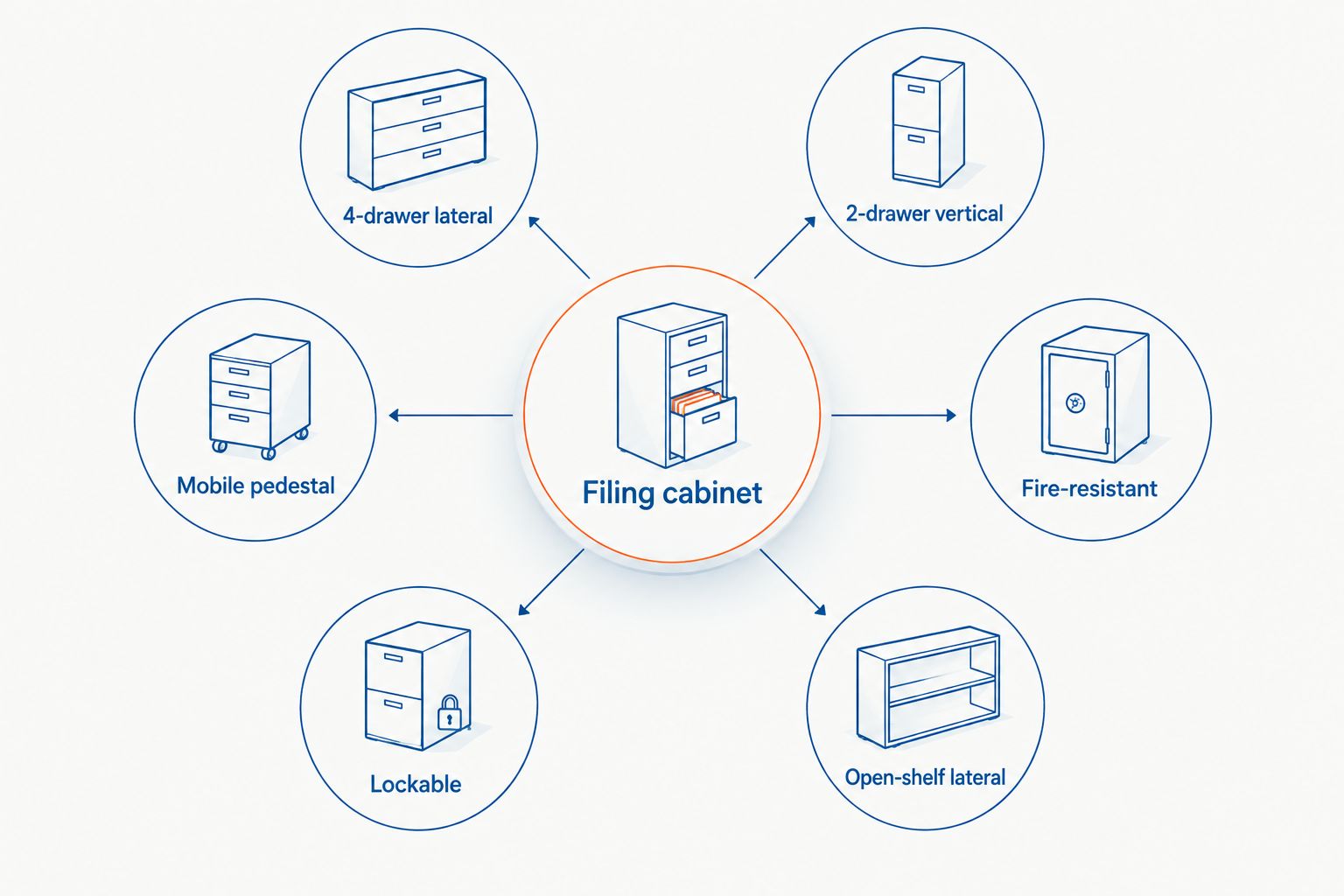
Suits general use: 4-drawer lateral filing cabinet. Suits tight offices: 2-drawer vertical filing cabinet. Suits a tight budget: mobile pedestal filing cabinet.
- A 4-drawer lateral unit suits high document volume well for small business.
- Best for tight offices: a 2-drawer vertical filing cabinet fits under a window or beside a desk.
- Best budget option: a mobile pedestal filing cabinet doubles as under-desk storage.
- Lockable and fire-resistant filing cabinets matter most for HR, tax and contract records.
Why this matters
The Australian Taxation Office requires most business records to be kept for five years, and signed contracts, old invoices and payroll paperwork still need a physical home even in a mostly digital office. That's a big part of why filing cabinet stays one of the highest-volume searches in the office storage category year after year.
A filing cabinet isn't a one-size decision. A sole trader with one lever arch folder a month needs something completely different from a business archiving five years of tax records or storing HR files that legally have to stay locked. The rest of this guide splits filing cabinets by what they're actually good at, not by who makes them.
What makes the best filing cabinet for small business
- Drawer capacity matched to real folder volume — not just drawer count
- Footprint that fits the space you actually have — corner nook versus open wall run
- Fire-resistance rating for tax, contract and compliance records
- Lock quality — a central locking bar beats individual drawer locks every time
- Full-extension runners so a loaded drawer doesn't jam halfway out
- Foolscap vs A4 compatibility with the binders for office filing or hanging folders you already use
Filing cabinets at a glance
| Type | Best for | Standout feature | Key limitation |
|---|---|---|---|
| 4-drawer lateral filing cabinet | High-volume, growing archives | Wide drawers fit files side by side | Needs more wall length than a corner unit |
| 2-drawer vertical filing cabinet | Tight offices and home-based businesses | Smallest footprint of any lockable option | Fills up fast once records stack |
| Mobile pedestal filing cabinet | Under-desk, budget-conscious setups | Rolls on castors, moves with the desk | Drawer depth rarely suits bulk foolscap files |
| Fire-resistant filing cabinet | Tax records, contracts, compliance files | Rated to protect paper against heat | Heavier and more expensive to freight |
| Lockable filing cabinet | HR files, payroll, confidential records | One central lock secures every drawer | Lock quality varies a lot between models |
| Open-shelf lateral filing system | Legal, medical or daily-turnover archives | Fastest pull-and-return access | No drawer front means no lock, more dust |
4-drawer lateral filing cabinet: best filing cabinet for high-volume archives
A lateral cabinet spreads drawers wide instead of deep, so hanging files sit side by side instead of front to back. It holds noticeably more per square metre of floor space than a vertical cabinet the same height, which matters once five years of ATO-required records start piling up.
4-drawer lateral filing cabinet pros:
- Widest drawer face fits more folders side by side than a vertical unit
- Full-extension runners give access to files at the back without hauling the whole drawer out
- Stacks cleanly along a wall for a dedicated archive area
4-drawer lateral filing cabinet cons:
- Needs a longer wall run than a corner will always provide
- Empty drawers waste vertical space compared to open shelving
Best for: businesses archiving multiple years of tax, invoice and contract records in one spot.
2-drawer vertical filing cabinet: best filing cabinet for tight offices
A vertical cabinet stacks drawers up instead of out, giving it the smallest footprint of any lockable filing option. It fits under a window, beside a desk, or into a corner a lateral unit simply won't fit into.
2-drawer vertical filing cabinet pros:
- Smallest footprint of any lockable filing cabinet type
- Doubles as a side table or printer stand
- Cheaper to freight and easier to relocate during an office move
2-drawer vertical filing cabinet cons:
- Two drawers fill up fast once payroll and tax records start stacking
- A loaded top drawer can tip the unit if the bottom drawer is empty
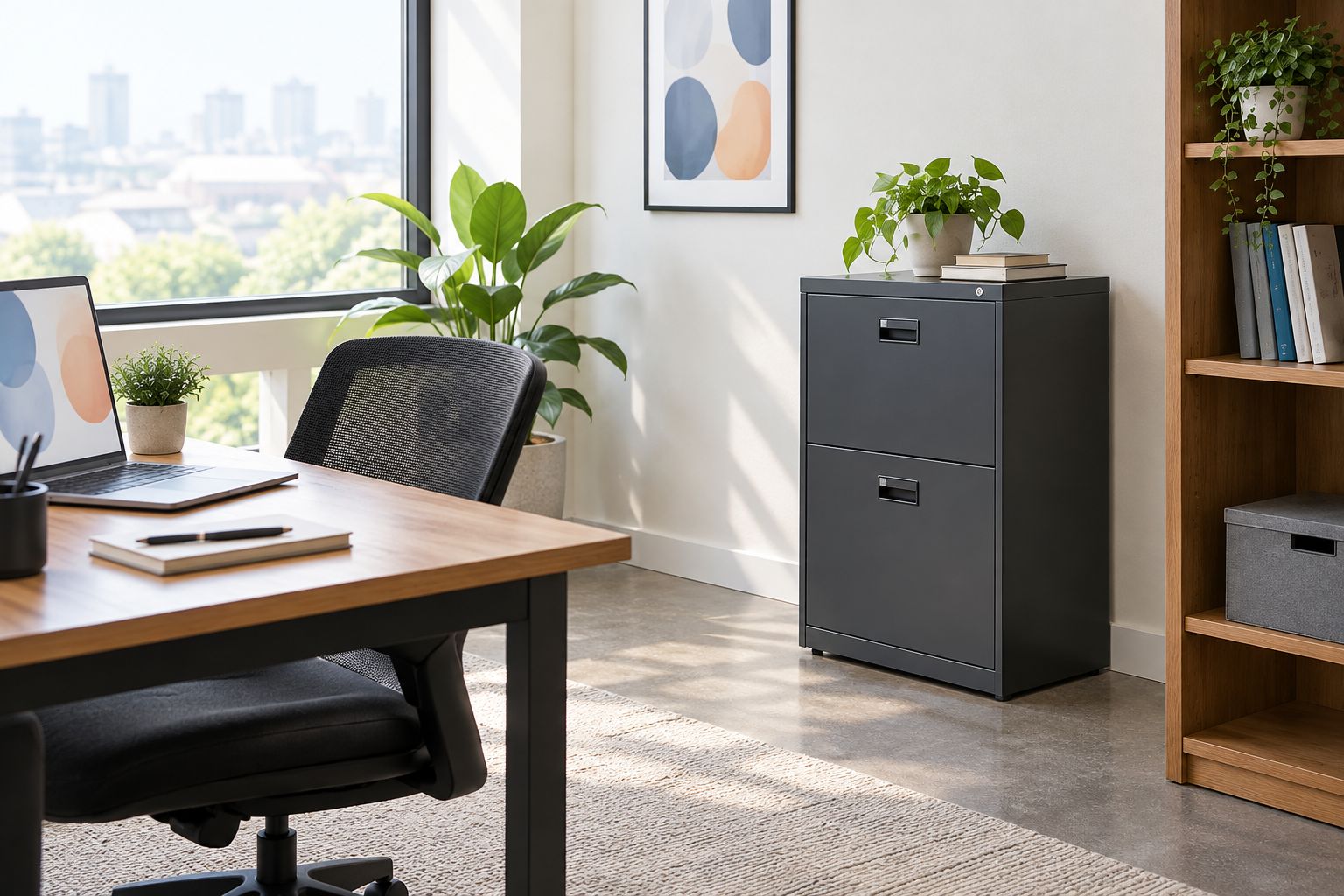
Best for: sole traders and home-based businesses with a handful of active folders, not a full archive.
Mobile pedestal filing cabinet: best filing cabinet for under-desk storage
A pedestal cabinet rolls on castors and sits under or beside a desk, usually with one filing drawer and one or two shallow stationery drawers on top. It's built to move with the desk, not to hold five years of archived records.
Mobile pedestal filing cabinet pros:
- Moves with the desk during office reshuffles or hot-desking setups
- Doubles as a side table or extra seat height
- Right-sized for one person's active working files
Mobile pedestal filing cabinet cons:
- Drawer depth rarely suits bulk foolscap files
- Castors are an extra failure point a static cabinet doesn't have
Best for: one desk's active working files, not long-term archive storage — a fit for one desk, not a whole office.
Fire-resistant filing cabinet: best filing cabinet for tax and contract records
A fire-resistant cabinet is built from heavier-gauge steel and rated to protect paper documents from heat for a set period, unlike a standard filing cabinet that offers no fire protection at all. It's not meant to hold everything — just the drawer you genuinely cannot afford to lose.
Fire-resistant filing cabinet pros:
- Protects the records the ATO requires businesses to keep for five years
- Signed leases, insurance documents and contracts survive a fire a standard cabinet won't
- Usually ships with a stronger lock than a standard cabinet as well
Fire-resistant filing cabinet cons:
- Considerably heavier — check floor loading before placing it upstairs
- Costs more to freight than a standard steel cabinet
Best for: the one drawer of paperwork a business can't afford to lose — a fit for the compliance drawer, not for everyday files.
Lockable filing cabinet: best filing cabinet for HR and payroll records
A lockable filing cabinet uses a central locking bar that secures every drawer at once, rather than individual drawer locks that get left open by accident. It's standard on most steel lateral and vertical cabinets, but the lock quality itself varies a lot.
Lockable filing cabinet pros:
- One lock secures the whole cabinet at the end of the day
- Keeps payroll, bank details and HR paperwork away from casual access
- Works on both vertical and lateral cabinet styles
Lockable filing cabinet cons:
- Lock quality varies a lot between models — a cheap barrel lock is a five-second bypass
- A lost key usually means calling a locksmith, not grabbing a spare
“A fireproof filing cabinet only protects paper from fire, not from staff — that job belongs to the lock.”
Best for: any drawer holding staff records or signed HR paperwork.
Open-shelf lateral filing system: best filing cabinet alternative for daily-turnover archives
An open-shelf system swaps drawer fronts for open shelving loaded with lateral file folders, built for fast pull-and-return access rather than drawer security. It suits offices where the same files get pulled and re-filed daily, like legal or medical practices.
Open-shelf lateral filing pros:
- Faster retrieval — no drawer to open and close for every file
- Fits more linear filing per square metre than closed drawers
- Works well paired with foolscap lateral file folders sized to match the shelving
Open-shelf lateral filing cons:
- No drawer front means no lock and more dust exposure over time
- Not suited to confidential HR or payroll files
Best for: high-turnover files pulled daily, not confidential records — a fit for active archives, not for anything confidential.
How to choose
Each type was assessed against the six criteria above: drawer capacity, footprint, fire rating, lock quality, runner build and folder compatibility. No two entries compete for the same use case — a lateral cabinet and a fireproof cabinet solve different problems, so both can be right for the same office at the same time.
Which filing cabinet should you choose?
For most small businesses starting a document archive, the 4-drawer lateral filing cabinet is the safe default — it holds the most per square metre and handles years of tax and contract records without running out of room. Sole traders and home offices should start smaller with a 2-drawer vertical filing cabinet. Any business holding HR or payroll files needs a lockable filing cabinet for that drawer specifically, no matter which style handles the everyday volume, and a fire-resistant filing cabinet for anything the ATO's five-year retention rule covers.
FAQ
What's the best filing cabinet for a small business?
A 4-drawer lateral filing cabinet suits small business needs well overall because it holds the most files per square metre of floor space. Home offices and sole traders are better off with a smaller 2-drawer vertical cabinet.
Is a lateral filing cabinet better than a vertical one?
A lateral filing cabinet holds more per drawer because files sit side by side instead of front to back. A vertical filing cabinet wins on footprint, which matters more in a small or home office.
How many drawers does a small business actually need?
Most sole traders manage on two drawers; a business archiving several years of tax and contract records usually needs four. Count active folders first, then add space for five years of records the ATO requires you to keep.
Do filing cabinets need to be fireproof?
Not every drawer needs fire protection, but tax records, signed contracts and insurance documents are worth putting in a fire-resistant filing cabinet. A standard steel cabinet offers no fire protection at all.
Should filing cabinets lock?
Any drawer holding HR, payroll or bank details should lock, ideally with a central locking bar rather than individual drawer locks. Lock quality varies between models, so check it before buying.
What size filing cabinet fits under a standard desk?
A mobile pedestal filing cabinet is built specifically for under-desk clearance and rolls on castors. It suits one desk's active working files, not long-term archive storage.
Are mobile pedestal filing cabinets sturdy enough for daily use?
Yes for everyday desk-side use, but the castors are an extra moving part a static cabinet doesn't have. They're built for active files, not heavy long-term archives.
Can I use lateral file folders instead of a full lateral cabinet?
Yes — an open-shelf lateral filing system uses the same lateral folders without drawer fronts, which speeds up retrieval for files pulled daily. It trades the drawer's lock and dust protection for faster access.
One last thing
Whatever cabinet you land on, match the drawer width to the folder size before you order — a lateral cabinet loaded with A4-only folders wastes width on both sides, and a vertical cabinet stuffed with foolscap files won't close properly. Get the folder size sorted first, and the cabinet decision gets a lot easier.


