

LED articulating desk lamps suit home office productivity because they combine adjustable brightness, adjustable colour temperature and a footprint that clears the desk. For small desks: clamp-mount desk lamps. On a budget: basic dimmable LED desk lamps. For long screen sessions: high-CRI natural light desk lamps.
- LED articulating desk lamps are a strong all-round choice for home office productivity — buy one with adjustable colour temperature.
- Clamp-mount desk lamps free up desk space on small or shared work surfaces.
- Basic dimmable LED desk lamps cover the budget end without sacrificing flicker-free light.
- High-CRI natural light desk lamps reduce eye strain during long video-call or reading sessions.
- Desk lamps with USB charging ports double as a charging station for phones and tablets.
Why this matters
A desk lamp is the cheapest fix for the two biggest home office complaints: eye strain from overhead lighting and glare on laptop screens. Overhead lights in most Australian homes sit at 2700K-3000K, which is warm and relaxing but poor for reading fine print or spotting typos.
The right desk lamp sits on the desk, points at the work surface, and lets you dial the colour temperature up for focus tasks and down for video calls. Browse the full office supplies catalogue at Mega Office Supplies for the broader range of home office gear that pairs with a good lamp — chairs, screens and cable management included.
The difference between a lamp bought on price alone and one bought against a checklist shows up after three months, not three days. Flicker becomes obvious under sustained screen use. A stiff, non-adjustable arm becomes annoying once the sun moves across the window.
What makes the best desk lamp for productivity
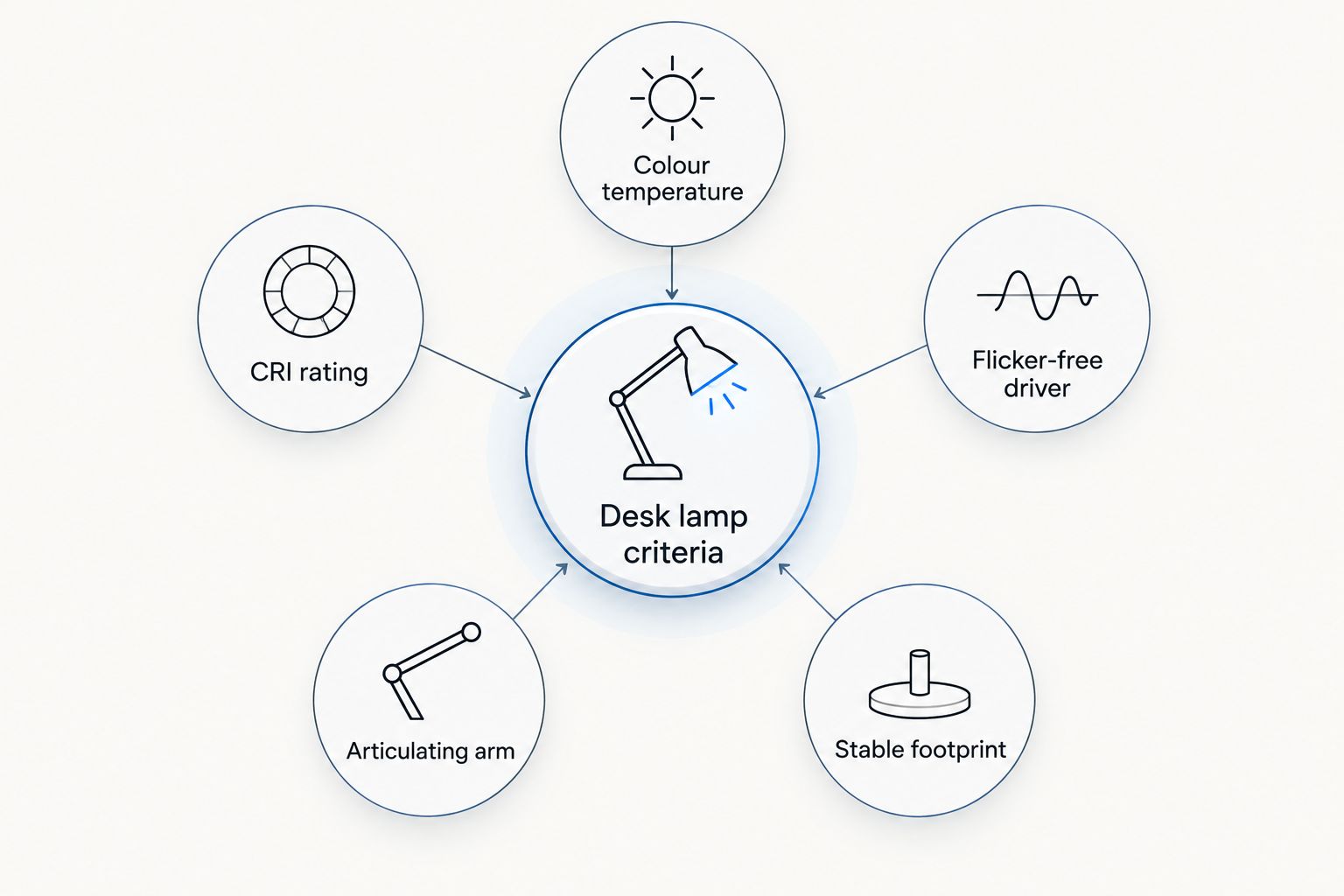
- Adjustable colour temperature — the ability to shift between warm (around 2700K) and cool daylight (around 6500K) light
- High CRI (colour rendering index) — 80 or above keeps colours and text looking accurate, not washed out
- Flicker-free LED driver — reduces eye fatigue over an 8-hour day
- Articulating arm or head — lets you redirect light without moving the lamp base
- Stable footprint or clamp mount — matters more on small or shared desks
- USB or USB-C output — useful if the lamp doubles as a charging point for a phone or tablet
Desk lamps at a glance
| Type | Best for | Standout feature | Key limitation |
|---|---|---|---|
| LED articulating desk lamp | Home office productivity overall | Adjustable colour temperature and arm | Larger footprint than a clamp lamp |
| Clamp-mount desk lamp | Small or shared desks | Clamps to the edge, frees up surface | Needs a desk edge under 60mm thick to clamp |
| Basic dimmable LED desk lamp | Budget buyers | Simple dimmer, flicker-free LED | Fixed colour temperature on most models |
| High-CRI natural light desk lamp | Long screen sessions, eye strain | CRI rated 90+ on premium models | Costs more than a basic dimmable lamp |
| USB-charging desk lamp | Multitasking with phone/tablet | Built-in USB or USB-C port | Charging port adds bulk to the base |
| Ring light desk lamp | Video calls and remote work | Even, shadow-free front lighting | Less useful for reading paperwork |
LED articulating desk lamp: best all-round choice for home office productivity
An LED articulating desk lamp uses a jointed arm to put light exactly where the work is, and most models let you cycle through several colour temperatures from a single touch panel. This is the default pick for anyone spending 6+ hours a day at a home desk.
LED articulating desk lamp pros:
- Arm repositions light for typing, reading or video calls without moving the base
- Multiple colour temperature settings cover both focus work and evening use
- Flicker-free LED drivers are standard at this tier
- Dimming steps let you match ambient light through the day
LED articulating desk lamp cons:
- Bigger footprint than a clamp or basic lamp
- Touch controls take a session or two to learn
Best for: anyone who wants one lamp to cover the whole workday.
Clamp-mount desk lamp: best for small desks
A clamp-mount desk lamp attaches to the desk edge instead of sitting on the surface, which matters on a small desk, a shared table, or a desk already crowded with a keyboard, monitor arm and notebook.
Clamp-mount desk lamp pros:
- Zero desk-surface footprint
- Easy to reposition or remove entirely
- Works well paired with a monitor arm setup
Clamp-mount desk lamp cons:
- Needs a desk edge thin enough to clamp onto
- Fewer models offer adjustable colour temperature than the articulating category
Best for: small desks, shared workstations, and anyone who already has a monitor arm eating desk space.
Basic dimmable LED desk lamp: best budget option
A basic dimmable LED desk lamp skips the articulating arm and multi-colour panel and just delivers flicker-free light with a dimmer. It is the right call when the budget needs to stretch across a whole home office setup, not just the lamp.
Basic dimmable LED desk lamp pros:
- Lowest cost entry point into flicker-free LED lighting
- Simple to operate, no learning curve
- Compact enough for any desk size
Basic dimmable LED desk lamp cons:
- Usually fixed at one colour temperature
- Less useful for tasks needing daylight-white accuracy
Best for: anyone furnishing a home office on a tight budget, if colour temperature flexibility isn't a priority.
High-CRI natural light desk lamp: best for eye strain and long hours
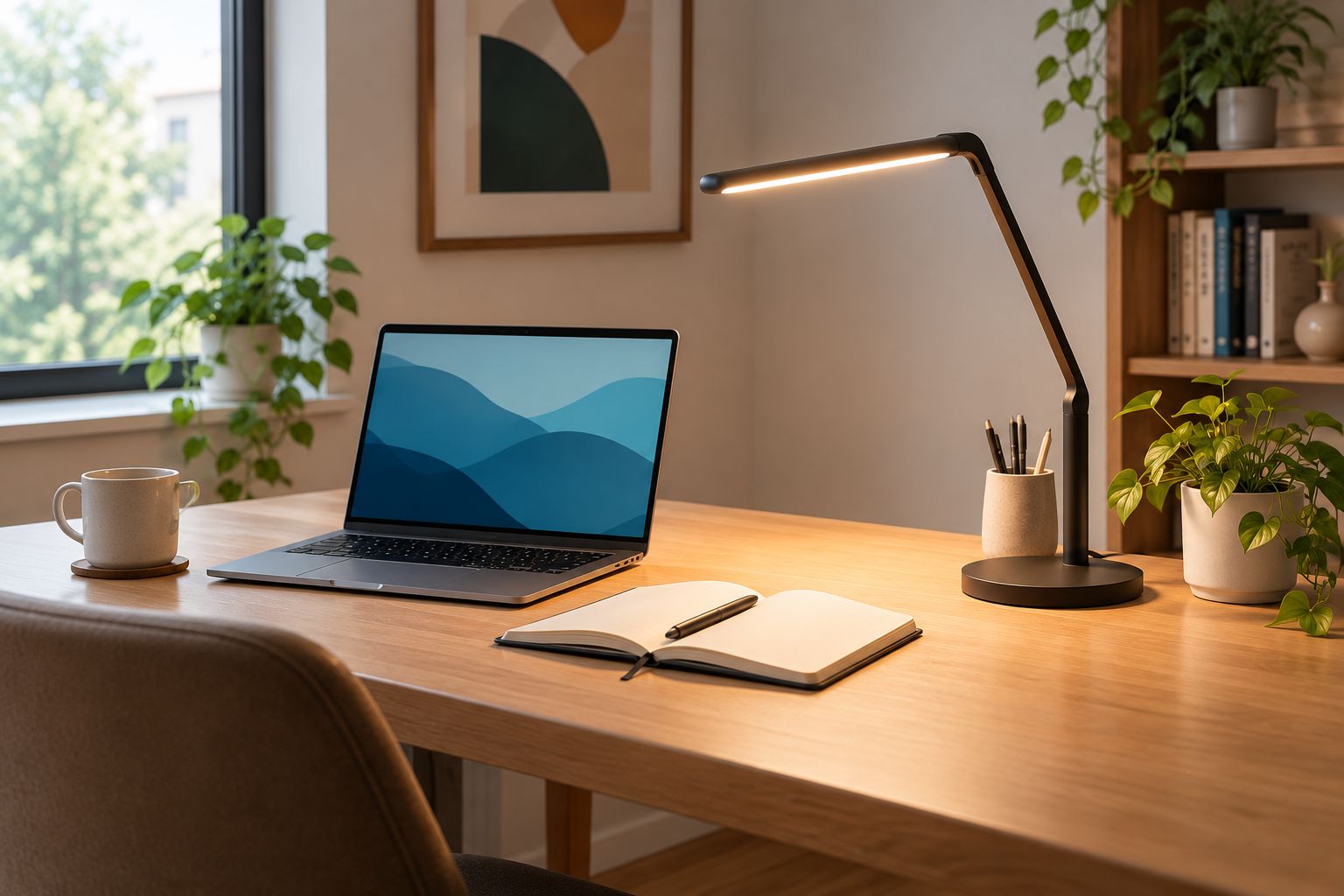
A high-CRI natural light desk lamp is built around colour accuracy rather than adjustability. Premium models publish a CRI above 90, which keeps skin tones on video calls and colours in documents looking true rather than washed out under standard LED light.
High-CRI natural light desk lamp pros:
- CRI 90+ on premium models keeps colour rendering accurate
- Reduces eye fatigue over long screen sessions
- Even light spread minimises harsh shadows
High-CRI natural light desk lamp cons:
- Costs more than a basic dimmable lamp
- Overkill for short, occasional desk use
Best for: anyone doing 8+ hour screen days, colour-sensitive work, or frequent video calls — a fit for heavy daily use.
Desk lamp with USB charging ports: best for multitasking
A desk lamp with a built-in USB or USB-C port turns the lamp base into a second charging point, useful for anyone juggling a phone, tablet and laptop on one desk without enough power outlets nearby.
USB-charging desk lamp pros:
- Frees up a powerboard slot for other devices
- Keeps a phone or tablet within reach while charging
- Reduces cable clutter on the desk surface
USB-charging desk lamp cons:
- Charging port adds bulk to the lamp base
- Charging speed is usually lower than a dedicated wall charger
Best for: desks short on power outlets or already running a full powerboard for office safety. A fit if outlet space is tight.
Ring light desk lamp: best for video calls
A ring light desk lamp wraps light evenly around the face rather than casting it down onto paperwork, which is why it shows up on video-call setups more than on reading desks.
Ring light desk lamp pros:
- Even, shadow-free light for video calls
- Adjustable brightness suits different room lighting
- Compact clip or stand mounting options
Ring light desk lamp cons:
- Less useful for reading documents or fine detail work
- Can create a visible ring reflection in glasses
Best for: remote workers on frequent video calls, if video calls are the main use case — skip it if the desk is mostly for reading and writing.
How to choose
Each category was measured against the six criteria above: colour temperature range, CRI, flicker-free performance, arm articulation, footprint, and charging output. No single lamp type wins on every criterion — that's why the list is split by use case rather than a single leaderboard.
Which desk lamp should you choose?
For most home offices, the LED articulating desk lamp is the default pick — it covers focus work, video calls and evening use from one fixture. Drop to a clamp-mount lamp if desk space is the binding constraint, or a basic dimmable LED lamp if the budget is. Pair whichever lamp you choose with tidy cable routing — a desk organiser keeps the lamp cord from tangling with keyboard and monitor cables.
FAQ
What's the best desk lamp for a home office?
An LED articulating desk lamp with adjustable colour temperature is a strong all-round pick for home office productivity. It covers focus work, reading and video calls from one fixture.
Is a clamp-mount desk lamp better than a base-mount lamp?
A clamp-mount desk lamp is better on small or shared desks because it frees up the entire work surface. A base-mount lamp is steadier and works better on larger desks with room to spare.
How much does a desk lamp cost?
Pricing varies by type and features — check the current range for exact figures. Basic dimmable LED lamps sit at the budget end, while high-CRI and articulating models cost more.
What colour temperature is best for a desk lamp?
A colour temperature between 4000K and 5000K suits most focus work, while warmer settings around 2700K-3000K suit evening use. An adjustable lamp lets you switch between the two.
Do desk lamps reduce eye strain?
A flicker-free LED desk lamp with a CRI above 80 reduces eye strain compared with harsh overhead lighting or an old incandescent lamp. Direct, adjustable light on the work surface matters more than raw brightness.
Are ring light desk lamps worth it for remote work?
A ring light desk lamp is worth it if video calls are a daily part of the job, since it lights the face evenly without shadows. It's less useful for reading or paperwork-heavy desks.
What is CRI and why does it matter for desk lamps?
CRI, or colour rendering index, measures how accurately a light source shows true colours. A desk lamp with a CRI above 80 keeps text, skin tones and printed colours looking natural.
Can a desk lamp double as a phone charger?
Some desk lamps include a built-in USB or USB-C port that charges a phone or tablet from the lamp base, which reduces the need for extra powerboard outlets on the desk.
One last thing
CRI gets ignored more than any other spec on a desk lamp box, yet it matters more than lumens for anyone doing colour-sensitive or detail-heavy work. A lamp rated CRI 95 and one rated CRI 75 can carry the same wattage and look identical in a showroom, but only one of them renders true colour on a printed proof or a video call.


