

Did you know that human error was a factor in 37% of all Australian data breaches in the first half of 2025? For procurement officers and office administrators, having paper shredder security levels explained is no longer just a technical curiosity; it's a vital part of modern risk management. You've likely felt the annoyance of a machine that constantly jams or overheats just as you're trying to clear a backlog of sensitive files. It's a common struggle to find the balance between high-volume efficiency and the rigorous demands of national privacy standards.
This professional guide provides the clarity you need to master the technical specifications of document destruction. We'll ensure your organisation remains compliant with the Privacy and Other Legislation Amendment Act 2024 and the latest international standards. You'll learn the difference between various particle sizes, understand the shift to ISO/IEC 21964 ratings, and discover how to choose durable, industrial-grade hardware that minimises maintenance downtime while protecting your professional reputation and operational workflow.
Key Takeaways
- Align document destruction with Australian Privacy Act standards to mitigate legal risks and protect sensitive organisational data.
- Get paper shredder security levels explained to ensure your P-rating matches the specific sensitivity of your workplace documents and files.
- Evaluate duty cycles and motor cooling requirements to prevent equipment overheating and maintain high-volume efficiency during large batch runs.
- Implement professional maintenance routines, including proper oiling and jam prevention, to maximise the operational life of your machinery.
- Optimise office workflows by selecting hardware with specifications tailored to the unique demands of your specific Australian professional environment.
Data Security and the Australian Privacy Act: Why Shredding Matters
Australian organisations are currently facing the most rigorous privacy landscape in the country's history. With the Privacy and Other Legislation Amendment Act 2024 now in effect, the responsibility for protecting personal information has moved from a best-practice recommendation to a strict legal mandate. While digital cybersecurity often takes the spotlight, physical document security remains a significant vulnerability. Between January and October 2025, Australia saw 71 publicly reported data breaches, a 48% increase from the previous year. A single discarded payslip or bank statement in a general waste bin can lead to a serious breach. Understanding how Paper shredder security levels are defined helps procurement officers select the right tools to mitigate these risks.
To better understand how these classifications protect your data, watch this helpful video:
Regulatory Compliance for Businesses and Schools
The Notifiable Data Breaches (NDB) scheme requires Australian organisations to notify individuals and the OAIC when a data breach is likely to result in serious harm. For schools, healthcare providers, and businesses, this means any document containing names, health records, or financial data must be destroyed beyond recognition. Relying on "general waste" disposal is a massive liability. If a document is retrieved from a bin and leads to identity theft, the organisation could face litigation under the statutory tort for serious invasions of privacy that took effect in 2025. The financial cost of a breach, including legal fees and reputational damage, far outweighs the investment in professional hardware. Aligning your equipment with your internal document retention policies ensures that once a file's legal holding period ends, it's permanently erased.
The Security Risks of Improper Disposal
Security gaps often appear in mundane places like reception areas, staff kitchens, or mailrooms where sensitive paperwork might sit for hours. Unattended documents in these high-traffic zones are prime targets for corporate espionage or opportunistic theft. It's not just about hiding a name; it's about protecting the "bundled" data cybercriminals crave for identity fraud. Professional technology acts as a physical firewall against these threats. Having paper shredder security levels explained allows you to choose a machine that turns a sensitive contract into thousands of unreadable particles, ensuring human error, which factored into 37% of 2025 breaches, doesn't compromise your firm. Document destruction is the final security gate for sensitive data.
Decoding Shredder Specifications: DIN 66399 Security Levels Explained
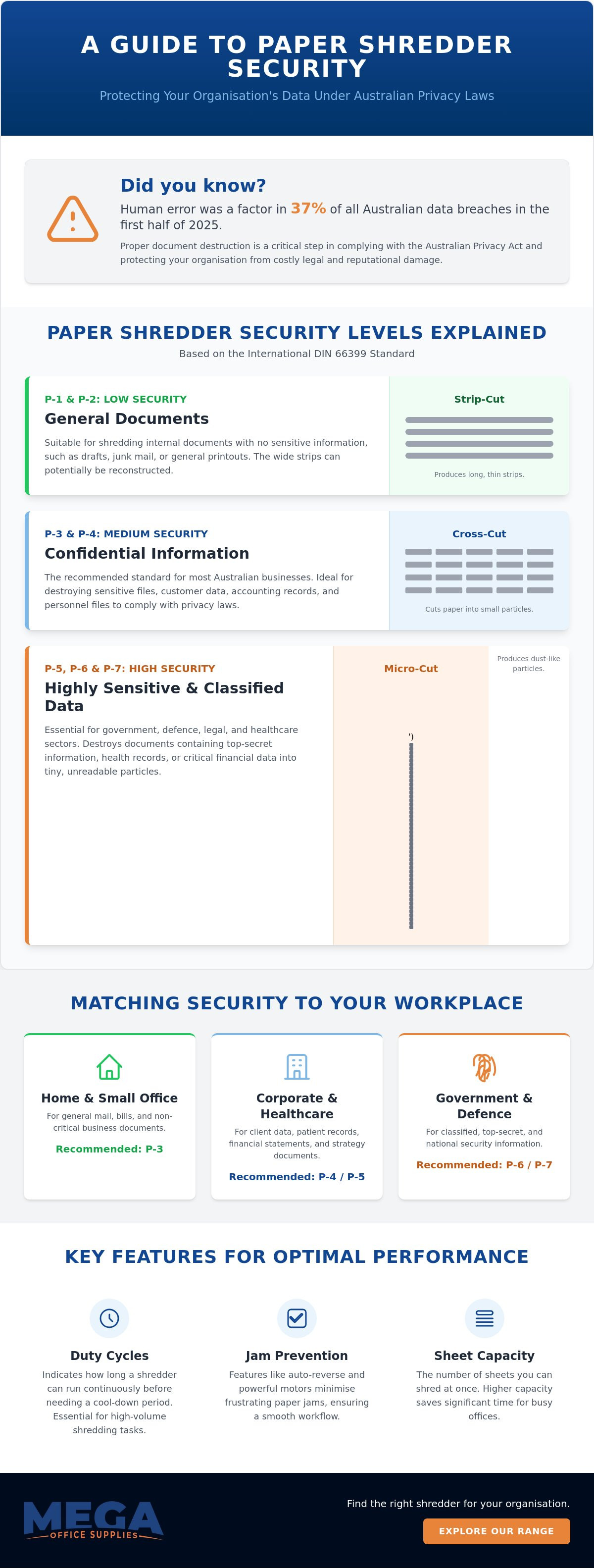
When selecting hardware for a professional environment, you'll encounter the DIN 66399 standard. This international benchmark classifies how effectively a machine destroys data carriers, ranging from P-1 to P-7. Having paper shredder security levels explained is essential for any procurement officer because the physical size of the shredded waste determines your level of protection. While the technical details can seem dense, they translate directly to your organisation's ability to meet the requirements of the Australian Privacy Act regarding the permanent destruction of sensitive records.
Understanding P-Ratings (P-1 to P-7)
The "P" in these ratings stands for paper. Lower ratings, specifically P-1 and P-2, are designed for general internal documents that don't contain sensitive data. These machines produce wide strips that a determined individual could potentially reassemble. For the vast majority of Australian businesses, P-3 and P-4 are the standard. These levels provide cross-cut particles that are ideal for accounting records and customer files. When you move into the P-5 to P-7 range, you're looking at micro-cut technology. These are the high-security requirements for legal, medical, and government sectors where even a single word escaping destruction could result in a significant data breach.
Cut Type Comparison: Strip vs. Cross vs. Micro
- Strip-cut: These machines are built for speed and high volume. They cut paper into long, spaghetti-like strips. While efficient for clearing out non-confidential archives, they offer minimal security.
- Cross-cut: This is the versatile, secure choice for most professional offices. By cutting paper from two directions, it creates small confetti-like pieces. It strikes a perfect balance between speed and security.
- Micro-cut: For HR files, pathology reports, or secret data, micro-cut is the only viable option. It turns an A4 sheet into over 2,000 tiny particles, making reassembly virtually impossible.
Workplace productivity isn't just about the cut type; it's also about sheet capacity and bin volume. If your team shreds large batches, a machine with a 20-sheet capacity and a 30-litre bin will save hours of labour compared to a smaller home-office unit. Higher security levels often mean slower shredding speeds because the blades must work harder to create smaller particles. Finding the "sweet spot" involves matching the P-rating to your most sensitive document type while ensuring the motor can handle your daily volume. If you're unsure which rating fits your specific sector, browsing a range of professional shredding technology can help you compare these specifications side-by-side.
Choosing the right paper shredder security levels explained above ensures that your disposal process is both efficient and compliant. A P-4 cross-cut machine is often the most reliable partner for a busy reception area or accounting department, providing peace of mind without sacrificing the speed required for high-volume tasks.
Choosing the Right Shredder for Your Australian Workplace
Selecting the correct hardware requires more than just looking at a price tag. You must match the machine to your specific office environment and the sensitivity of your data. Whether it's a bustling open-plan office or a quieter reception area, noise levels are a critical consideration across Australian workplaces. Many modern professional units feature "silent shred" technology to ensure that document destruction doesn't disrupt phone calls or client meetings. Beyond acoustics, you must assess your daily volume. A motor designed for a home office will likely overheat and fail if forced to process the high-volume archives typically found in a commercial warehouse or centralised mailroom. Having paper shredder security levels explained helps you understand that as security increases, speed often decreases, so choosing a machine with a higher sheet capacity can help offset this trade-off.
Workflow efficiency often comes down to the feeding mechanism. Manual feed shredders require a staff member to stand by the machine, which is fine for occasional use. However, for large-scale document disposal, automatic feed units allow you to stack hundreds of sheets and walk away. This frees up administrative staff for more productive tasks while the machine handles the destruction in the background.
Shredders for Schools and Educational Departments
Educational institutions manage a vast array of sensitive student records and staff documentation. When sourcing educational supplies, document security should be a primary pillar of your procurement strategy. Safety is the most important feature in these high-traffic administrative centres. Look for units with advanced safety sensors that instantly stop the cutters if hands touch the paper entry. Integrating secure disposal into your school's workflow ensures that old report cards and medical forms aren't just thrown into a recycling bin where they remain a liability.
Corporate and Government Solutions
Large-scale operations require heavy-duty units with extended run times. In a centralised finance department, a shredder might need to run for 30 minutes or more without a cool-down period. For these environments, we recommend high-capacity units that can handle staples, paper clips, and even credit cards. To ensure your procurement process remains efficient, we offer streamlined options for Australian government official purchase orders.
Healthcare and Medical Centre Requirements
Medical centres and hospitals deal with the most sensitive data of all: patient pathology reports and health records. To meet AHPRA standards and maintain medical confidentiality, a P-5 micro-cut shredder is the recommended baseline. These units turn a single page into over 2,000 unreadable particles. Since consultation rooms are often tight on space, look for slim, space-saving units that fit under a desk but still offer the high-security performance required for healthcare administrative hubs. Having the right paper shredder security levels explained ensures that your practice remains compliant with national health privacy regulations.
Maximising Longevity: Maintenance and Duty Cycles Explained
A machine's duty cycle is often its most overlooked specification. This term refers to the total time a shredder can operate continuously before the motor requires a dedicated cool-down period. In high-volume Australian offices, failing to respect these limits is the primary cause of hardware failure. While we have already had paper shredder security levels explained in terms of data protection, your choice must also account for these mechanical endurance ratings. A light-duty unit might only run for three minutes; however, an industrial-grade machine can operate for over an hour without stopping. Exceeding these thresholds leads to thermal cut-out, which halts productivity and can eventually cause permanent motor burnout.
Modern professional hardware often includes anti-jam technology to maintain office efficiency. These systems use sophisticated sensors to measure paper thickness, preventing the blades from engaging if the stack is too large. For non-paper items, transparency is key. Most commercial units handle staples and small paperclips with ease; however, credit cards and optical media often require a dedicated entry slot to protect the main cutting cylinders. Establishing a clear usage programme for your team prevents accidental damage from inappropriate materials.
Oiling and Blade Care
Lubrication is the lifeblood of any high-security shredder. Cross-cut and micro-cut machines require more frequent lubrication than basic strip-cut models because of the complex interaction between the precision blades. For peak performance, you should oil your machine every time the waste bin is emptied. You can use traditional shredder oil for manual precision or convenient oil sheets for a faster, mess-free alternative. Regular oiling can extend a shredder’s lifespan by up to 50%. This simple habit reduces friction, prevents rust, and ensures the motor doesn't have to work harder than necessary to pull paper through the cylinders.
Troubleshooting Common Issues
If a jam occurs, the first step is to use the manual reverse function. This usually clears the obstruction without further intervention. Never use metal tools or screwdrivers to pry paper out, as this will chip the blades and void your warranty. Modern automatic units may also trigger sensor errors if the waste bin is slightly ajar or if paper dust is obstructing the optical sensors. A quick wipe with a dry cloth often resolves these "ghost" errors. When a machine consistently overheats or makes grinding noises despite proper oiling, it's time to seek professional support. To avoid these common pitfalls, ensure your team is equipped with premium shredding hardware designed for the rigours of a professional workplace.
Maintaining your equipment is just as vital as having paper shredder security levels explained during the initial purchase. Consistent care ensures that your investment continues to provide the high-level data security your organisation requires under the Australian Privacy Act.
Streamlining Your Security Procurement with Mega Office Supplies
Managing workplace security equipment requires a strategic approach rather than reactive purchasing. Once you have paper shredder security levels explained across your various departments, the next step is consolidating that hardware into a reliable supply chain. Centralising your procurement for technology through a single, dependable partner reduces administrative friction and ensures consistency in your data protection protocols. Mega Office Supplies provides the logistical prowess needed to support large-scale operations while maintaining the accessibility of a business that's been family owned and operated since 2008. This blend of scale and regional expertise ensures that procurement officers receive both comprehensive solutions and direct assistance whenever a technical requirement arises.
Bulk Ordering and Business Accounts
Efficiency is the cornerstone of any well-run office. By setting up a business application, procurement officers can streamline the acquisition of heavy-duty machinery alongside daily essentials. This allows you to integrate your shredding hardware into a broader office supplies strategy. You can coordinate the delivery of maintenance oils and waste bags with your toner and ink cartridge orders. This habit minimises shipping costs and reduces the number of invoices your finance team needs to process. Our national delivery network ensures that multi-site organisations from Perth to Sydney receive professional-grade equipment on time. We understand the specific workflow of professional buyers who need to evaluate costs and quantities quickly, which is why our system is designed for rapid quoting and efficient fulfilment across all categories.
Expert Support and Reliability
Reliability isn't just about the hardware; it's about the support behind it. Our Australian-based team offers direct assistance for technical queries via our local contact line. Whether you have a specific question about a P-rating or need advice on high-volume motor endurance, our staff provide authoritative guidance grounded in decades of regional experience. For those seeking specific model recommendations, our review of the best paper shredder for small business Australia provides a detailed breakdown of top-performing units. We are committed to supplying durable, industrial-quality tools to every Australian sector. Our focus remains on longevity and functional clarity. We act as a hardworking, consistent partner that values stability over flashiness, ensuring your workplace maintenance remains organised and compliant year after year.
Secure Your Workplace Compliance Today
Securing your organisation's physical data is a continuous responsibility that demands the right hardware and a clear understanding of technical standards. With paper shredder security levels explained, you're now equipped to match your P-rating to the specific sensitivity of your documents; ensuring full compliance with the Australian Privacy Act. Remember that regular maintenance and respecting duty cycles are the keys to protecting your investment and preventing operational downtime in high-volume environments.
Family owned and operated since 2008, Mega Office Supplies is a dependable partner for Australian businesses, providing professional-grade workplace solutions across every sector. We understand the specific needs of procurement officers and administrators, which is why official Australian Government purchase orders are accepted and national delivery is standard for all multi-site operations.
Browse our full range of professional paper shredders to find the durable, high-capacity equipment your office requires. Take the final step in hardening your data security and enjoy the peace of mind that comes with industry-leading hardware.
Frequently Asked Questions
How do I choose the right P-rating for my Australian business?
Match the rating to the sensitivity of your records. P-4 is the standard for most corporate and financial documents. For medical or legal sectors, P-5 is the recommended baseline. Having paper shredder security levels explained helps you align your equipment with the Australian Privacy Act requirements for permanent destruction. Your choice should reflect the highest level of sensitivity found in your daily paperwork.
Can I shred staples and paperclips in a standard office shredder?
Most commercial-grade office shredders are designed to handle standard staples and small paperclips without damaging the blades. You should check your specific model's manual before processing heavy-duty fasteners. Large clips or industrial staples can chip the precision cutting cylinders. This leads to premature hardware failure and can void your warranty, so use caution with non-standard attachments.
What is the difference between a manual and automatic feed shredder?
Manual feed requires a staff member to feed paper into the machine by hand, while automatic feed allows you to stack a large pile of documents in a tray for unattended destruction. Automatic units are ideal for high-volume environments like centralised finance departments. They improve office efficiency by allowing employees to walk away while the machine processes up to 600 sheets in a single batch.
How often does a professional paper shredder need to be oiled?
You should oil your cross-cut or micro-cut shredder every time the waste bin is emptied to maintain peak performance. Regular lubrication reduces friction between the precision blades and prevents the motor from overworking. Using shredder oil or oil sheets consistently can extend the operational life of your machinery by up to 50%, ensuring the cutters remain sharp and efficient.
What should I do if my shredder overheats during a large job?
If your machine stops due to overheating, turn it off and allow it to cool down for the period specified in the manual, usually between 20 and 60 minutes. This thermal cut-out is a safety feature designed to protect the motor from permanent damage. To avoid this in the future, select a machine with a longer duty cycle that matches your organisation's typical daily shredding volume.
Are micro-cut shredders better than cross-cut shredders for security?
Micro-cut shredders provide a higher level of security because they turn an A4 page into over 2,000 tiny particles compared to the 400 pieces produced by a standard cross-cut unit. While cross-cut is sufficient for general business records, micro-cut is the superior choice for HR files and medical data. Having paper shredder security levels explained ensures you select the correct cut type for your sector's confidentiality needs.
Can I shred CDs and credit cards in any shredder model?
No, you should only shred non-paper items if your machine has a dedicated entry slot or is specifically rated for these materials. Feeding plastic cards or optical media into a standard paper slot can dull the blades and damage the motor. Many professional units include a secondary cutting system to handle these items safely while keeping the plastic waste separated for easier recycling.
How long is the typical duty cycle for a commercial-grade shredder?
Commercial-grade shredders typically offer duty cycles ranging from 20 minutes to continuous operation, depending on the motor's industrial rating. Entry-level office units often require a cool-down after 10 minutes of use. It's vital to choose a machine that can handle your largest batch runs without triggering the thermal safety switch, as consistent overheating will significantly shorten the hardware's total lifespan.
Article by
Mega Office Supplies Team
The Mega Office Supplies Team provides practical guidance for Australian businesses, schools, government organisations, healthcare providers, hospitality venues, warehouses and home offices. Based in Tweed Heads South, Mega Office Supplies is an Australian business, family owned and operated since 2008, offering office stationery, workplace furniture, technology products, labels, printers, cleaning and janitorial supplies, safety products, art materials, education resources and everyday business essentials from trusted brands.
General Information
This article is provided as general information only to help customers compare and choose office, workplace, school, cleaning, technology, furniture, safety and business supplies. Product details, specifications, compatibility, availability, pricing and suitability may vary. Always check the individual product page, manufacturer information, workplace requirements and relevant safety guidance before purchasing or using a product.


