


The most visually impressive executive chair in the showroom might be the single biggest contributor to your team's declining productivity during a humid Australian summer. When conducting a mesh vs leather office chair comparison, many procurement officers prioritise boardroom aesthetics over the technical realities of the local climate. You're likely aware that office seating is a significant long-term investment that must balance ergonomic support with daily maintenance requirements. With the domestic office furniture market growing at 3.5% annually, choosing the wrong material leads to more than just physical discomfort; it results in premature replacement costs and potential WHS compliance issues.
This 2026 guide helps you discover the definitive technical and practical differences between mesh and leather seating to maximise workplace comfort and durability. We'll provide the clarity you need to select chairs that meet AS/NZS 4438:1997 standards and AFRDI Level 6 certification. Our analysis covers everything from thermal regulation and airflow to the long-term hygiene and maintenance cycles of different upholstery. You'll gain a clear understanding of which material suits your specific environment, whether you're outfitting a high-traffic healthcare facility or a professional home office.
Key Takeaways
- Identify the technical differences in thermal regulation to ensure staff remain comfortable and productive during the warmer Australian months.
- Use this mesh vs leather office chair comparison to balance professional aesthetic preferences with the rigorous demands of high-volume commercial use.
- Evaluate the long-term maintenance requirements and lifecycle costs of each material to make a financially sound investment for your organisation.
- Align your furniture selection with current Australian WHS standards and AFRDI certifications to ensure safety and durability across your facility.
Comparison Overview: Mesh vs Leather at a Glance
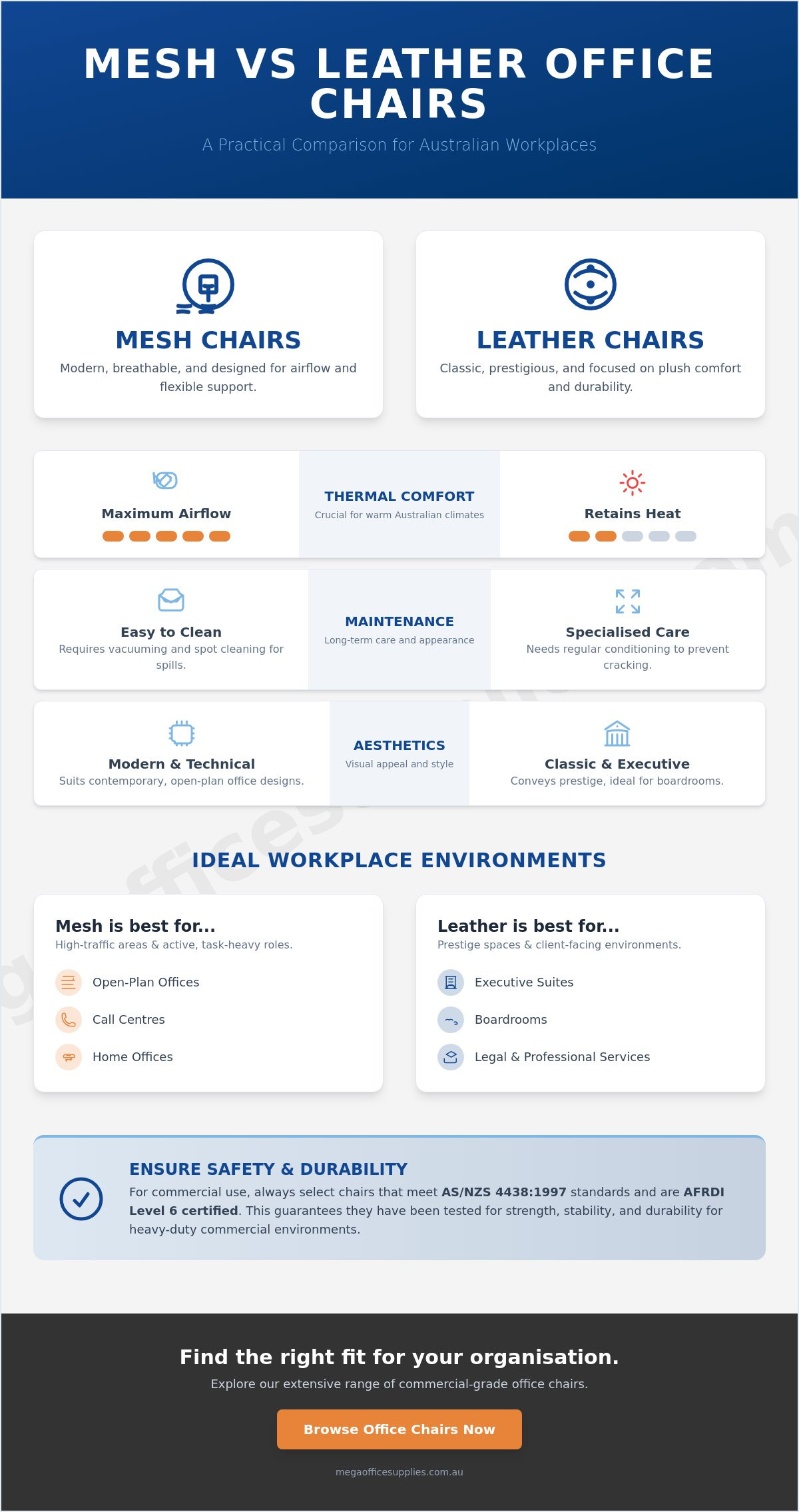
Selecting the right upholstery is a logistical decision that directly impacts staff retention and workplace health and safety. In any mesh vs leather office chair comparison, the primary distinction lies in the material's physical properties: elastomeric mesh is a breathable, flexible weave designed for airflow, while upholstered leather provides a dense, insulating surface focused on prestige and tactile comfort. For Australian organisations, this choice often dictates whether a workspace remains functional during peak summer temperatures or requires increased air conditioning loads to maintain occupant comfort.
To better understand the practical differences between these two upholstery types, watch this helpful comparison video:
Initial procurement costs vary significantly based on material grade. While entry-level mesh options are often more accessible for high-volume fit-outs, professional-grade mesh chairs with AFRDI Level 6 certification can rival the cost of premium leather. Leather remains the standard for executive suites and legal environments where "prestige factor" is a requirement, whereas mesh has become the operational standard for task-heavy roles in call centres and open-plan offices. You can browse our extensive range of office furniture to see how these materials are integrated into modern ergonomic designs.
Key Features Comparison Table
The following table provides a high-level technical breakdown for procurement officers evaluating bulk seating requirements.
| Feature | Mesh Chairs | Leather Chairs |
|---|---|---|
| Breathability | High (Elastomeric weave) | Low (Natural/Synthetic hide) |
| Maintenance | Vacuum and spot clean | Leather conditioner/Wipe down |
| Aesthetics | Modern and technical | Classic and executive |
| Summer Suitability | 5/5 (Maximum airflow) | 2/5 (Heat retention) |
The Evolution of Office Seating Materials
Modern seating has advanced rapidly from the rigid designs found in the History of the Office Chair. Early executive seating relied heavily on leather for its durability and status. Manufacturing improvements have since allowed for the development of high-tension mesh that provides consistent lumbar support without the sagging issues seen in older models. While leather remains a staple in Australian boardrooms for its longevity and traditional appeal, technical mesh is now the preferred solution for organisations prioritising active ergonomics and thermal regulation. Our team brings over 50 years of combined experience to help you navigate these material shifts and select the hardware that best fits your operational workflow.
Thermal Regulation and Ergonomics: The Science of Seating
The physiological impact of seating material is often overlooked during the procurement process. In a detailed mesh vs leather office chair comparison, the most significant technical difference is how each surface manages thermal energy. While leather provides a dense, comfortable barrier, it also acts as a powerful insulator. For staff working eight-hour shifts, this insulation can lead to a steady rise in core body temperature. Conversely, elastomeric mesh is engineered to facilitate passive cooling, which is a critical factor for maintaining focus in busy Australian workplaces.
Effective pressure distribution also varies between these two materials. Leather chairs rely on high-density foam padding to support the user's weight, which creates a "sink-in" feeling that many find psychologically comforting. Mesh chairs use a suspension system where the weight is distributed across a high-tension weave. When evaluating these profiles, referring to OSHA's Ergonomic Chair Guidelines provides a framework for understanding how seat pan depth and backrest height interact with different upholstery types to maintain spinal alignment.
Thermoregulation in the Australian Climate
Australian office environments often face high heat loads, particularly in buildings with large glass facades or inconsistent air conditioning. Leather and synthetic "pleather" options can become problematic in these conditions, leading to the "sticky" factor where the material adheres to the skin in humid weather. High-quality mesh minimises moisture accumulation during summer by allowing perspiration to evaporate through the weave rather than trapping it against the user's back. This constant airflow helps maintain a neutral skin temperature, reducing the fatigue associated with overheating. For organisations looking to improve staff comfort, reviewing our range of ergonomic office furniture can help identify models designed specifically for high-airflow environments.
Support Profiles: Tension vs. Cushioning
The ergonomic benefit of mesh lies in its ability to contour to the unique shape of the user's spine through variable tension. This ensures that the lumbar region receives consistent support without the need for thick padding that might degrade over time. Leather chairs offer a different support profile, often featuring built-in bolsters and layered foam that provide a more structured, rigid feel. While leather is excellent for shorter periods of high-focus work, the lack of breathability can impact posture over long sessions as users shift positions to find a cooler spot. Choosing between these profiles requires an assessment of your specific task requirements, whether that involves stationary deep work or active, multi-tasking movements. Each material offers distinct advantages for spinal health when integrated with a high-quality, adjustable frame.
Durability, Maintenance, and Lifecycle Costs
Long-term viability in office seating depends on the interaction between material composition and usage intensity. In a standard 40-hour work week, a chair undergoes significant mechanical stress that manifests differently across upholstery types. For mesh, the primary wear concern is "creep" or sagging, where the elastomeric fibres gradually lose tension over several years of use.
A thorough mesh vs leather office chair comparison reveals that while leather often requires a higher initial investment, its durability is strictly tied to the specific grade of the material. Selecting the wrong grade for a high-traffic environment leads to premature failure and increased replacement costs. Our team's 50 years of combined industry experience indicates that predicting lifecycle costs requires looking beyond the purchase price to the expected maintenance hours and the environment's specific demands.
Maintenance Requirements for Office Longevity
Maintenance protocols differ sharply between these two materials and impact the total cost of ownership. Mesh surfaces act as a mechanical filter, trapping dust and particulates within the weave; regular vacuuming with an upholstery attachment is mandatory to maintain workplace hygiene. Leather is less permeable, making it a practical choice for staff kitchens or shared breakout areas where spills are a frequent risk. A simple wipe down with a damp cloth handles most surface contaminants. However, genuine leather requires periodic conditioning to prevent natural oils from evaporating. When these maintenance cycles are neglected, the cost of replacing office furniture increases as individual units fail well before their expected seven-to-ten-year lifecycle.
Material Grades and Commercial Durability
Durability is not uniform across all product tiers. Commercial-grade mesh is often rated for heavy-duty use, featuring high-tensile polymers that resist stretching under constant load. In contrast, many lower-cost "executive" chairs utilise bonded leather, which consists of leather scraps adhered with polyurethane. This material frequently peels or "flakes" within 24 months of heavy use. Investing in top-grain or full-grain leather is the only way to ensure a leather chair survives a decade of professional service.
Australian procurement officers should prioritise hardware with AFRDI Level 6 certification. This standard ensures the chair has been tested to withstand 200,000 cycles of use, simulating the demands of a severe commercial environment. Checking the warranty period serves as a reliable proxy for quality; a two-year warranty often indicates a light-duty home office product, whereas a ten-year warranty signals a true commercial-grade investment. For high-traffic sectors like healthcare or education, high-quality mesh typically offers the most predictable and manageable lifecycle cost.
Selecting Material Based on Workplace Environment and Function
The operational success of a workspace often hinges on how well the furniture supports the specific tasks performed within it. While our previous sections analysed thermal science and material durability, this mesh vs leather office chair comparison focuses on matching hardware to the unique demands of different Australian office zones. A procurement officer outfitting a high-pressure call centre faces different logistical requirements than one designing a corporate boardroom. Identifying the primary function of each zone ensures that the material selected enhances rather than hinders staff performance.
In high-intensity, task-heavy environments like open-plan offices, mesh is the undisputed standard. Its lightweight profile and superior airflow support workers who remain seated for extended periods. Conversely, the "Executive Look" provided by leather continues to dominate the C-suite and legal sectors. Leather seating projects a sense of permanence and authority that is difficult to replicate with synthetic weaves. For organisations implementing hybrid work models, matching these chair materials with high-quality standing desks creates a versatile ergonomic flow that accommodates both focused deep work and active collaboration.
Material Choice by Office Zone
Reception areas require a balance between first impressions and high-traffic durability. Leather or high-grade synthetic alternatives are often preferred here as they handle the constant turnover of visitors while maintaining a polished appearance. In the education sector, classroom and training centre requirements prioritise high-density seating that is easy to move and store. Mesh is frequently the preferred choice for Australian schools because it remains comfortable in classrooms that may lack consistent climate control. Home office setups also benefit from mesh, particularly for workers who need to balance professional ergonomics with a domestic environment where air conditioning may not be running at full capacity throughout the day.
The Professional Aesthetic and Brand Image
Your choice of seating material serves as a silent communicator of your company culture. A modern tech firm might opt for technical mesh in vibrant colours to signal innovation and agility. A traditional financial institution may prefer the classic silhouette of black or tan leather to reinforce stability and trust. While leather palettes are typically limited to neutral tones, mesh offers extensive customisation options to align with corporate branding. For more detailed styling advice and technical specs, you can refer to our ergonomic office chair pillar. Selecting the right material ensures your office fit-out is both functional and visually consistent with your brand identity.
View our full range of office furniture to find the specific material and design that fits your workplace requirements.
Commercial-Grade Seating Solutions for Australian Organisations
Mega Office Supplies operates as a high-capacity provider, specialising in the logistical demands of large-scale workplace fit-outs. Our approach to furniture procurement prioritises functional clarity and long-term reliability over fleeting design trends. When conducting a mesh vs leather office chair comparison for a national organisation, we focus on how each material supports specific Work Health and Safety (WHS) requirements. Every chair in our commercial catalogue is evaluated for its ability to withstand the rigours of a professional environment while maintaining compliance with Australian ergonomic standards.
Our team brings over 50 years of combined industry experience to every consultation. This historical depth allows us to identify potential failure points in seating hardware before it reaches your facility. We maintain robust national delivery capabilities, ensuring that whether you're outfitting a single reception area or a multi-storey government department, your order arrives through a well-oiled distribution network. Reliability is our cornerstone; we position ourselves as a dependable partner that values the longevity of your investment.
This same dedication to longevity and quality can be found in other specialised Australian markets.
This focus on reliability extends to every component of a workplace fit-out.
Procurement and Bulk Ordering Efficiency
Simplifying the procurement process for facilities managers and administrators is a primary objective. We evaluate the durability of all seating units against AFRDI Level 6 standards, which simulate severe commercial use. This rigorous testing ensures that the mesh or leather options you select can handle a 120kg load over 200,000 cycles. For large-scale projects, we provide streamlined navigational options for rapid quoting and volume assessments. This efficiency-focused model helps business owners and procurement officers evaluate costs and quantities quickly, ensuring that the final selection aligns with both budgetary constraints and ergonomic needs.
The Logical Conclusion for Your Workplace
The final decision in the mesh vs leather office chair comparison depends on the specific environmental variables of your office zones. Mesh remains the superior technical choice for task-heavy roles where maximum airflow and thermal regulation are mandatory for staff comfort. Leather continues to serve as the benchmark for executive environments where prestige and a classic professional aesthetic are required. Many successful Australian organisations now adopt a mixed-material approach, deploying high-tension mesh in open-plan workstations and premium leather in boardrooms and private offices.
Selecting the right hardware is a critical step in workplace maintenance and employee well-being. Our extensive background in the Australian market ensures that you receive grounded, practical advice tailored to your sector's specific demands. We invite you to view our full range of ergonomic office chairs to find the professional-grade solutions that best suit your organisation's requirements. For direct assistance with high-volume orders or technical specifications, our local support team is available to provide expert guidance.
Optimising Your Workplace Seating Strategy
Selecting the right upholstery is a logistical decision that directly impacts staff productivity and long-term facility maintenance. This mesh vs leather office chair comparison has demonstrated that thermal regulation and specific usage cycles must drive your procurement process. While high-tension mesh provides the essential airflow required for active task work in the Australian climate, premium leather remains a durable and prestigious solution for executive environments and high-traffic reception zones. Prioritising hardware with AFRDI certification ensures your organisation remains compliant with current WHS ergonomic standards.
Just as ergonomic seating supports your professional life, personal comfort is equally vital for overall well-being.
Mega Office Supplies leverages over 50 years of combined industry experience to support complex office fit-outs. As a trusted supplier to government and educational sectors, we understand the need for reliable, commercial-grade furniture that survives heavy-duty use. Our established logistics network provides efficient national delivery across Australia to keep your operations running without friction. You can browse our comprehensive range of commercial-grade office chairs to find the ideal balance of technical support and professional aesthetic for your team. Investing in high-quality seating today ensures a safer and more efficient workplace for years to come.
Frequently Asked Questions
Is a mesh chair better for your back than a leather chair?
Neither material is inherently superior for spinal health; effective support depends on the chair's ergonomic frame and adjustability. A mesh vs leather office chair comparison shows that mesh provides tension-based contouring while leather relies on high-density foam cushioning. You should prioritise chairs that meet AS/NZS 4438:1997 standards to ensure proper lumbar support regardless of the upholstery material selected.
How do you clean a mesh office chair without damaging the fabric?
Vacuum the surface weekly with a soft brush attachment to remove dust and particulates trapped within the weave. For spills, blot the area with a damp cloth and mild detergent rather than rubbing the fabric. Avoid saturated cleaning as moisture can seep into the seat pan foam. Never use bleach or abrasive chemicals as these degrade the elastomeric fibres and reduce the material's lifespan.
Do mesh office chairs sag over time with heavy use?
Commercial-grade mesh chairs are specifically engineered to resist sagging over years of heavy use. While budget models may lose tension, units with AFRDI Level 6 certification are tested to withstand 200,000 cycles without significant deformation. This technical durability makes them a reliable choice for high-intensity environments like call centres or security hubs where chairs are in constant use.
Can leather office chairs be used in hot Australian summers?
Leather chairs are suitable for the Australian climate provided the workspace has consistent, high-performance air conditioning. Without effective climate control, leather acts as an insulator and retains body heat, which often leads to discomfort and perspiration.
Which material is more durable for a high-traffic office environment?
Genuine leather and high-quality mesh both offer excellent durability, but they serve different high-traffic requirements. Leather is superior for resisting spills and physical punctures in shared breakout areas or reception zones. Mesh is more durable for maintaining user comfort during active, long-duration task work. You should avoid bonded leather in high-traffic zones as it typically begins to peel or flake within 24 months.
What is the price difference between high-quality mesh and genuine leather?
High-quality mesh and genuine leather both represent significant professional investments, though genuine leather typically commands a higher upfront cost. This difference reflects the complexities of material sourcing and specialised upholstery labour required for natural hides. When performing a mesh vs leather office chair comparison, you should evaluate the total lifecycle cost, including maintenance and expected replacement cycles, rather than the initial purchase price alone.
Are mesh chairs suitable for formal boardroom settings?
Modern mesh chairs are increasingly popular in formal boardrooms, particularly for organisations aiming for a contemporary or tech-forward aesthetic. While leather remains the traditional standard for executive prestige, high-end mesh offers a sleek, minimal silhouette that complements modern office architecture. The choice often depends on whether your brand identity leans toward traditional authority or agile innovation.
How often should a commercial office chair be replaced?
Commercial office chairs should typically be replaced every 7 to 10 years when used in a standard 40-hour work week. You should monitor for signs of mechanical wear, such as a failing pneumatic lift or degraded lumbar tension, as well as visible upholstery damage. Choosing AFRDI-certified hardware and following a regular maintenance schedule can help extend the functional lifecycle toward the upper end of this range.
Article by
Mega Office Supplies Team
The Mega Office Supplies Team provides practical guidance for Australian businesses, schools, government organisations, healthcare providers, hospitality venues, warehouses and home offices. Based in Tweed Heads South, Mega Office Supplies is a family-owned and operated Australian business offering office stationery, workplace furniture, technology products, labels, printers, cleaning and janitorial supplies, safety products, art materials, education resources and everyday business essentials from trusted brands.
General Information
This article is provided as general information only to help customers compare and choose office, workplace, school, cleaning, technology, furniture, safety and business supplies. Product details, specifications, compatibility, availability, pricing and suitability may vary. Always check the individual product page, manufacturer information, workplace requirements and relevant safety guidance before purchasing or using a product.


