

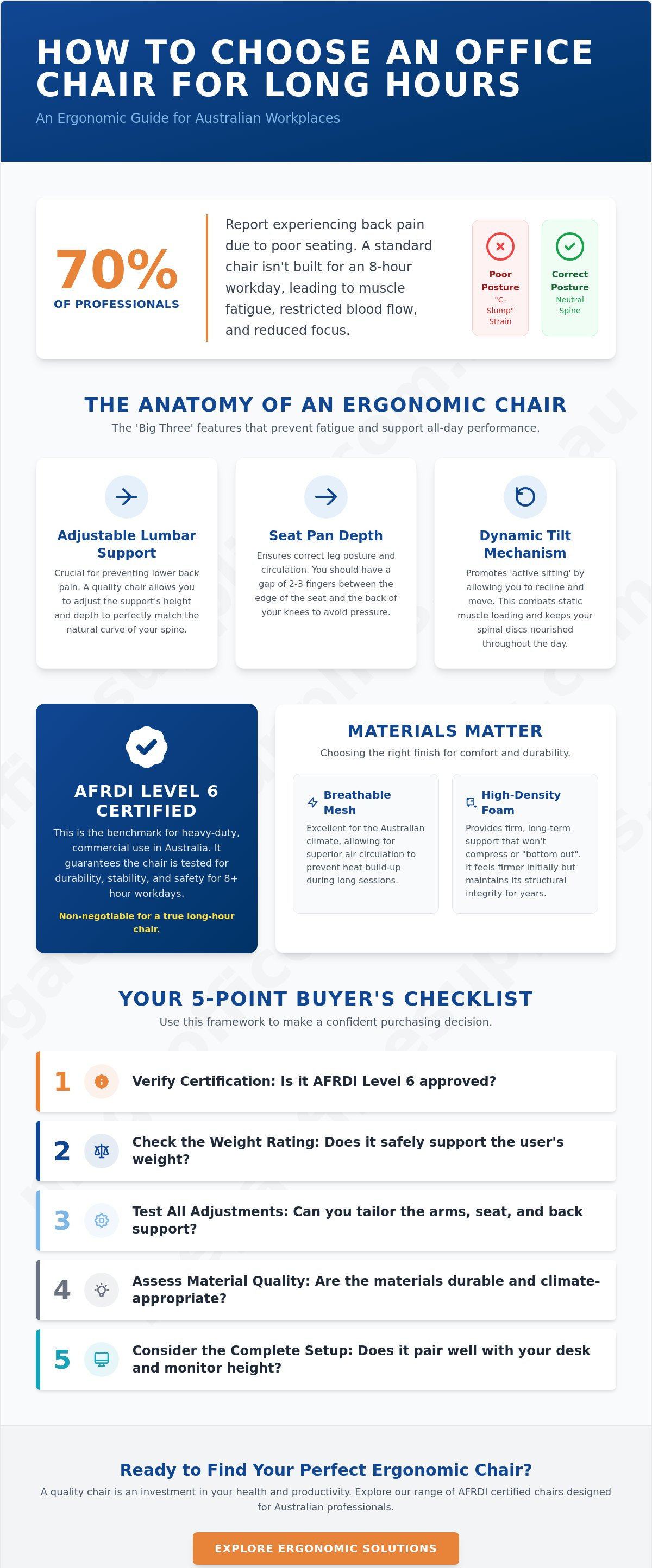
Did you know that nearly 70% of professionals report experiencing back pain due to poor seating? It's a common frustration for many Australians who find themselves tethered to a desk for eight or more hours a day. You likely know the feeling of cheap foam compressing by midday or the discomfort of non-breathable fabrics during a sweltering Australian summer. Learning how to choose an office chair for long hours is no longer a luxury; it's a vital health and productivity requirement for your organisation or home office.
This guide provides the technical specifications and ergonomic requirements you need to maintain your physical health and focus throughout the longest workdays. We will examine the essential Australian standards, such as AS/NZS 4438:1997, and explain why independent certifications like AFRDI Level 6 are the benchmark for a durable, professional-grade investment that lasts. By the end of this article, you'll be equipped to select hardware that minimises fatigue and supports your posture for years to come.
Key Takeaways
- Identify the "Big Three" ergonomic features—lumbar support, seat pan depth, and tilt mechanisms—that prevent static loading during extended shifts.
- Verify AFRDI Level 6 certification to ensure your investment meets the rigorous Australian standards for industrial-grade durability and safety.
- Follow a professional 5-point framework to learn how to choose an office chair for long hours, prioritising weight ratings and mechanical adjustability.
- Evaluate materials like breathable mesh and high-density foam to manage heat dissipation and prevent premature seat compression.
- Complement your ergonomic seating with standing desks and monitor arms to create a complete workspace solution that supports postural movement.
Understanding the 8-Hour Toll: Why Standard Task Chairs Fail
High-intensity sitting is the physical reality for approximately 6.7 million Australians who work from home or in corporate environments. While a standard task chair might suffice for a quick 30-minute email session, it is not engineered for the endurance required during an 8-hour shift. When you sit for extended periods, your body experiences "static loading." This occurs when your muscles remain in a constant state of contraction to maintain your upright position, which restricts blood flow and leads to premature fatigue. Understanding how to choose an office chair for long hours requires looking past the aesthetic and focusing on how a chair facilitates micro-movements to keep your circulation active.
To further combat the fatigue of long shifts, incorporating high-quality refreshments into your breaks can provide a necessary mental and physical reset.
A professional-grade ergonomic solution differs from a basic seat by prioritising dynamic movement. Unlike static chairs that lock you into a single pose, a high-quality ergonomic design encourages the user to tilt, pivot, and adjust their weight. This movement is essential for spinal health, as it ensures that the intervertebral discs receive the necessary nutrients through fluid exchange. When researching how to choose an office chair for long hours, the primary objective is to find hardware that supports your musculoskeletal system through every transition of the workday.
To better understand how sitting posture affects your physical health during long shifts, watch this helpful video:
The Difference Between Initial Comfort and Long-Term Support
Many buyers fall into the "showroom trap" by selecting chairs that feel plush and soft during a two-minute trial. However, overly soft seats often lead to significant pain after four hours because they lack the structural integrity to support your weight. This results in "bottoming out," where the foam compresses completely and leaves you sitting against the hard internal frame. Professional chairs utilise high-density, moulded foam that feels firmer initially but maintains its shape for years. This firm support is critical as it stabilises the pelvis and encourages a neutral spine, which allows for deeper breathing and better oxygen flow to the brain during complex tasks.
Calculating the Cost of Poor Ergonomics
Investing in quality furniture is a strategic business decision rather than a simple expense. Poor seating is directly linked to the "C-slump" posture, where the shoulders round and the head leans forward, putting immense strain on the neck and upper back. This physical strain quickly translates to reduced concentration and increased error rates. By providing proper support, organisations can significantly reduce workplace absenteeism and long-term injury claims. A chair that supports the body correctly ensures that employees remain focused on their output rather than their discomfort, making it a cornerstone of workplace efficiency.
The Anatomy of a Long-Hour Chair: Essential Technical Features
The transition from a standard seat to a professional-grade tool requires an understanding of the "Big Three" ergonomic pillars: the lumbar support, the seat pan, and the tilt mechanism. These components function as a single system to mitigate the physical strain of high-intensity sitting. Adjustability is the non-negotiable factor for any diverse Australian workforce. A chair that lacks customisation forces the user to adapt to the furniture, which inevitably leads to postural collapse.
The importance of a tailored fit is a concept that applies to more than just office furniture.
Active sitting is achieved through specialised mechanisms that allow the chair to move with the user. Instead of remaining locked in a rigid 90-degree angle, these chairs facilitate micro-movements that engage the core and promote blood flow. Adjustable armrests are equally critical. They should move in at least three dimensions (height, width, and depth) to support the weight of the arms. This reduces the load on the trapezius muscles, effectively preventing the neck and shoulder tension that often plagues office workers by mid-afternoon. When evaluating how to choose an office chair for long hours, the mechanical quality of these adjustment points is a primary indicator of long-term utility.
Lumbar Support: Beyond Basic Padding
Quality lumbar support must maintain the spine’s natural S-curve, specifically the lordotic curve of the lower back. Fixed padding is rarely sufficient because every person's torso length differs. Professionals should look for height-adjustable support that hits the small of the back precisely. Depth-adjustable lumbar, often called "aggressive" support, allows users to increase the pressure against the spine, while "passive" support relies on the natural tension of a mesh backrest. Identifying the right level of firmness is a key step in learning how to choose an office chair for long hours.
Mechanism Types: Synchro-Tilt vs. Multi-Function
Synchro-tilt is the preferred mechanism for long-duration use. It uses a 2:1 ratio, where the backrest reclines two degrees for every one degree the seat tilts. This opens the hip angle without lifting the feet off the floor, which is optimal for circulation. Tilt-tension control is a necessary companion feature; it allows you to calibrate the resistance of the recline based on your body weight. For those involved in intensive data entry, a forward-tilt option can be beneficial as it shifts the pelvis into a proactive position, reducing pressure on the underside of the thighs.
Seat Pan Depth and Waterfall Edges
The seat pan must be deep enough to support the thighs but short enough to avoid pressing into the popliteal fold, the sensitive area behind the knees. A "waterfall" front edge, which curves downwards, is essential for maintaining leg circulation and preventing numbness. To measure the correct depth, you should be able to fit two to three fingers between the edge of the seat and the back of your knees. Our range of professional office furniture includes models designed with these specific mechanical requirements in mind, ensuring a fit that supports the body through every hour of the shift.
Materials and Durability: Selecting for the Australian Climate
Selecting the right upholstery and internal components is a technical decision that impacts both user comfort and the lifespan of the asset. In many parts of Australia, high humidity and temperature fluctuations can cause inferior materials to degrade rapidly. When researching how to choose an office chair for long hours, you must consider thermal regulation as a primary ergonomic factor. A chair that traps heat will lead to discomfort and reduced focus, regardless of its mechanical support features. High-intensity sitting requires materials that facilitate heat dissipation rather than acting as an insulator.
Durability is also measured by the quality of the gas lift and the base construction. For environments operating on 24/7 shifts or for users requiring heavy-duty support, a standard Class 3 gas lift is often insufficient. Professional buyers should look for Class 4 gas lifts, which are engineered to handle higher weight loads and more frequent height adjustments without losing pressure. This level of technical scrutiny ensures that your office supplies investment remains functional for the full 5 to 10 year lifecycle typical of commercial furniture.
Mesh vs. Fabric: The Breathability Debate
High-quality mesh is frequently the preferred choice for Australian workplaces due to its superior ventilation. Unlike solid foam backrests, mesh allows for constant airflow, which prevents heat buildup against the user's spine during summer months. However, not all mesh is created equal. Low-grade mesh can lose its tension over time, leading to a "hammock effect" that compromises the very postural support you've invested in. You should look for elastomeric mesh, which is designed to be sag-resistant and return to its original shape after every use. As noted in UCLA's guide to selecting an ergonomic chair, the backrest must be sufficient in height and width to support the shoulder blades without restricting the user's range of motion. Fabric remains a viable alternative for climate-controlled offices, offering a softer feel, though it requires regular maintenance with commercial cleaning chemicals to maintain hygiene.
Australian Standards and Warranties
The most reliable indicator of a chair's suitability for the local market is the AFRDI (Australasian Furnishing Research and Development Institute) rating. An AFRDI Level 6 certification is the gold standard for the industry, confirming that the hardware has been tested for severe commercial use over 8-hour shifts. This testing covers strength, durability, and safety under rigorous conditions. When evaluating how to choose an office chair for long hours, always distinguish between domestic warranties, which may only cover 2 or 3 hours of daily use, and commercial warranties that cover full-time professional operation. Choosing a provider with locally available parts ensures that repairs can be performed quickly, minimising downtime for your organisation.
The Selection Framework: A 5-Point Check for Buyers
Developing a rigorous framework for how to choose an office chair for long hours ensures that your procurement process remains objective rather than subjective. Professional buyers must look beyond the visual design of the furniture and evaluate the hardware based on its mechanical performance and intended duty cycle. This five-point check provides a logical sequence for assessing any chair before it enters your workplace or home office environment.
- Step 1: Verify Weight Rating and Duty Cycle. Confirm the chair is rated for at least 8 hours of daily use. For control rooms or medical facilities, seek 24-hour ratings. Ensure the weight capacity exceeds the user's requirements to prevent premature structural fatigue.
- Step 2: Inspect Adjustment Points. Manually operate the lumbar support and seat pan depth. These should move smoothly and lock securely into position without excessive play in the mechanism.
- Step 3: Test the Tilt and Tension. Engage the recline to check for a fluid transition. The tension control should allow you to calibrate the resistance so the backrest supports you without feeling like it's pushing you forward or letting you drop back too quickly.
- Step 4: Assess the Base and Castors. Check if the castors are designed for your specific floor type. Hard castors are for carpet, while soft-tread castors prevent skidding and damage on timber or tiled surfaces.
- Step 5: Confirm Commercial Certification. Look for the AFRDI label and read the warranty fine print. A true commercial warranty covers the components under full-time operational conditions, not just occasional domestic use.
Matching the Chair to the User Profile
Shared office environments require chairs with a wide range of adjustability to accommodate both petite and tall staff members. A tall user requires a gas lift with sufficient travel to keep their hips slightly above their knees, while a shorter user may need a seat pan that retracts significantly to avoid pressure behind the legs. When organising a professional fit-out, remember that even the best castors can struggle on thick pile carpet. Utilising high-quality chair mats is an essential step to protect your flooring and reduce the physical effort required to move the chair throughout the day.
Testing for Ergonomic Alignment
Once you've narrowed down your selection, test for the "90-90-90" rule. This means your hips, knees, and elbows should all comfortably maintain right angles while your feet are flat on the floor or a footrest. The lumbar support must align with your lower vertebrae to maintain the spine's natural curve. If the chair includes a headrest, it should cradle the base of the skull during recline without forcing your chin toward your chest during upright tasks. You can view our full range of professional ergonomic office chairs to find models that meet these specific alignment criteria.
Beyond the Chair: Integrating Your Ergonomic Solution
Selecting a professional seat is the first step, but its effectiveness depends on how it integrates with your wider workstation. Even the most advanced hardware cannot compensate for a poorly organised desk layout that forces you into awkward reach patterns. Mastering how to choose an office chair for long hours involves viewing the chair as the central hub of a broader ergonomic ecosystem. When your chair is correctly calibrated, it should work in tandem with your standing desks to facilitate a healthy sit-stand routine. This integration is what prevents the musculoskeletal fatigue that often leads to workplace injury and reduced output over time.
The deployment of technology such as monitor arms is a critical secondary factor. These allow you to maintain eye-level alignment regardless of whether you are in a reclined or upright tasking position. By lifting the screen, you prevent the neck flexion that often occurs when a monitor is too low. A professional workspace also requires careful organisation of the primary reach zone. This area, within easy reach of your hands without leaning forward, should contain your keyboard, mouse, and frequently used stationery. Minimising repetitive strain starts with keeping your elbows close to your body and your wrists in a neutral position throughout the day.
While physical posture is paramount, visual health is also a key factor in workplace ergonomics.
The Sit-Stand Transition
Movement is the most effective countermeasure to the risks of prolonged sitting. We recommend a transition cycle where you stand for 15 to 20 minutes for every hour spent seated. This prevents blood pooling and re-energises the core muscles. When your chair is set to a higher position to match a specific desk height, your feet may not rest flat on the ground. If your feet don't reach the floor, a sturdy footrest is a mandatory addition to maintain circulation and prevent pressure on the underside of your thighs. For a more technical breakdown of these components, you can read our full guide on the ergonomics of a chair explained.
Desktop Ergonomics and Reach Zones
A holistic work environment considers every element from lighting to the placement of educational supplies in training rooms or classrooms. High-volume data entry tasks benefit significantly from document holders that place reference materials at the same height and plane as the monitor. This setup reduces the need for constant head rotation, which is a common cause of shoulder tension. You should also define your secondary reach zone for items used less frequently, such as binders or staplers, to ensure they don't clutter your immediate workspace. By integrating your professional chair with these supporting tools, you solidify your understanding of how to choose an office chair for long hours that truly supports your workflow. A well-configured workspace is an investment in your organisation's most valuable asset: its people.
Securing Your Long-Term Workplace Health
Selecting professional-grade furniture is a technical investment in your physical well-being and daily productivity. By prioritising hardware that meets AFRDI Level 6 standards, you ensure your seating remains supportive through every hour of a high-intensity shift. Mastering how to choose an office chair for long hours requires a focus on mechanical adjustability and climate-appropriate materials that prevent heat buildup. When you integrate these features with a sit-stand routine and proper monitor alignment, you create a workspace that minimises injury risk.
Mega Office Supplies has been family owned and operated since 2008, supporting national workplaces. We offer reliable national delivery to ensure you receive high-capacity solutions without logistical friction. Browse our commercial-grade Ergonomic Office Chairs at Mega Office Supplies to secure the hardware your team deserves. Start your journey toward a more efficient and healthier office environment today.
Frequently Asked Questions
How many hours a day can I sit in a standard task chair before it becomes harmful?
Standard task chairs are typically engineered for short-duration use, often rated for approximately 2 to 4 hours of daily sitting. Exceeding this limit in a non-ergonomic seat leads to postural collapse and "bottoming out" as the low-density foam loses its shape. When learning how to choose an office chair for long hours, it's vital to select commercial-grade models specifically rated for 8-hour or 24-hour shifts to prevent musculoskeletal strain.
Is a mesh office chair better than a padded fabric chair for long hours?
High-quality mesh is generally superior for the Australian climate because it facilitates constant airflow and dissipates body heat. While padded fabric chairs provide significant initial plushness, they often act as insulators and can become uncomfortably warm during summer months. If you select mesh, ensure it is an elastomeric, sag-resistant variety that maintains its structural tension and support over several years of high-intensity professional use.
What is the best way to adjust an office chair for lower back pain?
You should position the lumbar support so it sits firmly against the natural curve of your lower spine. Ensure your feet are flat on the floor or a footrest to stabilise the pelvis and reduce pressure on the lower vertebrae. This adjustment prevents the "C-slump" posture that often triggers chronic back pain during extended periods of administrative work, allowing for better breathing and reduced muscle fatigue.
Do I really need a headrest on my office chair for 8-hour workdays?
A headrest is not a mandatory requirement for upright typing, but it provides vital neck support during reclined tasks or phone calls. It helps to offload the weight of the head from the neck muscles when you lean back to review documents or take a break. If your workday involves frequent transitions between intensive tasking and active listening, a height-adjustable headrest can significantly reduce upper-body tension.
What does AFRDI Level 6 certification mean for an office chair?
AFRDI Level 6 is the highest commercial standard in Australia, indicating the hardware is suitable for severe commercial use. This certification confirms that the chair has passed rigorous testing for strength, durability, and safety over 8-hour daily shifts. Selecting a chair with this rating ensures procurement officers and business owners receive long-lasting, reliable furniture that meets strict national safety benchmarks for high-volume environments.
How often should I replace my professional office chair?
A professional-grade office chair should typically be replaced every 7 to 10 years, depending on the manufacturer's warranty and the intensity of use. You should inspect your hardware regularly for signs of foam compression, mechanical failure, or lost tension in the backrest. Replacing your seating before it loses its structural integrity is essential for maintaining workplace health and ensuring your team remains focused throughout the year.
Can an ergonomic chair help with carpal tunnel or shoulder strain?
Yes, a professional chair can alleviate these conditions by ensuring your arms are supported and your wrists remain in a neutral position. Proper armrest adjustment prevents you from shrugging your shoulders, which reduces tension in the trapezius muscles. When combined with correct monitor alignment, an ergonomic chair helps minimise the repetitive strain that leads to carpal tunnel and chronic shoulder pain in high-volume office environments.
Are armrests necessary for an ergonomic office setup?
Adjustable armrests are highly recommended for any ergonomic setup as they support the weight of your limbs and reduce the load on your spine. They should be adjusted so your elbows maintain a 90-degree angle while your shoulders remain relaxed. Without this support, the muscles in your neck and upper back must work constantly to hold your arms up, leading to premature fatigue and discomfort during long shifts.
Article by
Mega Office Supplies Team
The Mega Office Supplies Team provides practical guidance for Australian businesses, schools, government organisations, healthcare providers, hospitality venues, warehouses and home offices. Based in Tweed Heads South, Mega Office Supplies has been family owned and operated since 2008, offering office stationery, workplace furniture, technology products, labels, printers, cleaning and janitorial supplies, safety products, art materials, education resources and everyday business essentials from trusted brands.
General Information
This article is provided as general information only to help customers compare and choose office, workplace, school, cleaning, technology, furniture, safety and business supplies. Product details, specifications, compatibility, availability, pricing and suitability may vary. Always check the individual product page, manufacturer information, workplace requirements and relevant safety guidance before purchasing or using a product.


