


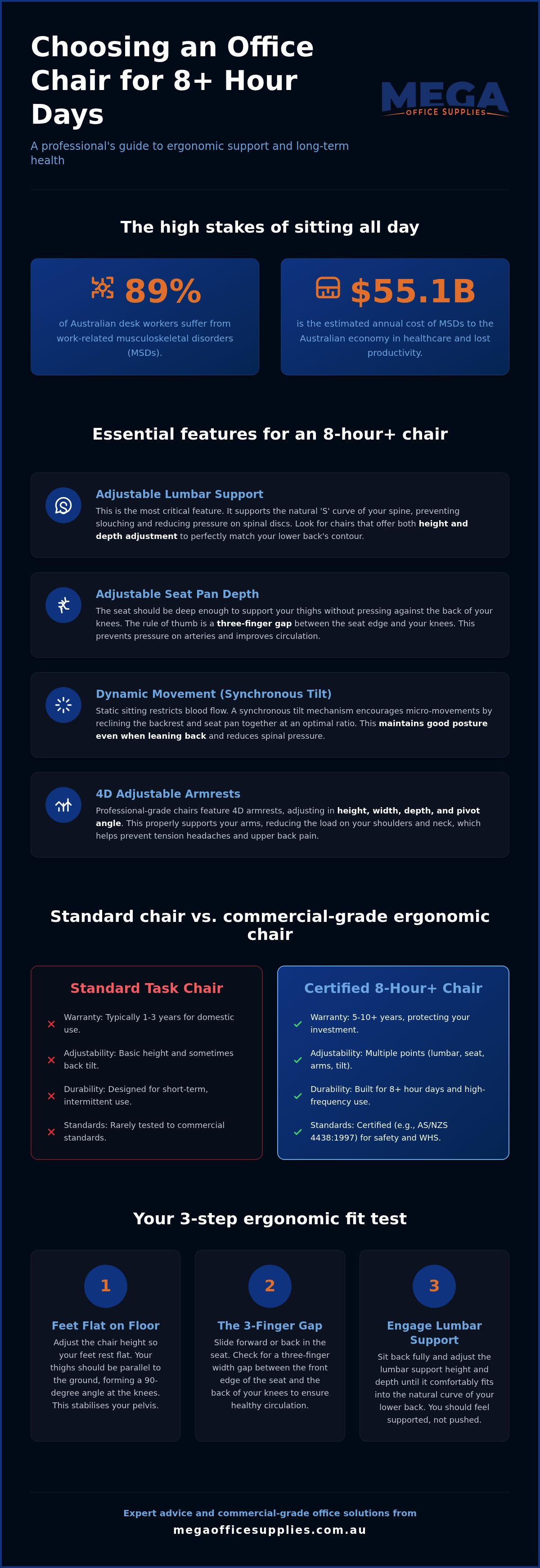
Recent data indicates that 89% of Australians who use a desk for work suffer from a work-related musculoskeletal disorder. It's a sobering statistic that explains why that mid-day lower back stiffness or the persistent tension in your shoulders feels so unavoidable. We understand the frustration of trying to decode complex adjustment mechanisms while your body is begging for a break. If you've ever felt like you're fighting your furniture just to get through a Tuesday, you aren't alone.
We've compiled this guide to teach you exactly how to choose an office chair for long hours, focusing on the technical specifications required for 8+ hour workdays. With over 150 years of combined industry experience, our team knows that a chair is a professional tool for productivity rather than just a place to sit. You'll learn how to identify essential ergonomic features, navigate Australian standards like AS/NZS 4438:1997, and use a practical checklist to ensure your next purchase provides genuine support. We're here to help you move from confusion to confidence, ensuring your workspace supports your long-term spinal health and helps minimise employee fatigue.
Key Takeaways
- Understand the mechanical differences between standard task chairs and certified 8-hour seats to prevent the physiological effects of static loading on your spine.
- Prioritise lumbar support that offers both height and depth adjustments, ensuring the chair maintains the natural curve of your lower back throughout the day.
- Learn how to choose an office chair for long hours by evaluating seat pan depth, aiming for a three-finger gap between the seat edge and your knees to support circulation.
- Distinguish between domestic furniture and commercial-grade equipment to secure 5 to 10-year warranties that protect your organisation's capital investment.
- Identify how adhering to Australian standards like AS/NZS 4438:1997 helps meet WHS obligations and reduces the risk of long-term employee absenteeism.
Understanding the impact of long-duration sitting on health and productivity
Sitting for eight hours is a technical endurance event for the human body. While a standard task chair is designed for short-duration use, learning how to choose an office chair for long hours requires looking for specific engineering and certifications, such as the AS/NZS 4438:1997 standard. Standard chairs often lack the mechanical durability to support static loading, where muscles remain under constant tension without relief. This leads to physical fatigue that quickly translates into a higher cognitive load. When your lower back is throbbing, your brain spends more energy managing pain than focusing on work accuracy or data entry.
The cost of poor ergonomics in Australian workplaces
Musculoskeletal disorders (MSDs) are more than just a personal inconvenience; they cost the Australian economy an estimated $55.1 billion annually in health costs and lost productivity. For high-pressure environments like healthcare centres or government departments, the right seating is a vital retention tool. Staff are less likely to seek new roles if their physical environment doesn't leave them exhausted by mid-afternoon. We define "ergonomic fit" as the relationship between a chair's adjustability and the user's specific physical dimensions. When organisations investigate how to choose an office chair for long hours, they often find that investing in commercial-grade durability is far more cost-effective than managing a single serious workers' compensation claim.
Static vs. dynamic seating: Why movement matters
Traditional fixed-back chairs force the body into a rigid posture that restricts blood flow and increases spinal pressure. Modern office furniture utilises dynamic mechanisms to encourage micro-movements throughout the shift. The ergonomic design of office chairs has evolved to include synchronous tilt, which maintains the correct ratio between the backrest and the seat pan. This mechanism ensures that the angle between your hips and torso remains optimal, even when reclining. It's the difference between being trapped in a static pose and having a chair that supports the body's natural need for motion. Choosing a chair with these features ensures that long shifts are manageable rather than physically taxing.
Essential ergonomic features to prioritise for 8-hour workdays
Determining how to choose an office chair for long hours requires a shift in focus from aesthetics to mechanical adjustability. The most critical component is lumbar support that allows for both height and depth modifications. This ensures the backrest matches the unique S-curve of your spine rather than forcing your body to adapt to a generic shape. If you can't adjust the depth of the lumbar support, you're essentially sitting in a chair designed for a statistical average that likely doesn't exist.
Seat pan depth is equally vital for long-term comfort. We recommend checking that a three-finger gap exists between the edge of the seat and the back of your knees. This gap prevents pressure on the popliteal artery, which is essential for maintaining healthy circulation during extended shifts. For upper body support, 4D armrests are the professional grade standard. These adjust in four directions: height, width, depth, and pivot angle. This level of precision properly supports the weight of your arms, reducing the load on your trapezius muscles and preventing neck strain.
Material choice should reflect your specific workspace environment. Breathable mesh provides superior thermal regulation for humid Australian climates. Conversely, high-density foam offers consistent pressure distribution that won't bottom out over years of high-frequency use. When you understand how to choose an office chair for long hours, you realise that the internal hardware is just as important as the fabric covering it.
The role of the gas lift and seat height
A heavy-duty gas lift is a non-negotiable requirement for durability in 24/7 environments like call centres or security hubs. These components are tested for higher weight capacities and frequent height cycles. For the correct ergonomic setup, adjust the height so your feet remain flat on the floor with your thighs parallel to the ground. This position stabilises the pelvis and reduces pressure on the lower spinal discs.
Backrest tension and tilt lock mechanisms
Mechanical sophistication varies between weight-sensitive tilt and manual tension adjustment. Weight-sensitive models automatically calibrate the recline force based on your body mass, whereas manual dials allow for custom precision. Selecting a model with a multi-position tilt lock is critical for varied tasks. It allows you to secure the chair in an upright position for focused typing or a slight recline for reading documents. You can browse our range of ergonomic office chairs to compare these specific mechanical features and find the right fit for your organisation.
Evaluating durability and procurement for Australian workplace environments
When determining how to choose an office chair for long hours, the distinction between domestic-grade and commercial-grade furniture is fundamental. Domestic chairs are typically engineered for occasional use, whereas commercial-grade seating is built to withstand high-frequency handling in professional settings. We recommend prioritising chairs with a 5 to 10-year warranty. This longevity protects your organisation's capital investment and ensures the hardware remains functional throughout its lifecycle. It's a pragmatic approach to procurement that prioritises stability over initial cost savings.
A complete ergonomic setup often integrates seating with other tools like standing desks to facilitate postural variation. Relying on local Australian support is another critical factor for business continuity. Unlike offshore call centres, our team offers direct assistance for assembly queries and warranty claims, backed by over 150 years of combined industry experience. Knowing how to choose an office chair for long hours involves more than just the seat itself; it's about the logistical support behind the product.
Streamlining procurement for schools and government
Acquiring furniture for public sectors requires adhering to specific budget cycles and compliance standards. We simplify this process by accepting official Australian Government purchase orders. For larger projects, such as bulk classroom fit-outs or department-wide upgrades, we provide custom quotes to ensure financial transparency and volume-based efficiency. This structured approach helps procurement officers meet their requirements without friction.
Maintenance tips to extend the life of your chair
Mechanical stability depends on regular upkeep. We suggest a six-monthly inspection of all bolts and tension knobs to ensure the chair continues to provide firm support. Additionally, using chair mats is a practical way to protect floor surfaces. These mats facilitate smoother caster movement, which reduces the effort required to reposition the chair and helps prevent unnecessary leg strain during long shifts. A small amount of preventative maintenance ensures your equipment performs reliably for years.
Securing your long-term workplace comfort
Transitioning from understanding the physiological impact of sitting to identifying the mechanical requirements of a commercial-grade chair ensures your workspace remains a productive asset. You now possess the technical knowledge to differentiate between a basic seat and a professional tool that adheres to Australian standards. Understanding how to choose an office chair for long hours is a vital step toward reducing employee fatigue and protecting the spinal health of your team.
We've been family-owned and operated since 2005, providing genuine local support to Australian businesses, schools, and government departments. Our team offers a combined 150 years of industry experience, ensuring we can assist with everything from individual ergonomic setups to high-volume procurement and official purchase orders. We prioritise functional clarity and durable hardware to give you peace of mind with every acquisition.
Browse our full collection of ergonomic office chairs
Our specialists are available weekdays from 8 am to 6 pm AEST to help you select the right workplace solution for your specific environment. We look forward to helping you build a more supportive workspace.
Frequently asked questions
How do I know if my current chair is suitable for 8 hours of use?
You can identify if your chair is suitable for 8 hours of use by checking for an AFRDI Level 6 Blue Tick or compliance with the AS/NZS 4438:1997 standard. If you experience lower back stiffness by mid-day or if the seat foam feels compressed after only two hours, your current seating is likely inadequate. A professional-grade chair should maintain its support profile and allow for independent seat and back tilt adjustments throughout a full shift.
Is a mesh back better than a padded back for long shifts?
Mesh backs are generally superior for thermal regulation in warmer Australian climates because they allow for consistent airflow across your back. High-density padded backs often provide better pressure distribution for users who prefer a firmer, more contoured support structure. When researching how to choose an office chair for long hours, ensure the material is commercial-grade to prevent mesh from sagging or foam from bottoming out over years of high-frequency use.
Do I need a headrest on my office chair for long hours?
A headrest is not strictly necessary for standard typing tasks where your head remains balanced over your shoulders, but it provides significant relief during reclining. If your role involves frequent document review or long video conferences, an adjustable headrest can reduce the load on your neck muscles. It's a personal preference that adds another layer of support when you need to shift your posture during an extended workday.
What is the difference between an ergonomic chair and a standard task chair?
The primary difference lies in the range of mechanical adjustability and the intended duration of use. An ergonomic chair offers multiple adjustment points, such as seat pan depth and lumbar height, to accommodate specific physical dimensions. Standard task chairs usually only offer basic height adjustment and are designed for short-duration activities. Understanding how to choose an office chair for long hours means prioritising these complex mechanisms to minimise the risk of work-related musculoskeletal disorders.
Article by
Mega Office Supplies Team
The Mega Office Supplies Team provides practical buying guides and workplace advice for Australian businesses, schools, government organisations, healthcare providers, hospitality venues, warehouses and home offices. Family-owned and operated since 2009 and based in Tweed Heads South on the Gold Coast–Tweed border, Mega Office Supplies brings more than 150 years of combined team experience to helping Australian workplaces choose the right office supplies, furniture, technology, cleaning, safety and education products — backed by genuine local service from real people.
General Information
This article is provided as general information only to help customers compare and choose office, workplace, school, cleaning, technology, furniture, safety and business supplies. Product details, specifications, compatibility, availability, pricing and suitability may vary. Always check the individual product page, manufacturer information, workplace requirements and relevant safety guidance before purchasing or using a product.


