

Selecting the right exercise books for an Australian classroom is no longer as simple as picking a random stack off the shelf. You've likely felt the frustration of staring at a school list that demands "QLD Ruled" or "18mm Dotted Thirds" without a clear explanation of why these specific standards exist. It's a common challenge for procurement officers and parents who need to avoid the mess of ink bleed-through or fragile bindings that fail before the semester ends.
This guide will help you master the technical specifications of these essential items, from understanding why 80gsm paper is the preferred standard for durability to navigating specific state-based ruling requirements. By focusing on the technical precision of your stationery, you can ensure your supplies withstand the rigours of daily use in schools or professional environments. We will break down binding durability, standard sizes like 225x175mm, and line widths to help you confidently select the correct book for any curriculum or administrative task.
Key Takeaways
- Understand why tactile handwriting remains a core part of the Australian Curriculum and how specialised rulings support specific student development stages.
- Learn to interpret technical specifications like GSM to ensure your exercise books prevent ink bleed-through and offer professional-grade durability.
- Decipher complex ruling requirements, including the difference between standard 8mm feint and specialised "Dotted Thirds" used in early childhood education.
- Identify the specific capacity and binding needs for various environments, from high-volume primary school classrooms to manual inventory logging in industrial warehouses.
- Optimise your organisation’s stationery budget by mastering the logistical considerations and benefits of high-volume procurement for schools and large corporations.
The Role of Exercise Books in Modern Australian Learning and Work
Exercise books serve as highly engineered tools designed for specific educational and administrative outputs. Unlike generic notepads, these books feature precise rulings and durable bindings that meet the rigorous demands of the Australian classroom. They provide a structured environment for students to develop literacy and numeracy skills through consistent practice.
Within the Australian Curriculum, the focus on tactile learning remains a priority for developing fine motor skills and long-term literacy. For a broader context, an exercise book overview highlights how these formats vary globally to support different pedagogical needs. In Australia, the standardisation of rulings ensures that a student in Perth uses the same foundational tools as one in Brisbane, providing regional consistency across the education sector.
To better understand how these essential items are produced, watch this helpful video:
Defining the Exercise Book: More than Just Paper
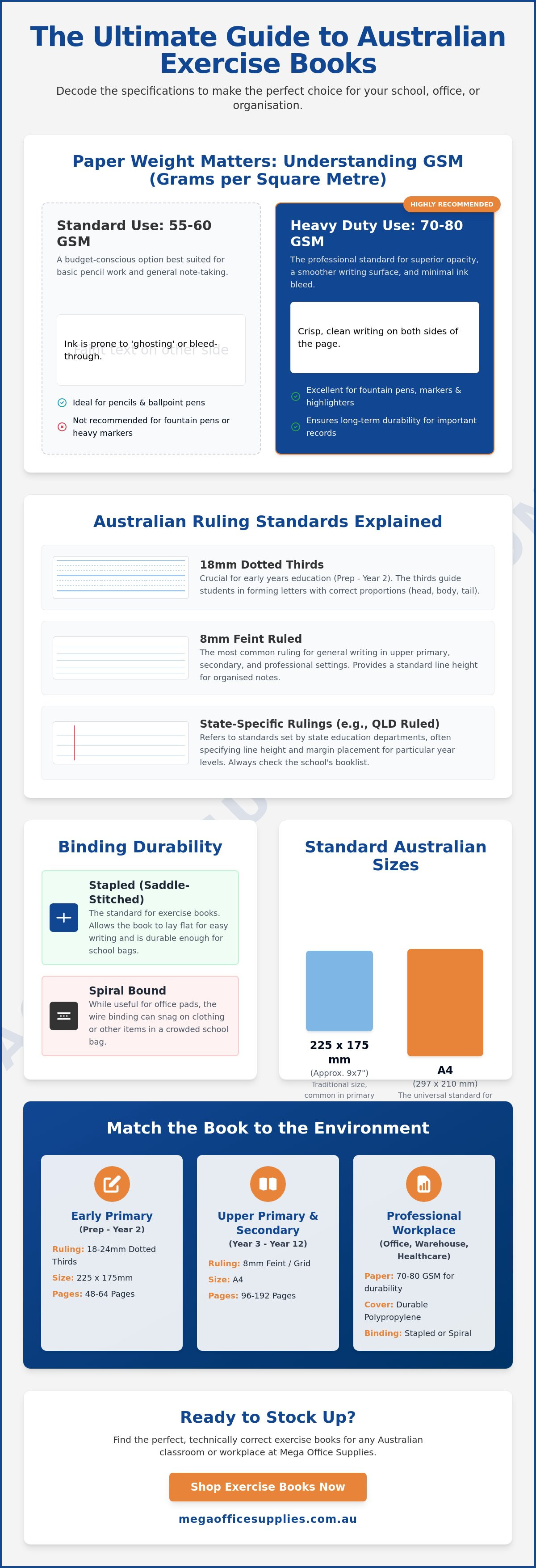
A standard exercise book is defined by its robust construction. Most feature a heavy-duty card or poly cover and a stapled spine, which allows the book to lay flat during use. This is distinct from spiral-bound notebooks that can be prone to wire snagging in a school bag or office drawer. The presence of a margin and feint ruling is essential for organised note-taking; it allows for teacher corrections, structured annotations, and professional record-keeping. These books are a core component of the broader range of educational supplies required for a functional classroom. Standard Australian sizes include the ubiquitous A4 format and the traditional 9x7 inch (225x175mm) format, often used for primary school exercises or specialised subject journals.
The Enduring Value of Handwriting in a Digital Age
Handwriting is linked to superior memory retention and cognitive processing. Research indicates that the physical act of forming letters helps students internalise information more effectively than typing. Exercise books provide a permanent, chronological record of progress over a term or year, making them invaluable for assessment and review. The transition from the large-format scrapbooks used in early primary years to the structured binder books of secondary school reflects a student's growing need for organisational complexity. Beyond the classroom, these books remain staples in professional environments. In warehouses or healthcare settings, they provide a secure, unalterable method for logging inventory or patient notes, ensuring data integrity where digital systems might be impractical.
Decoding the Specs: GSM, Binding, and Page Counts
Technical precision in stationery selection directly impacts the longevity of recorded data. When evaluating exercise books, procurement officers must look beyond the cover design and focus on the underlying hardware specifications. The relationship between paper density, binding method, and page capacity determines whether a book survives a full academic semester or fails within weeks. Understanding these variables allows for a more efficient allocation of resources and ensures that the end user has a reliable surface for their work.
Understanding Paper Weight (GSM) for Different Ink Types
GSM stands for Grams per Square Metre and serves as the primary metric for paper density and quality. For high-volume, budget-conscious requirements, paper in the 55 to 60 GSM range is often standard. While functional for basic pencil work, this lighter weight is prone to ghosting and ink bleed-through. For professional or senior secondary use where fountain pens or heavy highlighters are common, 70 to 80 GSM paper is highly recommended. This increased density provides superior opacity and a smoother writing surface. The National Archives of Australia notes that adhering to specific archival paper quality standards is vital for any records intended for long-term storage, as paper thickness and chemical stability prevent degradation over time.
Binding Methods: Stapled vs. Spiral vs. Perfect Bound
The binding method dictates how a book interacts with a flat desk surface and how it withstands transport in a school bag. Staple binding, also known as saddle stitching, is the most common choice for Australian schools. It allows the book to lay almost completely flat, which is essential for younger students developing their handwriting posture. Conversely, spiral binding offers 360-degree folding and allows for the neat removal of pages. If you frequently remove pages for assessment, consider this comprehensive guide to lever arch files to help organise those loose sheets for long-term reference. Perfect bound books offer a professional, book-like spine but often resist laying flat, making them better suited for journals than daily classroom exercises.
Capacity is another critical factor. A 48 or 64-page book is typically sufficient for specialised subjects or short terms. Core subjects like English or Mathematics usually require 96 or 128 pages to cover a full semester's worth of content. Beyond physical capacity, consider the environmental credentials of your stationery. Looking for FSC (Forest Stewardship Council) certification ensures the paper is sourced from responsibly managed forests. If you are managing a large-scale procurement, selecting professional-grade exercise books with reinforced poly covers can significantly minimise the need for mid-year replacements due to wear and tear.
Australian Rulings and State-Specific Standards Explained
The assumption that all exercise books are interchangeable is a common procurement error. In reality, the ruling, the pattern of lines on the page, is a deliberate pedagogical tool aligned with specific stages of the Australian Curriculum. Selecting the wrong ruling isn't just a minor inconvenience; it can actively hinder a student's ability to develop correct letter proportions or mathematical alignment. Understanding the nuances of these specifications is essential for schools and organisations managing bulk stationery orders.
Standard Rulings: From 8mm Feint to Dotted Thirds
The most common format for secondary students is the 8mm feint ruling. The term "feint" refers to the light grey or blue lines that provide a guide without dominating the page. For younger year levels, larger rulings like 10mm or 12mm are standard to accommodate larger handwriting. Dotted thirds, available in 14mm, 18mm, and 24mm, are critical for early childhood development. These lines feature a solid base line with two dotted lines above it to guide the height of lowercase letters and ascenders.
State-Specific Requirements: NSW, QLD, and VIC Standards
Regional preferences often dictate specific requirements that aren't immediately obvious to those outside the education sector. Queensland (QLD) frequently requires specific rulings for primary years that differ from New South Wales (NSW) or Victoria (VIC). For example, QLD Year 1 and 2 lists often specify 12mm or 18mm rulings with particular margin requirements, while NSW primary schools may favour specific handwriting books designed for the NSW Foundation Style. Before committing to high-volume orders of educational supplies, always verify the specific school list or departmental guidelines. Relying on a generic "ruling" description can lead to stock that doesn't meet local curriculum standards.
Specialist Rulings: Graph, Music, and Botany Books
Beyond standard horizontal lines, specialist exercise books support technical and creative subjects. Mathematics and science often require grid or graph paper, typically in 5mm or 10mm squares, to assist with technical drawing and data plotting. Botany books are unique because they feature alternating pages; one side is feint ruled for notes, while the opposite page is blank for scientific diagrams. Music students require books with pre-printed staves for theory and composition classes. Each of these formats is a specialised tool designed to facilitate a specific type of information recording, ensuring that the layout of the page matches the logic of the subject matter.
Selecting the Right Book for Your Specific Environment
The physical environment where a book is used dictates its required durability and capacity. While previous sections focused on rulings and paper weight, the actual application determines whether you need a lightweight 48-page book or a heavy-duty binder version. Whether you are managing a high-volume classroom or a busy industrial warehouse, the choice of exercise books should reflect the intensity of the work environment.
Classroom Essentials: Primary vs. Secondary School Needs
Primary school students, particularly in years K-2, require formats that accommodate developing fine motor skills. Scrapbooks and A4 18mm dotted thirds are the standard for these early years. These larger formats provide the necessary space for both illustrations and oversized handwriting practice. As students progress into secondary school, the requirement shifts toward higher page counts and tighter rulings. High school subjects generally demand 96-page or 128-page books with 8mm feint rulings to handle the increased volume of daily note-taking. For general classroom needs beyond books, including pens and adhesives, you can source high-quality office supplies to complete your stationery list.
Professional Contexts: Using Exercise Books for Meeting Minutes and Logs
In a professional setting, the utility of a bound book extends beyond simple note-taking. A4 binder books are particularly effective for corporate use because they feature pre-punched holes, allowing them to be integrated into existing filing systems once a project is complete. For legal, medical, or industrial logging, bound exercise books offer a security benefit that loose-leaf paper cannot match. A bound spine creates a permanent, unalterable audit trail where pages cannot be easily removed or replaced without detection. In boardrooms or client-facing environments, choosing books with professional cover colours like black or navy maintains a consistent corporate image while providing a reliable non-digital backup for critical meeting minutes.
In industrial settings like warehouses, manual logging remains a staple for inventory checks and safety inspections. Tablets and laptops can be fragile in dusty or high-traffic areas; however, a poly-covered book is resilient and requires no battery life. For parents preparing for the January "Back to School" rush, following a structured approach can minimise stress and prevent incorrect purchases.
- Review the specific school list for state-based ruling requirements to ensure curriculum compliance.
- Select 70-80 GSM paper if the student uses ink pens or highlighters to prevent ghosting.
- Prioritise poly covers for core subjects to ensure the book lasts the entire academic year.
- Purchase in bulk for common sizes like A4 to avoid mid-term shortages.
Selecting the right tools is the first step toward an organised and productive year. To ensure you have the correct specifications for your team or students, browse our range of exercise books today.
Efficient Procurement: Managing Bulk Stationery for Organisations
Managing high-volume orders of exercise books requires a shift from tactical purchasing to strategic procurement. For schools and large corporations, bulk acquisition provides a buffer against supply chain volatility and ensures uniform quality across all departments. Effective forecasting involves analysing student enrolment data or staff headcount to determine precise volume requirements before the peak January period. By centralising these orders, organisations can achieve logistical stability and ensure that every student or employee has the specialised tools they need from day one.
Inventory Management and Storage Best Practices
Paper is a hygroscopic material, which means it naturally absorbs moisture from the surrounding air. Storing exercise books in climate-controlled environments is essential to prevent page curling, ink feathering, or adhesive failure in the binding. Implementing a "First In, First Out" (FIFO) system ensures that older stock is utilised before newer arrivals, maintaining the integrity of the paper's writing surface over time. High-density storage areas, such as school stockrooms or office basements, must be managed with safety as a priority. It is professional best practice to ensure first aid kits are easily accessible and clearly marked near these heavy-lifting and high-volume storage zones to maintain workplace compliance.
Streamlining the Supply Chain for Schools and Offices
Standardising stationery lists across year levels or business units reduces procurement complexity and minimises the risk of selecting incorrect rulings. This level of organisation allows for better stock control and simplifies the distribution process within a large facility. For a deeper analysis of high-level acquisition strategies, refer to our Stationery Supplies Australia professional procurement guide. Procurement officers should utilise rapid quoting tools to evaluate costs and lead times quickly, ensuring that high-volume educational orders arrive well before the first day of term. This proactive approach prevents the common "Back to School" shortages that can disrupt the start of the academic year.
Mega Office Supplies positions itself as a dependable partner for large-scale operations across Australia. Our team brings together decades of combined industry experience to support schools, government departments, and private enterprises with their logistical needs. We focus on providing stable, high-capacity solutions that allow your organisation to focus on its core objectives rather than managing stationery shortages. Whether you are coordinating a regional school district or a multi-state office rollout, our established infrastructure is designed to handle high-volume demands without friction.
Optimising Your Stationery Strategy for Long-Term Success
Mastering the technical nuances of paper weight and state-specific rulings is the first step toward a more efficient educational or professional environment. By prioritising durability and curriculum alignment, you ensure that your documentation remains secure and your students remain supported throughout the academic year. Whether you are managing a single classroom or a national corporate rollout, the strategic selection of exercise books is a foundational component of workplace productivity.
Mega Office Supplies has been family owned and operated since 2008. Our team provides reliable national delivery for schools, government departments, and businesses. We understand the logistical pressures of the Australian academic calendar and offer the scale needed to handle high-volume demands without friction.
Browse our extensive range of exercise books and educational supplies to find the perfect match for your specific requirements. We look forward to supporting your organisation with the hardware and expertise needed for a successful year ahead.
Frequently Asked Questions
What is the difference between A4 and 9x7 exercise books?
A4 measures 297 x 210 mm, while the traditional 9x7 inch format, often referred to as 225 x 175 mm, is significantly more compact. A4 is the standard for secondary and tertiary education because it accommodates larger handouts and complex diagrams. The 9x7 format is a staple in primary schools for daily exercises and journals. Choosing the right size ensures that the book fits comfortably in school bags and meets the specific spatial requirements of the subject.
What are dotted thirds and why are they used in primary schools?
Dotted thirds are specialised rulings featuring a solid baseline and two dotted lines above it. These are used in primary schools to help students master letter height and the correct placement of ascenders and descenders. By providing a clear visual guide for lowercase and uppercase letters, dotted thirds support the development of consistent handwriting. They are essential for early years literacy as outlined in the Australian Curriculum.
Does GSM matter when choosing an exercise book for school?
GSM, or grams per square metre, is a critical factor when selecting exercise books for students using ink pens or highlighters. A higher GSM, such as 70 or 80, indicates thicker paper that prevents ink from bleeding through to the other side. Lower GSM paper is often cheaper but can lead to ghosting, making the reverse side of the page difficult to read. For senior students, higher density paper ensures that notes remain legible on both sides.
What is the difference between NSW and QLD ruled exercise books?
The difference lies in the specific line spacing and formatting required by each state's Department of Education. Queensland (QLD) rulings often specify 12mm or 18mm spacings for primary years, while New South Wales (NSW) lists frequently require books designed for the NSW Foundation Style. These variations ensure that the stationery matches the specific handwriting techniques taught in each region. Always verify your specific school list to ensure curriculum compliance.
Are exercise books recyclable in standard Australian kerbside bins?
Most exercise books are fully recyclable through standard Australian kerbside yellow bins. Because they are primarily composed of paper, they are highly sought after by recycling facilities. Metal staples don't need to be removed manually, as they are separated during the pulping process. However, if the book features a heavy poly or plastic cover, you should check with your local council to see if the cover needs to be removed before disposal.
What does "feint" mean in relation to exercise book ruling?
"Feint" refers to the lightly printed grey or blue lines that provide a guide for writing without dominating the page. These lines are designed to be visible enough to assist with alignment but subtle enough to allow handwriting and diagrams to stand out. In the context of Australian stationery, feint ruling is the industry standard for most secondary and tertiary subjects where a clear, non-distracting writing surface is required for complex note-taking.
Which binding is best for a student who uses their books heavily?
Staple binding, also known as saddle stitching, is the most durable option for students who carry their books in packed bags or lockers. This binding method allows the book to lay flat on a desk, reducing the risk of the spine cracking or pages tearing out. For maximum longevity, combine staple binding with a poly cover. This combination protects the internal paper from moisture and physical wear, ensuring the book survives a full academic year.
How many pages should I choose for a single-semester subject?
A 64-page or 96-page book is typically sufficient for a single-semester subject in a secondary school environment. Core subjects like Mathematics or English often require 128 pages to handle the higher volume of daily work. For shorter, specialised units or primary school subjects, 48 pages may be adequate. Forecasting your page count correctly minimises waste and ensures that students don't have to transition to a new book mid-way through a term.
Article by
Mega Office Supplies Team
The Mega Office Supplies Team provides practical guidance for Australian businesses, schools, government organisations, healthcare providers, hospitality venues, warehouses and home offices. Based in Tweed Heads South, Mega Office Supplies has been family owned and operated since 2008, offering office stationery, workplace furniture, technology products, labels, printers, cleaning and janitorial supplies, safety products, art materials, education resources and everyday business essentials from trusted brands.
General Information
This article is provided as general information only to help customers compare and choose office, workplace, school, cleaning, technology, furniture, safety and business supplies. Product details, specifications, compatibility, availability, pricing and suitability may vary. Always check the individual product page, manufacturer information, workplace requirements and relevant safety guidance before purchasing or using a product.


