

The standard cork board you've relied on for decades might be the very thing undermining your office's professional image. While it's a staple in Australian staff rooms and warehouses, many administrators eventually face the frustration of crumbling edges and permanent, unsightly holes that refuse to heal. When weighing up the cork board vs felt board for pinning, the right choice depends entirely on your specific environment and how often you update your displays.
We understand that you need a solution that balances immediate budget constraints with a five to ten year lifecycle. You shouldn't have to choose between a functional pinning surface and a board that matches your corporate colour scheme. This guide provides a technical breakdown of durability and aesthetics to help you select the ideal noticeboard. We'll compare the self-healing properties of felt against the cost-effective utility of natural cork; this ensures your next procurement decision is backed by industry expertise and practical workplace knowledge.
Key Takeaways
- Understand the structural differences between natural oak bark and synthetic felt to determine which surface best withstands your team's specific pinning frequency.
- Discover why the self-healing properties of felt help maintain a professional appearance when evaluating a cork board vs felt board for pinning in high-traffic collaborative zones.
- Identify opportunities to align workplace decor with corporate branding by selecting from a diverse range of felt colours rather than standard neutral cork.
- Evaluate sector-specific requirements to choose between the rugged utility needed for warehouses and the refined aesthetic required for healthcare or government offices.
- Gain insights into achieving long-term value for money by sourcing professional-grade noticeboards from an established Australian retailer with decades of industry experience.
Defining the Pinning Surface: What are Cork and Felt Boards?
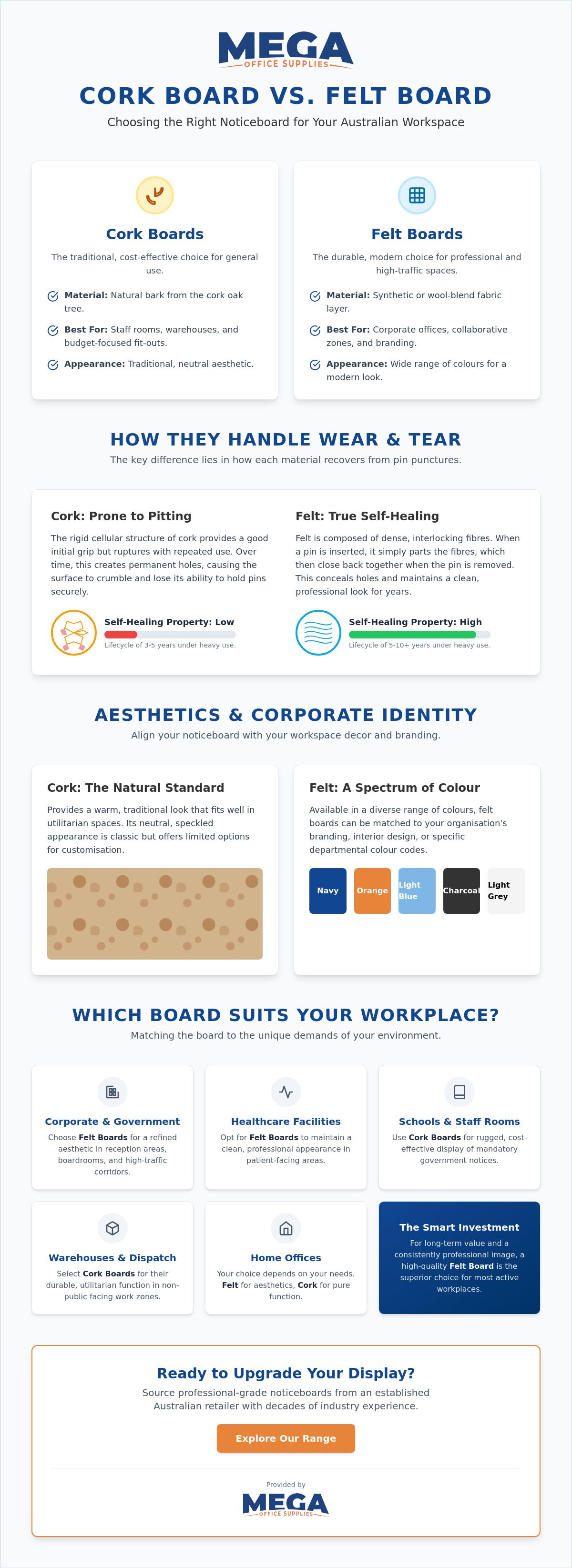
Selecting the right communication tool for a professional environment requires a clear understanding of material specifications. A cork board is a traditional, sustainable option featuring a surface layer harvested from the bark of the Mediterranean cork oak tree. This natural material is prized for its elasticity and cellular structure, which provides a reliable grip for standard map pins and push pins. In contrast, a felt board consists of a synthetic or wool-blend fabric layer bonded to a rigid backing. Choosing between a cork board vs felt board for pinning involves evaluating how these surfaces interact with daily office hardware to maintain a functional display area.
The primary utility of these surfaces is the secure display of mandatory safety notices, project timelines, and collaborative concepts. In the industry, we measure the effectiveness of these tools through "pin retention," which is the ability of the board to hold a pin firmly without the document slipping or the surface material degrading. While both materials serve as a central bulletin board for staff engagement, their performance under high-volume use varies significantly due to their internal composition.
To better understand the practical differences between these surfaces, watch this helpful video regarding installation and utility:
The Anatomy of a Professional Noticeboard
A professional-grade board is more than just its visible surface. The core material is typically constructed from high-density softboard, which provides the necessary depth for pin penetration and long-term grip. This core is then wrapped in either natural cork or architectural-grade felt. Frame selection also plays a vital role in the board's lifecycle. Anodised aluminium frames offer superior durability in high-traffic corridors, whereas timber frames are often selected for their aesthetic alignment with traditional office furniture. The surface layer's primary job is to manage the physical impact of pins; felt excels at concealing puncture marks, while cork relies on its natural density to resist crumbling over years of service.
Common Applications in Australian Workplaces
Different sectors across Australia have specific requirements for their pinning surfaces. In corporate boardrooms, felt boards are frequently utilised for project mapping and visualisations because they can be colour-coordinated to match the organisation's branding. Educational staffrooms often prefer large-scale cork boards for displaying mandatory government safety notices and curriculum schedules due to their rugged, utilitarian nature. For the growing number of home offices, these boards provide a dedicated space for personal organisation and inspiration, helping to separate professional tasks from domestic life. Whether it is a healthcare reception area or a warehouse dispatch centre, the choice of material directly impacts the clarity and longevity of the information displayed.
Material Science: Durability and Self-Healing Properties
The debate over cork board vs felt board for pinning often centres on how the surface recovers from repeated physical trauma. Cork relies on a unique suberin-rich cellular structure. These microscopic hexagonal cells act like tiny cushions, providing the friction needed to grip a pin securely. Research into the properties of cork highlights its natural elasticity, yet this resilience has structural limits. In a standard 6mm commercial-grade cork surface, daily pinning cycles eventually rupture these cell walls. Over a period of three to five years, this leads to "pitting," where the surface can no longer hold the weight of a heavy document or card stock.
Felt operates on an entirely different mechanical principle. Instead of rigid cells, it uses a dense network of interlocking synthetic or wool fibres. When a pin is inserted, these fibres are pushed aside rather than broken. Once the pin is removed, the fibres naturally migrate back to their original position. This is the true definition of a "self-healing" surface. It's the primary reason felt maintains its integrity in high-activity zones, such as staff kitchens or project rooms, where notices change daily. You can browse our range of professional-grade noticeboards to find a surface built for these high-volume cycles.
The Crumbling Factor: Why Quality Matters
Low-quality noticeboards often use a thin cork veneer over a cheap cardboard or softboard backing. These surfaces fail quickly under Australian conditions as the adhesive dries and the cork pulls away from the core. Professional-grade boards utilise high-density felt or solid cork layers to prevent sagging and delamination over time. Pin hole visibility is the key aesthetic differentiator for high-use areas; it refers to the permanent, visible marks left behind on the board surface after a pin is removed. While cork eventually shows its age through these marks, felt hides them almost entirely within its fibrous weave.
Long-term Maintenance and Resilience
Australian workplaces must account for specific environmental factors like high UV levels and fluctuating humidity. Natural cork is susceptible to drying out in our climate, which causes it to become brittle and eventually flake off. UV-stabilised felt is engineered to resist fading and structural breakdown, even when mounted in sun-drenched reception areas or school corridors. In high-traffic zones, felt is often the preferred choice because it doesn't produce the fine cork dust or debris that can accumulate on the floor over time. This makes it a cleaner, more resilient option for healthcare and hospitality environments where hygiene and presentation are paramount.
Aesthetic and Functional Comparison: Colour, Velcro, and Maintenance
The visual impact of a noticeboard often dictates the professional atmosphere of a workplace. While the material properties of cork provide a warm, organic aesthetic that suits sustainable or traditional office designs, felt boards offer a modern, high-intensity colour palette. This distinction is critical when deciding on a cork board vs felt board for pinning in client-facing areas. Felt surfaces allow procurement officers to align office hardware with corporate branding, using specific shades of blue, grey, or charcoal to create a cohesive interior design. This level of customisation isn't possible with natural cork, which is limited to its native tan and brown tones.
A significant functional advantage of felt is its compatibility with hook-and-loop fasteners, commonly known as Velcro. This feature transforms a standard noticeboard into a multi-purpose display system. In environments where documents are swapped out multiple times a day, Velcro dots allow for rapid updates without the need for sharp hardware. While cork remains the industry standard for high-grip pinning of heavy cardstock or multi-page reports, felt provides a more versatile solution for lightweight notices and temporary signage.
Maintenance is a common concern for facility managers, as felt is often perceived as a "dust trap." In reality, maintaining a felt surface is straightforward. Regular cleaning with a standard vacuum brush attachment or a lint roller effectively removes airborne dust and fibres. Cork, while resistant to lint, can produce fine debris as it ages and loses its elasticity. For long-term hygiene in healthcare or hospitality sectors, both surfaces are viable, provided they are framed in high-quality aluminium to prevent moisture ingress at the edges. You can explore our full range of commercial office furniture to see how these different finishes integrate into professional fit-outs.
Matching the Board to Your Office Decor
Acoustic and visual "zoning" is a growing trend in large Australian open-plan offices. By utilising different colours of felt, managers can visually categorise departments; for example, using blue boards for the finance team and red for emergency alerts. Cork is better suited to creative studios or "green" offices where natural textures are prioritised. The frame choice further refines this look. A slimline aluminium frame projects a sleek, industrial vibe, while a timber frame complements the earthy tones of a natural cork surface.
Velcro vs Pins: Versatility in Action
Safety and speed are the two primary drivers for choosing Velcro-compatible felt. In early learning centres and primary schools, the absence of sharp pins is a major safety benefit, allowing teachers to display student work without risk. However, for industrial settings like warehouse dispatch centres, the superior grip strength of cork is often required. When weighing up cork board vs felt board for pinning, consider the weight of the items being displayed. If you're pinning heavy laminated maps or thick manuals, the dense cellular structure of cork provides a more secure hold than a standard felt weave.
Selection Guide: Matching the Board to Your Australian Environment
A successful procurement strategy for noticeboards starts with identifying the "Pinning Frequency" of the target area. When comparing a cork board vs felt board for pinning, high-traffic zones like reception areas or staff hubs demand the self-healing resilience of felt to avoid the pitted, aged look of over-used cork. Conversely, for static displays where notices remain for months, such as long-term policy documents in a government office, the traditional utility of cork provides excellent value for money. Choosing the wrong material can lead to premature surface failure and a cluttered, unprofessional appearance.
In healthcare and government sectors, the choice often shifts toward presentation and hygiene. Felt boards in charcoal or grey provide a professional backdrop that hides pinholes, maintaining a clean aesthetic in patient waiting rooms. For procurement officers managing national fit-outs, it's vital to consider the ambient environment. While felt is the standard for air-conditioned corporate centres, natural cork often performs better in non-conditioned spaces where humidity levels fluctuate significantly, provided the material is of a professional grade.
Before finalising your order, use this checklist to ensure the board meets the specific demands of the site:
- Frequency: Will pins be moved daily, or is this for long-term notices?
- Environment: Is the area climate-controlled or subject to high ambient heat?
- Aesthetic: Does the board need to match corporate branding or a natural theme?
- Safety: Are sharp pins appropriate, or is a Velcro-compatible surface required?
The Educational and Classroom Context
Durability is the non-negotiable factor for educational supplies. Felt has become the standard for Australian classrooms because it withstands the aggressive pinning cycles of student work displays and remains compatible with Velcro for younger year levels. This material avoids the crumbling edges often associated with budget cork when handled by students. For a standard Australian classroom, a large-format board measuring 2400 x 1200mm is the most effective size for maximising display space without overwhelming the wall.
Industrial and Facility Management Needs
In warehouses and workshops, the requirements for facility supplies change. High-heat environments, such as those near industrial machinery or in uninsulated sheds, can cause synthetic felt fibres to degrade or lose their vibrant colour over time. In these instances, the rugged, heat-resistant nature of cork is superior. For staff kitchens or moisture-prone areas, ensuring the board features a moisture-resistant backing and a high-grade aluminium frame will prevent the delamination commonly seen in cheaper alternatives. To ensure your facility is equipped with durable, professional-grade surfaces, you can browse our professional noticeboard collection available for national delivery.
Sourcing Professional Grade Noticeboards for National Fit-outs
Managing a large-scale workplace upgrade requires more than just a product selection. It demands a logistical partner capable of coordinating delivery across multiple states and territories. When procurement officers evaluate the cork board vs felt board for pinning, they must also assess the reliability of the supplier to ensure project timelines are met. Mega Office Supplies functions as a high-capacity provider, offering a massive inventory of office furniture supplies designed to meet the rigorous standards of Australian corporate and government sectors. Bulk procurement allows organisations to standardise their communication tools while maintaining strict budget control across different regions.
A comprehensive catalogue is essential for streamlining national fit-outs. By sourcing from a single, reliable retailer, administrators can ensure that the noticeboards in a Perth branch match those in a Sydney headquarters. This consistency reinforces a professional brand image. Our operation is built to handle high-volume demands without the friction often associated with smaller suppliers. We prioritise functional clarity and logistical efficiency, ensuring that every board delivered meets the industrial quality expected by seasoned industry professionals.
The Mega Office Supplies Advantage
As a family owned and operated business since 2008, we act as a dependable partner for e-commerce and bulk procurement needs, supporting Australian businesses with professional-grade hardware that prioritises longevity over flashiness. We understand the specific workflow of professional buyers who need to evaluate costs and quantities quickly. For corporate and government accounts, our business application form simplifies the procurement process, enabling rapid quoting and direct assistance via our regional support lines. This direct support distinguishes us from faceless global competitors and ensures you receive the stability your organisation requires.
Streamlining Your Workplace Procurement
Efficiency in facility management is achieved by bundling requirements into a single logistical flow. You can consolidate your noticeboard order with essential office supplies to reduce administrative overhead and logistical friction. Our national delivery network is engineered for speed of fulfilment, ensuring that hardware arrives on schedule regardless of the project's scale. This "problem-solution-action" flow is designed for high-intent buyers who value their time and require precise execution.
When making your final decision on a cork board vs felt board for pinning, consider the long-term value over a five to ten year lifecycle. Choose natural cork for rugged, low-frequency pinning in warehouses or budget-conscious zones. Invest in felt for high-traffic collaborative spaces, healthcare environments, or reception areas where aesthetics and self-healing performance are non-negotiable. By selecting the right material and a reliable Australian partner, you secure a durable pinning surface that maintains its professional appearance for years to come.
Selecting the Right Foundation for Your Office Displays
Choosing the correct pinning surface ensures your workplace remains organised and professional for years to come. When you evaluate a cork board vs felt board for pinning, remember that high-traffic zones benefit from the self-healing resilience of felt; conversely, static displays find long-term value in the rugged utility of natural cork. Your decision directly impacts the maintenance costs and aesthetic standards of your facility.
Mega Office Supplies has been family owned and operated since 2008. Our team is here to help you navigate large-scale procurement with total confidence. We understand the specific administrative needs of various sectors, which is why official purchase orders are accepted for Australian Government departments. This ensures a friction-free experience for procurement officers across the country.
Ready to upgrade your workspace? Explore our full range of professional noticeboards and office furniture to find the ideal solution for your next fit-out. We look forward to supporting your organisation's long-term success.
Frequently Asked Questions
Is a felt board better than a cork board for heavy pinning?
No, cork boards generally provide superior grip for heavy items due to their dense cellular structure. While felt is excellent for standard paper, the natural grit of cork holds cardstock and multi-page documents more securely. This makes cork the standard choice for industrial environments like warehouses where heavy-duty pinning is frequent. It remains the most dependable option for securing thick manuals or laminated safety maps.
Do cork boards eventually dry out and crumble?
Yes, natural cork can become brittle and crumble over time, especially when exposed to high temperatures or low humidity. This process is often accelerated in non-conditioned Australian environments. High-quality commercial boards use thicker cork layers to delay this degradation, but eventually, the material loses the elasticity required to grip pins effectively. Once crumbling begins, the board's ability to hold weight is significantly compromised.
Can I use velcro on a standard cork board?
No, standard cork boards are not compatible with Velcro or other hook-and-loop fasteners. The surface of the cork is too smooth and dense for the hooks to engage. If your workplace requires a versatile display that uses both pins and Velcro dots, a felt board is the necessary choice for your facility. This functionality is particularly useful in educational settings where displays are changed frequently without hardware.
Which board type is easier to clean in a dusty environment?
Cork boards are typically easier to clean in high-dust areas like workshops or loading docks. You can simply wipe the surface with a damp cloth to remove grit and debris. Felt boards tend to trap airborne particles within their fibres, requiring a vacuum with a brush attachment to maintain a professional appearance. For environments where hygiene is the priority, the smooth surface of cork offers a faster maintenance cycle.
Are felt pin boards more expensive than traditional cork boards?
Generally, felt boards carry a higher initial purchase price than basic cork boards of the same size. This cost difference reflects the additional manufacturing step of bonding fabric to a softboard core. However, when comparing a cork board vs felt board for pinning, many procurement officers find that felt offers better long-term value due to its self-healing properties and superior aesthetics. This investment often pays off in high-use corporate environments.
What is the best way to mount a large noticeboard on an office wall?
Large noticeboards should be mounted using a four-corner masonry kit or a split-batten system for a flush finish. It is critical to identify the wall type, such as plasterboard or brick, to ensure you use the correct anchors. For boards exceeding 1800mm in width, we recommend using a professional installer to ensure the board remains level and secure. Proper mounting prevents the frame from warping under the weight of heavy displays.
How do I choose between a framed and an unframed noticeboard?
Framed boards, typically using anodised aluminium, offer the best durability for high-traffic corridors and staff rooms. The frame protects the edges of the material from fraying or chipping over time. Unframed boards, often referred to as wrapped boards, provide a sleek, modern look that allows multiple boards to be mounted side-by-side for a continuous pinning surface. Your choice should depend on whether you prioritised rugged edge protection or a seamless visual aesthetic.
Are there specific fire-rated felt boards for government buildings?
Yes, specific fire-rated felt boards are available to meet Australian building standards for corridors and public spaces. These boards use specialised fire-retardant fabrics and cores to minimise smoke development and flame spread. Procurement officers should always check the technical specifications for Group 1 or Group 2 fire ratings when outfitting government departments or educational facilities. This ensures compliance with local safety regulations for high-occupancy areas.
Article by
Mega Office Supplies Team
The Mega Office Supplies Team provides practical guidance for Australian businesses, schools, government organisations, healthcare providers, hospitality venues, warehouses and home offices. Based in Tweed Heads South, Mega Office Supplies is an Australian business, family owned and operated since 2008, offering office stationery, workplace furniture, technology products, labels, printers, cleaning and janitorial supplies, safety products, art materials, education resources and everyday business essentials from trusted brands.
General Information
This article is provided as general information only to help customers compare and choose office, workplace, school, cleaning, technology, furniture, safety and business supplies. Product details, specifications, compatibility, availability, pricing and suitability may vary. Always check the individual product page, manufacturer information, workplace requirements and relevant safety guidance before purchasing or using a product.


