

Most people assume a first aid kit is simply a box of adhesive strips tucked away in the kitchen cupboard, yet in a professional Australian workplace, maintaining compliant first aid kits is a legal necessity that requires active management. We understand that deciphering the Safe Work Australia Model Code of Practice often feels like a complex chore, particularly when you're juggling different state-based WHS requirements and the constant risk of an unexpected safety audit.
Our professional guide ensures your workplace meets Australian safety standards by simplifying the process of selecting and maintaining your equipment. We'll provide a clear checklist to help you navigate risk assessments, establish a reliable restocking routine, and manage expiry dates with confidence. By the end of this article, you'll have a practical framework to keep your staff safe and your organisation fully compliant without the usual administrative headache.
Key Takeaways
- Identify your workplace's specific risk profile to ensure you meet the legal obligations set out in the Safe Work Australia Model Code of Practice.
- Differentiate between fixed wall-mounted cabinets and portable soft-pack first aid kits to determine which format best suits your specific operational environment.
- Simplify multi-state operations by choosing kits that align with 'Workplace National' standards, ensuring consistent safety levels across all your Australian sites.
- Establish a structured restocking process and audit schedule to ensure all sterile components remain within their expiry dates and ready for immediate use.
Navigating Australian workplace first aid compliance
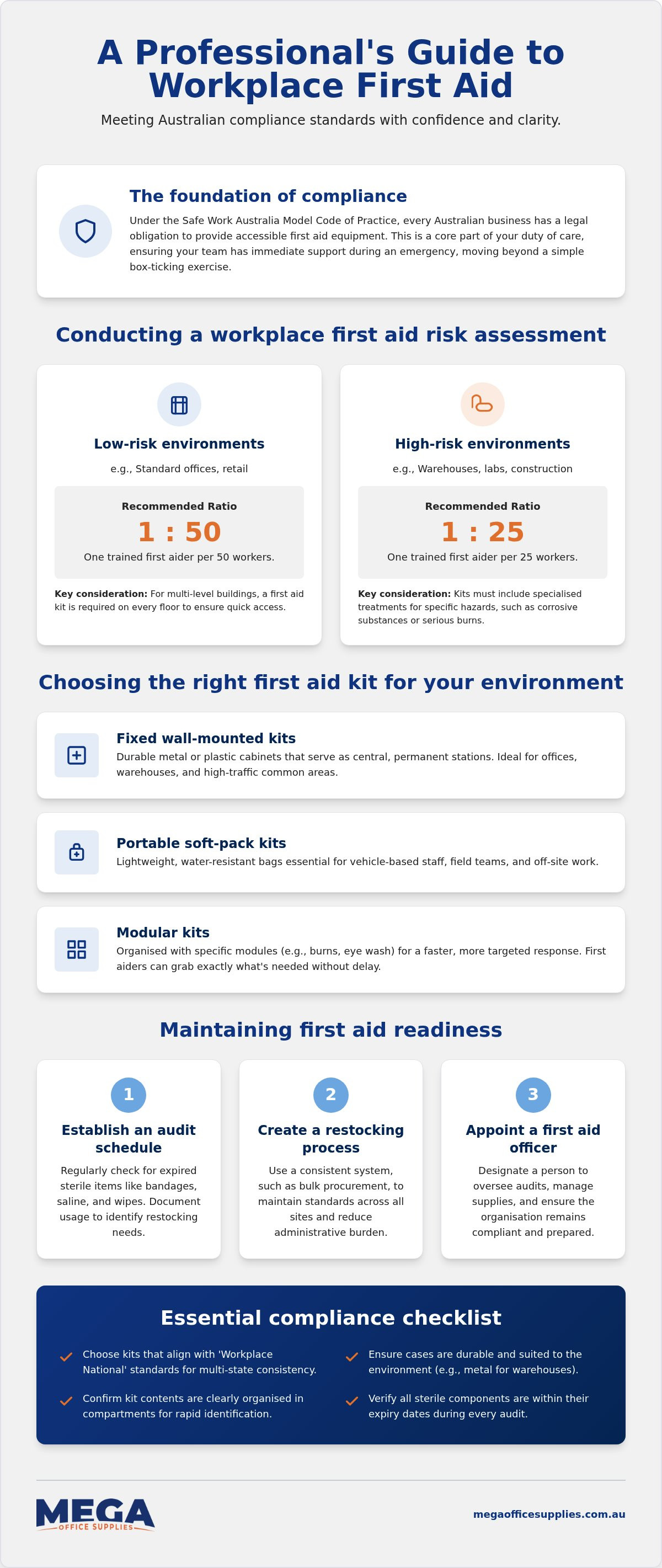
Compliance begins with understanding that a first aid kit isn't a static item but a responsive tool based on your specific workplace risk profile. Under the Safe Work Australia 2019 Model Code of Practice, every Person Conducting a Business or Undertaking (PCBU) has a legal obligation to provide accessible equipment and facilities. This isn't just about ticking a box; it's about ensuring your team has immediate support during an emergency. Safety isn't just about having enough bandages to cover a minor papercut epidemic.
Your floor plan and staff numbers dictate the scale of your setup and the quantity of first aid kits required. For low-risk environments like standard offices, the recommended ratio is one trained first aider for every 50 workers. However, if your organisation operates across multiple levels, you'll need kits on every floor to ensure accessibility within minutes. This proactive approach ensures that every staff member, regardless of their location on-site, has immediate access to life-saving equipment. A designated first aid officer plays a vital role here, overseeing regular audits and maintaining the high standards required for safety compliance.
Conducting a workplace first aid risk assessment
We recommend starting with a thorough audit of your environment to determine your specific needs for first aid kits. A standard office is low-risk, but warehouses or school labs involve machinery that shifts the category to high-risk. In these areas, the ratio drops to one first aider per 25 workers. If your team handles specific hazards like corrosive substances, your kits must include specialised treatments for those risks. This ensures you're prepared for the actual hazards of your industry.
Choosing the right first aid kit for your environment
Selecting the correct hardware depends on whether your team is stationary or mobile. Wall-mounted metal cabinets serve as central hubs for permanent stations, while portable soft-pack first aid kits are essential for field teams or vehicle-based staff. For organisations operating across state lines, choosing kits that align with 'Workplace National' standards ensures you aren't accidentally compliant in Queensland but a rebel in New South Wales. This approach simplifies procurement and aligns with the Code of Practice for First Aid, which emphasises that equipment must be fit for purpose. Integrating these requirements into your broader stationery supplies Australia strategy allows for more efficient facility management and budget tracking.
Modular kits offer a more targeted response than a generic box. By using specific modules for burns or eye wash stations, first aiders can grab exactly what they need without rummaging through unrelated items. It is the medical equivalent of a well-indexed binder; speed is everything when an incident occurs and every second counts during the initial response.
Essential features to compare before purchasing
Durability remains a primary consideration for longevity. Plastic boxes work well for indoor office environments, but high-traffic warehouses or outdoor sites require rugged metal or water-resistant cases. Look for internal organisation in your first aid kits that uses clear, compartmentalised layouts to facilitate rapid identification under pressure. We often suggest trusted brands like Kensington for high-quality safety accessories that withstand daily wear. If you are managing a large-scale facility, you can browse our full range of workplace safety solutions to find the right fit for your specific hazards.
Maintaining your first aid readiness and restocking
Compliance isn't a one-time event. You must establish a rigid audit schedule to identify expired sterile items like bandages and eyewash. In high-volume environments, items disappear or expire faster than you'd expect. Managing first aid kits across multiple sites or large campuses requires a logistical framework that prioritises consistency. Bulk procurement helps maintain this standard while reducing the administrative load of individual orders. Our local team can assist with custom quotes for safety audits. We ensure your facility stays ready for any inspection. We simplify the process by accepting Australian Government official purchase orders, removing the friction often found in public sector procurement.
Professional procurement for schools and government
Centralised business accounts make managing safety budgets across various departments more efficient. This allows procurement officers to track total safety spend and ensure every classroom or office receives consistent restocking without manual oversight for every small item. It's vital to include high-value safety assets, such as defibrillators (AEDs), in your annual facility management budget to avoid funding gaps during the year.
If you need to verify specific technical details or kit contents before a large-scale rollout, our local support team is available weekdays from 8–6 AEST. We provide direct assistance to help you choose the right first aid kits based on real-world use cases rather than generic, one-size-fits-all checklists. This ensures your organisation remains fully equipped to handle emergencies while staying within your allocated budgetary constraints.
Securing your workplace safety standards
Meeting Australian safety standards requires more than a standard box; it demands a thorough risk assessment and a strategic approach to equipment placement. Regular audits ensure that all sterile components in your first aid kits remain within their expiry dates and ready for immediate deployment. Streamlining procurement through official purchase orders and bulk accounts allows you to focus on your core operations while maintaining a compliant environment.
As a family owned and operated business since 2008, we offer the local support and industry knowledge needed to navigate complex WHS requirements. Our team provides direct assistance without offshore call centres and accepts official Australian Government purchase orders to facilitate a smooth procurement process.
Browse our range of workplace first aid kits and safety supplies
We look forward to helping you maintain a safer, more organised workplace.
Frequently Asked Questions
How many first aid kits does my workplace legally require?
Every Australian workplace must have at least one kit, but the total number required depends on your specific floor plan and staff distribution. For multi-level buildings, you must provide at least one kit on every floor to ensure accessibility. We recommend placing first aid kits in central locations like kitchens or near high-risk equipment where they can be reached within minutes during an emergency.
What is the difference between a low-risk and high-risk first aid kit?
Low-risk kits are designed for environments like retail or office spaces where minor injuries are expected. High-risk versions are more comprehensive, containing specialised modules for burns, heavy bleeding, or chemical exposure common in industrial workshops. While a standard kit covers basic wound care, high-risk variants are built for environments where medical assistance might be delayed or hazards are more severe.
How often should workplace first aid kits be audited and restocked?
You should audit your first aid kits at least once every six to twelve months, or immediately after an incident occurs. This schedule ensures that sterile items like bandages and saline haven't passed their expiry dates. Regular checks also confirm that the kit remains fully stocked and that all components are in good condition. We suggest assigning a dedicated officer to manage this task.
Do first aid kits in schools have different requirements than corporate offices?
Schools require supplies that cater to diverse activities, including playground supervision and off-site excursions. While a corporate office might only need stationary cabinets, educational facilities often require portable soft-pack equipment for teachers on duty. Additionally, schools must account for higher volumes of minor incidents, necessitating larger quantities of basic supplies like adhesive strips and antiseptic wipes compared to a standard office.
Article by
Mega Office Supplies Team
The Mega Office Supplies Team provides practical buying guides and workplace advice for Australian businesses, schools, government organisations, healthcare providers, hospitality venues, warehouses and home offices. Family owned and operated since 2008 and based in Tweed Heads South on the Gold Coast–Tweed border, Mega Office Supplies helps Australian workplaces choose the right office supplies, furniture, technology, cleaning, safety and education products — backed by genuine local service from real people.
General Information
This article is provided as general information only to help customers compare and choose office, workplace, school, cleaning, technology, furniture, safety and business supplies. Product details, specifications, compatibility, availability, pricing and suitability may vary. Always check the individual product page, manufacturer information, workplace requirements and relevant safety guidance before purchasing or using a product.


