


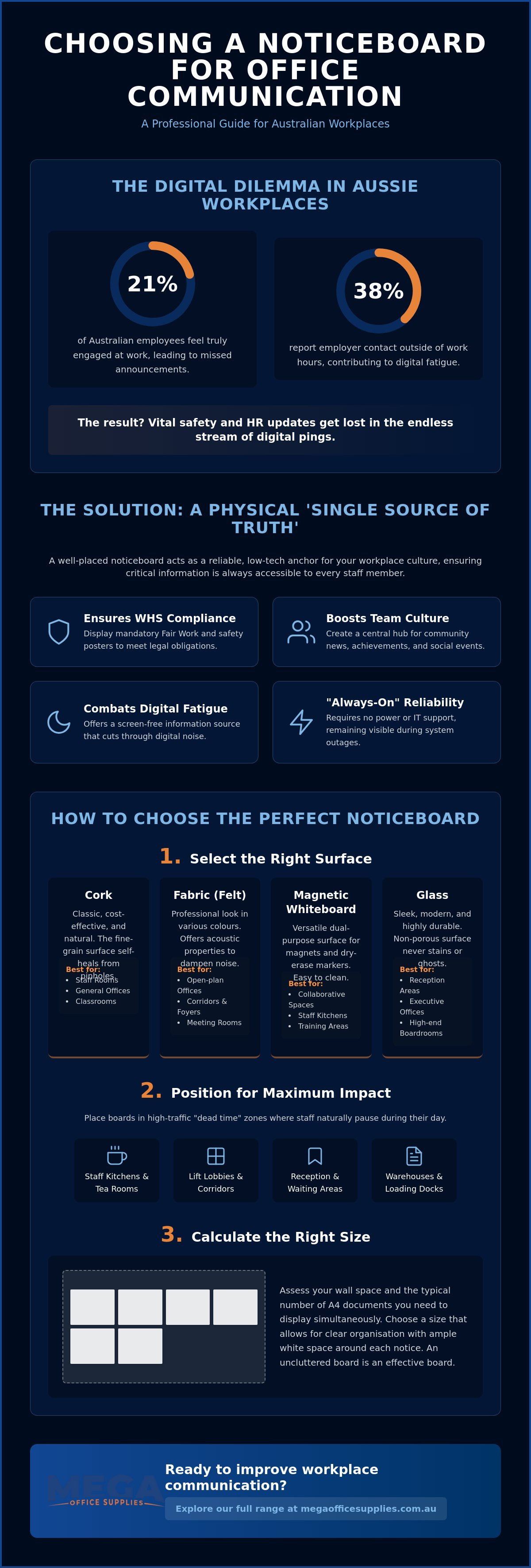
Did you know that as of April 2026, only 21% of Australian employees feel truly engaged at work? It's a common frustration for procurement officers and administrators who see vital safety updates and HR announcements get lost in the endless stream of digital pings. You likely agree that digital overload has made it harder than ever to ensure staff actually read mandatory compliance notices. When you are choosing a noticeboard for office communication, you are doing more than just picking a wall fixture; you are establishing a physical anchor for your workplace culture and safety standards.
This 2026 professional guide will show you how to master workplace information design by selecting the ideal surface, size, and location for your specific Australian environment. We'll explore how the right hardware helps you meet tightened WHS regulations, such as the new Workplace Exposure Limits (WEL) transition, while turning cluttered tea rooms into professional information hubs. From acoustic fabric boards to lockable security cases, we will provide the technical specifications you need to make a confident, durable investment for your facility.
Key Takeaways
- Understand why physical information hubs are essential for combating digital fatigue and serving as a reliable "single source of truth" for your team.
- Compare the functional advantages of different materials, including the self-healing properties of natural cork and the acoustic benefits of fabric-covered boards.
- Learn the critical legal requirements for choosing a noticeboard for office communication to ensure compliance with Australian WHS policies and mandatory Fair Work postings.
- Identify high-traffic "dead time" zones like staff kitchens and lift lobbies to maximise engagement through strategic placement.
- Calculate precise sizing requirements by assessing available wall space against standard A4 document capacity to ensure a professional, uncluttered display.
Beyond Digital: Why Physical Noticeboards Are Essential for Australian Workplaces
Digital saturation has reached a tipping point in the Australian workplace. With 38% of working Australians reporting contact from their employers outside of contracted hours, the demand for constant digital engagement has led to significant information overload. Establishing a physical "single source of truth" provides a necessary counterpoint to this digital noise. When choosing a noticeboard for office communication, you are investing in a persistent trust anchor that remains visible regardless of software updates, notification settings, or inbox volume. It provides a reliable, low-tech solution that ensures critical information is always accessible to every staff member.
To better understand the practical benefits of a physical communication hub, watch this helpful video:
A physical board does not just hold paper; it commands attention through its permanent presence in the shared environment. In high-traffic zones such as reception areas or staff kitchens, these boards capture "dead time" when employees are away from their screens. This ensures that essential updates, such as changes to Workplace Exposure Limits (WEL) or revised incident-notification rules, are seen by those who might otherwise miss a fleet-wide email. This tactile approach to information design is particularly vital in Australian warehouses and industrial sites where staff may not have regular access to a computer terminal during their shift.
The Psychology of the Physical Communication Hub
Permanent physical placement signals the weight and authority of the information displayed to your team. Unlike a transient Slack message or a pop-up notification that can be dismissed with a click, a document pinned to a professional-grade board implies longevity and institutional importance. By creating a dedicated "community centre" in the staff tea room or breakout area, you foster a sense of shared identity and culture that digital platforms often struggle to replicate. Physical boards effectively eliminate the risk of "inbox blindness" by ensuring that critical safety and HR updates remain in the peripheral vision of your workforce until they are no longer required.
Noticeboards vs. Digital Signage: Finding the Balance
While digital screens offer dynamic content, they often fall short in high-stakes environments due to technical complexity and maintenance requirements. Traditional boards are exceptionally cost-effective for displaying static, long-term information like WHS policies or emergency evacuation procedures. They require zero power and zero IT support, remaining fully functional during power outages or system downtime. Reviewing the history of the bulletin board reveals its evolution into a professional tool that prioritises functional clarity. These "always-on" tools provide peace of mind for administrators who need to ensure that mandatory compliance posters are visible 24 hours a day, seven days a week, without the risk of a hardware failure or software glitch.
In industrial settings, choosing a noticeboard for office communication is a matter of safety and operational efficiency. Large-format displays in loading docks or near machinery ensure that urgent safety reminders are impossible to ignore. This persistence is vital for maintaining compliance with Australian WHS regulations, particularly as psychosocial hazard management becomes a regulated and enforceable obligation in every jurisdiction across the country.
Comparing Noticeboard Surfaces: Cork, Felt, Magnetic and Glass
The choice of surface material is the most critical technical decision you'll face when choosing a noticeboard for office communication. It dictates not only how the board will look after months of heavy use but also how staff will interact with the information provided. Professional buyers must weigh the manual precision of traditional pin-based systems against the sleek, low-maintenance requirements of modern magnetic surfaces to ensure long-term value for the facility.
Traditional Surfaces for Pin-Heavy Environments
Natural cork remains the industry standard for high-traffic zones where information changes daily. Its cellular structure is inherently "self-healing," which means the granules expand to fill the hole left by a push-pin once it is removed. This durability makes it the most cost-effective choice for staff rooms, warehouses, or construction site offices where dozens of notices are pinned and replaced every week. To keep these boards looking professional, administrators should perform a monthly audit to remove outdated flyers and ensure the surface isn't becoming cluttered.
Felt and fabric-covered boards have gained significant traction in 2026 due to the industry shift toward wellness-led design. Beyond their professional appearance, these boards offer valuable acoustic properties by dampening ambient noise in open-plan offices. Using a colour-coded system with different fabric shades allows you to communicate your strategy more effectively. For example, using charcoal felt for operational updates and a vibrant blue for community news creates an intuitive visual hierarchy that helps staff process information quickly.
Modern Magnetic and Glass Alternatives
For corporate boardrooms and reception areas, magnetic glass boards are the premium choice. They provide a non-porous surface that is completely resistant to ghosting and staining, which is a common failure point for lower-grade whiteboards. The aesthetic of a frameless glass board aligns with modern, minimalist office fit-outs while remaining a highly functional communication tool. These surfaces are exceptionally easy to clean, requiring only a quick wipe to maintain their professional-grade clarity.
Magnetic porcelain-on-steel whiteboards offer a versatile, dual-purpose solution for agile team environments. These surfaces allow teams to pin up project timelines with heavy-duty magnets while simultaneously using dry-erase markers for brainstorming sessions. This flexibility supports the 2026 trend of creating offices that serve as collaborative destinations. Using magnetic accessories is a practical way to organise documents without the physical damage caused by traditional pins. If you are currently planning a workspace upgrade, you can explore a wide range of professional surfaces in our office furniture supplies collection.
Compliance and WHS: Legal Requirements for Australian Office Noticeboards
Compliance in the Australian workplace is a high-stakes environment where physical documentation often serves as the primary evidence of a business meeting its duty of care. When you are choosing a noticeboard for office communication, you must prioritise the legal requirements set by the Fair Work Ombudsman and various state-based WHS regulators. A board isn't merely a piece of furniture; it's a critical tool for maintaining transparency and ensuring that every staff member has immediate access to their rights and safety protocols. In 2026, this responsibility has intensified with the regulation of psychosocial hazards and expanded incident-notification rules across all jurisdictions.
Mandatory Displays for Australian Employers
Every Australian employer is legally required to provide employees with the Fair Work Information Statement. While digital distribution is permitted, maintaining a physical copy on a central noticeboard is the most reliable method to ensure "reasonable access" for all staff, including those without regular computer use. Crucially, your board must also display the contact details for your Health and Safety Representatives (HSRs) and designated first aid officers. We recommend that first aid kits are co-located with these safety noticeboards to create a singular, high-visibility response zone.
As of 1 December 2026, Australia has transitioned to Workplace Exposure Limits (WEL) for airborne contaminants. This change requires businesses to update their displayed safety data sheets and exposure standards. Failing to provide these updates in a visible, physical format can lead to non-compliance during a SafeWork audit. Additionally, for businesses in New South Wales, approved Codes of Practice became mandatory benchmarks on 1 July 2026. Displaying these specific codes on a professional-grade board ensures your organisation meets these heightened legal standards.
Securing Sensitive Information
Not all compliance data should be open to the elements or casual tampering. For official licences, certificates of currency, or sensitive site-specific permits, a lockable, tamper-proof display case is essential. These enclosed boards protect documents from dust and grime, which is a significant factor in warehouse or workshop environments. They also prevent the unauthorised removal or relocation of documents that must remain fixed by law. Using a lockable board in public-facing reception areas allows you to display mandatory insurance and registration details while maintaining a clean, professional appearance that reflects your company's stability.
Accessibility is another vital factor in choosing a noticeboard for office communication. To maintain an inclusive workplace, boards should be mounted at a height that is visible and reachable for all employees, including those using wheelchairs. Standard visibility rules suggest that the centre of the board should be at eye level, approximately 1500mm from the floor, ensuring that emergency evacuation procedures and first aid lists are legible during a high-stress incident. A well-organised, compliant board acts as a silent partner in your risk management strategy, providing peace of mind for procurement officers and business owners alike.
Strategic Placement and Organisation for Maximum Staff Engagement
Effective communication depends on strategic visibility. When choosing a noticeboard for office communication, you must identify "dead time" zones where employees are naturally stationary. Lift lobbies, printing stations, and corridors are prime locations. These areas provide a window of opportunity for staff to absorb information without the pressure of an active task. Given that only 21% of Australian employees feel truly engaged in 2026, capturing these brief moments of transition is vital for maintaining a connected workforce.
To prevent information overload, adopt a "Zone System" for your displays. Categorise your boards by urgency and purpose. Safety and compliance documents require a dedicated, high-visibility area. Social and operational news should have their own separate spaces. This separation helps staff mentally filter information, which reduces the risk of "noticeboard fatigue." Curation is essential for long-term effectiveness. You should remove any document that has been posted for more than 30 days unless it is a permanent legal requirement. Fresh content signals that the information is relevant and worth reading.
The Kitchen and Tea Room: The Social Hub
This area serves as your cultural anchor. Use it for staff photos, social club events, and birthday notices to foster engagement. It creates a "community centre" feel that is much more approachable than a formal boardroom. This zone is the natural companion to your coffee and tea supplies, turning a beverage break into a cultural touchpoint. Keep this board distinct from formal HR or safety zones to maintain its relaxed atmosphere. This prevents vital safety information from being perceived as "background noise" in a social setting.
Operational Zones: Warehouses and Reception Areas
In warehouses, visibility during roster changes is critical for operational efficiency. Mount boards at eye level, approximately 1500mm from the floor, near clock-in stations or loading docks. For reception areas, use premium glass or magnetic boards to convey professionalism to visitors and clients. Using professional-grade stationery supplies like high-quality markers and heavy-duty magnets ensures your displays remain tidy and authoritative. A cluttered board with curling paper and mismatched pins undermines the professional image of your facility.
Ready to upgrade your workplace communication hubs? View our full range of professional office furniture supplies to find the ideal solution for your specific environment.
Technical Specifications: Sizing, Framing and Installation Considerations
Technical specifications form the foundation of a durable workplace investment. When choosing a noticeboard for office communication, you must look beyond the surface to the structural integrity of the hardware. For procurement officers and administrators, this means evaluating frame durability, mounting security, and capacity requirements to ensure the board serves the facility for many years. Functional clarity and manual precision in your selection process will prevent the need for frequent replacements in high-traffic environments.
Sizing Your Board for Professional Use
Sizing decisions should be based on a precise calculation of your document volume rather than guesswork. A standard 900x600mm board accommodates approximately 9 A4 sheets, while a larger 1200x900mm unit holds up to 15 sheets comfortably. Avoid the common mistake of filling every square centimetre of the surface. Maintaining "white space" around your notices significantly improves readability and ensures that staff aren't overwhelmed by visual clutter. For notices that are no longer current but require retention for audit purposes, we recommend using lever arch files to maintain a tidy, archived record in your storage area.
Framing and Durability Standards
Anodised aluminium frames are the professional standard for Australian schools, healthcare facilities, and government offices. This material provides superior resistance to corrosion and physical impact; it ensures the board remains securely fixed and professional-looking in high-traffic corridors. While wooden frames offer a softer aesthetic for boutique home offices, they often lack the industrial longevity required for a busy warehouse or classroom. In high-occupancy buildings, safety is a primary concern. Always check for fire-retardant felt and backing materials to meet specific Australian building code requirements. You can explore our full range of office furniture and noticeboards to find a solution that meets these rigorous commercial standards.
Installation requires more than just a few basic wall plugs. For heavy-duty commercial use, boards should be mounted using a secure four-corner fixing system to prevent sagging or accidental detachment. If you anticipate your communication needs will grow, consider modular systems that allow for expandable display options. These future-proof designs let you add sections as your team expands, which maintains a consistent look across the facility. Taking these technical factors into account when choosing a noticeboard for office communication ensures your facility remains organised, compliant, and professional for the long term.
Optimising Your Workplace Communication Strategy
Mastering workplace information design requires a balance of technical durability and strategic placement. By selecting the ideal surface and sizing, you ensure your facility meets Australian WHS standards while effectively combating digital fatigue. Whether you're outfitting a school, warehouse, or corporate office, choosing a noticeboard for office communication remains a vital long-term investment in your organisation's culture and safety.
Mega Office Supplies is an Australian family-owned and operated business with over 20 years of combined industry experience. We understand the specific procurement workflows of professional buyers and proudly accept official government purchase orders. Our team is ready to support your next facility upgrade with reliable, high-capacity solutions that stand the test of time. Browse the full range of professional Noticeboards at Mega Office Supplies and secure a durable communication hub for your team today.
Frequently Asked Questions
What is the best type of noticeboard for a high-traffic staff kitchen?
A magnetic glass board or fire-retardant felt board is ideal for these environments. Glass is exceptionally easy to sanitise in areas where food and drinks are prepared. If you prefer a softer look, felt boards help dampen the clatter of a busy breakroom. Both options provide the durability required for daily staff interaction while maintaining a professional appearance that matches your facility's hygiene standards.
Are there specific legal requirements for what must be on an Australian office noticeboard?
Australian employers must display the Fair Work Information Statement and various WHS documents. This includes your emergency evacuation plan, first aid officer lists, and Health and Safety Representative (HSR) details. When choosing a noticeboard for office communication, ensure it's large enough to house these mandatory documents alongside any industry-specific safety standards, such as the 2026 Workplace Exposure Limits (WEL) updates.
How do I clean and maintain a felt noticeboard without damaging the fabric?
Regular vacuuming with a soft brush attachment is the most effective way to remove dust from fabric surfaces. For light stains, use a damp cloth with a mild, pH-neutral detergent and gently dab the area. Don't scrub the fabric or use harsh chemicals; this can cause pilling or discolouration. Keeping your pinboards clean ensures they remain a professional-grade fixture in your reception or staff areas.
Can I use a magnetic whiteboard as a noticeboard for a professional look?
Magnetic glass or porcelain whiteboards are excellent alternatives to traditional pinboards for a sleek, modern aesthetic. These surfaces allow you to use heavy-duty magnets to secure documents, which prevents the surface damage caused by repeated pinning. They're particularly useful in boardrooms or reception areas where you need to switch between permanent notices and temporary handwritten notes during team briefings.
What size noticeboard do I need for a small team of 10 employees?
A 900x600mm board is generally the most practical size for a team of this scale. These dimensions allow you to post up to nine A4 documents comfortably while leaving enough "white space" to prevent visual clutter. It's sufficient for housing mandatory Fair Work statements, emergency procedures, and a rotating selection of social updates or team achievements without overwhelming the available wall space.
How do I prevent my noticeboard from becoming cluttered and unread?
Assign a dedicated "board curator" to audit the content every month. This individual should remove any outdated flyers, expired event notices, or duplicate safety sheets to keep the information relevant. When choosing a noticeboard for office communication, consider a modular system that allows you to separate urgent safety news from social updates. This organisation helps staff quickly identify the most important information.
Are lockable noticeboards necessary for all types of office communication?
Lockable cases are specifically recommended for sensitive documents or high-traffic public zones. You don't need them for general internal updates, but they're vital for protecting official licences, insurance certificates, or restricted site permits from unauthorised removal. In warehouse or workshop settings, an enclosed board also protects documents from dust and grime, ensuring that mandatory safety protocols remain legible for all employees.
Is natural cork better than synthetic felt for long-term durability?
Natural cork is the superior choice for high-frequency pinning because its granules expand to fill holes automatically. This "self-healing" property makes it exceptionally durable for operational zones where notices change daily. Synthetic felt is often preferred for corporate environments where aesthetics and noise reduction are the priority. Both materials offer long-term value if they're mounted securely using a professional fixing system.
Article by
Mega Office Supplies Team
The Mega Office Supplies Team provides practical guidance for Australian businesses, schools, government organisations, healthcare providers, hospitality venues, warehouses and home offices. Based in Tweed Heads South, Mega Office Supplies is a family-owned and operated Australian business offering office stationery, workplace furniture, technology products, labels, printers, cleaning and janitorial supplies, safety products, art materials, education resources and everyday business essentials from trusted brands.
General Information
This article is provided as general information only to help customers compare and choose office, workplace, school, cleaning, technology, furniture, safety and business supplies. Product details, specifications, compatibility, availability, pricing and suitability may vary. Always check the individual product page, manufacturer information, workplace requirements and relevant safety guidance before purchasing or using a product.


