


For most professionals over 190cm, the typical ergonomic chair is often a source of daily discomfort rather than a support tool. You've likely experienced the frustration of headrests that dig into your shoulder blades or seat pans that end halfway down your thighs, leading to persistent leg fatigue. Finding the best office chair for tall person Australia requires moving beyond generic marketing and looking at the specific mechanical requirements of taller frames.
We understand that proper support is a matter of precise geometry, not just scale. In this 2026 professional buyer's guide, you'll discover the technical specifications and commercial-grade features required to support longer limbs and larger frames in any Australian workplace. We will preview the essential components of a long-term investment, from gas lifts with extended travel to lumbar support that actually reaches the lower back rather than resting on the pelvis. Backed by over 150 years of combined industry knowledge, our team provides the practical insights needed to select a chair that meets rigorous Australian standards and supports your health throughout the full working day.
Key Takeaways
- Identify why standard ergonomic chairs fail taller frames by understanding the relationship between seat pan depth and leg circulation.
- Prioritise an adjustable seat slide as the most critical feature to provide full femur support and ensure lumbar placement hits the lower back correctly.
- Select the best office chair for tall person Australia by verifying the gas lift range allows your hips to remain slightly above your knees for optimal posture.
- Look for AFRDI Level 6 certification to guarantee the hardware meets Australian commercial standards for durability and stability.
- Distinguish between high weight ratings and ergonomic fit to ensure the chair's technical dimensions actually accommodate a longer torso and legs.
Why standard ergonomic chairs fail tall Australians
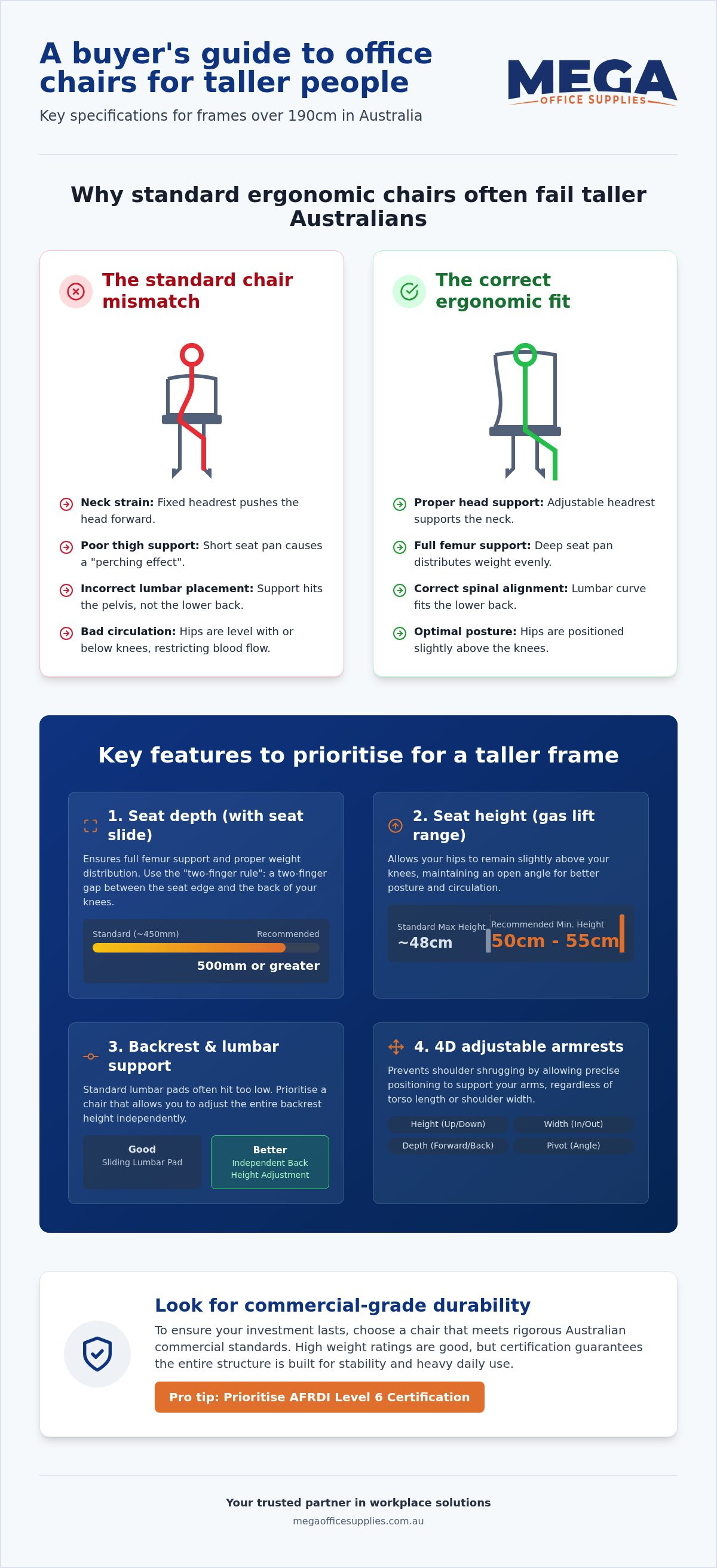
Most office chairs in the Australian market are built for the average height range of 165cm to 180cm, leaving anyone taller struggling with the perching effect. This occurs when a short seat pan fails to support the full length of the femur, which forces you to balance on the edge of the seat. This posture restricts blood flow and leads to significant leg fatigue before you've even finished your first coffee.
Many manufacturers use a "big and tall" label as a catch-all, but this often prioritises weight capacity over height-specific ergonomic design features. A chair that supports 150kg but lacks a deep seat pan or a high-range gas lift won't provide the necessary alignment. We often see standard gas lifts bottom out, preventing users from reaching a height where their hips remain slightly above their knees. Proper mechanical support is essential for long-term spinal health.
To see how these dimensions impact real-world use, watch this comparison by tall users:
The ergonomic mismatch: neck strain and shoulder fatigue
Low backrests are a primary culprit for upper body pain. When the backrest ends at the mid-shoulder, it forces the spine into a "C-shape" slouch to find any semblance of support. Fixed headrests are even worse; they often hit a tall person in the upper back or neck, pushing the head forward and straining the cervical spine. It's like trying to fit a 2-metre ladder into a 1.5-metre garden shed.
Leg discomfort and the importance of seat pan depth
We recommend using the "two-finger rule" to check for a proper fit. There should be a gap of roughly two fingers between the front edge of the seat and the back of your knees. If the gap is larger, your thighs aren't getting enough support, which increases pressure on the lower spine and causes lumbar support to hit the pelvis rather than the lower back curve. Finding the best office chair for tall person Australia requires a seat depth that actually accommodates your femur length to ensure even weight distribution.
Key features to prioritise for a taller frame
Identifying the best office chair for tall person Australia is a matter of verifying specific technical specifications rather than relying on "extra-large" marketing labels. We focus on the mechanical ranges that allow the chair to adapt to your body's proportions. The most critical component is often the adjustable seat slide. This feature allows you to move the seat pan forward or backward, ensuring your thighs are fully supported without the front edge cutting into the back of your knees.
Seat depth and height: the non-negotiables
Most standard chairs offer a seat depth of roughly 450mm, which leaves tall users feeling like they are sliding off. Look for seat depths of 500mm or greater to provide adequate femur support. Gas lift range is equally vital for maintaining a healthy posture. To keep your hips slightly above your knees, we recommend a gas lift that reaches a minimum seat height of 50cm to 55cm. This prevents the "knees-in-chest" position that often occurs with standard-height furniture.
Lumbar and backrest geometry
Tall users frequently find that standard lumbar pads hit their sacrum rather than the lower back. We suggest prioritising independent back-height adjustment over simple sliding pads. This allows you to raise the entire backrest structure so the built-in curve aligns with your spine's natural shape. Adhering to professional ergonomic principles for office chairs, a synchro-tilt mechanism is also highly beneficial. It allows the backrest to recline at a 2:1 ratio compared to the seat, opening the hip angle while keeping your feet firmly on the floor.
Armrest adjustability is the final piece of the puzzle. Look for 4D armrests that adjust for height, width, and depth. This prevents shoulder shrugging and ensures your elbows can rest comfortably regardless of your torso length. You can browse our full range of ergonomic office chairs to find commercial-grade models that include these specific technical features.
Selecting commercial-grade solutions for durability
Selecting the best office chair for tall person Australia requires a focus on commercial-grade durability to ensure the investment lasts beyond the first year. Taller frames naturally apply more leverage to a chair's mechanical components, particularly the seat pan and gas lift. We recommend moving away from consumer-grade models and prioritising hardware that carries professional certification for high-use environments.
Why AFRDI ratings matter for taller users
The Australasian Furnishing Research and Development Institute (AFRDI) provides the "Blue Tick" certification, which is the benchmark for quality in the Australian workplace. For tall users, an AFRDI Level 6 rating is vital because it signifies the chair has been tested for severe commercial use, including 24/7 environments. This testing ensures the gas lift and castors can withstand higher load capacities and repetitive adjustments without mechanical failure. You can read more about these standards in our Professional Buying Guide to Ergonomic Office Chairs in Australia (2026).
It is important to distinguish between a weight rating and an ergonomic fit. A chair might be rated for 180kg, but if it lacks the seat depth and backrest height we discussed in previous sections, it remains unsuitable for a tall frame. We prioritise chairs that combine high load capacities with the specific geometry needed for long-term spinal health.
Procurement for Australian organisations
We've spent over 17 years helping procurement officers and office managers streamline their furniture requirements. We understand the specific budget cycles and compliance needs of schools, healthcare providers, and government departments. To facilitate this, we accept Australian Government official purchase orders and offer national delivery across the country.
For businesses looking to outfit a full department or upgrade multiple workstations, we encourage submitting a business application. This allows our team to provide volume pricing and tailored quotes that meet your specific logistical needs. Our combined 150 years of industry knowledge ensures you receive hardware that is fit for purpose and built to last.
Selecting hardware for lasting workplace comfort
Selecting the best office chair for tall person Australia requires looking beyond basic aesthetics to the underlying mechanical specifications. Prioritising seat pan depth and high-range gas lifts eliminates the fatigue associated with poor ergonomic alignment. By choosing AFRDI Level 6 certified hardware, you ensure that your investment meets the highest national standards for durability. Your spine will thank you for finally providing a chair that doesn't feel like it was borrowed from a primary school classroom.
We've been Australian owned and operated since 2009, leveraging over 150 years of combined team industry knowledge to support local workplaces. Our logistical network provides national delivery on all office furniture, making it simple to outfit your space with professional-grade solutions.
Browse our range of commercial ergonomic office chairs
Proper support is a fundamental requirement for a productive day. We're here to help you find a solution that fits your frame and your budget perfectly.
Frequently Asked Questions
How do I know if an office chair is deep enough for my legs?
You can determine if a seat is deep enough by checking the gap between the front of the seat pan and the back of your knees while sitting fully back. This gap should be roughly the width of two fingers. If the gap is wider, your thighs aren't receiving adequate support, which increases pressure on your lower spine. Choosing the best office chair for tall person Australia often involves selecting a model with an adjustable seat slide to customise this distance.
What is the difference between a high-back and an executive office chair for tall people?
High-back chairs are designed to support the entire length of the spine, while executive chairs often focus on aesthetic status and thick padding. For taller users, a high-back chair with independent back-height adjustment is usually the better choice. Executive models frequently have fixed lumbar support that sits too low for a longer torso. This misalignment can lead to slouching and mid-back pain during extended periods of work.
Do I need a special gas lift if I am over 190cm tall?
You will likely need a high-range gas lift to ensure your seat height allows your hips to remain slightly above your knees. Standard gas lifts often have a maximum extension that is too low for those over 190cm, forcing the knees into an upward angle that strains the hips. We recommend looking for a gas lift that provides a seat height of at least 55cm to maintain correct ergonomic posture.
Are mesh chairs better than upholstered chairs for taller users?
Mesh chairs provide superior breathability, but the underlying frame geometry is more important than the material for taller users. Some mesh designs feature a rigid plastic rim that can cause discomfort if your thighs press against the front edge. When selecting the best office chair for tall person Australia, prioritise technical dimensions and AFRDI durability ratings over the upholstery type.
Article by
Mega Office Supplies Team
The Mega Office Supplies Team provides practical buying guides and workplace advice for Australian businesses, schools, government organisations, healthcare providers, hospitality venues, warehouses and home offices. Family-owned and operated since 2009 and based in Tweed Heads South on the Gold Coast–Tweed border, Mega Office Supplies brings more than 150 years of combined team experience to helping Australian workplaces choose the right office supplies, furniture, technology, cleaning, safety and education products — backed by genuine local service from real people.
General Information
This article is provided as general information only to help customers compare and choose office, workplace, school, cleaning, technology, furniture, safety and business supplies. Product details, specifications, compatibility, availability, pricing and suitability may vary. Always check the individual product page, manufacturer information, workplace requirements and relevant safety guidance before purchasing or using a product.


