


The softest mat in the showroom is often the quickest to fail both your spine and your budget. While a "cloud-like" feel is a popular marketing angle, professional-grade support requires specific material density to prevent the foam from bottoming out under your weight. If you're looking for a comprehensive anti-fatigue mat for standing desk review, you've likely noticed that many cheaper options flatten within months, leaving you standing on the hard floor. You need a durable solution that maintains its structural integrity while minimising trip hazards in a busy Australian office or home workspace.
We recognise that persistent leg fatigue and lower back pain can quickly undermine the productivity gains of a sit-stand workstation. It's frustrating when equipment designed for health ends up causing more discomfort. This guide provides the technical framework you need to evaluate ergonomic benefits, safety bevels, and long-term material resilience. We'll examine why high-density composition is the most critical factor for lasting comfort and show you how to select a product that meets rigorous Australian workplace safety standards. Whether you're fit out an enterprise-scale office or a personal study, understanding these specifications ensures your investment delivers the stability your team requires for 2026 and beyond.
Key Takeaways
- Learn how micro-movements on an ergonomic surface activate the "venous pump" to improve blood circulation and reduce lower back pain during long standing intervals.
- Understand why material density is a more reliable indicator of long-term support than simple thickness, ensuring your mats don't flatten over time.
- Utilise our anti-fatigue mat for standing desk review to compare flat commercial polyurethane models with topographical active mats designed for varied terrain.
- Identify essential safety features, such as non-slip backing and bevelled edges, to minimise trip hazards and maintain hygiene in high-traffic Australian workplaces.
- Streamline your facility procurement by sourcing durable ergonomic solutions that meet professional standards for comfort and durability.
Why an Anti-Fatigue Mat is Critical for Your Standing Desk Setup
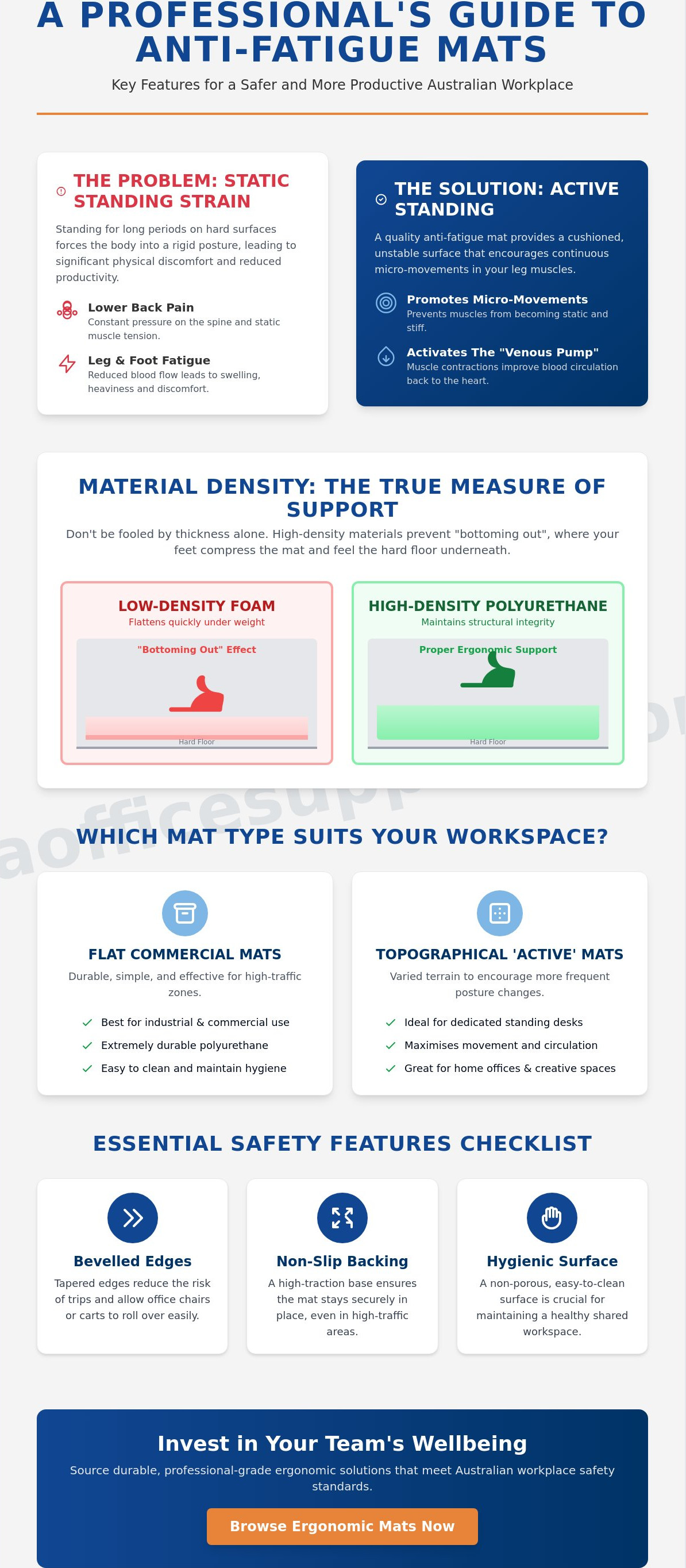
Standing for extended periods on unyielding surfaces like concrete or standard office carpet creates significant physical strain that radiates from the feet to the lower back. Anti-fatigue mats are specifically engineered ergonomic tools designed to counteract this by encouraging subtle, involuntary muscle contractions. Unlike static standing, which forces the body into a rigid posture, these mats provide a slightly unstable surface that necessitates constant engagement from the lower limbs. This is particularly relevant when performing an anti-fatigue mat for standing desk review, as the primary objective is to eliminate the "bottoming out" effect seen in inferior, low-density products.
This engagement triggers what medical professionals call the "venous pump" effect. As your muscles contract and relax to maintain balance, they compress the veins, effectively pushing blood back toward the heart and improving overall circulation. Professional-grade cushioning differs from residential mats by providing enough resistance to facilitate this movement without being so soft that it creates instability. When conducting an anti-fatigue mat for standing desk review, it's essential to understand that the goal isn't just "softness" but the facilitation of this circulatory process. It's a critical component of a modern workspace, working in tandem with your ergonomic office chair to provide a versatile environment that supports both sitting and standing intervals.
To better understand the physiological impact of these ergonomic tools, watch this helpful video:
The Science of Micro-movements
The effectiveness of a mat lies in its ability to keep the body in a state of "active standing." When you stand on a hard floor, your muscles can become static, leading to increased pressure on the joints and significant lower limb oedema. This swelling is not just uncomfortable; it's a precursor to long-term vascular issues. By introducing a surface that requires micro-movements, you activate the body's natural recovery mechanisms. Proprioception, which is the body's ability to sense its position and movement in space, plays a key role here by allowing the nervous system to coordinate these minor shifts and reduce overall joint fatigue.
Economic Benefits for Australian Businesses
Australian business owners and procurement officers recognise that employee wellbeing is linked to the bottom line. Investing in high-quality furniture and ergonomic accessories is a proactive strategy to minimise absenteeism and the costs associated with repetitive strain injuries. A well-supported workforce is a productive one. By delaying the physiological onset of leg heaviness and fatigue, these mats help staff maintain peak cognitive performance throughout the day. In a competitive labour market, providing a workspace that prioritises physical health is a powerful tool for staff retention and overall workplace satisfaction.
Key Features to Evaluate in a Standing Desk Mat Review
Selecting the right equipment requires looking beyond aesthetic appeal. When conducting an anti-fatigue mat for standing desk review, the technical specifications of the core material determine whether the product is a long-term asset or a short-lived expense. Many entry-level mats rely on thickness to provide comfort, yet a 20mm mat made of low-grade foam often provides less support than a 15mm high-density polyurethane model. High-density materials ensure the user's feet stay suspended above the floor rather than sinking through the cushion. This is known as the "bottoming out" test. If you can feel the floor through the mat when shifting your weight, the material lacks the necessary resilience for commercial use.
Polyurethane is widely considered the gold standard for office environments. It is a solid, non-porous material that does not absorb spills or skin oils, making it easy to maintain with standard cleaning chemicals. In contrast, open-cell foam mats often suffer from "permanent set," where the material remains compressed after use, eventually becoming as hard as the floor it was meant to cover. Surface texture also plays a role in grip and maintenance. A lightly textured surface provides enough traction for leather-soled shoes while remaining smooth enough to wipe down at the end of a shift. For those managing a full office fit-out, sourcing commercial-grade ergonomic furniture alongside these mats ensures a cohesive and safe environment for all staff.
Polyurethane vs. Foam vs. Gel
In a professional anti-fatigue mat for standing desk review, durability is the primary differentiator. Polyurethane mats are engineered to maintain their shape for years, resisting the "compression set" that plagues cheaper alternatives. Foam mats are often suitable for light home use but fail quickly in a busy office or warehouse where they are subjected to constant weight. Gel mats offer high initial comfort but can create a "squishy" sensation. This instability actually increases muscle fatigue by requiring more effort to maintain a stable posture, making them less ideal for standard eight-hour workdays.
Safety Geometry: Bevelled Edges
Safety is as critical as comfort. According to CCOHS guidelines on anti-fatigue mats, improper edges are a primary cause of workplace trips. A professional mat should feature a 20-degree bevelled edge to allow for a smooth transition from the floor. This geometry prevents the mat from curling or catching the soles of shoes. Additionally, the base must have a high-friction surface to prevent "creep," which is the tendency for a mat to slide across polished floors or carpet during the day. Stability ensures the mat stays exactly where it's needed without requiring constant repositioning.
Reviewing the Best Anti-Fatigue Mat Types for Professional Use
Choosing the correct mat involves matching the hardware to the specific workflow of your department. In any professional anti-fatigue mat for standing desk review, the selection typically falls into four primary categories: flat commercial, topographical, industrial-grade, and portable options. Flat commercial mats are the standard choice for corporate standing desks. These provide a clean, uniform aesthetic that fits seamlessly into modern office environments while offering the high-density support required for eight-hour shifts. They are particularly effective in professional settings where staff frequently transition between standing and using their ergonomic chairs.
Topographical or "active" mats represent a shift toward dynamic standing. These products feature varied terrain, such as raised side rails, massage balls, or central mounds. These features encourage the user to stretch their calves and shift their weight constantly. For environments beyond the standard office, such as warehouses, staff kitchens, or reception areas, industrial-grade mats are necessary. These models prioritised extreme durability and resistance to chemicals or oils. If your workspace requires frequent reconfiguration, portable mats with integrated handles or lightweight cores allow for rapid storage when the floor needs to be cleared for cleaning or chair use.
Flat vs. Topographical Mats
Staff who move frequently between tasks often prefer flat surfaces because they don't require careful foot placement. However, topographical mats are superior for individuals who stand for long, uninterrupted intervals. According to the Canadian Centre for Occupational Health and Safety guide, the goal of any ergonomic mat is to reduce the static load on the body. While a flat mat achieves this through density, a topographical mat like the Desky Ball style achieves it through movement. The varied terrain forces the user to engage different muscle groups, which can significantly delay the onset of leg heaviness.
Size Considerations for Australian Workstations
Standard dimensions for professional mats usually hover around 500x800mm, which provides ample room for a natural stance without encroaching on the footprint of the desk legs. It's vital to ensure the mat is large enough to accommodate your full range of motion but compact enough to be tucked away. Measuring your personal stance width is the first step in buying. Simply measure the distance between the outside of your feet when standing comfortably to ensure the mat you select provides full coverage. This prevents the risk of half-standing on the edge of the mat, which can create an uneven surface and lead to ankle strain.
Implementation: Positioning, Maintenance, and Safety
Integrating a high-quality mat into a workstation requires a clear strategy for daily logistics. While previous sections detailed the importance of density and material, the practical implementation of an anti-fatigue mat for standing desk review often comes down to how easily it fits into a fluid workspace. In a professional Australian office, floor space is a premium asset. You must ensure the mat doesn't become a trip hazard for colleagues or a hindrance when you need to return to your ergonomic chair. Adhering to local Occupational Health and Safety (OH&S) guidelines is mandatory for any commercial fit-out to minimise liability and ensure staff wellbeing.
Managing the Mat-to-Chair Swap
The most common logistical challenge is the transition between sitting and standing. Professional-grade mats are often heavy to provide the necessary stability and prevent "creep" on carpeted surfaces. However, this weight can make them difficult to move manually. Some modern designs include integrated "quick-slide" undersides that allow you to push the mat aside with your foot, while others are designed to be hung on a dedicated mat hook under the desk. Storing the mat vertically or sliding it completely under the desk cavity is essential to keep walkways clear and maintain a safe environment for all personnel.
Cleaning and Long-term Care
Hygiene is a priority in shared environments, especially in healthcare or education sectors. Non-porous polyurethane surfaces are essential because they don't trap bacteria, dust, or skin oils. While it's tempting to use industrial-strength cleaning chemicals, harsh solvents can actually degrade the molecular structure of cheaper foam-based mats, causing them to become brittle or lose their "bounce." For solid polyurethane, a simple solution of warm water and mild soap is sufficient for regular maintenance.
You should inspect your equipment quarterly for signs of "pitting" or "cracking" at the edges. These are clear markers of material fatigue, indicating that the internal structure has broken down and no longer provides the supportive resistance required for ergonomic health. Once a mat loses its ability to rebound quickly after pressure is applied, it should be decommissioned and replaced to avoid staff discomfort. Safe floor management is a cornerstone of workplace maintenance. If you are ready to upgrade your facility, you can view our range of ergonomic floor solutions to find a durable option for your team.
Procuring Ergonomic Solutions with Mega Office Supplies
Professional procurement requires a partnership with a supplier that understands the logistical demands of large-scale operations. When conducting an anti-fatigue mat for standing desk review, procurement officers often find that individual product performance is only half the equation. The other half is the reliability of the supply chain and the ability to source a comprehensive range of office supplies and furniture from a single Australian partner. Mega Office Supplies positions itself as a dependable ally for businesses, schools, and government departments across the country, providing the stability needed for complex ergonomic fit-outs.
We prioritise functional clarity and efficiency in every transaction. Our commitment to providing durable, commercial-grade equipment ensures that your investment meets the high standards required for Australian workplace safety. By integrating high-density anti-fatigue mats into a broader workplace wellness strategy, organisations can proactively address the physical strain of standing roles. This holistic approach to ergonomics supports long-term staff retention and reduces the risk of repetitive strain claims.
Bulk Orders and Fit-out Consultations
Streamlining the acquisition process for the government, education, and healthcare sectors is a core competency of our operation. We leverage our decades of combined industry experience to help administrators select the correct mat density and material for their specific environment. Whether you're outfitting a single reception area or a multi-storey corporate headquarters, our team provides the regional expertise and direct support required to manage national shipping requirements efficiently. We focus on delivering hardware that withstands the rigours of Australian workplace conditions while maintaining competitive rates for high-volume demands.
The Mega Office Supplies Difference
Choosing Mega Office Supplies means gaining access to a massive inventory that spans from daily stationery needs to premium ergonomic workstations. Our system is designed for financial transparency and logistical speed, prioritising high-volume fulfilment without the friction often associated with global competitors. We understand the specific workflow of professional buyers who need to evaluate costs and quantities quickly. You can view our full range of ergonomic office furniture and accessories to begin building a more resilient and supportive workspace for your team.
Optimising Your Ergonomic Investment
Selecting the right ergonomic hardware is a decision that impacts long-term staff health and operational productivity. As explored in this anti-fatigue mat for standing desk review, the technical specifications of your equipment matter more than initial softness. Focusing on solid polyurethane construction and high-density support ensures your mats remain resilient under commercial use, preventing the physical fatigue that leads to reduced performance in the afternoon hours.
Our team at Mega Office Supplies leverages over 20 years of combined industry experience to provide Australian organisations with equipment that meets rigorous commercial-grade durability standards. We understand the logistical requirements of modern facilities, offering national Australian shipping and direct support to simplify your procurement process. By choosing high-performance materials and observing proper safety geometry, you create a workspace that actively supports the physical wellbeing of your team.
You can upgrade your workplace ergonomics with our professional mat range today. We look forward to helping you build a safer, more efficient environment that stands the test of time.
Frequently Asked Questions
Do I really need an anti-fatigue mat for my standing desk?
An anti-fatigue mat is essential if you intend to stand for more than 20 minutes at a time. Without this supportive layer, the static pressure on your joints and the lack of muscle movement can lead to significant lower back and leg discomfort. A proper mat facilitates the micro-movements necessary to maintain healthy circulation and reduce physical strain throughout the workday.
Can I use an anti-fatigue mat with office chair wheels?
You should not roll an office chair directly onto an anti-fatigue mat. The concentrated pressure from the castors can puncture or permanently deform the material, particularly if it's a foam-based product. For a safe transition, it's best to slide the mat aside or use a dedicated mat hanger when you switch to a seated position to protect both the mat and your chair's stability.
How thick should a standing desk mat be for maximum comfort?
Optimal thickness for a professional mat typically ranges between 15mm and 20mm. While thicker mats might seem more comfortable, the material density is the deciding factor in long-term performance. A mat that is too thick and soft can cause instability and ankle strain, while one that is too thin will fail to provide the necessary ergonomic resistance required for an eight-hour shift.
What is the best material for a long-lasting anti-fatigue mat?
Solid polyurethane is the most durable material for commercial and professional environments. Unlike PVC or multi-layered foam alternatives, solid polyurethane doesn't delaminate or lose its rebound capacity over years of use. This material is also non-porous and resistant to skin oils, making it an ideal choice for shared office spaces where hygiene and longevity are primary concerns.
Are anti-fatigue mats a trip hazard in a busy office?
Professional mats are designed with bevelled edges and high-friction bases to minimise trip hazards. When selecting a product for a high-traffic area, ensure it has a low-profile taper and stays flat against the floor without curling at the corners. High-quality mats include a non-slip backing that prevents the unit from sliding across polished floorboards or commercial carpets during the day.
How do I clean my anti-fatigue mat without damaging the surface?
Use a damp cloth with mild soap and warm water for regular maintenance of polyurethane surfaces. It's important to avoid bleach or harsh ammonia-based cleaners, as these can break down the molecular structure of the material over time. For high-traffic zones like reception areas or staff kitchens, a quick wipe-down at the end of each day is sufficient to maintain a professional appearance.
Should I wear shoes or go barefoot on an anti-fatigue mat?
Most commercial-grade mats are designed for use with standard office footwear. While you can use them barefoot or in socks in a home office environment, shoes provide additional arch support that complements the mat's cushioning. You should avoid using high heels on these surfaces, as the concentrated weight can puncture the outer skin of the mat and void your warranty.
How often should a professional office mat be replaced?
A high-quality polyurethane mat typically lasts between three and five years in a professional setting. You should monitor the surface for visible cracks or a noticeable loss in "bounce" when you step on it. In any anti-fatigue mat for standing desk review, longevity is a key metric; if the mat no longer rebounds quickly after pressure is applied, it's time for a replacement.
Article by
Mega Office Supplies Team
The Mega Office Supplies Team provides practical guidance for Australian businesses, schools, government organisations, healthcare providers, hospitality venues, warehouses and home offices. Based in Tweed Heads South, Mega Office Supplies is a family-owned and operated Australian business offering office stationery, workplace furniture, technology products, labels, printers, cleaning and janitorial supplies, safety products, art materials, education resources and everyday business essentials from trusted brands.
General Information
This article is provided as general information only to help customers compare and choose office, workplace, school, cleaning, technology, furniture, safety and business supplies. Product details, specifications, compatibility, availability, pricing and suitability may vary. Always check the individual product page, manufacturer information, workplace requirements and relevant safety guidance before purchasing or using a product.


