

Suits general small business use: Fellowes Saturn A3. Suits high-volume runs: GBC Laminator Foton 30 Automated. Suits a tight budget: Leitz iLAM Home Office A4. Suits thick pouches: Fellowes Jupiter A3. Suits classrooms: GBC Laminator 240 Home Office A4. Suits daily commercial use: PHE Rynak Pro 6R Commercial.
- Fellowes Saturn A3 is the best all-round laminator for small business use.
- GBC Laminator Foton 30 Automated suits classrooms and offices running high volumes without manual pouch feeding.
- Leitz iLAM Home Office A4 is the cheapest laminator worth buying for occasional home office runs.
- Fellowes Jupiter A3 handles pouches up to 250 micron for signage and menus that need extra rigidity.
- PHE Rynak Pro 6R Commercial suits businesses laminating daily, thanks to its 6-roller path.
Why this matters
Most small businesses and schools buy a laminator once and expect it to last years, so the wrong pick shows up as jammed pouches, a machine that can't handle A3 posters, or a unit sitting idle because it's overkill for a reception desk. Mega Office Supplies stocks laminator ranges from Fellowes, GBC, Leitz and PHE, spanning basic A4 home-office units through to the GBC Laminator Foton 30 Automated, which uses automated pouch feed to cut handling time on longer runs.
The right laminator for a two-person office is not the right laminator for a school front office churning through worksheets every term. This guide groups six laminators against the jobs they actually solve, not against each other in a vacuum.
What makes the best laminator
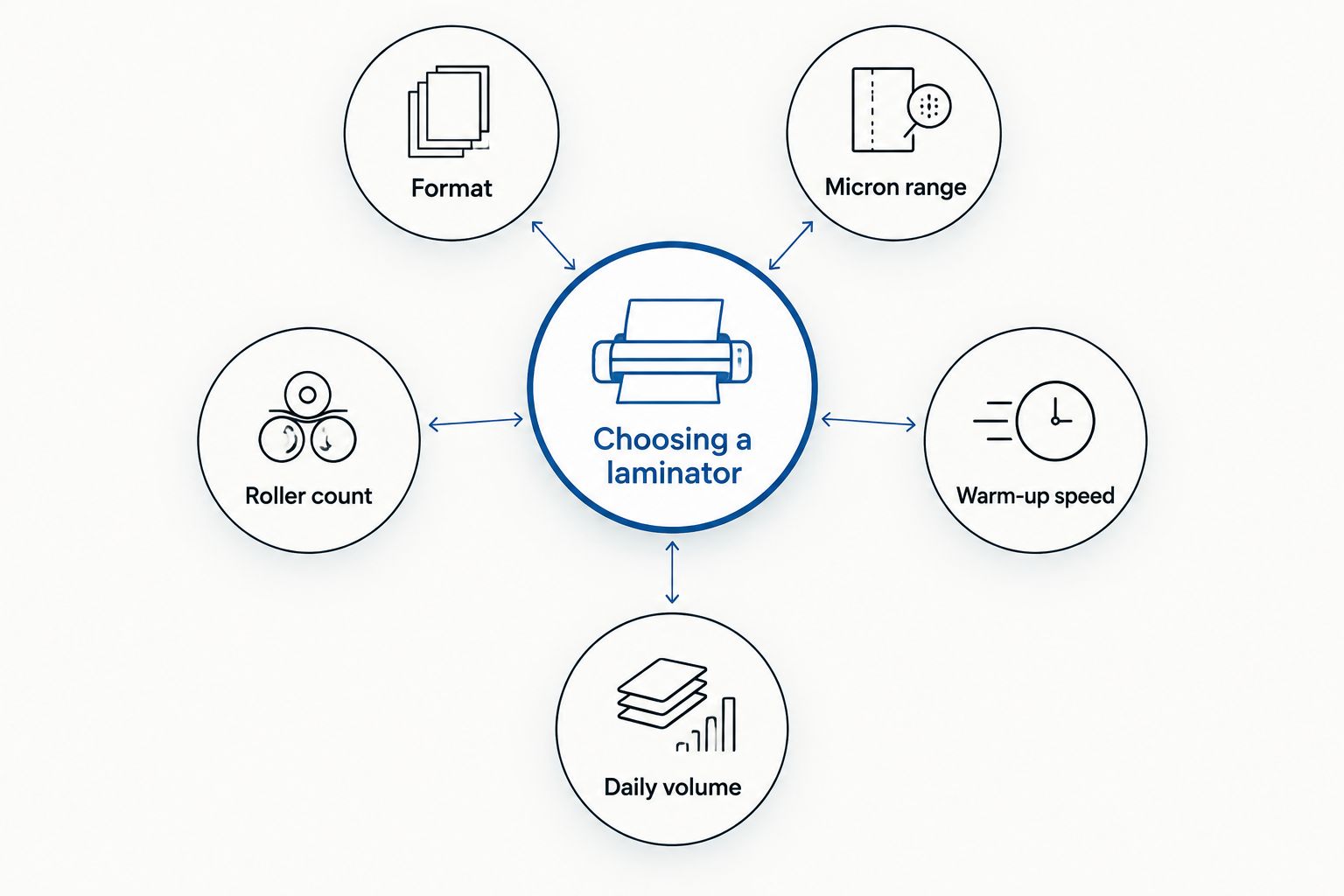
- Format — A4 covers most documents and ID cards; A3 is needed for posters, menus and classroom displays.
- Micron range — 80-125 micron suits everyday paper protection; up to 250 micron suits signage that needs to stand up to handling.
- Roller count — 2-roller machines suit light-to-moderate use; 6-roller paths run faster and more evenly under daily volume.
- Warm-up and speed — matters more in a school office running back-to-back batches than in an office laminating a handful of sheets a week.
- Volume tolerance — a laminator rated for occasional home-office use will overheat or slow down under classroom-level daily throughput.
- Manual vs automated feed — automated feed reduces jams and operator time on high-volume jobs.
At a glance
| Laminator | Best for | Standout feature | Key limitation |
|---|---|---|---|
| Fellowes Saturn A3 | Small business all-rounder | A3 format with 80-125 micron range and 2-roller path | Not built for pouches thicker than 125 micron |
| GBC Laminator Foton 30 Automated | High-volume runs without manual feeding | Automated pouch feed cuts handling between sheets | Refill film sold as a separate reloadable cartridge |
| Leitz iLAM Home Office A4 | Budget or occasional use | Lowest-cost laminator in this list | A4 only, not built for daily classroom volume |
| Fellowes Jupiter A3 | Thick pouches up to 250 micron | 6-roller path handles heavier laminate for signage | Bulkier and pricier than 2-roller A3 models |
| GBC Laminator 240 Home Office A4 | Classroom worksheets | Simple one-button operation for teachers | A4 size limits use for A3 posters and displays |
| PHE Rynak Pro 6R Commercial | Daily commercial use | 6-roller commercial-grade path built for volume | Overkill for occasional home-office laminating |
Fellowes Saturn A3: best laminator for small business use
The Fellowes Saturn A3 laminates documents up to A3 in 80 to 125 micron pouches using a 2-roller path. It covers the two things most small businesses actually laminate: A4 paperwork and the occasional A3 sign or menu.
Fellowes Saturn A3 pros:
- Handles both A4 and A3 in one machine
- 80-125 micron range covers most everyday laminating jobs
- Straightforward operation, no learning curve for staff
Fellowes Saturn A3 cons:
- Can't run pouches above 125 micron
- 2-roller path is slower than 6-roller commercial units under heavy daily use
A guillotine trimmer such as the Ideal 1071 manual clamp guillotine pairs well here for trimming the excess pouch edge to size after laminating.
Best for: small businesses that need one laminator to cover A4 paperwork and occasional A3 signage.
GBC Laminator Foton 30 Automated: best for high-volume runs without manual feeding
The GBC Laminator Foton 30 Automated feeds pouches through automatically rather than requiring manual alignment for every sheet, which matters once you're running dozens of pages back to back. It's built for the office or school front desk that laminates in batches rather than one page at a time.
GBC Foton 30 Automated pros:
- Automated feed cuts hands-on time per sheet
- Suited to repeated, high-volume laminating sessions
- Reduces the jamming that comes with manual pouch alignment
GBC Foton 30 Automated cons:
- Refill film is a separate reloadable cartridge, not individual pouches
- Less flexible than a standard pouch laminator for one-off odd-sized jobs
Best for: offices and schools laminating large batches regularly, not occasional single sheets.
Leitz iLAM Home Office A4: best budget laminator
The Leitz iLAM Home Office A4 is the lowest-cost laminator in this Mega Office Supplies range, built for home offices and light small-business use rather than daily commercial runs.
Leitz iLAM A4 pros:
- Lowest cost of entry in this list
- Compact footprint suits a desk or small office
- Simple to operate with no settings to configure
Leitz iLAM A4 cons:
- A4 only, no A3 capability
- Not rated for daily classroom-level volume
Best for: solo operators and home offices laminating occasionally, if budget is the deciding factor.
Fellowes Jupiter A3: best laminator for thick pouches
The Fellowes Jupiter A3 runs pouches up to 250 micron through a 6-roller path, which is the spec that matters for signage, menus and displays that need to survive repeated handling rather than sit in a filing tray.
Fellowes Jupiter A3 pros:
- Runs up to 250 micron for rigid, durable finishes
- 6-roller path handles heavier laminate evenly
- A3 format suits posters and display boards
Fellowes Jupiter A3 cons:
- Bulkier than the 2-roller Saturn or Cosmic models
- More laminator than most standard paperwork needs
Best for: businesses laminating signage, menus or display material that needs to be rigid — a fit for heavy-duty output.
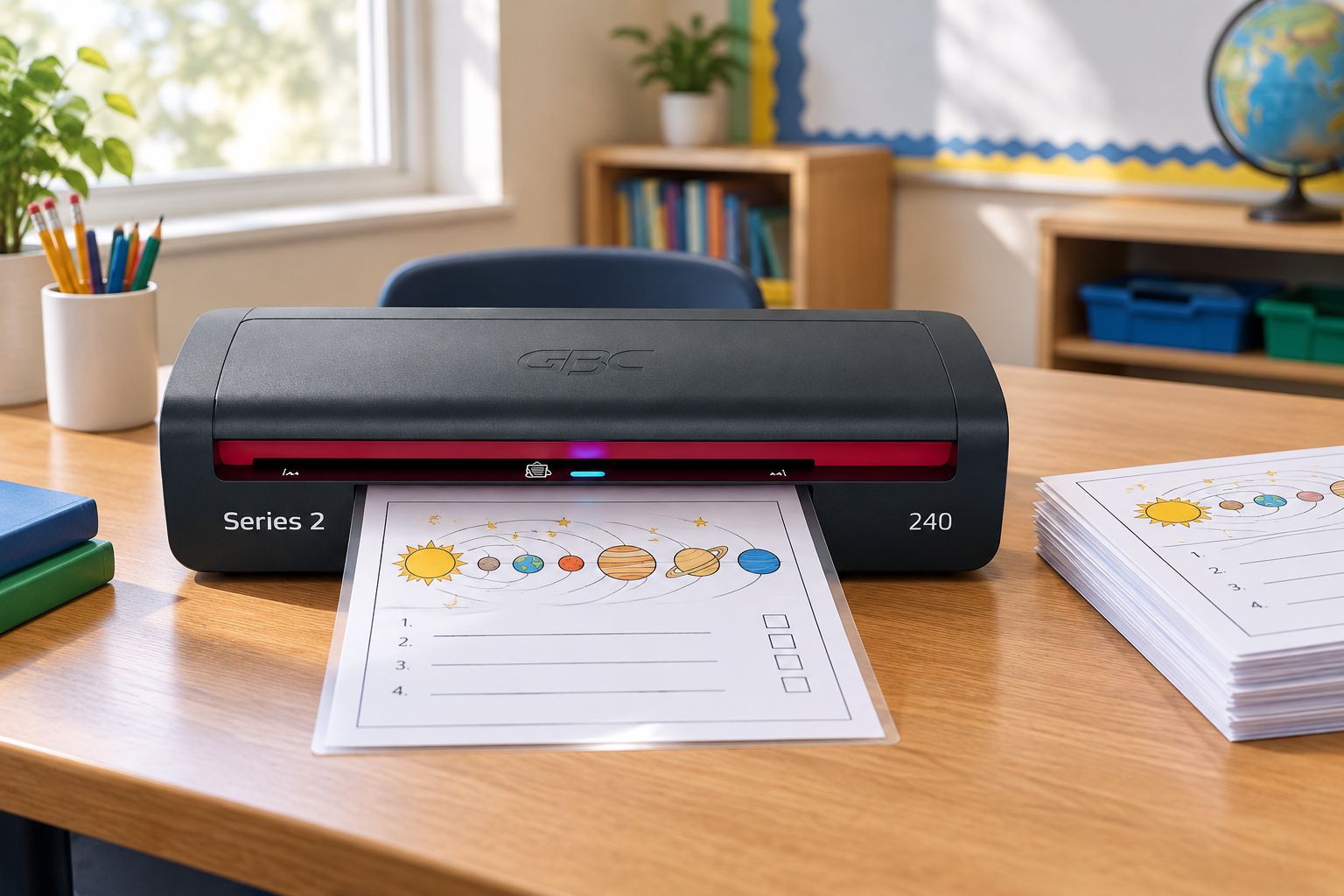
GBC Laminator 240 Home Office A4: best for classroom worksheets
The GBC Laminator 240 Home Office A4 is built around simple, one-button operation, which is the priority in a school office where whoever's on duty needs to laminate a worksheet without training.
GBC 240 Home Office A4 pros:
- One-button operation, minimal training needed
- Compact enough for a front-office bench
- Reliable for standard paper-weight worksheets
GBC 240 Home Office A4 cons:
- A4 only, no A3 posters or displays
- Not built for continuous daily high-volume use
Best for: school offices laminating worksheets and permission slips at A4 size — a fit for light classroom use.
PHE Rynak Pro 6R Commercial: best for daily commercial use
The PHE Rynak Pro 6R Commercial runs a 6-roller path built for businesses laminating every day rather than a few times a week — print shops, real estate offices and schools running continuous batches.
PHE Rynak Pro 6R pros:
- 6-roller path built for sustained daily volume
- Commercial-grade construction outlasts home-office units under heavy use
- Consistent output across long runs
PHE Rynak Pro 6R cons:
- More machine than an occasional-use office needs
- Larger footprint than A4 home-office laminators
Best for: businesses laminating daily at commercial volume — worth it if you laminate every day, skip for occasional use.


“Buy the roller count and micron range your daily volume actually needs, not the cheapest laminator on the shelf.”
How to choose
Each laminator was assessed against the six criteria above: format, micron range, roller count, warm-up and speed, volume tolerance, and manual versus automated feed. No two entries share the same "best for" slot — the list is built as a decision tree, so the right answer depends on what you're laminating and how often, not on a single leaderboard position.
Which laminator should you choose?
For most small businesses, the Fellowes Saturn A3 is the safe default — it covers A4 and A3 work in one machine without paying for capacity you won't use. Step up to the PHE Rynak Pro 6R Commercial if you're laminating every day, or the Fellowes Jupiter A3 if what you're laminating needs to survive heavy handling. Schools running A4 worksheets are better served by the GBC Laminator 240 Home Office A4 or, for higher volume, the GBC Laminator Foton 30 Automated. If budget is the only constraint, the Leitz iLAM Home Office A4 does the job for occasional use.
Mega Office Supplies carries all six laminators covered here, alongside pouches, trimmers and the presentation folders many businesses use once documents are laminated, such as the Marbig Professional Series A4 presentation folder.
FAQ
What's the best laminator for small business use?
The Fellowes Saturn A3 is the best all-round laminator for small business use because it covers A4 and A3 documents in one 80-125 micron machine. It suits businesses that need flexibility without stepping up to commercial-grade equipment.
What's the best laminator for schools and classrooms?
The GBC Laminator 240 Home Office A4 suits classroom worksheet volumes with simple one-button operation. Schools running higher batch volumes are better served by the GBC Laminator Foton 30 Automated, which reduces manual handling between sheets.
Is A3 or A4 better for a laminator?
A4 covers most paperwork, ID cards and worksheets, while A3 is needed for posters, menus and classroom displays. Businesses that need both regularly should buy an A3-capable laminator like the Fellowes Saturn A3 rather than two separate machines.
What micron pouch should I use for daily laminating?
An 80-125 micron pouch covers everyday paper protection for most office and school documents. Pouches up to 250 micron, run through laminators like the Fellowes Jupiter A3, suit signage and menus that need extra rigidity.
How many rollers does a laminator need for classroom use?
A standard 2-roller laminator, such as the GBC Laminator 240 Home Office A4, handles typical classroom worksheet volume. Schools laminating continuously through the day get more consistent output from a 6-roller commercial model.
Is the GBC Laminator Foton 30 Automated better than manual laminators?
The GBC Laminator Foton 30 Automated is better for high-volume batches because its automated pouch feed reduces manual alignment and jamming. For occasional single-sheet jobs, a standard manual-feed laminator is simpler and covers the need just as well.
How much does a laminator cost in Australia?
Laminator pricing varies by format, roller count and micron capacity, from entry-level A4 home-office units through to commercial 6-roller machines. Check current pricing on the Mega Office Supplies laminator range for exact figures.
What's the difference between a 2-roller and 6-roller laminator?
A 2-roller laminator, like the Fellowes Saturn A3, suits light-to-moderate daily use and standard micron pouches. A 6-roller laminator, like the PHE Rynak Pro 6R Commercial, runs faster and more evenly under sustained daily volume and thicker pouches.
One last thing
The detail buyers skip: micron range and roller count matter more than format when volume climbs, because a 2-roller A3 laminator run at classroom volume every day will wear out faster than a 6-roller machine running the same load. If your laminator is running most days of the week, buy for the roller count first and the format second.


