


Professionals shopping for a fountain pen in 2026 want something that survives daily signatures, meeting notes and the odd dropped cap without skipping or drying out between uses. This guide ranks six established fountain pen lines by nib material, filling system and how they hold up on a desk that doesn't slow down.
Best overall fountain pen for professionals in 2026: Lamy Safari. Best for high-volume note-takers: TWSBI Eco. Best budget option: Pilot Metropolitan. All three write cleaner than a ballpoint on a signature page, and none of them need refilling more than once every few weeks of daily use.
- Lamy Safari is the best fountain pen for professionals in 2026, with a steel nib that swaps widths in seconds.
- TWSBI Eco wins for high-volume writers because its piston fill holds far more ink than a cartridge pen.
- Pilot Metropolitan is the best budget fountain pen for a first-time buyer testing the habit.
- Parker Sonnet and Cross Bailey suit client-facing moments over daily note-taking grind.
- Fountain pen pulls close to 9,900 searches a month in Australia, a sign demand hasn't fully moved to gel pens.
Why this matters
A fountain pen still says something a ballpoint doesn't when you're signing a contract or handing a client a card. Search interest backs that up: fountain pen pulls close to 9,900 searches a month across Australia, a volume that has held steady even as most offices switched to gel and rollerball pens for everyday notes.
Mega Office Supplies doesn't stock fountain pens directly, but the notebooks, diaries and presentation folders that make a fountain pen worth carrying to work every day sit in the same desk kit. Pick the wrong nib width or fill system and the pen ends up in a drawer by March 2026; pick the right one and it outlasts three gel pen refills.
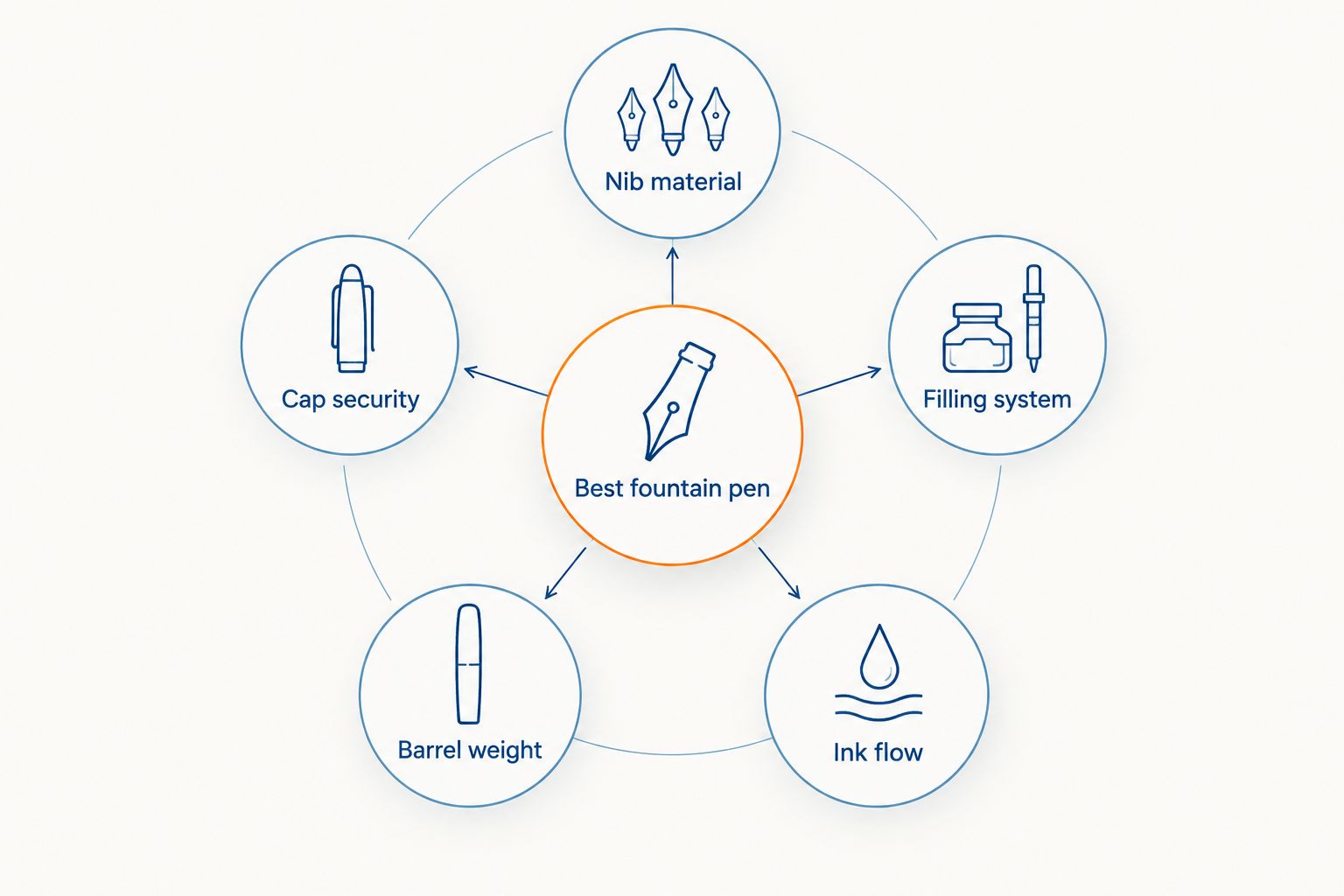
What makes the best fountain pen for professional use
- Nib material — steel nibs handle daily signatures and note-taking without babying; gold nibs add flex but cost more and need gentler pressure.
- Filling system — cartridge, converter or piston. Piston pens carry more ink per fill and cost less per page over a year of daily use.
- Barrel weight and grip — a pen that sits heavy in a shirt pocket gets left at home; balance matters more than looks in a meeting.
- Ink flow consistency — a nib that skips after sitting capped over a weekend is a liability during Monday's first call.
- Cap security — screw caps seal tighter for pens that travel in a bag; snap caps uncap faster for a desk that never moves.
Fountain pens for professionals compared at a glance
| Fountain pen | Best for | Standout feature | Key limitation |
|---|---|---|---|
| Lamy Safari | Everyday professional writing | Swappable steel nib units | Angular barrel feels plain next to a Parker |
| TWSBI Eco | High-volume writers | Piston fill holds far more ink than a cartridge | Demonstrator barrel isn't to everyone's taste |
| Pilot Metropolitan | Budget-conscious first buyers | Metal barrel at an entry price point | Fixed nib, no swap options |
| Parker Sonnet | Boardroom and client-facing work | Recognisable brand, refined cap action | Heavier barrel for long writing sessions |
| Cross Bailey | Lightweight daily carry | Slim brass barrel, fast snap cap | Smaller cartridges need more frequent swaps |
| Pelikan M200 | Smooth, consistent ink flow | Piston fill, striped demonstrator barrel | Wider grip section, not suited to small hands |
1. Lamy Safari: best fountain pen for everyday professional writing
The Lamy Safari is a cartridge-converter fountain pen with an injection-moulded barrel and a stainless steel nib that clips out and swaps for a different width in seconds. It's the pen most professionals recommend to someone buying their first fountain pen, because the nib doesn't need to be babied to write cleanly.
Lamy Safari pros:
- Steel nib swaps between extra-fine, fine, medium and broad without a repair shop
- Cartridge or converter fill, so ink choice isn't locked to one brand
- Clip holds firm in a shirt pocket or notebook cover
Lamy Safari cons:
- Triangular grip section suits some hands better than others
- Barrel look reads more student desk than executive suite
- Injection-moulded plastic feels lighter than a brass-barrel pen
Best for: professionals who write daily notes and want to change nib width without buying a second pen. Verdict: Buy.
2. TWSBI Eco: best fountain pen for high-volume writers
The TWSBI Eco fills by piston straight from a bottle, skipping cartridges entirely and carrying enough ink for weeks of daily meeting notes on one fill. The clear demonstrator barrel doubles as an ink gauge, so you know before a client call whether it's time to refill.
TWSBI Eco pros:
- Piston fill holds noticeably more ink than a cartridge pen
- Steel nib comes pre-tuned and writes reliably out of the box
- Clear barrel shows exactly how much ink is left
TWSBI Eco cons:
- Bottled ink is another item to carry when travelling
- Piston mechanism needs an occasional flush with water to keep moving smoothly
- Larger barrel diameter isn't ideal for small hands
Best for: professionals who fill pages of notes daily and don't want to refill mid-week. Verdict: Buy.
3. Pilot Metropolitan: best budget fountain pen for a first-time buyer
The Pilot Metropolitan pairs a metal barrel with a steel nib at an entry price point, which is why it shows up on almost every first-fountain-pen recommendation list. It runs on Pilot's cartridge system or a converter, both widely available.
Pilot Metropolitan pros:
- Metal barrel feels sturdier than most pens at this tier
- Steel nib writes smoothly with minimal skipping
- Slim profile fits a shirt pocket or pen loop easily
Pilot Metropolitan cons:
- Nib is fixed, no swapping between widths
- Pilot cartridges aren't interchangeable with other brands without a converter
- Cap posts loosely on some units
Best for: professionals buying a first fountain pen who don't want to spend much to find out if they'll stick with it. Verdict: Buy.
4. Parker Sonnet: best fountain pen for client-facing work
The Parker Sonnet carries the brand recognition that matters when a pen sits on the table during a client meeting or gets handed over as a gift. Its heavier barrel and refined cap mechanism feel different from a plastic-bodied pen the moment you pick it up.
Parker Sonnet pros:
- Brand recognition many clients notice immediately
- Solid metal barrel with a refined cap action
- Available with nib options for different writing pressure
Parker Sonnet cons:
- Heavier barrel tires the hand over long writing sessions
- Sits above the other pens on this list in tier and finish
- Servicing needs a specialist rather than a swap-in nib
Best for: professionals who want brand recognition for client-facing moments. Verdict: Buy for boardroom use, skip for daily note-taking.
5. Cross Bailey: best fountain pen for lightweight daily carry
The Cross Bailey keeps a slim brass barrel and a snap cap, which makes it faster to uncap for a quick signature than a screw-cap pen. It's built lighter than the Sonnet, so it fits a jacket pocket without weighing it down.
Cross Bailey pros:
- Slim brass barrel is easy to carry daily
- Snap cap uncaps faster than a screw-cap pen
- Cartridge-converter fill keeps ink options open
Cross Bailey cons:
- Smaller cartridges need swapping more often than a piston pen
- Nib is fixed, no width options
- Snap cap can loosen with heavy daily use
Best for: professionals who sign documents throughout the day and want a fast uncap. Verdict: Buy.
6. Pelikan M200: best fountain pen for smooth, consistent ink flow
The Pelikan M200 fills by piston like the TWSBI Eco but wraps it in a striped demonstrator barrel that looks more finished on a desk. The nib is tuned for a smoother, wetter line than most steel nibs at this tier.
Pelikan M200 pros:
- Piston fill holds more ink than cartridge pens
- Nib lays down a smoother, wetter line
- Striped barrel looks more finished than a plain demonstrator
Pelikan M200 cons:
- Wider grip section doesn't suit smaller hands
- Piston needs the same occasional flush as the TWSBI Eco
- Nib width isn't swappable without buying a new nib unit
Best for: professionals who want the smoothest ink flow on this list and don't mind a wider grip. Verdict: Buy.
How the ranking works
Every pen above is checked against the five criteria listed earlier: nib material, filling system, barrel weight and grip, ink flow consistency and cap security. None of the six pens fails on ink flow or cap security, which is why the ranking splits mainly on filling system and grip. Pens that swap nibs or hold more ink per fill rank higher for daily professional use than pens built mainly for how they look sitting on a desk.
Which fountain pen should you choose?
If you write daily notes and want to change nib width without buying a second pen, the Lamy Safari is the safest pick for 2026. If you fill a notebook every week, the TWSBI Eco's piston fill saves you from refilling mid-meeting. Buying your first fountain pen just to test the habit? Start with the Pilot Metropolitan and upgrade later once you know you'll stick with it.
Whatever you land on, pair it with paper that doesn't bleed fountain pen ink. A 2027 casebound diary or a grid-ruled notebook holds up better than the thin stock in a cheap pad. Offices ordering a batch of diaries for the team can use Mega Office Supplies' 30 Day Credit Terms and free shipping over $149 rather than paying up front for individual orders.
FAQ
What's the best fountain pen for professionals in 2026?
The Lamy Safari is the best overall pick for 2026 because its steel nib swaps widths in seconds and it runs on cartridges or a converter. It suits daily signatures and note-taking without needing careful handling.
Is a fountain pen better than a gel pen for signing documents?
A fountain pen puts down a more consistent, lower-pressure line than a gel or ballpoint pen, which matters over dozens of signatures a day. Gel pens are more forgiving if dropped or left uncapped for long periods.
How much does a fountain pen cost in 2026?
Entry steel-nib fountain pens like the Pilot Metropolitan sit at the budget end of the stationery aisle, while gold-nib and brand-name models like the Parker Sonnet sit well above that. Check current pricing on the retailer you're buying from since it varies by model and finish.
Do fountain pens need special paper?
Fountain pen ink bleeds through thin, low-quality paper, so a casebound diary or a heavier notebook stock performs better than a cheap pad. Standard photocopy paper works for quick notes but shows through on the reverse side.
How do you maintain a fountain pen?
Flush the nib and feed with water every few ink changes to stop dried ink from clogging the flow, especially on piston-fill pens like the TWSBI Eco and Pelikan M200. Cartridge pens need less maintenance since the ink path stays shorter.
What nib size should a professional choose?
A fine or extra-fine steel nib suits most office paper and small handwriting, while a medium or broad nib suits bigger signatures and thicker paper. Start fine if you're unsure; it's easier to write over a fine line than fix a broad one that bleeds.
Can you take a fountain pen through airport security in Australia?
Yes, a capped fountain pen travels fine in carry-on luggage through Australian airport security. Cabin pressure changes can cause minor ink seepage, so keep the pen nib-up in a case rather than loose in a bag.
What's the difference between cartridge and converter fountain pens?
A cartridge pen uses a pre-filled plastic tube of ink that's swapped out when empty, while a converter lets you draw ink from a bottle into a refillable chamber. Piston-fill pens like the TWSBI Eco skip both and fill the barrel itself directly from the bottle.
One last thing
Lamy's steel nib units are interchangeable across the entire Safari line, which means a pen bought in 2026 can still take a new nib years later — something no gel or rollerball pen on a stationery shelf offers. That single feature is why the Safari keeps showing up on office recommendation lists year after year instead of getting swapped out for whatever's newest.


