

The cheapest cartridge on the shelf might actually be the most expensive addition to your quarterly budget. It's a common frustration for procurement officers and business owners across Australia who find themselves trapped in a cycle of frequent replacements and inconsistent print quality. Managing toner and ink cartridges effectively requires looking beyond the initial price tag to understand the long-term impact on your machine's health and your organisation's professional image.
We recognise that balancing a strict budget with the need for crisp, reliable documents is a constant challenge for any busy workplace. This guide will help you master the technicalities of printer consumables to reduce costs and maintain high standards across your office. You'll learn how to evaluate the choice between genuine and compatible options, calculate your true cost-per-page, and understand the latest Australian e-waste standards following the 2025 Basel Convention updates.
Key Takeaways
- Identify whether liquid ink or laser toner technology is better suited for specific settings like high-volume warehouses or client-facing reception areas.
- Learn how to interpret ISO/IEC page yield standards to accurately compare the efficiency of different toner and ink cartridges.
- Understand the operational impact of choosing genuine OEM products versus high-quality compatible alternatives for your professional document output.
- Optimise your organisational budget by adopting bulk procurement strategies and centralised storage systems to prevent stockouts and loss.
- Ensure your workplace remains compliant with the latest Australian e-waste regulations following the 2025 Basel Convention updates.
Understanding the Fundamentals: Toner vs. Ink Cartridges
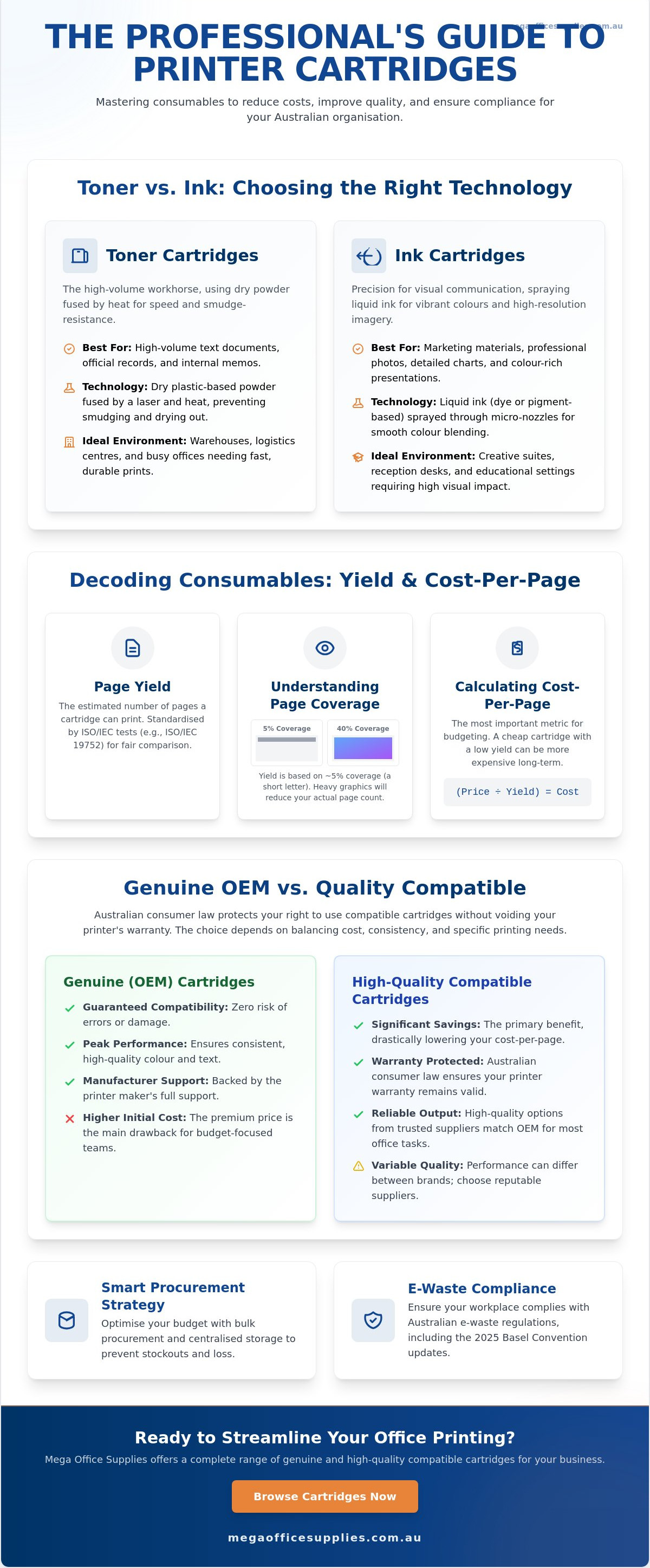
Choosing the right technology for your office begins with understanding the physical properties of the consumables. Inkjet printers utilise liquid ink, which is stored in small tanks and sprayed through microscopic nozzles onto the page. Laser printers, however, rely on a dry, plastic-based powder. This fundamental difference determines how the machine handles high-volume tasks and fine detail.
Environment plays a critical role in this decision. A warehouse printing thousands of picking slips and shipping labels requires the speed and smudge-resistance of laser technology. In contrast, a reception desk or creative suite might prioritise the vibrant colour reproduction and high-resolution output of an inkjet system. Each technology serves a distinct purpose in a professional setting.
To better understand the mechanical differences between these options, watch this helpful comparison:
Toner Cartridges: The High-Volume Workhorse
A Toner cartridge is designed for efficiency and precision. During the printing process, a laser beam draws the document onto a photosensitive drum, which then attracts the toner powder. The powder is fused to the paper using heat and pressure. This creates a permanent bond that's highly resistant to smudging, making it the superior choice for high-volume text documents and official records. Because the "ink" is actually a dry powder, these cartridges won't dry out if the printer sits idle for several weeks. The inclusion of a high-quality drum unit ensures that every page maintains crisp, professional-grade text from the first sheet to the last.
Ink Cartridges: Precision for Visual Communication
Ink cartridges are the preferred choice for visual communication and professional imagery. They excel at blending colours smoothly; this is vital for marketing materials and detailed charts. Most professional systems use either dye-based inks for vibrant colours or pigment-based inks for better archival quality and water resistance. These are particularly effective in educational settings where classroom resources require high-resolution graphics to engage students. Maintaining a reliable supply of both toner and ink cartridges ensures your workplace can handle everything from basic internal memos to high-end presentation folders without compromising on quality.
Decoding Printer Consumables: Yield, Capacity, and Compatibility
Page yield serves as the primary metric for evaluating the lifespan of toner and ink cartridges. This figure represents the estimated number of pages a cartridge will print before requiring replacement. To ensure consistency across the industry, manufacturers use ISO/IEC testing standards. For monochrome laser printers, this is usually ISO/IEC 19752; for colour inkjet machines, it is ISO/IEC 24711. These tests are based on approximately 5% page coverage, which is roughly equivalent to a short business letter. If your documents include heavy borders, large logos, or dense tables, your actual yield will be lower than the stated figure.
Compatibility is equally critical. Even within the same brand, cartridges are rarely interchangeable between different model series. Using an incorrect cartridge can lead to mechanical errors or poor print quality. When evaluating third-party options for your fleet, you should be aware of consumer rights on non-HP ink cartridges and similar hardware. Australian law protects your ability to use compatible consumables without automatically voiding your printer's warranty. This ensures procurement officers have the flexibility to manage costs effectively.
Calculating Cost-Per-Page for Business Budgeting
Business budgeting relies on financial transparency. To find your cost-per-page, divide the price of the cartridge by the manufacturer's expected page yield. A cartridge costing $100 with a 2,000-page yield results in a 5-cent cost-per-page. Tracking this data over a three-month period allows you to forecast annual procurement needs with precision. It also highlights which departments, such as busy warehouses or administrative hubs, are consuming resources most rapidly.
High-Yield Cartridges: When to Make the Switch
High-yield (XL) and extra high-yield (XXL) toner and ink cartridges contain more consumable material while using the same physical shell. The tipping point for switching usually occurs when a department prints more than 500 pages per month. Beyond the financial savings, these options offer environmental benefits by reducing the amount of plastic waste and packaging generated per printed page. They also minimise workplace interruptions, as staff spend less time performing manual cartridge swaps during critical projects. If you are looking to modernise your fleet, reviewing our latest office technology options can reveal machines designed for these high-capacity workflows.
Genuine OEM vs. Compatible Cartridges: A Professional Comparison
Choosing between genuine and compatible toner and ink cartridges is a decision that impacts both document longevity and your organisation's bottom line. Genuine OEM (Original Equipment Manufacturer) products represent the benchmark for reliability; they're the result of extensive research and development cycles. Conversely, the market for third-party compatible cartridges has matured significantly. These alternatives offer a viable path to cost reduction for many Australian organisations when sourced from a reputable supplier. Balancing these two options requires a clear understanding of your specific printing requirements and the legal protections afforded by Australian Consumer Law.
A common concern among procurement officers involves the status of printer warranties when using third-party consumables. It's a common myth that using a compatible cartridge automatically voids your manufacturer's warranty. Under the Australian Consumer Law, manufacturers cannot exclude their responsibility for hardware failures unless they can prove the third-party cartridge directly caused the fault. This regulatory environment supports a competitive market, allowing businesses to diversify their supply chain without losing essential protections. Reports to the ACCC regarding consumer guarantees for electronics increased by 20% in 2025, highlighting the importance of working with established partners who understand these compliance standards.
The Case for Genuine OEM Cartridges
Genuine cartridges from brands like Brother, HP, and Canon are engineered to work in perfect synchronisation with your specific hardware. This precision results in lower failure rates and consistent colour accuracy across high-volume print runs. For archival-quality documents, legal records, or specialised marketing materials, the chemical composition of OEM ink and toner provides superior resistance to fading and chemical degradation. In high-demand environments like medical centres or government departments, the peace of mind offered by OEM reliability often outweighs the initial cost savings of alternatives. These products ensure your fleet maintains peak performance without the risk of leaking or drum damage.
Evaluating Compatible Alternatives for Daily Operations
Compatible cartridges excel in low-stakes environments where high-volume internal documentation is the priority. When vetting a compatible brand, you should look for ISO 9001 or ISO 14001 certifications to ensure manufacturing consistency. A professional-grade compatible should offer a failure guarantee that matches the performance of an OEM equivalent. If you're managing a diverse range of office supplies, integrating compatibles for internal drafts and warehouse picking slips can significantly lower your annual expenditure. Success with these products depends on local technical support; having a direct line to an Australian-based team ensures any compatibility issues are resolved quickly without disrupting your workflow.
The Procurement Strategy: How to Optimise Your Office Printing Budget
Procurement strategy for office consumables extends beyond the initial transaction. To truly optimise a budget, organisations must look at the total cost of ownership (TCO) and the efficiency of their internal supply chain. National organisations often benefit from bulk procurement; this stabilises supply and reduces the administrative burden of frequent, small-scale orders. Centralising your storage for toner and ink cartridges into a single, climate-controlled location prevents loss and ensures that stock is used in a first-in, first-out sequence. This level of organisation is particularly beneficial for large-scale operations like schools or government departments where multiple users draw from a shared inventory.
Bulk Buying and Inventory Management
Effective inventory management starts with a defined "buffer stock" level. For critical machines, keeping at least one full set of replacement cartridges on hand prevents downtime. It's vital to remember that toner and ink have different storage profiles. Toner, being a dry powder, has a significantly longer shelf life and is less susceptible to environmental degradation. Ink cartridges, however, contain liquid that can settle or dry out if left for several years. Standardising your printer models across different departments simplifies this process. It allows for a leaner inventory because multiple machines can draw from the same stock. If you are planning a fleet upgrade, reviewing our technology range can help you identify machines that share common consumable platforms.
Maintenance Tips to Extend Cartridge Life
Operational habits directly influence how often you need to replace consumables. For inkjet systems, printing a single test page once a week prevents the print heads from clogging. This simple habit saves you from performing expensive deep-cleaning cycles that waste significant amounts of ink. Most modern drivers include a "Draft Mode" or "Toner Save" setting. Using this for internal drafts or warehouse picking slips can reduce consumption significantly without compromising readability. Cartridges should always be stored in a cool, dry place and kept level to maintain the integrity of the internal seals and sponges.
Environmental responsibility is now a standard requirement for Australian procurement. The "Cartridges 4 Planet Ark" programme provides a free recycling pathway for used consumables with a zero-waste-to-landfill guarantee. Participating in these industry-led initiatives reinforces your organisation's commitment to sustainability while managing e-waste effectively. You can order your bulk toner and ink cartridges through our streamlined procurement portal to ensure your workplace remains fully stocked and efficient.
Streamlining Your Supply Chain with Mega Office Supplies
Mega Office Supplies operates as a dependable partner for Australian businesses, schools, and government departments. Our team holds decades of combined industry experience, providing a level of stability and technical knowledge that global competitors often lack. When you source toner and ink cartridges through our platform, you're accessing a well-oiled distribution network designed to handle high-volume demands without friction. We understand the logistical pressures of workplace maintenance; this is why we prioritise functional clarity and speed of fulfilment across our entire national network.
Efficiency in procurement isn't just about the product; it's about the breadth of the catalogue. Consolidating your requirements for office supplies alongside your printing consumables reduces administrative overhead significantly. From high-capacity warehouses to specialised healthcare clinics, our inventory covers every facet of the modern workplace, including facilities and breakroom essentials. This single-source approach allows procurement officers to evaluate costs and quantities quickly, ensuring that every department remains operational and fully equipped.
A Comprehensive Partner for Australian Workplaces
Managing a professional document standard often requires more than just ink. For instance, many of our clients find value in sourcing binding machines and specialised stationery alongside their monthly toner orders. By using a single Australian supplier for your standard consumables, you minimise the number of invoices to process and the number of deliveries to coordinate. This is particularly vital for the government and healthcare sectors, where stability and transparency are non-negotiable. Our collective background in high-capacity supply allows us to provide professional-grade solutions that meet the rigorous demands of these specialised environments.
Ready to Equip Your Office?
Finding the exact match for your printer fleet is straightforward with our integrated search tools. Whether you need standard capacity units for a home office or extra high-yield options for a national organisation, our catalogue is structured for rapid navigation. If you have complex requirements or need a custom quote for a large-scale fit-out, our local support team is available via our regional telephone line. We provide direct assistance and grounded advice to help you make confident purchasing decisions. Browse our full range of toner and ink cartridges today to experience a more efficient approach to office procurement.
Securing Your Workplace Supply Chain
Strategic management of printer consumables is a vital component of organisational efficiency. By selecting the correct technology for your specific environment and understanding the mechanics of page yield, you can significantly reduce your cost-per-page. It's also essential to maintain compliance with Australian e-waste regulations and consumer law when evaluating toner and ink cartridges for your fleet. These steps ensure your office maintains high document standards while protecting your bottom line.
Mega Office Supplies operates a national distribution network for rapid fulfilment, offering a comprehensive range that covers all major brands and high-quality compatibles. Our team understands the logistical demands of high-volume workplaces and is ready to provide the stability your organisation requires.
Optimise your procurement process today. Shop Professional Toner and Ink Cartridges at Mega Office Supplies to secure reliable, professional-grade results. We are here to help you maintain a seamless and productive workplace.
Frequently Asked Questions
How long do toner and ink cartridges typically last in storage?
Toner cartridges can last almost indefinitely if stored in a cool and dry environment because they contain stable plastic powder. Ink cartridges have a shorter shelf life, typically between 18 and 24 months, as the liquid components can eventually settle or dry out. Always keep your spare consumables in their original sealed packaging and store them level to maintain the integrity of the internal sponges and seals.
Will using compatible cartridges void my printer warranty in Australia?
Using compatible cartridges does not automatically void your printer warranty under the Australian Consumer Law. Manufacturers are legally prohibited from refusing a warranty claim unless they can prove that the third-party consumable directly caused the specific fault. If your printer develops a mechanical issue unrelated to the ink or toner, the manufacturer is still obligated to honour their consumer guarantee and provide a repair or replacement.
What is the difference between a toner cartridge and a drum unit?
A toner cartridge is the reservoir that holds the dry powder, while the drum unit is the photosensitive cylinder that transfers that powder onto the page. Some printer brands combine these into a single piece, but many professional laser machines keep them separate to reduce waste. In these systems, you will typically replace the toner and ink cartridges several times before the drum unit eventually wears out and requires its own replacement.
How can I tell if my printer needs a new ink cartridge or just a head cleaning?
You likely need a head cleaning if your documents show horizontal streaks or patchy colours while your software indicates there is still plenty of ink remaining. If the printer software reports a "low ink" or "depleted" status and the prints are consistently faint, it is time for a new cartridge. Running a diagnostic nozzle check is the most efficient way to identify if the issue is a physical blockage or a lack of material.
What does 5% page coverage actually look like in a professional document?
A 5% page coverage is roughly equivalent to a short business letter with approximately 200 to 250 words and no large graphics or borders. This is the industry standard used for yield testing, but it rarely reflects the reality of modern office work. If your organisation regularly prints dense reports, invoices with tables, or marketing flyers, your actual yield will be significantly lower than the number stated on the cartridge packaging.
Are high-yield XL cartridges compatible with all printer models?
High-yield XL cartridges are usually compatible with the same printer models as their standard counterparts because they share the same physical footprint. The "XL" label indicates a higher volume of ink or toner inside the shell rather than a larger exterior size. However, you should always check your specific model number before purchasing, as some compact or specialised printers may only accept standard-capacity units due to internal clearance restrictions.
How do I responsibly recycle empty cartridges in my local area?
You can recycle your empty toner and ink cartridges by visiting free drop-off points at major retail outlets throughout Australia. Most of these locations participate in the "Cartridges 4 Planet Ark" programme, which provides a zero-waste-to-landfill guarantee for all collected items. For larger organisations, registering for a dedicated workplace collection box is an effective way to manage high volumes of e-waste and support your company's environmental sustainability goals.
Can I mix genuine and compatible cartridges in the same printer?
Most modern printers allow you to mix genuine and compatible cartridges within the same machine without encountering operational errors. It is common for procurement officers to use a genuine black cartridge for high-stakes correspondence while utilising compatible colours for internal drafts to manage costs. As long as each individual cartridge is designed for your specific printer model, the internal chips will communicate correctly with the machine to track usage levels.
Article by
Mega Office Supplies Team
The Mega Office Supplies Team provides practical guidance for Australian businesses, schools, government organisations, healthcare providers, hospitality venues, warehouses and home offices. Based in Tweed Heads South, Mega Office Supplies has been family owned and operated since 2008, offering office stationery, workplace furniture, technology products, labels, printers, cleaning and janitorial supplies, safety products, art materials, education resources and everyday business essentials from trusted brands.
General Information
This article is provided as general information only to help customers compare and choose office, workplace, school, cleaning, technology, furniture, safety and business supplies. Product details, specifications, compatibility, availability, pricing and suitability may vary. Always check the individual product page, manufacturer information, workplace requirements and relevant safety guidance before purchasing or using a product.


