

A business card holder only earns desk space if it matches how you actually use business cards - filed in a planner, displayed at reception, or carried between meetings. This guide groups five practical options by use case, with one default pick for anyone who hasn't settled on a system yet.
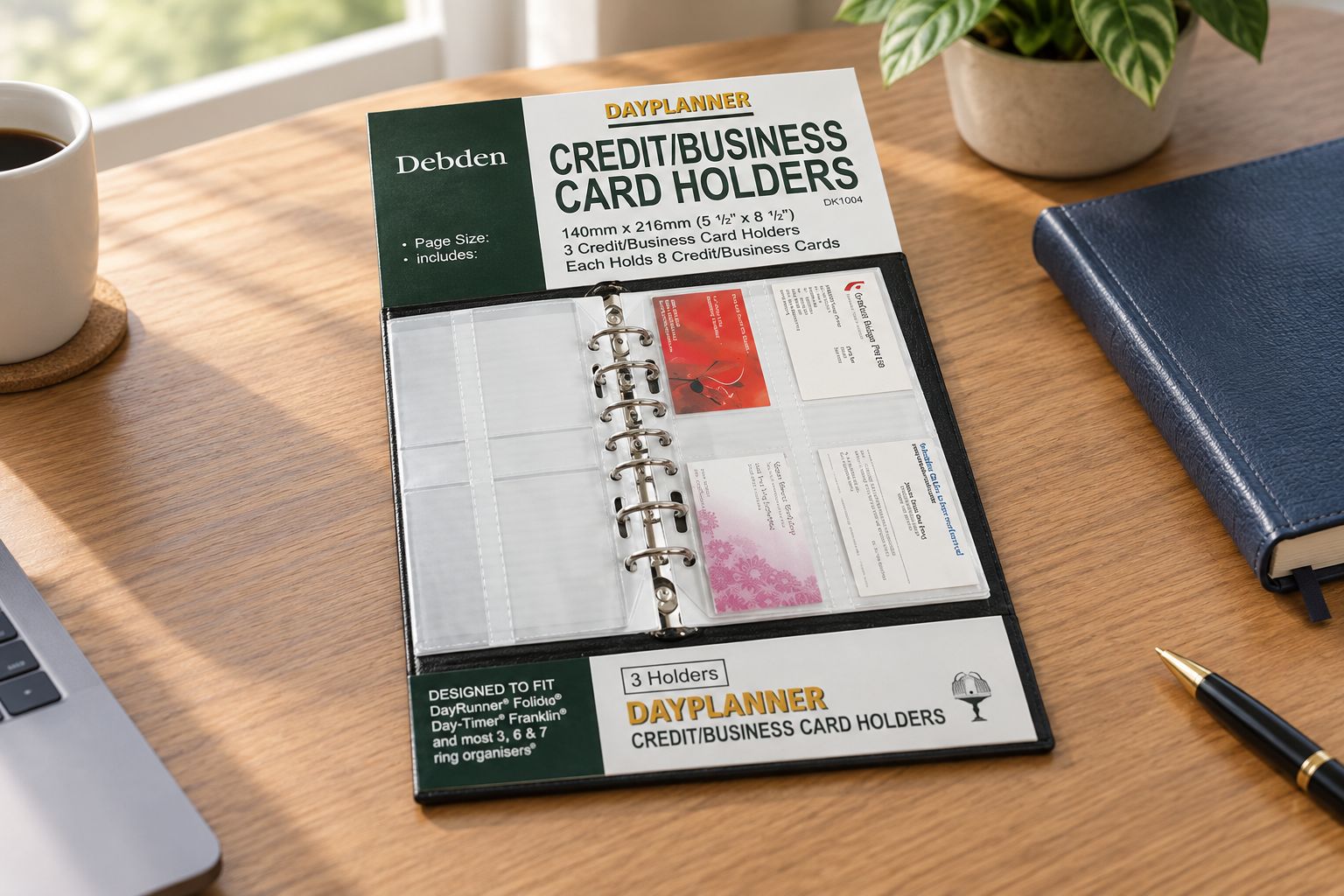
- Collins Debden's DK1004 desk-size refill is the default pick for storing business cards inside a paper day planner.
- A rotary business card file suits anyone holding 50 or more contacts and needing fast alphabetical retrieval.
- A zippered pouch with a note-card pocket works best for carrying business cards between meetings, not for permanent desk storage.
- Collins Debden's PR2004 personal-size refill fits smaller diaries for professionals who don't run a desk-size planner.
Why this matters
Business cards still change hands at meetings, trade shows and client visits across Australia, and most desks end up with a loose pile of them within a month. A dedicated holder solves two problems at once: it stops cards getting lost in a drawer, and it puts the right contact in front of you in seconds instead of minutes.
Mega Office Supplies stocks the planner refills behind two of the picks below, alongside the rest of its filing and desk accessory range for exactly this kind of organisation problem.
The category splits into two real approaches: insert-based holders that slot into a planner or diary, and standalone holders like rotary files or acrylic stands that sit on the desk by themselves. Picking the wrong type usually means buying twice.
At a glance
For planner users: the Collins Debden DK1004 Dayplanner Desk-Size Business Card Holder Refill. For reception display: an acrylic desktop card stand. For bulk filing: a rotary business card file. For mobile professionals: a zippered pouch with a built-in note-card pocket. For personal-size organisers: the Collins Debden PR2004 Personal-Size refill.
What makes the best business card holder
- Capacity - how many business cards it holds before you need a second holder
- Desk footprint - whether it sits flat, stands upright, or takes shelf space
- Retrieval speed - how fast you can find one card among dozens
- Refill compatibility - whether replacement pages are easy to reorder
- Portability - whether it stays on the desk or travels in a bag
- Build material - plastic, leather or paper stock, and how it holds up to daily handling in offices
Business card holders at a glance
| Holder | Best for | Standout feature | Key limitation |
|---|---|---|---|
| Collins Debden DK1004 Desk-Size Refill | Paper day planner users | Slots into most 3, 6 and 7-ring desk diaries | Only useful with a compatible planner |
| Acrylic desktop card stand | Reception and front-desk display | Keeps one card visible at eye level | Displays only one contact at a time |
| Rotary business card file | High-volume contact filing | Spins to any card by alphabetical tab | Takes up real desk space |
| Zippered mesh pouch with note-card pocket | Mobile professionals between meetings | Zips shut so cards don't spill in transit | Not built for permanent desk display |
| Collins Debden PR2004 Personal-Size Refill | Compact personal organisers | Fits smaller personal-size diary formats | Lower card capacity than desk-size |
Collins Debden DK1004 Dayplanner Desk-Size Business Card Holder Refill: best business card holder for paper planner users
This desk-size business card holder refill adds business card pages directly into a desk-size day planner, so contacts sit in the same book as your schedule instead of a separate drawer. Each page holds cards in clear pockets that slot into most 3, 6 and 7-ring diary systems. It comes as a pack of 3 pages, giving spare capacity when you need to reorganise contacts by project or client.
Collins Debden DK1004 pros:
- Slots into most 3, 6 and 7-ring desk-size diaries without extra hardware
- Keeps business cards next to your daily schedule instead of a separate holder
- Pack of 3 gives room to split contacts by category
Collins Debden DK1004 cons:
- Only useful if you already run a compatible desk-size day planner
- Doesn't work as a standalone desk accessory on its own
- Shows one page of cards at a time, not the full collection at once
Best for: professionals who already carry a paper day planner and want business cards filed next to their calendar.
If your planner takes standard refill pages, this is the least fuss way to keep business cards organised on a professional desk.
Acrylic desktop card stand: best business card holder for reception and front-desk display
A freestanding acrylic stand holds a single business card upright at eye level, usually near a phone or counter. It's built to display one contact clearly rather than store a collection, which is why reception desks and single-person counters use them.
Acrylic card stand pros:
- Near-zero desk footprint compared with a filing system
- Keeps one card visible and easy for visitors to read
- Simple to swap the card out when contact details change
Acrylic card stand cons:
- Displays only one contact - not a storage solution
- Can tip over on a busy, knocked-about desk
- Doesn't help you file or retrieve other people's business cards
Best for: reception desks and single-desk setups where a visitor needs to see one contact's details, not store their own.
Good for display, skip it if you need to store business cards you've collected.
Rotary business card file: best business card holder for filing large stacks of contacts
A rotary file spins on a base and holds business cards in tabbed, alphabetical sleeves, similar to the old Rolodex format. It's built for volume: models like this hold several hundred cards without any of them getting lost in a stack.
Rotary file pros:
- Retrieves any card by name in seconds using alphabetical tabs
- Holds hundreds of business cards in one unit
- No software, app or account needed to use it
Rotary file cons:
- Takes up noticeably more desk space than a planner insert
- Filing new cards is a manual, ongoing task
- Looks dated next to a phone-based contacts app
Best for: anyone filing 50 or more business cards by contact name and retrieving them often.
A fit for high-volume paper filers who don't want to rely on a phone app.
Zippered mesh pouch with note-card pocket: best business card holder for professionals between meetings
An A4 mesh pouch with a built-in note-card pocket keeps loose business cards contained inside a laptop bag or folio, separate from paperwork. The zip closure stops cards sliding out mid-commute, and the note-card compartment is sized for standard card dimensions.
Mesh pouch pros:
- Zips shut so business cards don't scatter loose in a bag
- Separates cards from meeting notes and paperwork in the same pouch
- A4 sizing means it also carries printed agendas or handouts
Mesh pouch cons:
- Not designed to sit upright or stay visible on a desk
- Smaller card capacity than a dedicated filing system
- Not a permanent storage answer once you're back at your desk
Best for: professionals who collect business cards at meetings or trade shows and need them contained until they're back in the office.
A fit for mobile card collection, not desk-based storage.
Collins Debden PR2004 Personal-Size Business Card Holder Refill: best business card holder for compact personal organisers
This is the personal-size business card holder refill version of the same system, sized for smaller diaries rather than a full desk-size planner. It slots into personal-size ring formats and holds business cards in the same clear-pocket style as the desk-size version.
Collins Debden PR2004 pros:
- Fits personal-size diaries that don't take desk-size refills
- Comes as a pack of 3, giving spare pages for reorganising
- Matches the desk-size DK1004 format if you run both diary sizes
Collins Debden PR2004 cons:
- Smaller pocket size holds fewer cards per page than the desk-size refill
- Still tied to owning a compatible personal-size planner
- Not a standalone holder if you don't already use a diary system
Best for: mobile professionals whose day-to-day organiser is a personal-size diary rather than a desk-size one.
If your planner is personal-size, this is the matching option to the desk-size DK1004.


How to choose
Each holder was measured against the criteria above: capacity, desk footprint, retrieval speed, refill availability, portability and build material. No single holder wins on every criterion - a rotary file beats a pouch on capacity but loses on portability, which is why the list splits by use case instead.
“If you need to find one contact among fifty business cards in under ten seconds, a rotary file beats a pouch every time.”
Which business card holder should you choose?
Start with the Collins Debden DK1004 desk-size refill if you already run a paper day planner - it's the lowest-friction way to keep business cards organised on a professional desk without adding another item to the desk. Choose an acrylic stand only for a reception counter, a rotary file if you're filing dozens of contacts, and a zippered pouch if most of your business cards get collected away from the desk in the first place.
FAQ
What's the best business card holder for a professional desk?
For most desks, a planner refill like the Collins Debden DK1004 is the best fit because it keeps business cards in the same book as your schedule. Reception counters do better with a single-card acrylic stand instead.
Is a rotary card file better than a planner refill for business cards?
A rotary file is better once you're storing 50 or more business cards, since it retrieves any card by name in seconds. A planner refill suits smaller collections tied to a day-to-day diary.
How many business cards does a rotary file usually hold?
Rotary files are built for volume and typically hold several hundred business cards across tabbed, alphabetical sleeves. That capacity is the main reason to pick one over a planner insert.
Can I store business cards in a personal-size diary instead of a desk-size one?
Yes - the Collins Debden PR2004 personal-size refill fits smaller diary formats and holds business cards in the same clear-pocket style as the desk-size version, just with less capacity per page.
What's the best way to carry business cards between meetings?
A zippered pouch with a built-in note-card pocket is the best option for carrying business cards between meetings, since the zip stops cards spilling loose in a bag. It's not meant to replace a desk-based filing system.
Do acrylic card stands work for storing multiple business cards?
No - an acrylic stand displays one business card at eye level and isn't designed for storage. Use a rotary file or planner refill if you need to keep more than one contact on hand.
How often should I file loose business cards to keep a holder useful?
File a business card the same day you receive it, since loose cards left in a drawer are the most common way contacts get lost. Any holder only works as well as the filing habit behind it.
Are paper business card holders still worth using with contact apps around?
Yes for anyone who prefers a physical filing system or runs a paper day planner day to day. A rotary file or planner refill still finds a specific contact as fast as scrolling a phone app for most desk setups.
One last thing
Business cards left loose in a drawer are the most common way contacts disappear from a desk - a refill page or a rotary file only works if you file the card the same day you receive it. Set that habit before buying a holder, because the holder never fixes a filing habit on its own.
Related guides
- Best desk organisers for a tidy workspace
- Best office supplies suppliers for Australian businesses


