

The best acoustic panels for office noise control depend on where sound is reflecting: Sana Drop In Acoustic PET Ceiling Tiles suit open-plan ceilings, SANA Altitude desk dividers suit workstation privacy, and Visionchart Peel 'n' Stick Wall Tiles suit meeting rooms. The SANA Arc desk divider is the budget pick for offices treating multiple desks through Mega Office Supplies.
- Sana Drop In Acoustic PET Ceiling Tiles suit open-plan offices.
- SANA Altitude desk dividers are best for reducing distractions between opposing workstations.
- Visionchart Peel 'n' Stick Wall Tiles are the practical choice for bare meeting-room walls.
- Mega Office Supplies offers ceiling, desk and wall acoustic panel formats for different noise-control jobs.
Why this matters
Acoustic panels absorb reflected sound. They do not stop every sound entering or leaving a room, so they should not be confused with soundproofing materials used inside walls, doors and ceilings.
That distinction matters in an office fitout. If voices sound harsh and linger after someone stops speaking, absorption is the relevant treatment. If private conversations remain clearly audible through a closed wall, the room needs a broader sound-isolation assessment rather than additional decorative panels.
Mega Office Supplies is an Australian family-run online retailer serving businesses and consumers. Its acoustic panel options cover three practical installation areas: suspended ceilings, individual desks and finished walls.
At a glance
For open-plan ceilings: Sana Drop In Acoustic PET Ceiling Tile. For workstation privacy: SANA Slide-On Acoustic Desk Divider in Altitude style. For meeting rooms: Visionchart Peel 'n' Stick Acoustic Wall Tiles. For a tight budget: SANA Slide-On Acoustic Desk Divider in Arc style.
The products are grouped by use case rather than appearance alone. A ceiling tile and desk screen solve different problems, even when both are described as acoustic panels.
What makes the best acoustic panels
- Correct placement: Panels should sit on the ceiling, wall or desk surface closest to the reflection or distraction being addressed.
- Useful coverage: The panel dimensions and pack quantity determine how much surface one order can treat.
- Suitable mounting: Drop-in, slide-on and peel-and-stick products require different surfaces. Confirm compatibility before ordering.
- Documented thickness: Thickness alone does not establish acoustic performance, but it helps you compare the physical construction and fit.
- Appropriate profile: A tall desk screen provides more visual separation, while a curved or inclined edge keeps the workstation more open.
- Relevant acoustic data: When a formal acoustic target applies, request the tested absorption data for the exact product rather than assuming every felt panel performs equally.
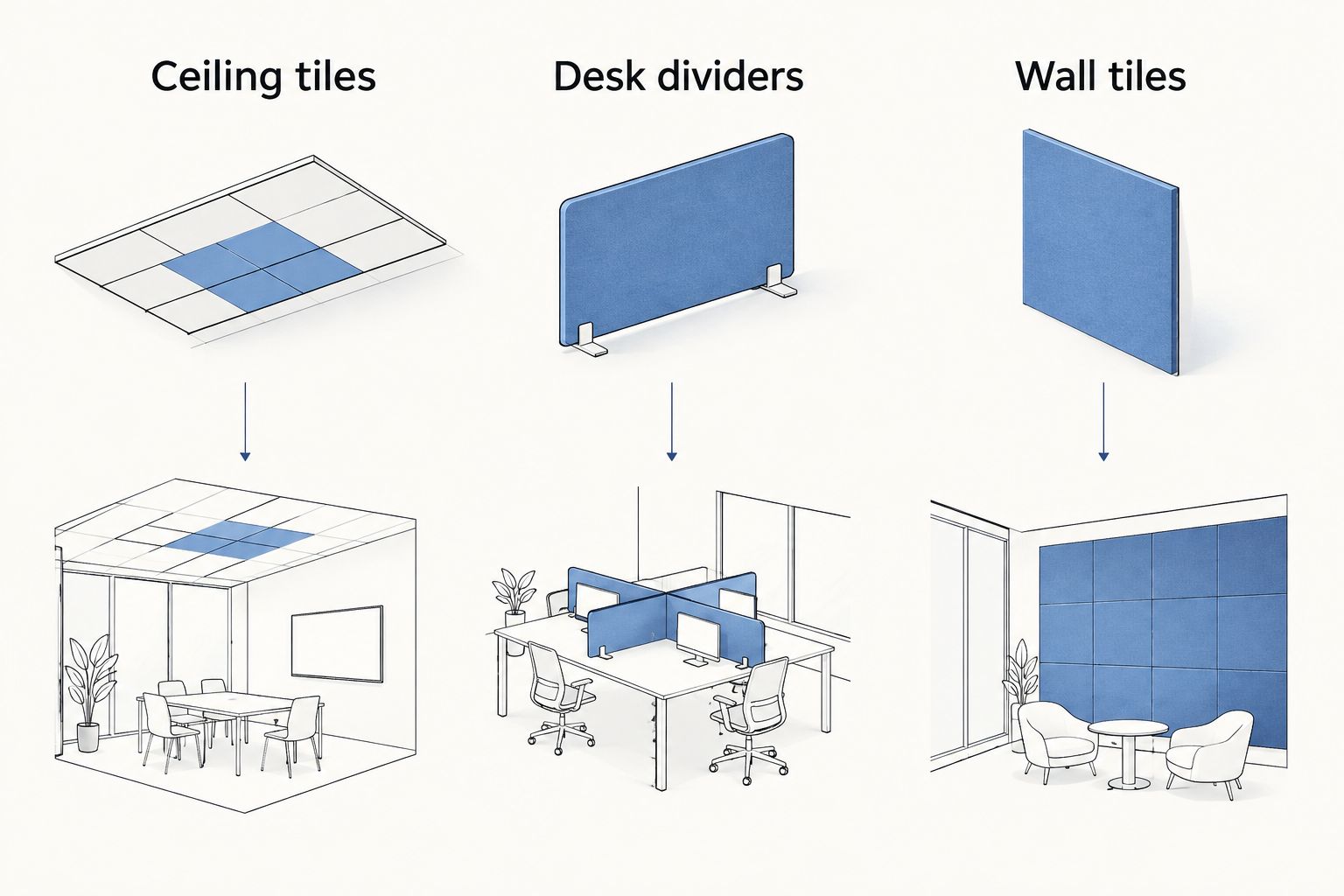
Acoustic panels at a glance
| Acoustic panel | Best for | Standout feature | Key limitation |
|---|---|---|---|
| Sana Drop In Acoustic PET Ceiling Tile | Open-plan offices with compatible ceiling grids | Eight 1195 x 595mm PET tiles per pack | Not suitable for offices without the correct grid |
| SANA Slide-On Acoustic Desk Divider Altitude | Privacy between opposing desks | Straight, tall edge at 680 x 420mm | Treats one workstation boundary, not the whole room |
| Visionchart Peel 'n' Stick Acoustic Wall Tiles | Meeting and collaboration rooms | Six 600 x 600mm tiles per pack | Adhesive placement requires careful planning |
| SANA Slide-On Acoustic Desk Divider Arc | Multi-desk rollouts | Curved edge and slide-on format | Less edge height than the Altitude profile |
| SANA Slide-On Acoustic Desk Divider Incline | Reception and service counters | Sloped edge keeps the front more open | Provides less consistent-height screening |
Sana Drop In Acoustic PET Ceiling Tile: best for open-plan offices
The Sana Drop In Acoustic PET Ceiling Tile is the best acoustic panel for offices where sound reflects across a broad open area. Each tile measures 1195 x 595 x 12mm, and each pack contains eight tiles.
Those dimensions provide about 5.69 square metres of nominal tile area per pack. Measure the intended ceiling positions rather than the entire floor area, then confirm that the tile dimensions match the existing grid before ordering.
The ceiling position is useful because it leaves walls, desks and walkways clear. It also lets a facilities team distribute tiles across a defined work zone instead of concentrating all absorption behind one desk.
Sana Drop In Acoustic PET Ceiling Tile pros:
- Eight tiles per pack support treatment across a wider zone
- Drop-in format avoids occupying wall or desktop space
- PET construction is stated directly in the product name
- Mushroom, Moonlight, Shadow and Frost options are listed in the available range
Sana Drop In Acoustic PET Ceiling Tile cons:
- Requires a compatible drop-in ceiling system
- Not designed as a direct wall or desk treatment
- Grid dimensions must be checked before purchase
Best for: open-plan offices, shared work areas and rooms with a compatible suspended ceiling.
A fit when ceiling reflections affect a broad office zone; skip it when the office has a solid ceiling without a suitable grid.
SANA Altitude Desk Divider: best for workstation privacy
The Visionchart SANA Altitude divider is a 680 x 420mm acoustic desk screen with a 12mm thickness. Its straight, tall front profile provides a consistent boundary between adjacent or opposing workstations.
The screen slides onto the desk rather than occupying a wall or ceiling position. That makes it a targeted choice when the problem comes from one nearby workstation, not from reverberation across the whole room.
A desk divider also adds visual separation. That does not make the workstation soundproof, but it addresses two common sources of distraction at the same boundary: direct sightlines and nearby speech.
SANA Altitude Desk Divider pros:
- Straight edge provides consistent-height screening
- Compact 680 x 420mm format targets an individual desk boundary
- Slide-on design avoids permanent wall placement
- Moonlight, Mushroom and Frost versions appear in the supplied range
SANA Altitude Desk Divider cons:
- Does not treat ceiling or wall reflections elsewhere in the room
- Desktop edge compatibility must be confirmed
- One panel only addresses one section of a workstation
Best for: back-to-back desks, bench seating and workstations where nearby speech is the main distraction.
A fit for targeted desk separation; hold off if the noise remains equally loud throughout the room, because a ceiling or wall treatment fits that problem better.
Visionchart Peel 'n' Stick Wall Tiles: best for meeting rooms
Visionchart Peel 'n' Stick Acoustic Wall Tiles measure 600 x 600mm and come in a pack of six. That equals 2.16 square metres of nominal panel area before allowing for the chosen spacing or pattern.
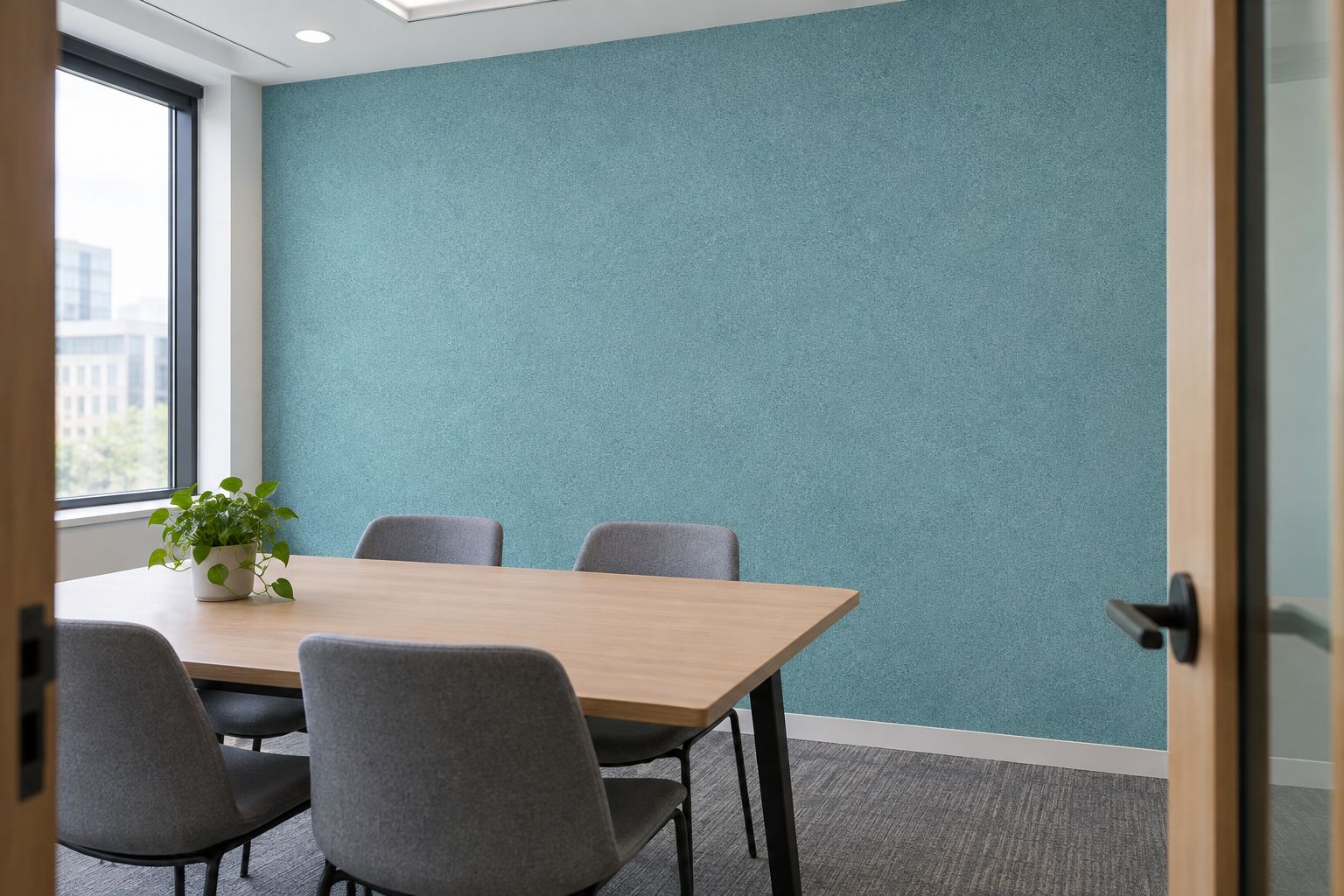
The Falling Water design turns a bare wall into the treatment surface. This format suits meeting rooms, interview rooms and collaboration spaces where a ceiling-grid product is unavailable and a desk divider would cover too little area.
Plan the arrangement before removing any backing. Check that the wall is clean, flat and suitable for adhesive installation, particularly when the office is leased or the painted surface must be restored later.
Visionchart Peel 'n' Stick Wall Tiles pros:
- Six 600 x 600mm tiles provide flexible wall arrangements
- Peel-and-stick format does not require a ceiling grid
- Falling Water design creates a patterned treatment
- Suitable for treating a defined wall area
Visionchart Peel 'n' Stick Wall Tiles cons:
- Adhesive placement is less flexible after installation
- Wall condition affects whether the mounting method is appropriate
- One pack will not cover every wall in a larger meeting room
Best for: meeting rooms and enclosed collaboration spaces with bare, reflective walls.
A fit when a defined wall is the best available treatment surface; wait until the property manager approves adhesive installation in a leased office.
SANA Arc Desk Divider: best budget option
The SANA Arc desk divider uses the same listed 680 x 420mm size and 12mm thickness as the other supplied slide-on desk screens. Its curved upper edge creates a less enclosed profile than the straight Altitude option.
The Arc version is the budget pick for a rollout because its format is focused on individual workstations without requiring a ceiling installation or a multi-tile wall layout. It is available in Mushroom, Shadow, Moonlight and Frost versions in the supplied product data.
SANA Arc Desk Divider pros:
- Curved profile keeps the desk boundary visually open
- Slide-on format supports workstation-level placement
- Four listed colour options provide a wider finish choice
- Compact dimensions suit targeted installations
SANA Arc Desk Divider cons:
- Curved edge provides less full-height separation than Altitude
- Does not address reflections across the wider room
- Desk-edge compatibility still needs checking
Best for: offices placing acoustic dividers across several workstations while retaining a softer sightline.
A fit for a practical multi-desk rollout; skip it if full-height visual separation is the priority.
SANA Incline Desk Divider: best for reception counters
The SANA Incline desk divider measures 680 x 420mm with a 12mm thickness and a sloped front edge. The profile keeps one end lower than the other, making it relevant where staff need separation without a uniformly tall barrier across the entire counter.
This shape suits reception points and service desks better than a straight panel when face-to-face interaction must remain open. It is not automatically better than Arc or Altitude; the counter layout determines whether the slope is useful.
SANA Incline Desk Divider pros:
- Sloped profile balances screening with an open counter edge
- Slide-on format targets one workstation boundary
- Shadow, Frost and Mushroom options are present in the supplied range
- Uses the same listed 680 x 420mm footprint as the other SANA desk dividers
SANA Incline Desk Divider cons:
- Lower sections provide less separation than a straight profile
- Not intended for room-wide acoustic treatment
- The slope may not suit symmetrical desk layouts
Best for: reception desks, service counters and customer-facing workstations.
Hold off until the counter orientation is confirmed — it fits when the low end can face the customer and the higher end can sit toward the noisier work area.


How these acoustic panels compare
This comparison uses the supplied product dimensions, pack quantities, mounting formats, profiles and listed finishes. It does not assign unsupported acoustic ratings or claim that one material blocks a stated number of decibels.
The list starts with the product that treats the broadest nominal area, then separates the remaining panels by their clearest use case. Mega Office Supplies acoustic panels are grouped as a decision tree: ceiling tiles for broad reflections, wall tiles for enclosed rooms and desk dividers for local workstation distractions.
Which acoustic panels should you choose?
Choose Sana Drop In Acoustic PET Ceiling Tiles when a compatible grid covers the noisy office zone. Choose SANA Altitude when opposing desks need the strongest visual boundary, Arc when several workstations need a more open profile, or Incline when a customer-facing counter requires a lower front edge.
Choose Visionchart Peel 'n' Stick Wall Tiles when a meeting room has an available wall but no suitable ceiling grid. For movable floor zoning rather than fixed absorption, compare the panel options with the Visionchart Vista lightweight mobile divider.
A practical default is the Sana Drop In Acoustic PET Ceiling Tile for compatible open-plan ceilings; for a single noisy workstation, choose the SANA Altitude desk divider instead.
FAQ
What are the best acoustic panels for office noise control?
Sana Drop In Acoustic PET Ceiling Tiles suit a compatible open-plan ceiling. SANA desk dividers suit individual workstations, while Visionchart Peel 'n' Stick Wall Tiles suit enclosed meeting rooms.
Do acoustic panels soundproof an office?
No, acoustic panels mainly absorb reflected sound inside a space rather than fully soundproofing it. Noise passing through walls, doors or ceilings requires a broader sound-isolation assessment.
Are ceiling tiles better than wall acoustic panels?
Ceiling tiles are better when the ceiling is the available treatment area and a compatible grid exists. Wall tiles are better when the room has a suitable bare wall but no drop-in ceiling system.
Which desk divider is better: Arc, Altitude or Incline?
Altitude is best for consistent-height privacy, Arc keeps the sightline more open, and Incline suits customer-facing counters. All three supplied options measure 680 x 420mm and are listed at 12mm thick.
How much area does one pack of Sana ceiling tiles cover?
Eight tiles measuring 1195 x 595mm provide about 5.69 square metres of nominal tile area. Confirm the ceiling-grid dimensions and planned spacing before deciding how many packs are required.
How much wall area does one pack of Visionchart tiles cover?
Six tiles measuring 600 x 600mm provide 2.16 square metres of nominal panel area. The final layout depends on whether the tiles touch or are spaced as a pattern.
How much do office acoustic panels cost?
The cost depends on whether you need a single desk divider or a pack of ceiling or wall tiles. Check the current product cards and listings because prices can change.
Where should acoustic panels go in an office?
Place acoustic panels on the surface relevant to the problem: ceiling tiles for broad overhead reflections, wall tiles for enclosed rooms and desk dividers for local workstation distractions. Use measured room conditions when a formal acoustic result is required.
One last thing
Do not order acoustic panels by colour before identifying the noise path. A well-matched finish in the wrong position remains the wrong treatment.
For a fitout, mark the problem area on a floor plan first, choose ceiling, wall or desk placement second, and compare finishes last. Mega Office Supplies provides options in all three formats, but the installation surface decides which category belongs on the shortlist.


